


- Algal omega-3 is becoming a premium alternative in the omega-3 ingredients market because it gives brands a fish-free route to DHA and EPA without depending fully on marine oil sourcing.
- Fish oil still leads the market because it has scale, established refining capacity, lower cost, and strong use across supplements, pharmaceutical omega-3, infant nutrition, pet nutrition, and functional food applications.
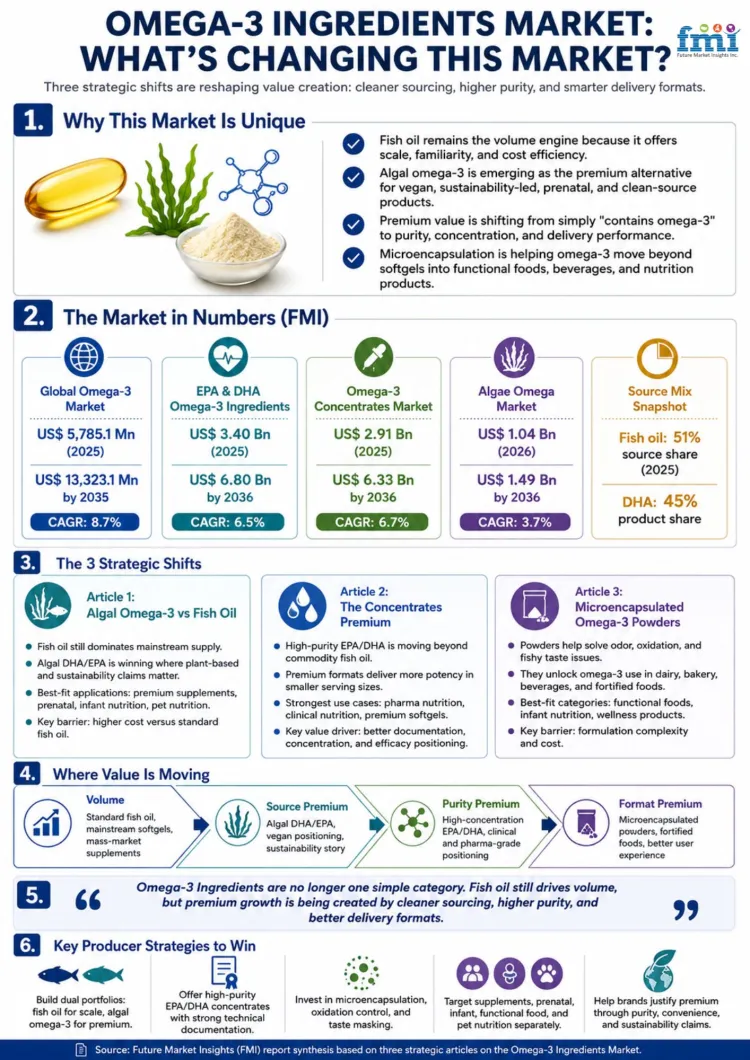
- FMI’s Omega-3 Market shows that fish oil accounted for 51% share of the source type segment in 2025, while DHA held 45% share of the product type segment in 2025.
- FMI’s EPA DHA Omega 3 Ingredients Market values the category at USD 3.40 billion in 2025 and projects it to reach USD 6.80 billion by 2036 at a 6.5% CAGR, showing that long-chain omega-3 demand remains structurally strong.
- The biggest opportunity is not immediate replacement of fish oil. The real opportunity is selective premium substitution in vegan supplements, prenatal DHA, infant nutrition, clean-label functional foods, pet food, and sustainability-led omega-3 formulations.
Algal omega-3 is becoming one of the most important premium shifts in the omega-3 ingredients market. The issue is not simply that algae oil gives brands a vegan alternative to fish oil. The deeper issue is that algae changes the source economics, sustainability story, claim structure, and procurement strategy behind DHA and EPA ingredient selection.
For many years, fish oil has been the commercial backbone of the omega-3 ingredients market. Fish oil has broad availability, established extraction and refining capacity, recognized use in softgels and concentrates, and strong acceptance among supplement, pharmaceutical, infant nutrition, and pet nutrition manufacturers. This gives fish oil a clear cost and scale advantage. In high-volume omega-3 applications, especially mainstream softgels and standard supplement formats, fish oil remains difficult to displace.
FMI’s Omega-3 Market shows why fish oil continues to matter strategically. The market was valued at USD 5,785.1 million in 2025 and is projected to reach USD 13,323.1 million by 2035, expanding at an 8.7% CAGR. FMI also identifies fish oil as the leading source type with 51% share in 2025, while DHA held 45% share of the product type segment. This means the market is still built around marine oil scale, but it is also clearly anchored in DHA-led health positioning.
At the same time, FMI’s EPA DHA Omega 3 Ingredients Market shows that the ingredient-level opportunity is becoming more specialized. The EPA DHA omega-3 ingredients market was valued at USD 3.40 billion in 2025, is estimated to reach USD 3.62 billion in 2026, and is projected to reach USD 6.80 billion by 2036 at a 6.5% CAGR. FMI defines the market as EPA and DHA ingredients from marine oil, algae oil, and high-purity concentrate sources in oil, powder, and encapsulated forms for dietary supplements, functional food, pharmaceutical, infant formula, and pet food applications.
This definition is important because it shows that algae is not sitting outside the mainstream omega-3 ingredient market. It is part of the same EPA/DHA ingredient competition. The question is therefore not whether algae can provide omega-3. The real question is where algae-derived DHA and EPA can create enough value to justify a premium over standard fish oil.
The strongest argument in favor of fish oil is still cost efficiency. Fish oil benefits from large marine raw material flows, established processing plants, known refining routes, and decades of formulation experience. Ingredient buyers understand fish oil specifications, oxidation parameters, concentration levels, EPA:DHA ratios, and softgel compatibility. For contract manufacturers and mass-market supplement brands, this familiarity reduces execution risk.
Fish oil also has a strong position in pharmaceutical and high-concentration omega-3 applications. These applications depend on consistent quality, regulatory documentation, concentration technology, and supply reliability. For this reason, fish oil and marine concentrates will continue to remain important in prescription omega-3, high-potency softgels, clinical nutrition, and premium cardiovascular supplements. Algae can participate in some of these areas, but fish oil has the advantage of a deeper installed base.
However, the fish oil model also carries structural limitations. It depends on marine resources, fisheries-linked supply, raw material variability, sustainability scrutiny, and consumer concerns about fishy odor, aftertaste, heavy metals, allergens, and animal-derived sourcing. Not all of these concerns apply equally to every fish oil product, especially when high-quality refining and testing are used. But they do influence how consumers and brands perceive marine omega-3.
This is where algal omega-3 creates a different value proposition. Algal DHA and EPA can be positioned as fish-free, vegetarian or vegan, sustainability-led, traceable, and suitable for consumers who avoid fish-derived ingredients. It gives brands a way to retain long-chain omega-3 benefits while changing the source story. That source story is highly valuable in products where consumers are willing to pay more for plant-based, clean-label, or environmentally responsible positioning.
FMI’s Algae Omega Market reinforces this premium route. The algae omega market is expected to reach USD 1.04 billion in 2026 and USD 1.49 billion by 2036, growing at a 3.7% CAGR. FMI also expects dietary supplements to hold 58.0% share of the algae omega application segment in 2026. This shows that algae omega is still strongly supplement-led, but the supplement opportunity is increasingly linked to premium health, plant-based nutrition, and cleaner source claims.
The first major opportunity for algal omega-3 is vegan and vegetarian dietary supplements. A consumer who avoids fish oil still needs access to DHA and EPA. Flaxseed, chia, and other ALA-based plant oils can support omega-3 positioning, but they do not directly deliver DHA and EPA in the same way as algae or fish oil. This gives algal omega-3 a stronger technical role than general plant-based omega-3 oils. It is not only a plant-based claim. It is a plant-based route to long-chain omega-3.
The second opportunity is prenatal and maternal nutrition. DHA is strongly associated with brain and eye development, and prenatal supplement buyers are usually more sensitive to purity, sourcing, and trust. Algal DHA can work well in this space because it avoids fish-derived positioning and can be marketed around controlled production, traceability, and suitability for vegetarian consumers. In prenatal nutrition, the ingredient story is not only about price per gram. It is about confidence, safety perception, and brand trust.
The third opportunity is infant nutrition. Infant formula and baby food manufacturers need stable DHA sources and strong documentation. Fish oil can serve this need, but algae-derived DHA has a strong fit where brands want fish-free sourcing, vegetarian positioning, or a cleaner sensory profile. This makes algae especially relevant in premium infant nutrition, toddler nutrition, and specialized pediatric formulations.
The fourth opportunity is functional food and beverage fortification. Omega-3 fortification has historically faced technical barriers because fish oil can create odor, taste, and oxidation issues. Algae oil does not automatically solve every formulation problem, but it can support cleaner positioning and may be paired with encapsulation, emulsification, and stabilization technologies. Dairy alternatives, fortified yogurts, nutritional beverages, gummies, powders, and meal solutions are all areas where brands may test algal DHA or EPA systems.
The fifth opportunity is pet nutrition and animal feed. Pet food brands are increasingly using humanized nutrition claims such as skin and coat health, cognitive support, joint support, and healthy aging. Fish oil has been widely used in this space, but algae-derived DHA can reduce reliance on fish oil and support sustainability positioning. Corbion’s AlgaPrime DHA, for example, is positioned as a vegetarian source of DHA for animal feed that helps maintain omega-3 levels while reducing dependency on fish oil.
The sixth opportunity is aquaculture. This is different from consumer supplements, but it matters because aquaculture is one of the largest structural uses for omega-3-rich inputs. Veramaris positions algal oil as an alternative source of omega-3 that can reduce supply risk and help close the omega-3 supply gap in aquaculture. This makes algae part of the broader effort to reduce pressure on marine resources while maintaining nutritional quality in farmed seafood.
For ingredient suppliers, the shift creates two different commercial playbooks. Fish oil suppliers will continue to win where the buyer needs cost, volume, established specifications, concentration flexibility, and proven regulatory acceptance. Their value proposition is operational reliability. They can support large supplement brands, private label manufacturers, pharmaceutical ingredient users, and softgel producers that need stable global supply.
Algal omega-3 suppliers will win where the buyer needs differentiation. Their value proposition is not only DHA or EPA content. It is fish-free sourcing, sustainability communication, vegan positioning, controlled production, and reduced dependency on marine oil. This creates stronger appeal in premium supplements, prenatal formulas, infant nutrition, plant-based wellness products, and sustainability-led pet nutrition.
The biggest challenge for algal omega-3 is the premium itself. If algae oil costs more than fish oil, the finished product must justify the difference. A brand cannot simply replace fish oil with algae and expect consumers to pay more without a clear reason. The product must explain why the ingredient is better for that consumer: vegan suitability, no fish-derived source, cleaner sourcing, sustainability, traceability, sensory benefits, or premium health positioning.
This creates a very different selling environment for suppliers. Fish oil is often sold through performance, purity, price, and concentration. Algal omega-3 must be sold through performance plus story. The supplier must help the brand translate the ingredient into consumer language. That may include claim support, certification support, sustainability data, formulation guidance, sensory support, and education around DHA and EPA.
The first pressure point is price comparison. In the mainstream supplement aisle, consumers often compare omega-3 products by capsule count, milligrams, brand trust, and price. Fish oil is advantaged in this environment because it can deliver attractive price-per-serving economics. Algal omega-3 is less likely to win the lowest-price shelf unless production economics improve significantly. It is more likely to win when the consumer is specifically looking for fish-free or premium omega-3.
The second pressure point is concentration and format. Many algae products historically focused on DHA, while fish oil products often provided both EPA and DHA. Newer algal omega-3 solutions are expanding the ability to provide EPA and DHA from algae, but ingredient buyers still need to compare actual dosage, potency, bioavailability, oil form, encapsulation format, oxidative stability, and finished product performance. A strong source story cannot compensate for weak technical delivery.
The third pressure point is supply security. One reason algae is strategically attractive is that it can create a supply route that is less directly tied to fishery cycles. Controlled algae fermentation or cultivation can improve traceability and consistency. However, algae supply still depends on production capacity, fermentation economics, capital intensity, and supplier scale. Buyers will need to evaluate whether algal omega-3 suppliers can support repeat commercial volumes, not only premium launch volumes.
The fourth pressure point is certification and documentation. Vegan certification, non-GMO positioning, allergen management, contaminant testing, oxidation control, sustainability documentation, and regulatory support all matter. In premium omega-3, the buyer is not only purchasing an oil. The buyer is purchasing documentation that can protect claims, reduce quality risk, and support product positioning across markets.
The fifth pressure point is application fit. Algal omega-3 is not equally suited for every product. It is more compelling where fish-free positioning is visible and valued by the consumer. A vegan prenatal DHA capsule, a premium plant-based wellness gummy, or a sustainability-led pet food has a clear reason to use algae. A low-cost generic omega-3 softgel may not. This means algae adoption will be selective and application-driven rather than universal.
The misconception to avoid is that algal omega-3 will quickly replace fish oil. That is unlikely. Fish oil has too much scale, too much installed manufacturing capacity, and too much cost advantage in mainstream omega-3. It will remain the volume engine of the category. Algal omega-3 will instead take share in the parts of the market where source differentiation matters more than lowest cost.
Another misconception is that algae omega-3 is only for vegans. Vegan consumers are important, but they are not the only target. Algal omega-3 can also appeal to flexitarian consumers, parents, prenatal buyers, sustainability-minded consumers, pet owners, and brands that want a cleaner omega-3 story. The consumer may not always identify as vegan. They may simply prefer a fish-free or ocean-friendly source.
A third misconception is that all plant-based omega-3 ingredients are the same. They are not. ALA-rich plant oils and algal DHA/EPA ingredients play different roles. ALA ingredients support general plant-based omega-3 positioning, but algal DHA and EPA directly compete with marine long-chain omega-3 ingredients. For brand owners, this distinction matters because the health-positioning, dosage logic, and consumer education requirements are different.
For manufacturers, the winning strategy is not to choose fish oil or algae in isolation. The better strategy is to build a source ladder. Fish oil can serve value and mainstream omega-3 formats. High-concentrate marine oils can serve potency-led supplements and pharmaceutical applications. Algal DHA and EPA can serve premium, fish-free, vegan, prenatal, infant, and sustainability-led formats. This allows brands to address different price tiers without forcing one ingredient to do every job.
For ingredient suppliers, this means portfolio design becomes important. A supplier with only standard fish oil may remain strong in volume but may miss premium plant-based growth. A supplier with only algal oil may have a strong story but limited access to cost-sensitive volumes. The strongest position may come from suppliers that can offer source flexibility, formulation support, and application-specific guidance across fish oil, concentrates, powders, and algae-derived omega-3.
For brands, the commercial question is clear: when does the consumer pay for algae? The answer depends on whether the claim is visible, credible, and relevant. Vegan DHA, fish-free EPA/DHA, prenatal purity, infant nutrition trust, clean-label fortification, and sustainability-led pet nutrition are all credible premium zones. Generic omega-3 replacement without claim clarity is weaker.
The best way to analyze this market is through a value-per-claim lens. Key metrics include source type share, algal oil share within EPA/DHA ingredients, price premium versus fish oil, application mix, vegan or vegetarian claim penetration, prenatal and infant nutrition uptake, functional food stability performance, and supplier concentration. These metrics show whether algae is expanding the omega-3 ingredients market or simply substituting a portion of fish oil demand.
Bottom line: algal omega-3 is becoming a real premium alternative in the omega-3 ingredients market, but it is not a universal replacement for fish oil. Fish oil will continue to dominate mainstream volume because of scale, cost efficiency, and established manufacturing infrastructure. Algal omega-3 will gain where fish-free sourcing, vegan positioning, sustainability, traceability, and premium health claims are strong enough to justify higher ingredient cost. In the next phase of the market, the winners will not be the suppliers that argue only for fish oil or only for algae. The winners will be the suppliers and brands that match the right omega-3 source to the right consumer promise.
FMI Related Reports
- Omega-3 Market: Primary interlink in the introduction when discussing overall market size, fish oil share, DHA share, and source-led market structure
- EPA DHA Omega 3 Ingredients Market: Use when discussing EPA/DHA ingredient demand, source competition, applications, and the role of algae oil within long-chain omega-3
- Algae Omega Market: Use when discussing algal omega demand, dietary supplement-led adoption, and plant-based omega-3 premium positioning
- Omega-3 Concentrates Market: Use when explaining high-purity EPA/DHA, premium softgels, pharmaceutical-grade concentrates, and potency-led product development
- Microencapsulated Omega-3 Powders Market: Use when discussing fortified foods, powders, taste masking, oxidation control, and functional food applications
- Algae Oil Market: Use when discussing algae oil as a broader source platform for supplements, food applications, and sustainable lipid innovation
- Dietary Supplements Market: Use when linking omega-3 ingredient demand to supplement formats, preventive health, and premium wellness positioning
- Functional Food Ingredients Market: Use when discussing omega-3 fortification in functional foods, beverages, dairy alternatives, gummies, and nutritional products
- Pet Food Ingredients Market: Use when discussing algal DHA in pet nutrition, skin and coat health, cognitive support, and sustainable animal nutrition

