


- The ambulatory surgical centers market is projected to reach USD 171.0 billion by 2036 from USD 110.1 billion in 2026, at a CAGR of 4.5% during the forecast period supported by the rising focus of healthcare systems on the effective delivery of outpatient care.
- The transition to value-based care is having an impact on ambulatory surgical centers (ASCs) purchasing decisions and, subsequently, the demand for medical devices and pricing.
- ASC operators are increasingly focused on devices that improve clinical outcomes, decrease complications and promote faster recovery.
- There is mounting pressure on device manufacturers to demonstrate they have tangible economic and clinical value and not just compete on product performance.
- When making decisions on medical technology, procurement teams are increasingly considering total cost of ownership, lifecycle costs and procedural efficiency.
- Bundled payment programs and outcome-based reimbursement models are driving the use of devices that provide predictable and consistent treatment outcomes.
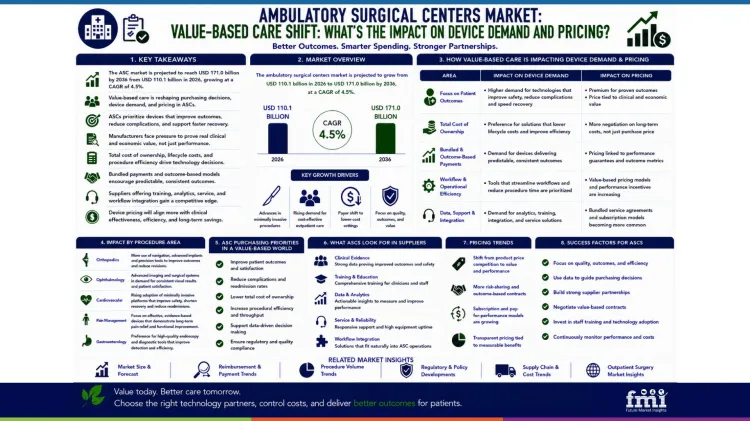
The ambulatory surgical centers market continues to be driven by the global trend of outpatient healthcare delivery. The market is estimated to be worth USD 171.0 billion by 2036 from USD 110.1 billion in 2026, growing at a CAGR of 4.5% during the forecast period. Market growth is being driven by progress in minimally invasive procedures, rising awareness of healthcare costs and growing demand for economical treatment settings.
ASC operations will continue to evolve as the industry shifts away from traditional fee-for-service payment models and toward value-based care models. The change is dramatically changing the way healthcare providers assess medical technologies, manage procurement budgets and negotiate with device manufacturers.
Fee-for-service systems typically paid healthcare providers based on the number of procedures they performed. Clinical functionality and physician preference often drove the purchasing decision making. But today, reimbursement models are increasingly rewarding quality outcomes, patient satisfaction, efficiency and cost containment. This change is having a big impact on device demand and pricing across the ASC ecosystem.
There is a growing need for medical devices that can help in improving patient outcomes. ASC operators are gravitating toward technologies that reduce complications, reduce time in the procedure, reduce recovery times and reduce chances of readmission. These performance characteristics line up directly with value-based care objectives, and can have a positive impact on reimbursement outcomes.
Orthopedic procedures are a very good example of this trend. ASCs that perform joint replacement surgeries are investing more into navigation systems, advanced implants and precision surgical instruments that help improve accuracy in procedures and patient outcomes. The technologies may be more expensive upfront, but providers see them as an investment that can reduce complications and improve value over time.
Similarly, eye care centers are using the most advanced imaging platforms and surgical technologies that improve the consistency of procedures and visual results. In a value-based world, the ability to deliver predictable outcomes becomes more important than ever, as patient satisfaction and clinical performance measures can impact financial performance directly.
In the cardiovascular space, we are also seeing meaningful shifts in device demand. As more cardiovascular procedures are performed in the outpatient setting, ASCs are investing in monitoring, imaging and minimally invasive intervention platforms that allow for safe, efficient delivery of treatment. Providers are increasingly considering whether such technologies can improve outcomes while still supporting cost-effective care pathways.
Another big impact of value-based care is the rising focus on total cost of ownership. ASC procurement teams look beyond the acquisition price to consider the wider financial implications over the product lifecycle.
Purchasers are more and more concerned about maintenance needs, training costs, equipment uptime, consumable use, workflow efficiency and projected clinical outcomes. A device with a higher initial cost may have higher economic value over time if the higher cost is associated with greater operational efficiencies or lower complication-related costs.
This shift is posing new challenges for device makers. More and more, suppliers are being asked to prove that their products deliver economic and clinical benefits. Clinical studies, real-world outcome data and health economics analyses are increasingly the basis for sales and contract negotiations.
Thus, the competition in the medical device industry is changing. Traditionally, manufacturers have competed through improvements in product and pricing strategies. Many suppliers today have a comprehensive value proposition covering technology, education, service support and data-driven performance monitoring.
Also, the contracts are getting more complicated. ASC operators are increasingly looking for partners that can provide implementation assistance, clinician training programs, technical support, software updates, and ongoing performance optimization services. These additional capabilities can have a significant impact on purchasing decisions in the value-based care models.
Even the price of the device is evolving slowly. Models driven by broader health outcomes are replacing traditional pricing approaches which are largely driven by product specifications. Some manufacturers are testing performance-based agreements, where some of the pricing is tied to measurable clinical or operational results.
Some healthcare segments are expected to see growth in outcome-based contracting, although it remains somewhat limited as providers seek better alignment between technology investments and reimbursement objectives. Such arrangements could reduce the financial risk for health care providers and give manufacturers an incentive to focus more on long-term performance.
The growing importance of data analytics also supports these trends. ASCs are increasingly tracking clinical outcomes, patient satisfaction, procedure efficiency and resource utilization through digital platforms. The ability to generate data that can be acted upon is becoming increasingly attractive as it supports continuous improvement initiatives and regulatory reporting requirements.
The ability to adapt is also becoming ever more valuable. Providers want technologies that can work with electronic health records, scheduling systems, billing platforms, and clinical workflow applications. Better integration can help achieve value-based care goals by improving operational efficiency and reducing administrative burden.
Even with these technological advances, managing costs remains a big problem. ASC operators continue to face increasing costs of labor, regulatory compliance and investments in infrastructure. That means buying teams are under more pressure than ever to justify every capital spend and prove measurable ROI.
Demand for devices affects specialties differently. Procedural specialties that do a lot of volume, such as orthopedics, gastroenterology, ophthalmology and pain management, tend to gravitate toward technologies that make them more efficient and increase their throughput. More specialized procedures may focus on clinical differentiation and optimizing outcomes. In either case, still, the principles of value-based purchasing are gaining ground.
Geographically, adoption patterns also differ. In more mature markets with value-based payment programs, the focus on measuring outcomes and being cost-effective is often greater. The worldwide proliferation of these reimbursement models is anticipated to have a broader impact on demand and pricing of devices.
The notion that price is the most important factor in device purchasing decisions is becoming outdated. Clinical effectiveness, operational efficiency, workflow integration, patient outcomes and long-term economic value are all top priorities for ASC operators in the current value-based healthcare environment.
In the future, the correlation between reimbursement policy and uptake of medical technology is expected to become stronger. Device makers will be better positioned to succeed in a healthcare environment that continues to focus on value, not volume, if they can demonstrate a measurable impact on quality improvement and cost control.
Bottom Line
Ambulatory surgery centers are changing how they source and purchase medical devices as the industry shifts toward value-based care. Demand is increasingly for technologies that improve outcomes, improve efficiency and help long-term cost savings. At the same time, pricing strategies are moving away from product specifications and toward more holistic measures of clinical and economic value. And as value-based healthcare continues to grow, ASC operators and device manufacturers will need to align their strategies to measurable performance, operational effectiveness and patient-centric outcomes.

