


- The animal feed ingredients market is shifting from basic nutrition supply toward precision nutrition, gut health, and antibiotic-reduction strategies.
- FMI’s animal feed and feed additives coverage highlights feed conversion, feed stability, starter feed control, direct technical selling, and plant-based carriers as important structural themes.
- Functional ingredients such as amino acids, enzymes, probiotics, eubiotics, organic acids, minerals, and novel additives are moving from optional boosters to formulation controls.
- The trend is strongest in poultry, swine, dairy, aquaculture, and young-animal feed programs where performance variability is costly.
- Adoption depends on measurable species data, approved claims, processing tolerance, and the ability to fit existing premix and compound feed systems.
- The misconception to avoid is that antibiotic-free feed is only a marketing claim. It is a formulation challenge that requires nutritional precision and gut-health management.
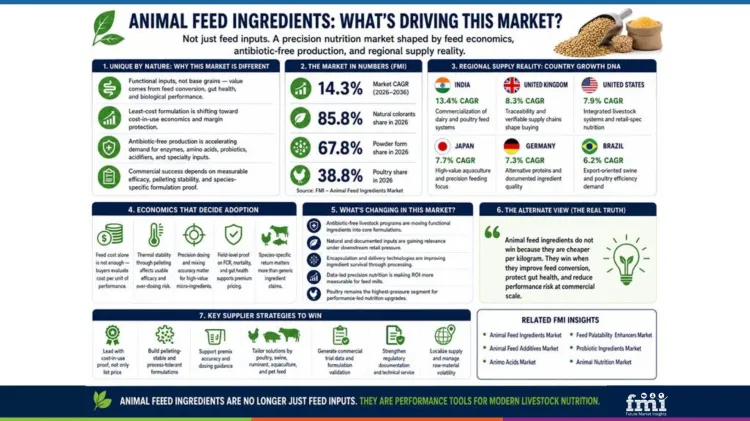
The animal feed ingredients market is undergoing a structural shift. For many years, feed formulation was dominated by least-cost ration balancing: meet the animal’s basic nutrient requirement at the lowest possible formulation cost. That approach still matters, but it is no longer enough. The market is moving toward precision nutrition, antibiotic-reduction strategies, gut-health management, and performance-linked formulation decisions.
This makes the trend angle especially relevant. In the Animal Feed Ingredients Market, ingredient demand is no longer driven only by volume growth in meat, milk, eggs, and aquaculture. It is increasingly shaped by how producers manage feed conversion efficiency, mortality risk, disease pressure, animal welfare requirements, and retailer or processor standards. Ingredients that once looked like optional additives are becoming formulation controls.
FMI’s Animal Feed Ingredients Market page describes the category as functional and nutritional inputs designed to improve feed conversion and gut health. The Animal Feed Market also points to precision nutrition as a growing theme, while the Animal Feed Additives Market highlights the movement of additives from optional feed inputs toward clearer nutrition and performance functions. Together, these signals show that feed ingredients are being evaluated through measurable animal performance rather than only nutrient labels.
Antibiotic reduction is one of the biggest drivers of this transition. In many livestock markets, producers face pressure to reduce routine antibiotic growth promoter use because of regulations, retailer standards, processor requirements, foodservice commitments, and consumer concern about antimicrobial resistance. Removing antibiotics without rebuilding the nutrition program can expose producers to weaker gut health, higher disease pressure, lower growth uniformity, and poorer feed conversion. This creates demand for functional ingredients that support resilience rather than simply replace one additive with another.
Eubiotics are central to this shift. The Eubiotics Market is relevant because probiotics, prebiotics, organic acids, essential oils, and related gut-health ingredients are positioned around microbial balance and digestive support. These products are not purchased only because they sound natural. They are purchased when they help maintain performance under commercial stress: diet changes, stocking density, heat stress, pathogen pressure, and early-life vulnerability.
Probiotics and microbial feed additives also sit at the center of the trend. The Animal Feed Probiotic Market and Microbial Feed Additives Market show why live organisms and microbial systems are gaining attention in animal nutrition. In practice, buyers need more than a strain name. They need stability through feed processing, survival under storage, compatibility with feed forms, species-specific evidence, and clear dosage guidance. A probiotic that performs in a brochure but fails during pelleting or storage does not create value.
Enzymes represent another major precision nutrition tool. The Feed Enzymes Market shows how phytase, carbohydrases, proteases, and other enzymes help release nutrients from feed materials. Enzymes allow nutritionists to improve digestibility, adjust matrix values, reduce waste, and sometimes use lower-cost raw materials more efficiently. This is especially important when grain and oilseed prices fluctuate. Precision nutrition is partly about knowing what the animal needs and partly about unlocking more value from the ration.
Amino acids are equally important. The Feed Amino Acids Market supports the shift from crude protein logic toward more exact nutrient balancing. Instead of over-formulating protein to cover amino acid gaps, feed mills can use targeted amino acids to improve efficiency and reduce nitrogen waste. This matters for both cost control and environmental performance. In poultry and swine, amino acid balancing is not a niche activity; it is central to modern feed economics.
Young-animal feeding is one of the clearest use cases. The Animal Feed Additives Market notes starter feed as an important application, because young animals require tighter dosing and more controlled nutrition. Piglets, chicks, calves, and young aquaculture species are more sensitive to digestive stress and nutrient gaps. Precision nutrition in this life stage is not simply about accelerating growth. It is about reducing early losses, improving uniformity, and setting up later-stage productivity.
Aquaculture adds another layer of complexity. Fish and shrimp feed programs must manage protein quality, digestibility, water stability, immune support, and species-specific nutrition. Functional ingredients such as amino acids, enzymes, organic acids, probiotics, algae-derived inputs, and mineral systems can help optimize performance, but adoption depends on clear species evidence. The Algae based Animal Feed Market is relevant where producers look for alternative nutrient sources, pigmentation support, or sustainability-linked feed inputs.
Feed form and processing conditions also shape adoption. Ingredients must survive grinding, mixing, pelleting, extrusion, storage, and transport. Some probiotics may lose viability under heat. Some enzymes may require coating or thermostable forms. Some organic acids may need encapsulation to improve handling or targeted delivery. The Feed Encapsulation Market is useful here because protected delivery systems can help sensitive ingredients perform in real feed conditions.
Direct technical selling is becoming more important. FMI’s Animal Feed Additives Market indicates that direct sales are projected to hold a major channel position because large feed mills require trial and dosing guidance. This aligns with market reality. A feed mill does not switch enzyme, probiotic, mineral, or premix systems based only on a catalog. It needs formulation support, trial design, species data, compliance documents, and problem-solving during scale-up.
The trend also changes supplier qualification. Ingredient suppliers must provide more than availability. They need documentation on regulatory status, contaminant control, stability, active content, handling, species fit, dosage, and compatibility with other ingredients. Feed producers are increasingly operating under processor audits, retailer standards, export requirements, and sustainability claims. As a result, documentation is becoming part of the ingredient value proposition.
Precision nutrition also depends on data integration. Large integrators increasingly monitor feed intake, growth rate, mortality, disease events, carcass quality, milk output, egg production, and feed conversion at a granular level. The more performance data they collect, the easier it becomes to evaluate whether a feed ingredient is creating value. This shifts the market away from broad benefit claims and toward proof by species, life stage, ration type, and farm condition.
Regulatory and approval pathways also shape the speed of adoption. Feed ingredients may need local authorization, residue assessments, strain identification, safety data, labeling compliance, or claim restrictions depending on the product and country. Novel additives, microbial products, methane-reduction ingredients, and functional compounds can face longer approval cycles than standard nutrients. This means technical promise alone is not enough. Suppliers must manage regulatory readiness as part of commercialization.
The trend is not limited to poultry and swine. Dairy and beef systems are also becoming more performance-managed. Ruminant nutrition programs may use protected amino acids, organic minerals, yeast products, buffers, enzymes, and emerging methane-reduction additives to manage productivity and sustainability. Adoption is strongest when the input can be linked to milk components, weight gain, fertility, rumen stability, or emissions intensity.
Aquaculture is another proving ground for precision nutrition. Fish and shrimp producers often face high feed costs and strong sensitivity to water quality, survival, and disease pressure. Ingredients that improve digestibility, immune resilience, feed stability, or fishmeal replacement have clear commercial relevance. However, aquaculture buyers are also highly species-specific. What works for salmon may not work for shrimp, tilapia, carp, or seabass without adaptation.
For suppliers, the implication is clear: the winning portfolio is not simply a longer catalog of additives. It is a validated toolbox. Amino acids, enzymes, probiotics, organic acids, minerals, phytogenics, yeast products, encapsulated nutrients, and specialty proteins must be matched to specific production problems. The supplier that can explain where not to use a product may be more trusted than the supplier that recommends every product for every species.
The misconception to avoid is that antibiotic-free feed is mostly a consumer-facing claim. It is not. It is a technical formulation challenge. When antibiotics are reduced, the feed system must work harder through nutrition precision, gut-health inputs, hygiene, biosecurity, and farm management. Functional feed ingredients cannot solve every problem, but they are increasingly part of the control system.
Bottom line: animal feed ingredients are shifting from basic ration inputs toward measurable performance tools. The winners will be suppliers that can prove species-specific benefits, survive feed processing, support antibiotic-reduction programs, and help nutritionists link ingredient use to feed conversion, gut health, and production consistency.

