


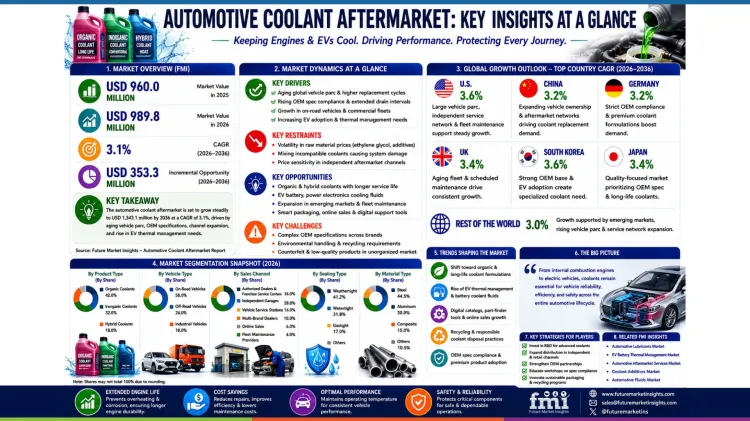
- Authorized dealers and franchise service centers currently control the largest visible sales channel, with FMI projecting a 36.0% share in 2026.
- Their strength comes from warranty compliance, OEM fluid specifications, scheduled service intervals, and consumer trust in brand-approved maintenance.
- Independent garages remain highly influential because they serve aging vehicles, out-of-warranty cars, price-sensitive customers, and mixed-brand fleets.
- The coolant aftermarket is structurally split. Authorized dealers lead specification-led demand, while independent garages control a large share of everyday replacement accessibility.
- Multi-brand dealers, service chains, fleet maintenance providers, and online channels are creating more fragmented procurement routes.
- The channel that wins depends on vehicle age. Younger and warranty-linked vehicles lean toward authorized channels, while older vehicles increasingly move to independent garages and retail supply.
Coolant replacement demand does not sit in one channel. A three-year-old vehicle under warranty, a twelve-year-old family car, a delivery van, a tractor, a forklift, and a performance car may all need coolant service, and the buyer journey differs. Some customers return to the dealer. Some visit an independent garage. Some buy coolant from an auto parts retailer. Some fleet operators purchase drums directly. Some consumers order online.
The FMI segmentation shows that authorized dealers and franchise service centers lead the sales channel category with 36.0% share in 2026. That share is meaningful because it indicates the continuing strength of OEM-aligned maintenance in coolant procurement. At the same time, independent garages, vehicle service stations, multi-brand dealers, fleet maintenance providers, and online sales remain central to the broader aftermarket.
Authorized dealers have a clear structural advantage in the early years of vehicle ownership. They are tied to OEM service schedules, warranty conditions, model-specific fluid specifications, and manufacturer-approved parts and fluids. For coolant, this matters because using the wrong formulation can create cooling-system risk and, in some cases, warranty disputes. A dealer can reassure the customer that the coolant meets the required specification.
This advantage becomes stronger as coolant chemistry becomes more specialized. Organic, inorganic, hybrid, non-glycol, synthetic organic, and advanced multipurpose fluids are not interchangeable by default. FMI states that OEM specification compliance creates product differentiation and premium pricing for specification-compliant fluids. Dealers benefit from this environment because the customer often trusts them to choose the correct product.
Authorized dealers also benefit from scheduled maintenance visibility. A customer visiting the dealer for periodic service may have coolant inspected, topped up, flushed, or replaced as part of a broader maintenance package. The coolant sale is therefore attached to a service relationship rather than a standalone retail purchase.
Japan is a strong example of structured maintenance. FMI states that Japan shaken vehicle inspection system supports consistent aftermarket fluid replacement demand and that Japanese consumers and service operators prioritize product quality and OEM specification compliance. This type of inspection and maintenance culture naturally supports dealer and authorized-channel fluid procurement.
Independent garages win for different reasons. Their strength grows as vehicles age and move out of warranty. ACEA 2026 vehicle parc report states that EU cars average 12.7 years of age and trucks average 14 years. Older vehicles often migrate away from authorized dealers because owners become more price-sensitive, repair frequency rises, and independent garages offer convenience.
This aging-fleet dynamic is central to coolant replacement. Older vehicles may need more frequent cooling-system maintenance because hoses, radiators, water pumps, heater cores, gaskets, and thermostats experience wear. Coolant may become contaminated or diluted. Leaks and overheating events may trigger fluid replacement. Independent garages capture much of this work because they are local, flexible, and cost-competitive.
FMI projects the USA to grow at 3.6% CAGR through 2036 and links the country demand to an extensive auto parts retail and independent service network. This is where independent garages exert practical control. They may not lead the channel share in the FMI segmentation, and they control a large part of everyday aftermarket accessibility. A customer with an aging vehicle is more likely to visit a trusted local mechanic or service chain than a franchised dealer.
The channel split also changes by vehicle type. FMI states that on-road vehicles account for 58.0% of vehicle demand, covering passenger cars, commercial vehicles, motorcycles, and scooters. Commercial fleets may use dealers during warranty, then shift toward fleet maintenance providers, multi-brand service chains, or in-house workshops. Off-road vehicles such as tractors, excavators, loaders, bulldozers, cranes, and road rollers may depend on equipment dealers, regional service providers, or industrial maintenance contractors. Industrial vehicles such as forklifts and tow tractors may buy through fleet-maintenance contracts.
This makes channel control more nuanced than the headline share suggests. Authorized dealers lead in specification confidence. Independent garages lead in reach across older and mixed vehicles. Fleet maintenance providers lead in structured commercial procurement. Online channels are emerging as a support route for do-it-yourself buyers and professional replenishment, and coolant replacement still often requires service execution.
Online sales are unlikely to displace workshops entirely because coolant service can involve draining, flushing, air bleeding, disposal, and leak diagnosis. A consumer may buy a bottle online for top-up, and a full cooling-system service is usually workshop-led. The e-commerce opportunity is therefore stronger for retail bottles, brand replenishment, and price comparison than for controlling the complete replacement event.
Multi-brand dealers and service chains are becoming important because they combine independent accessibility with more formalized procurement. They can stock specification-led products, maintain technician training, and purchase fluids in bulk. In emerging markets, FMI notes that independent and multi-brand service networks are expanding as vehicle populations grow in Asia and Latin America, creating new distribution channels for coolant and brake fluid products.
The dealer versus independent question also relates to product mix. Dealers are more likely to use OEM-approved organic or hybrid formulations tied to specific vehicle platforms. Independent garages need broader inventories because they service multiple brands. A garage may choose universal or multipurpose coolant claims, and that creates risk if the product does not truly match the required specifications. This is why training and catalog support are valuable.
Coolant brands can support independent garages by providing lookup tools, specification charts, service guidance, and clear labeling. A garage that can confidently select the correct coolant for Asian, European, American, hybrid, and older vehicles can compete more effectively with authorized dealers. Without that support, independent garages may either overstock many fluids or risk incorrect substitution.
Authorized dealers also face limitations. They can be more expensive, less convenient for older vehicles, and less likely to serve multi-brand customers. Their share can decline as vehicles age. A customer who no longer visits the dealer for routine service may still need coolant every few years, and that sale shifts to independent channels.
The EU provides another channel dynamic. FMI projects the EU market at 3.5% CAGR and states that vehicle inspection and emissions standards create structured maintenance requirements that support regular fluid replacement. It also notes that premium European brands specify proprietary coolant formulations that support aftermarket price premiums. This can help dealers and brand-authorized channels, while independent garages still serve the large aging fleet.
From a supplier perspective, the channel strategy should not choose one side exclusively. A coolant manufacturer needs dealer relationships for specification credibility, independent distribution for volume reach, fleet accounts for structured demand, and retail or online channels for replenishment. The same brand may need different pack sizes and messaging across channels, namely small bottles for retail, drums for fleets, dealer-approved formulations for authorized service, and broad coverage products for independent garages.
Channel control also affects pricing. Authorized dealers can command premiums because they sell confidence, warranty alignment, and OEM approval. Independent garages compete more on price and availability, and premium fluids can still sell if the technician believes the product prevents repeat repairs. Fleets care about total maintenance cost and downtime, making drums and bulk procurement important.
The clearest market reading is that authorized dealers currently control the largest formal share, and independent garages control much of the long-tail replacement market. As vehicles age, the channel influence shifts from OEM-centered service to local and multi-brand repair networks. As coolant specifications become more complex, the winner is the channel that can combine correct product selection with convenient service.
Authorized dealers lead where warranty, specification, and brand trust matter. Independent garages lead where accessibility, aging vehicles, and cost-sensitive repair dominate. The aftermarket is not moving toward a single channel. It is dividing by vehicle age, owner behavior, and service complexity.

