


- The fastest payback usually comes from automation that removes a clearly measurable bottleneck rather than from the most sophisticated system on the market.
- AMRs, palletizing robots, warehouse execution software, and targeted sortation upgrades can offer quicker value where labour shortages, walking time, and repeat handling are the immediate issues.
- Conveyors retain a strong ROI case in stable, high-throughput flows with predictable routes, particularly in parcel, food, beverage, and manufacturing lines.
- Automated storage and retrieval systems create a larger strategic return where land, building height, inventory density, and order accuracy are more valuable than short-term capital recovery.
- FMI estimates that a fully automated distribution centre can require USD 50 million to USD 200 million and may have a three- to five-year return timeline.
- The useful investment question is not which technology pays back fastest. It is which task carries enough labour, error, space, or throughput cost to justify automation first.
Material handling automation is often discussed as a broad warehouse transformation decision. In practice, return on investment is usually decided by a much narrower operating problem. A facility may be losing time through long walking distances. It may be struggling to staff night shifts. It may have repeated palletizing injuries, slow replenishment, congested packing stations, low inventory accuracy, or expensive floor-space constraints. The system that addresses that constraint first is usually the one with the clearest payback.
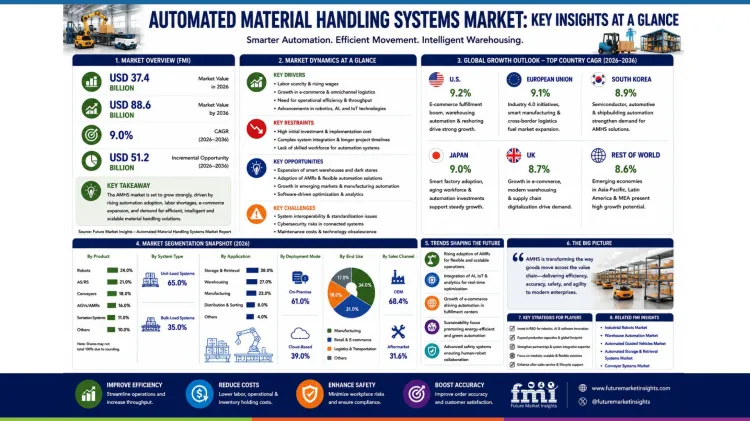
FMI projects the automated material handling systems market to grow from USD 37.4 billion in 2026 to USD 88.6 billion by 2036 at a 9.0% CAGR. The market is expected to create USD 51.2 billion in incremental opportunity over the forecast period. Robots lead the product category with a 24.0% share, unit-load systems account for 65.0% of system demand, and storage and retrieval represents 38.0% of application demand. These figures point to a market that is not being built around one universal technology. Buyers are selecting different automation formats for different cost problems.
Fast Payback Usually Starts with Repeatable Labour-Heavy Tasks
Palletizing is often one of the clearer early automation candidates. It involves repetitive lifting, predictable movement, standard load patterns, and frequent labour pressure. In food and beverage, consumer goods, pharmaceuticals, chemicals, and end-of-line manufacturing, a palletizing robot can be evaluated against direct labour cost, injury risk, shift coverage, consistency, and throughput.
The payback can be attractive because the automation is contained. A palletizer does not always require a warehouse-wide redesign. It can be installed at a defined line, linked to a conveyor or packaging system, and measured through cycle time, labour redeployment, damage reduction, and output consistency.
Pick-and-place robots follow a similar logic in controlled environments. Electronics, automotive parts, packaging, and pharmaceutical operations often use repetitive handling tasks that are structured enough for automation. The system is most compelling when it replaces frequent manual movement rather than sporadic work.
FMI identifies industrial robots for pick-and-place and palletizing as important within the 24.0% robot product segment. This is useful because it separates industrial robotics from the broader AMR story. A robot does not need to move through an entire facility to generate a good return. In many cases, the best ROI comes from automating one predictable point in the flow.
AMRs Often Win Where Layout Flexibility Is the Main Constraint
Autonomous mobile robots are gaining attention because they reduce the need for fixed tracks, extensive conveyor routes, or major building changes. Their strongest use case is not simply moving goods. It is moving goods in environments where product mix, travel paths, storage locations, or volume patterns change frequently.
An e-commerce fulfilment centre may experience seasonal order spikes, changing SKU profiles, and shifting pick zones. A fixed conveyor network can work well, and it may become inefficient if the flow changes materially. AMRs can be deployed in phases and redirected through software, which can reduce the cost and disruption of redesign.
Their ROI is often strongest where workers spend a meaningful share of time walking. Goods-to-person workflows, batch picking, replenishment, and transport between stations can all be candidates. The financial logic is based on reducing non-value-added travel, improving pick productivity, and maintaining throughput during labour shortages.
FMI directly notes that AMR adoption is increasing because operators need flexible and scalable movement that can adapt to fluctuating order volumes without proportional labour additions. The report also identifies warehouse navigation and goods movement as key AMR sub-categories. That places AMRs in a different ROI bracket from conveyors. They are not necessarily cheaper in every scenario, and they are easier to phase into facilities where the final layout remains uncertain.
Conveyors Deliver Strong ROI When Flow Is Stable and Fast
Conveyors are sometimes described as legacy automation because AMRs receive more attention. That interpretation misses where conveyors remain highly effective. High-speed sorting, parcel movement, baggage handling, bottling lines, assembly flows, and repetitive distribution routes still favour fixed conveyance.
A conveyor is most attractive when goods move along the same path repeatedly, volume is high, product dimensions are reasonably consistent, and facility layout is unlikely to change materially. In such settings, its throughput, predictability, and mechanical simplicity can produce a strong return.
The capital burden can be substantial if the system spans a large building or requires sortation, controls, scanners, merges, diverts, and safety infrastructure. The operating economics can still be compelling when the alternative is hundreds of metres of manual cart movement or repeated forklift travel.
Conveyors often create their best return in facilities where every minute of delay affects the next process. Parcel hubs, high-volume retail distribution centres, food and beverage plants, automotive assembly operations, and airports all fit this pattern. The system is not flexible in the same way as an AMR fleet, and high utilisation can make that lack of flexibility acceptable.
ASRS Has a Different ROI Logic
Automated storage and retrieval systems are rarely the fastest payback option in a simple labour calculation. Their value usually comes from a combination of density, accuracy, space savings, inventory control, and service level.
An ASRS can store pallets, cartons, bins, or trays in high-density vertical layouts. In land-constrained markets, expensive urban logistics zones, cold storage facilities, pharmaceutical warehouses, semiconductor environments, and high-value inventory operations, this can change the economics substantially. The buyer is not only reducing headcount. It is avoiding building expansion, improving stock control, reducing product damage, and supporting throughput in a constrained footprint.
FMI places storage and retrieval at 38.0% of application demand, showing its importance in automated warehousing and manufacturing inventory management. The report also notes that fully automated distribution centres can require USD 50 million to USD 200 million depending on scale and technology mix. It indicates that three- to five-year returns may constrain adoption among mid-sized operators.
That does not make ASRS a weak investment. It means the justification needs to include real estate, inventory, service level, and capacity expansion, not only labour savings.
Warehouse Management Software Can Improve ROI Across Multiple Assets
Warehouse management systems are often overlooked in physical automation discussions. A warehouse can have conveyors, AMRs, sorters, and storage equipment, and poor inventory logic or weak task orchestration can reduce the benefit of every asset.
Cloud-based WMS platforms are gaining attention because multi-site operators need central inventory visibility, order optimization, and real-time control. FMI states that on-premise deployment still accounts for 61.0% of demand, while cloud-based platforms are growing faster as total-cost-of-ownership benefits become clearer in multi-facility operations.
Software can offer relatively fast value where the facility already has equipment but lacks coordination. Slotting improvements, inventory accuracy, labour balancing, order prioritization, replenishment logic, and exception handling can raise throughput without adding a large amount of new machinery.
The ROI is strongest when software is linked to clear operational data. A warehouse with poor item master data, inconsistent location discipline, or unreliable scanning may not realize the expected return immediately. The technology works best when process discipline and data quality are addressed alongside implementation.
Manufacturing Automation Has a Different Payback Profile
Manufacturing accounts for 34.0% of end-use demand in the FMI market segmentation. Automotive is the largest manufacturing sub-segment, supported by assembly operations, EV battery handling, and parts logistics. In factories, automation ROI is often measured through line uptime, takt consistency, safety, WIP reduction, and material availability rather than warehouse labour alone.
AGVs and AMRs can be effective in factory logistics where materials need to move between receiving, storage, kitting, line-side supply, and finished-goods areas. Automated guided vehicles can suit highly structured routes, while AMRs are better suited to changing paths or mixed-model production.
Heavy machinery, metal processing, chemicals, and food production may also favour cranes, AGVs, pallet conveyors, and automated transfer systems where the material is too heavy, hazardous, hot, or repetitive for manual handling.
The Payback Ladder Is More Useful Than a Single Winner
Material handling investments can be organized into four broad stages.
- Task automation comes first. Palletizing, picking assistance, scanning, and basic mobile transport can address immediate labour or safety pain points.
- Flow automation follows. Conveyors, sorters, automated guided vehicles, and line-side delivery systems improve movement through defined processes.
- Storage automation is a further stage. ASRS, shuttle systems, vertical storage, and high-density retrieval systems address space, accuracy, and inventory challenges.
- Orchestration sits across the others. WMS, warehouse execution software, analytics, and cloud platforms coordinate equipment, people, inventory, and orders.
The most successful investments often build through these stages. A facility may start with palletizing robots or AMRs, then connect them through software, then add storage automation once volume and site constraints justify it. Trying to automate every process at once can increase integration risk and lengthen the payback timeline.
A common investment error is to evaluate automation only against labour reduction. Labour is important, particularly in markets facing workforce shortages, higher wages, and turnover. FMI identifies labour scarcity as a major reason automation is shifting from discretionary spending to operational necessity. The broader return may include improved throughput, higher order accuracy, lower injury exposure, reduced damage, better inventory availability, and stronger customer service.
The more credible conclusion is that no single material handling system has the fastest payback in every facility. Palletizing robots and targeted AMR deployments often offer quicker value in labour-intensive workflows. Conveyors can outperform mobile robotics in stable high-volume routes. ASRS makes sense when space and inventory density are the larger economic problem. Warehouse software can improve returns across every physical asset.
The investment sequence should therefore follow the bottleneck, not the technology trend. Automation pays back fastest when the system is sized around a clearly measurable operating loss and integrated into a process that the business is prepared to run differently.

