


- The black maca extract market is expected to reach USD 70.5 million by 2026 and USD 126.3 million by 2036, growing at a CAGR of 6.0% between 2026 and 2036, due to the rising demand for nutraceutical, functional food and herbal wellness applications.
- Global ingredient buyers are increasingly looking at nearshoring strategies to reduce the impact of logistics disruptions, geopolitical uncertainty and long supply chains.
- Localised manufacturing and processing facilities may offer increased security of supply and responsiveness of delivery, but can also raise production and labour costs compared to traditional sourcing hubs.
- Procurement teams are finding that they increasingly need to balance resilience goals with margin pressures, specifically in the competitive dietary supplement market where ingredient costs directly impact profitability.
- The appeal of multi-region sourcing strategies for manufacturers seeking to maintain cost advantages and improve supply chain resilience.
- The competitive arena is shifting from buying on the lowest-cost basis to more extensive assessments of supply reliability, inventory security, traceability and operational flexibility.
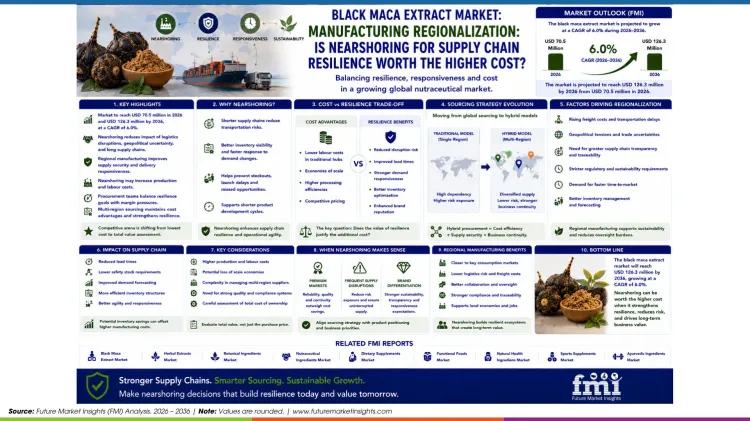
The black maca extract market is still riding on the coattails of rising consumer interest in natural health products, plant-based supplements, and functional nutrition solutions. The market is projected to reach USD 126.3 Million by 2036 from USD 70.5 Million in 2026, at a CAGR of 6.0% during the forecast period. Sourcing and manufacturing strategies are becoming a more critical competitive factor for ingredient suppliers and finished-product manufacturers as demand increases globally.
One of the biggest trends impacting procurement decisions is a greater emphasis on regionalization and nearshoring of manufacturing.
Historically, the supply chains for black maca extraction have been characterized by centralized processing and distribution chains globally. Often, manufacturers would prefer to locate their production environments and extraction facilities at large scale and low cost so as to maximize operating efficiency and keep competitive pricing.
But recent disruptions in supply chains have highlighted the risks of geographically concentrated sourcing models.
Transportation delays, port congestion, geopolitical tensions and rising freight costs are causing procurement teams to rethink traditional sourcing strategies.
As a result, nearshoring has been seen as a possible solution to improve supply chain resilience.
The fundamental idea behind nearshoring is simple.
By moving manufacturing, extraction, packaging or distribution activities closer to end markets, companies can reduce transportation risks, improve visibility of their inventory and accelerate their response to changes in customer demand.
These benefits can be particularly useful for buyers of black maca extract.
Nutraceutical brands are under more pressure than ever to keep products on the market, and they are working on shorter product development cycles. Supply disruptions can lead to inventory shortages, launch delays and missed sales opportunities.
Nearshoring provides the chance to reduce these risks via shorter supply chains and increased responsiveness.
At the same time, the economic trade-offs remain large.
Traditional sourcing regions still benefit from advantages of labor costs, manufacturing scale and processing efficiencies. Concentration of extraction or processing nearer to important markets for consumption may increase the costs of production and reduce economies of scale.
Consequently, the question facing procurement teams is not whether resilience has value, but whether that value justifies the additional cost.
For many organizations, the answer depends on product positioning.
High-end supplement makers are typically more interested in the reliability, quality and continuity of supply than they are in incremental cost savings. Such companies may be willing to bear the higher procurement costs if supply chains become regionalized, resulting in greater operational stability and brand reputation.
On the other hand, manufacturers in highly competitive markets with a value orientation may still be focusing on minimizing the cost of ingredients.
In these parts, aggressive nearshoring strategies are difficult to defend unless supply chain disruptions escalate or intensify.
Purchaser behavior points to the industry moving toward a middle ground.
Many companies are adopting hybrid procurement models rather than throwing global sourcing models away.
But these approaches still allow for primary supply volumes from traditional manufacturing hubs, with secondary regional suppliers added for better business continuity planning.
This helps organizations maintain cost advantages and not be as dependent on a single geography.
Inventory management considerations also affect decisions about regionalization.
Variation in transportation causes safety stock in long-haul supply chains. Nearshoring will reduce lead times, strengthen forecasting and help companies build more efficient inventory structures.
In some cases, these inventory savings can help offset higher manufacturing costs.
Traceability is becoming more important, which further drives regionalized supply chains.
Consumers are more curious than ever about where ingredients come from, sustainability practices and quality assurance. Increasing transparency of sourcing and processing activities can help companies improve their competitive position.
Regional manufacturing arrangements can help achieve these objectives by reducing oversight burdens and increasing supply chain transparency.
There are also regulatory factors that come into play.
The suppliers of ingredients to the North American and European markets will need to adjust to changing compliance requirements and documentation standards. Regional processing capabilities may help in communicating with regulators, improve audit readiness and support more efficient quality management procedures.
These operational benefits are increasingly relevant for procurement teams when evaluating suppliers.
Further context is provided by trends in market segmentation.
The biggest demand is in the nutraceutical and dietary supplement applications, as continuity of supply is directly related to product availability and consumer loyalty. Manufacturers in these segments often are early adopters of diversified sourcing and regionalization strategies.
Functional food producers are also looking at resilience strategies, as product portfolios expand and ingredient supply chains become more complex.
Regionally, regionalization efforts do not necessarily eliminate international sourcing relationships.
Instead, companies are building more flexible procurement ecosystems that can respond to changing market conditions. The goal is usually to improve resilience rather than to change the entire supply chain.
This difference is significant as the economics of black maca extract production still favor established manufacturing networks in many cases.
The myth we need to bust is that nearshoring will automatically provide you with better results.
Indeed, successful regionalization strategies require a deep assessment of production costs, quality standards, supplier capacity, logistics performance and customer requirements.
If there is no clear economic reason for regionalization, organizations could face margin pressures that are greater than operational benefits.
The market will mature and buying decisions will be more data-led and risk-oriented.
Bottom line: Nearshoring is becoming a more and more important strategic consideration in the black maca extract market, but it is not a panacea. Regionalized manufacturing can lead to increased supply chain resilience, visibility, and responsiveness, but these benefits often come at the cost of increased operating costs. The most successful organizations will probably pursue balanced sourcing strategies that combine the efficiency of existing global supply networks with the flexibility and risk mitigation of regional suppliers.

