

- Industry Size (2026)
- USD 348.10 Mn
- Forecast (2036)
- USD 495.79 Mn
- CAGR (2026 to 2036)
- 3.6%
Demand for Black Tea Extracts in Japan Market Size, Market Forecast and Outlook By FMI
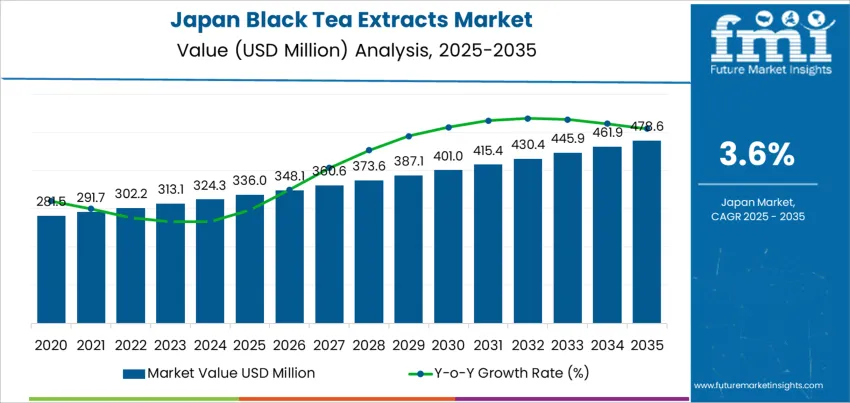
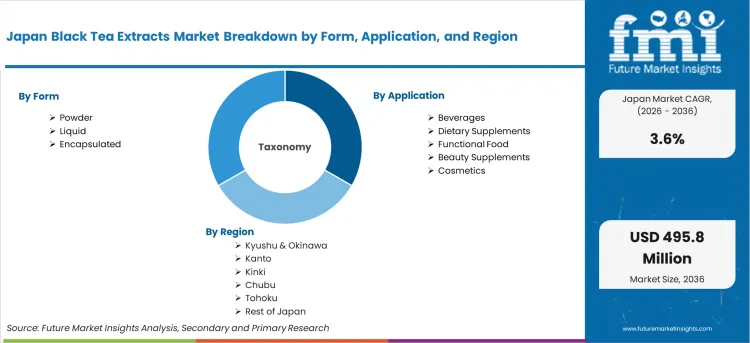
The demand for black tea extracts in japan market was valued at USD 336.00 million in 2025, projected to reach USD 348.10 million in 2026, and is forecast to expand to USD 495.79 million by 2036 at a 3.6% CAGR. As per FMI, Japanese functional beverage manufacturers are tightening procurement specifications for polyphenol-standardized tea extracts in response to expanding Foods with Function Claims (FFC) product registration requirements. Ingredient suppliers that have invested in advanced standardization and traceability documentation are capturing a growing share of the premium extract supply market.
Summary of Demand for Black Tea Extracts in Japan Market
- Market Overview
- The market is valued at USD 336.00 million in 2025 and is projected to reach USD 495.79 million by 2036.
- The industry is expected to grow at a 3.6% CAGR from 2026 to 2036, creating an incremental opportunity of USD 147.69 million.
- The market is a specification-driven, polyphenol-standardized ingredient category where procurement is governed by FFC notification requirements, active compound concentration thresholds, and supplier traceability documentation.
- Demand and Growth Drivers
- Demand is driven by the expanding pipeline of Foods with Function Claims (FFC) notifications incorporating polyphenol-based functional claims.
- Functional beverage manufacturers are tightening procurement specifications for standardized catechin and theaflavin content thresholds.
- Growing integration of tea-derived actives into beauty supplement and cosmetic ingredient formulations is widening the application base.
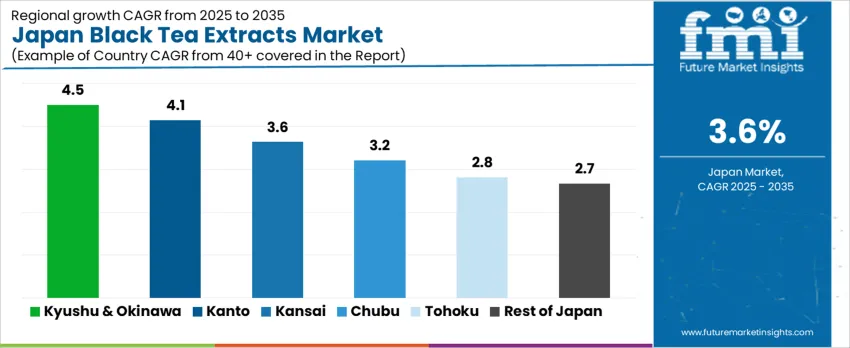
- Among key regions, Kyushu & Okinawa at 4.5% CAGR, Kanto at 4.1% CAGR, Kinki at 3.6% CAGR, Chubu at 3.2% CAGR, Tohoku at 2.8% CAGR, Rest of Japan at 2.7% CAGR.
- Product and Segment View
- The market includes powder, liquid, and encapsulated black tea extract forms standardized for polyphenol, theaflavin, or catechin content.
- Applications span beverages, dietary supplements, functional food, beauty supplements, and cosmetics.
- Powder leads by Form with 48.0% share in 2026.
- Beverages leads by Application with 37.0% share in 2026.
- The scope includes standardized tea extracts for industrial applications, excluding finished consumer beverages, matcha, and unprocessed tea leaves.
- Geography and Competitive Outlook
- Kyushu & Okinawa leads at 4.5% CAGR, supported by functional food manufacturers and health food retail chains.
- Kanto is the largest volume base, anchored by Tokyo's beverage R&D laboratories and supplement manufacturing.
- Competition is shaped by polyphenol standardization and FFC documentation capabilities, with key players including Synthite Industries Ltd., Martin Bauer Group, Tata Consumer Products, Cymbio Pharma Pvt Ltd, Kemin Industries.
- Analyst Opinion at FMI
- Nandini Roy Choudhury, Principal Consultant for Food & Beverage analysts observe that: 'In my analysis, I have observed that Japanese functional beverage manufacturers are tightening polyphenol content specifications for black tea extract procurement, pushing suppliers toward higher standardization grades that command premium pricing. Beverage R&D teams that continue sourcing generic, non-standardized extracts face product claim rejection risks under Japan's Foods with Function Claims (FFC) regulatory framework, making specification upgrades a compliance necessity rather than a quality preference.'
- Strategic Implications / Executive Takeaways
- Beverage R&D teams must standardize polyphenol content procurement specifications to meet FFC notification evidentiary requirements for functional claims.
- Extract suppliers should invest in advanced standardization documentation and batch traceability systems to qualify for premium-tier procurement contracts.
- Supplement brand managers should secure supply agreements with FFC-compliant extract producers ahead of notification filing cycles to avoid formulation delays.
Demand for Black Tea Extracts in Japan Market Key Takeaways
| Metric | Details |
|---|---|
| Industry Size (2026) | USD 348.10 million |
| Industry Value (2036) | USD 495.79 million |
| CAGR (2026-2036) | 3.6% |
Source: Future Market Insights, 2026
An absolute dollar opportunity of USD 147.69 million over the forecast period reflects the expanding application of polyphenol-standardized extracts in functional beverages, dietary supplements, and beauty supplement formulations driven by the FFC regulatory pathway. FMI analysts observe that the growing pipeline of FFC notifications incorporating black tea extract-based functional claims is converting what was previously a commodity tea ingredient into a specification-grade functional input. Suppliers with verifiable standardization documentation are capturing an increasing share of new product development supply contracts.
Regional demand for black tea extracts across Japan reflects functional beverage manufacturing concentration and health food retail density. Kyushu & Okinawa at 4.5%, Kanto at 4.1%, Kinki at 3.6%, Chubu at 3.2%, Tohoku at 2.8%, Rest of Japan at 2.7%. Kyushu and Okinawa lead growth, supported by a concentrated base of functional food manufacturers and expanding regional health food retail chains. Kanto represents the largest volume base, anchored by the Tokyo metropolitan area's density of beverage R&D laboratories and supplement manufacturing facilities. Kinki maintains steady demand through Osaka's food ingredient trading networks and Kobe's cosmetic ingredient supply chains.
Demand for Black Tea Extracts in Japan Market Definition
Black tea extracts are concentrated polyphenol-rich ingredients derived from oxidized Camellia sinensis leaves through water-based or solvent-based extraction processes. These extracts are standardized for theaflavin, catechin, or total polyphenol content and are used in functional beverages, dietary supplements, functional foods, beauty supplements, and cosmetic formulations. In Japan, procurement specifications are governed by active compound concentration standards, the FFC notification framework, and MHLW food additive regulations.
Demand for Black Tea Extracts in Japan Market Inclusions
Market scope includes powder, liquid, and encapsulated black tea extract forms. The scope covers applications in beverages, dietary supplements, functional food, beauty supplements, and cosmetics across hot water soluble and cold water soluble product types distributed throughout Japan.
Demand for Black Tea Extracts in Japan Market Exclusions
The scope excludes finished consumer tea beverages, unprocessed tea leaves, green tea extracts, matcha powder, and herbal tea infusions. Tea-flavored confectionery and tea-based cosmetic finished products are also excluded from the market valuation.
Demand for Black Tea Extracts in Japan Market Research Methodology
- Primary Research: Analysts conducted structured interviews with procurement managers, distribution executives, and category specialists to map purchasing decision criteria, contract renewal cycles, and supplier qualification processes.
- Desk Research: Data collection aggregated publicly available trade statistics, regulatory filings, industry association reports, and company financial disclosures to establish baseline market parameters.
- Market-Sizing and Forecasting: Baseline values derive from a bottom-up aggregation of trade volumes, applying category-specific growth coefficients and regional penetration rates to project forward demand trajectories.
- Data Validation and Update Cycle: Projections are cross-checked against reported company revenues, trade body statistics, and periodic primary research updates to maintain forecast accuracy.
Why is the Demand for Black Tea Extracts in Japan Growing?
Demand for black tea extracts in Japan is increasing as consumers and manufacturers shift toward functional, health oriented, and natural ingredients in foods, beverages, supplements, and cosmetics. Black tea extracts contain compounds such as theaflavins, thearubigins, and catechins, which are valued for antioxidant, anti inflammatory, and metabolic health supporting properties. Growing health awareness among Japanese consumers supports demand for antioxidant rich, natural extracts in drinks, dietary supplements, and wellness products. The popularity of ready to drink teas and functional beverages contributes to demand for soluble black tea extracts in powdered or liquid form. In cosmetics and personal care products, black tea extracts are increasingly used for their perceived antioxidant and skin beneficial properties, which broadens their application beyond food and beverage.
At the same time the broader tea and beverage market in Japan remains robust as domestic tea consumption evolves and demand shifts toward convenience and functional value. As traditional tea consumption declines, bottled and canned tea drinks including black tea remain popular. This shift supports use of extracts rather than loose leaf teas for ease of processing, formulation, and product consistency. Manufacturers and beverage producers favour extracts for their stability, ease of use, and scalability when producing large volumes of drinks, supplements, or cosmetic products. As markets for functional beverages, health supplements, and natural ingredient cosmetics expand, demand for black tea extracts is likely to grow steadily in coming years.
What Is the Current State of the Demand for Black Tea Extracts in Japan in Terms of Form and Application?
The demand for black tea extracts in Japan is driven by form and application. The leading form is powder, accounting for 48% of the market share, while beverages is the dominant application, capturing 37% of the demand. Black tea extracts are widely used for their antioxidant properties, as well as their ability to enhance flavor and offer health benefits. The growing demand for natural, functional ingredients in various sectors continues to fuel the popularity of black tea extracts in Japan, particularly in beverages and dietary supplements.
How Is Powder Form Leading the Demand for Black Tea Extracts in Japan?
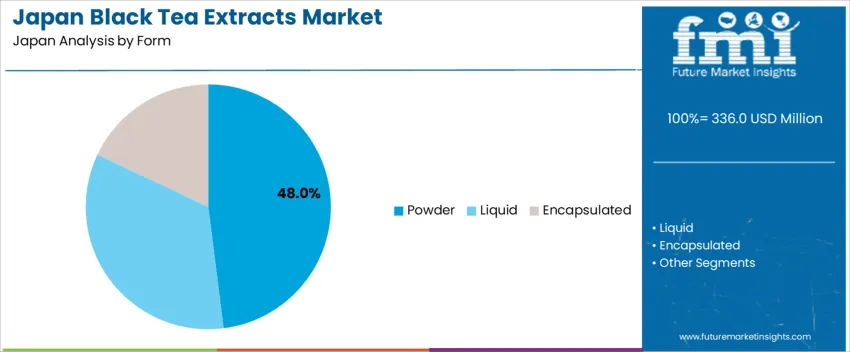
Powder form leads the demand for black tea extracts in Japan, holding 48% of the market share. The powdered form of black tea extract is favored for its versatility and ease of use in a wide range of applications, from beverages to dietary supplements. This form allows for easy incorporation into various products such as tea blends, energy drinks, and capsules. Additionally, powdered extracts have a longer shelf life and are easier to store and transport compared to liquid forms.
The demand for powder form black tea extract is driven by its practicality in mass production and its effectiveness in delivering the active compounds of tea, such as polyphenols and antioxidants. As health-conscious consumers in Japan seek functional ingredients that provide a natural source of antioxidants, powdered black tea extract continues to grow in popularity. It is particularly used in health supplements and functional food products, providing both health benefits and flavor enhancement.
How Is Beverages Leading the Application Demand for Black Tea Extracts in Japan?
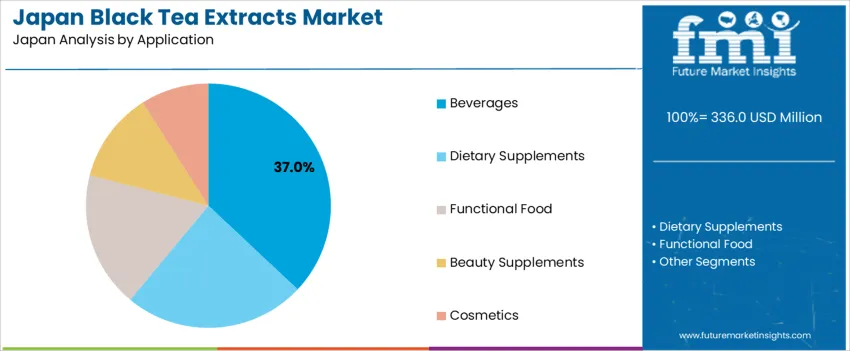
Beverages is the leading application for black tea extracts in Japan, accounting for 37% of the demand. Black tea extracts are widely used in beverages, especially in ready-to-drink tea products, functional beverages, and energy drinks. The extract enhances the flavor of beverages while providing antioxidants and health benefits, such as improving cardiovascular health and boosting metabolism. As the demand for healthier, functional drinks grows, black tea extracts have become a popular ingredient for manufacturers looking to offer products with added value.
The demand for black tea extracts in beverages is driven by the Japanese consumer's interest in functional drinks that offer both taste and health benefits. The growing preference for natural, plant-based ingredients has contributed to the rise in black tea extract use in the beverage sector. With an increasing focus on wellness and preventive health, particularly among younger and health-conscious consumers, black tea extracts are expected to continue playing a significant role in the beverage industry in Japan.
What is the Summary of Demand for Black Tea Extracts in Japan?
Demand for black tea extracts in Japan has been increasing as consumers and manufacturers show more interest in functional beverages, health oriented drinks, and convenient ready to drink options that offer antioxidant or wellness benefits. Black tea extracts are used in beverages, supplements, and health oriented formulations where their flavonoids and polyphenols are valued. As lifestyles become more fast-paced and demand grows for on the go drinks, black tea–based ready beverages and tea derived extracts see rising consumption. Market awareness around natural ingredients and health benefits supports growth in black tea extract demand in Japan.
What are the Drivers of Demand for Black Tea Extracts in Japan?
One key driver is growing consumer interest in health and wellness products. Black tea extracts are valued for antioxidant properties, metabolism support, and potential health benefits, which appeals to health conscious consumers. Another driver is the expansion of the ready to drink tea and coffee segment. As consumers seek convenience, bottled or canned black tea beverages and drinks incorporating tea extracts are increasingly popular. Demand from functional beverage producers and supplement manufacturers for natural antioxidant sources also supports uptake of black tea extracts. Additional driver is shifting consumer taste preferences. Younger and urban populations in Japan show rising acceptance of Western style black tea and flavored teas, which encourages formulation of beverages and products based on black tea extract. Growing demand for diversity in tea based beverages beyond traditional green tea drives interest in black tea–based extracts as ingredients.
What are the Restraints on Demand for Black Tea Extracts in Japan?
Some factors limit the growth of black tea extract demand in Japan. First, traditional preference for green tea remains strong, which reduces black tea’s share in total tea consumption and may limit willingness to substitute with black tea extracts. For many consumers daily tea habits continue to favour green tea over black tea. Second, taste preferences and cultural habits may make black tea–based drinks less appealing to segments accustomed to light or mild flavors, limiting market penetration for extract based beverages. Third, black tea extract usage in functional drinks or supplements may face regulatory or quality hurdles, especially if health claims are involved; this can slow product development or market entry. Finally, competition from other functional ingredients (herbal extracts, green tea extracts, vitamins, botanical additives) may reduce the relative demand for black tea extracts, particularly when alternatives offer similar benefits or are more familiar to consumers.
What are the Key Trends Influencing Demand for Black Tea Extracts in Japan?
A notable trend is growing demand for functional and health oriented beverages using natural ingredients, which favours black tea extracts as antioxidant sources. Consumers increasingly prefer products that combine convenience with perceived health benefits. Another trend is the expansion of ready to drink teas and bottled tea beverages, which often use extracts to standardize flavor and ensure consistency; this supports steady demand for extract based ingredients. Use of black tea extracts in supplements, nutraceuticals, and wellness products is rising as the population ages and health awareness increases. A third trend is shifting taste preferences among younger generations and urban consumers toward Western style beverages, including black tea and flavored teas, which broadens the potential consumer base for black tea extract products. Finally, product innovation in beverage and health food industries — including flavored teas, antioxidant drinks, and tea based functional beverages — encourages use of black tea extracts as a versatile ingredient.
What is the Regional Demand Outlook for Black Tea Extracts in Japan?
The demand for black tea extracts in Japan shows steady growth across regions, with Kyushu & Okinawa leading at a CAGR of 4.5%. Kanto follows closely with a CAGR of 4.1%, supported by its strong beverage and wellness markets. The Kinki region shows moderate growth at 3.6%, while Chubu, Tohoku, and the Rest of Japan exhibit slower growth, with respective CAGRs of 3.2%, 2.8%, and 2.7%. These differences reflect regional variations in consumer preferences, beverage consumption habits, and the increasing demand for functional ingredients in food and wellness products.
.webp "Top Country Growth Comparison Japan Black Tea Extracts Market Cagr (2026 2036)")
| Region | CAGR (%) |
|---|---|
| Kyushu & Okinawa | 4.5 |
| Kanto | 4.1 |
| Kinki | 3.6 |
| Chubu | 3.2 |
| Tohoku | 2.8 |
| Rest of Japan | 2.7 |
What factors are driving the demand for black tea extracts in Kyushu & Okinawa?
The demand for black tea extracts in Kyushu & Okinawa is projected to grow at a CAGR of 4.5%, driven by the region’s growing interest in health-conscious beverages and natural ingredients. Kyushu & Okinawa have a rich history of tea consumption, with tea being a key part of local culture. The increasing focus on functional beverages that offer health benefits, such as antioxidants and improved digestion, is driving the popularity of black tea extracts. Additionally, the rise in demand for organic and plant-based ingredients in food and drinks, combined with the region’s emphasis on wellness, is further boosting the adoption of black tea extracts. As consumers seek healthier alternatives to sugary drinks, black tea extracts are becoming a key ingredient in functional beverages, contributing to strong demand in Kyushu & Okinawa.
Why is the demand for black tea extracts increasing in Kanto?
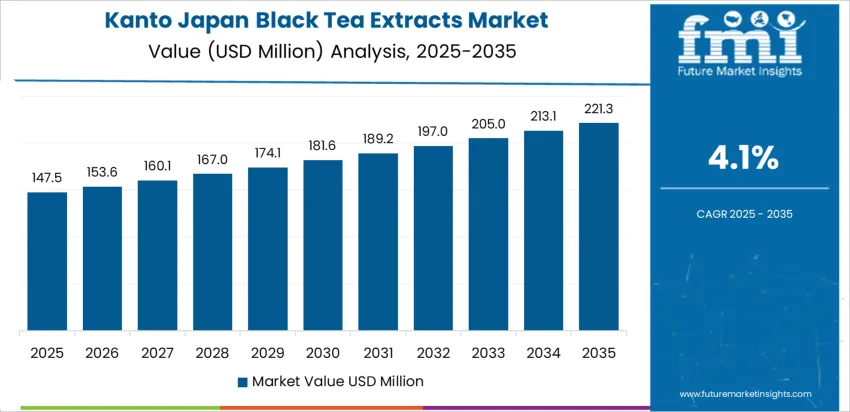
In Kanto, the demand for black tea extracts is expected to grow at a CAGR of 4.1%, supported by the region’s large population and thriving beverage industry. Kanto, home to Tokyo and surrounding areas, is a major hub for consumer goods, including beverages and functional foods. As consumer interest in healthier, natural, and plant-based ingredients continues to rise, black tea extracts, with their proven antioxidant properties and health benefits, are increasingly being incorporated into a variety of products. The demand for functional beverages, including teas, energy drinks, and dietary supplements, is particularly high in Kanto, where the wellness trend is gaining momentum. The region’s growing focus on clean labels and natural ingredients in food and drinks further supports the rise in black tea extract adoption.
What influences the demand for black tea extracts in Kinki?
The demand for black tea extracts in Kinki is projected to grow at a CAGR of 3.6%, reflecting steady growth driven by the region’s food and beverage sector. Kinki, which includes major cities like Osaka and Kyoto, has a well-established food culture where tea plays an important role in traditional and modern consumption. The region’s increasing interest in functional beverages and natural food products is fueling the demand for black tea extracts, especially those that offer added health benefits such as weight management and antioxidant support. Kinki’s growing wellness market, particularly in skincare and health supplements, is also contributing to the rise in black tea extract usage. While growth in Kinki is more moderate compared to Kyushu & Okinawa and Kanto, the region’s diverse food and beverage industry ensures steady demand for black tea extracts in both traditional and innovative product formulations.
How is the demand for black tea extracts growing in Chubu?
The demand for black tea extracts in Chubu is expected to grow at a CAGR of 3.2%, driven by the region’s focus on food and beverage innovation. Chubu, home to industrial cities like Nagoya, has a strong presence in manufacturing, including food production, where black tea extracts are increasingly used as a natural flavor enhancer and functional ingredient. The growing trend toward healthy beverages and functional foods in Chubu, especially those that cater to the wellness-conscious consumer, is driving demand for black tea extracts. Additionally, Chubu’s emphasis on organic and natural food products is contributing to the popularity of black tea extracts in beverages and health supplements. While growth in Chubu is slightly slower than in Kyushu & Okinawa and Kanto, the region’s food and beverage market is adapting to the growing demand for healthier, plant-based ingredients.
What factors are influencing the demand for black tea extracts in Tohoku?
In Tohoku, the demand for black tea extracts is projected to grow at a CAGR of 2.8%, reflecting moderate growth compared to more urbanized regions. Tohoku has a smaller industrial and food production base, but consumer awareness of the benefits of natural and functional ingredients is on the rise. As the region increasingly embraces health-conscious lifestyles, the demand for black tea extracts is expected to grow, particularly in the form of functional beverages and supplements. Black tea extract’s antioxidant properties, combined with its ability to promote digestive health, make it an attractive option for consumers in Tohoku. Although growth is slower compared to other regions, Tohoku’s gradual adoption of wellness and health trends will contribute to a steady increase in demand for black tea extracts.
How is the demand for black tea extracts evolving in the Rest of Japan?
In the Rest of Japan, the demand for black tea extracts is expected to grow at a CAGR of 2.7%, reflecting a gradual increase in adoption in rural and less industrialized areas. This region, which includes smaller cities and rural areas, has a more traditional approach to food and beverages, but as consumer interest in health and wellness products grows, so does the demand for natural ingredients like black tea extract. The use of black tea extracts in local food products, teas, and wellness supplements is contributing to this steady growth. While the growth rate is slower compared to more industrialized regions, the increasing awareness of the health benefits of black tea and the demand for plant-based ingredients ensures a consistent rise in black tea extract adoption across the Rest of Japan.
How Are Companies Competing in the Black Tea Extracts Market in Japan?
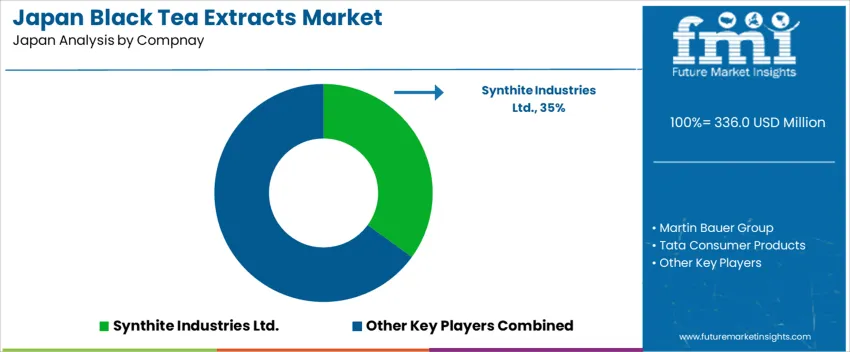
Demand for black tea extracts in Japan is increasing as beverage producers, nutraceutical firms, and food manufacturers seek concentrated, convenient forms of tea for drinks and functional foods. Leading suppliers in this market include Synthite Industries Ltd. (holding about 35% market share), Martin Bauer Group, Tata Consumer Products, Cymbio Pharma Pvt Ltd, and Kemin Industries. These companies supply standardized black tea extracts in various formats — liquid, powder, or granule — for use in ready to drink teas, energy drinks, dietary supplements, and bakery or confectionery items.
Competition in this industry centers on extract quality, standardization, and application versatility. Suppliers emphasize consistent polyphenol content, flavor profile retention, and stability to meet Japanese food safety and quality standards. Another important factor is formulation flexibility: extracts that dissolve easily in cold or hot water, or integrate well with other ingredients, appeal to beverage developers and food product manufacturers. Some firms also offer custom extract blends tailored for caffeine level, taste, or antioxidant content. Supply reliability and traceability from source tea leaves through to finished extract are additional competitive advantages, particularly for clients aiming for clean label or premium positioning. Companies that combine high quality extracts, consistent supply, and adaptable product formats are best positioned to grow in Japan’s black tea extracts market.
Key Players of the Black Tea Extracts Industry in Japan
- Synthite Industries Ltd.
- Martin Bauer Group
- Tata Consumer Products
- Cymbio Pharma Pvt Ltd
- Kemin Industries
Scope of the Report
| Metric | Value |
|---|---|
| Quantitative Units | USD 348.10 million to USD 495.79 million, at a CAGR of 3.6% |
| Market Definition | Black tea extracts encompass polyphenol-standardized ingredients derived from Camellia sinensis for functional beverage, supplement, food, and cosmetic applications. |
| Segmentation | Form: Powder, Liquid, Encapsulated; Application: Beverages, Dietary Supplements, Functional Food, Beauty Supplements, Cosmetics; Product Type: Hot Water Soluble, Cold Water Soluble |
| Regions Covered | Kyushu & Okinawa, Kanto, Kinki, Chubu, Tohoku, Rest of Japan |
| Key Companies Profiled | Synthite Industries Ltd., Martin Bauer Group, Tata Consumer Products, Cymbio Pharma Pvt Ltd, Kemin Industries |
| Forecast Period | 2026 to 2036 |
| Approach | Forecasting models apply a bottom-up methodology starting from trade volume baselines, applying category-specific growth coefficients and cross-validating against reported company financials and trade statistics. |
Key Segments of the Demand for Black Tea Extracts in Japan
Form:
- Powder
- Liquid
- Encapsulated
Application:
- Beverages
- Dietary Supplements
- Functional Food
- Beauty Supplements
- Cosmetics
Product Type:
- Hot Water Soluble
- Cold Water Soluble
Region:
- Kyushu & Okinawa
- Kanto
- Kinki
- Chubu
- Tohoku
- Rest of Japan
Bibliography
- Consumer Affairs Agency, Japan. (2024). Foods with Function Claims Notification Database. CAA Japan.
- Ministry of Health, Labour and Welfare, Japan. (2024). Food Additive Standards: Tea Extract Specifications. MHLW.
- Japan External Trade Organization. (2024). Japanese Market Report: Functional Foods and Health Foods. JETRO.
- Food and Agriculture Organization of the United Nations. (2024). Tea Market Situation and Medium-Term Outlook. FAO.
- World Health Organization. (2024). WHO Technical Report Series: Safety Evaluation of Certain Food Additives. WHO.
This bibliography is provided for reader reference. The full Future Market Insights report contains the complete reference list with primary research documentation.
Frequently Asked Questions
How large is the demand for black tea extracts in japan market in 2026?
The demand for black tea extracts in japan market is estimated to be valued at USD 348.10 million in 2026.
What will be the market size of demand for black tea extracts in japan by 2036?
Market size for demand for black tea extracts in japan is projected to reach USD 495.79 million by 2036.
What is the expected CAGR for demand for black tea extracts in japan between 2026 and 2036?
The demand for black tea extracts in japan market is expected to grow at a CAGR of 3.6% between 2026 and 2036.
Which form segment is poised to lead in 2026?
Powder accounts for 48.0% share in 2026, making it the leading form segment.
Which application segment holds a leading position?
Beverages holds 37.0% share in 2026, commanding the leading position by application.
Which region records the highest growth rate?
Kyushu & Okinawa records the highest CAGR at 4.5% during 2026 to 2036.
What is included in the scope of this report?
Market scope includes powder, liquid, and encapsulated black tea extract forms. The scope covers applications in beverages, dietary supplements, functional food, beauty supplements, and cosmetics acro.
What is excluded from the scope of this report?
The scope excludes finished consumer tea beverages, unprocessed tea leaves, green tea extracts, matcha powder, and herbal tea infusions. Tea-flavored confectionery and tea-based cosmetic finished prod.
Preview the report firsthand - request a free sample
Get SampleGet the brochure for pricing and purchase details.
Get PDFTable of Content
- Executive Summary
- Japan Market Outlook
- Demand-side Trends
- Supply-side Trends
- Technology Roadmap Analysis
- Analysis and Recommendations
- Market Overview
- Market Coverage / Taxonomy
- Market Definition / Scope / Limitations
- Research Methodology
- Chapter Orientation
- Analytical Lens and Working Hypotheses
- Market Structure, Signals, and Trend Drivers
- Benchmarking and Cross-market Comparability
- Market Sizing, Forecasting, and Opportunity Mapping
- Research Design and Evidence Framework
- Desk Research Programme (Secondary Evidence)
- Company Annual and Sustainability Reports
- Peer-reviewed Journals and Academic Literature
- Corporate Websites, Product Literature, and Technical Notes
- Earnings Decks and Investor Briefings
- Statutory Filings and Regulatory Disclosures
- Technical White Papers and Standards Notes
- Trade Journals, Industry Magazines, and Analyst Briefs
- Conference Proceedings, Webinars, and Seminar Materials
- Government Statistics Portals and Public Data Releases
- Press Releases and Reputable Media Coverage
- Specialist Newsletters and Curated Briefings
- Sector Databases and Reference Repositories
- FMI Internal Proprietary Databases and Historical Market Datasets
- Subscription Datasets and Paid Sources
- Social Channels, Communities, and Digital Listening Inputs
- Surveys
- Focus Groups
- Observational and In-context Research
- Social and Community Interactions
- Stakeholder Universe Engaged
- C-suite Leaders
- Board Members
- Presidents and Vice Presidents
- R&D and Innovation Heads
- Technical Specialists
- Domain Subject-matter Experts
- Scientists
- Physicians and Other Healthcare Professionals
- Governance, Ethics, and Data Stewardship
- Research Ethics
- Data Integrity and Handling
- Desk Research Programme (Secondary Evidence)
- Tooling, Models, and Reference Databases
- Data Engineering and Model Build
- Data Acquisition and Ingestion
- Cleaning, Normalisation, and Verification
- Synthesis, Triangulation, and Analysis
- Quality Assurance and Audit Trail
- Market Background
- Market Dynamics
- Drivers
- Restraints
- Opportunity
- Trends
- Scenario Forecast
- Demand in Optimistic Scenario
- Demand in Likely Scenario
- Demand in Conservative Scenario
- Opportunity Map Analysis
- Product Life Cycle Analysis
- Supply Chain Analysis
- Investment Feasibility Matrix
- Value Chain Analysis
- PESTLE and Porter’s Analysis
- Regulatory Landscape
- Regional Parent Market Outlook
- Production and Consumption Statistics
- Import and Export Statistics
- Market Dynamics
- Japan Market Analysis 2021 to 2025 and Forecast, 2026 to 2036
- Historical Market Size Value (USD Million) Analysis, 2021 to 2025
- Current and Future Market Size Value (USD Million) Projections, 2026 to 2036
- Y-o-Y Growth Trend Analysis
- Absolute $ Opportunity Analysis
- Japan Market Pricing Analysis 2021 to 2025 and Forecast 2026 to 2036
- Japan Market Analysis 2021 to 2025 and Forecast 2026 to 2036, By Form
- Introduction / Key Findings
- Historical Market Size Value (USD Million) Analysis By Form , 2021 to 2025
- Current and Future Market Size Value (USD Million) Analysis and Forecast By Form , 2026 to 2036
- Powder
- Liquid
- Encapsulated
- Powder
- Y-o-Y Growth Trend Analysis By Form , 2021 to 2025
- Absolute $ Opportunity Analysis By Form , 2026 to 2036
- Japan Market Analysis 2021 to 2025 and Forecast 2026 to 2036, By Application
- Introduction / Key Findings
- Historical Market Size Value (USD Million) Analysis By Application, 2021 to 2025
- Current and Future Market Size Value (USD Million) Analysis and Forecast By Application, 2026 to 2036
- Beverages
- Dietary Supplements
- Functional Food
- Beauty Supplements
- Cosmetics
- Beverages
- Y-o-Y Growth Trend Analysis By Application, 2021 to 2025
- Absolute $ Opportunity Analysis By Application, 2026 to 2036
- Japan Market Analysis 2021 to 2025 and Forecast 2026 to 2036, By Product Type
- Introduction / Key Findings
- Historical Market Size Value (USD Million) Analysis By Product Type, 2021 to 2025
- Current and Future Market Size Value (USD Million) Analysis and Forecast By Product Type, 2026 to 2036
- Hot Water Soluble
- Cold Water Soluble
- Hot Water Soluble
- Y-o-Y Growth Trend Analysis By Product Type, 2021 to 2025
- Absolute $ Opportunity Analysis By Product Type, 2026 to 2036
- Japan Market Analysis 2021 to 2025 and Forecast 2026 to 2036, By Region
- Introduction
- Historical Market Size Value (USD Million) Analysis By Region, 2021 to 2025
- Current Market Size Value (USD Million) Analysis and Forecast By Region, 2026 to 2036
- Kyushu & Okinawa
- Kanto
- Kinki
- Chubu
- Tohoku
- Rest of Japan
- Market Attractiveness Analysis By Region
- Kyushu & Okinawa Market Analysis 2021 to 2025 and Forecast 2026 to 2036, By Country
- Historical Market Size Value (USD Million) Trend Analysis By Market Taxonomy, 2021 to 2025
- Market Size Value (USD Million) Forecast By Market Taxonomy, 2026 to 2036
- By Country
- By Form
- By Application
- By Product Type
- By Country
- Market Attractiveness Analysis
- By Country
- By Form
- By Application
- By Product Type
- Key Takeaways
- Kanto Market Analysis 2021 to 2025 and Forecast 2026 to 2036, By Country
- Historical Market Size Value (USD Million) Trend Analysis By Market Taxonomy, 2021 to 2025
- Market Size Value (USD Million) Forecast By Market Taxonomy, 2026 to 2036
- By Country
- By Form
- By Application
- By Product Type
- By Country
- Market Attractiveness Analysis
- By Country
- By Form
- By Application
- By Product Type
- Key Takeaways
- Kinki Market Analysis 2021 to 2025 and Forecast 2026 to 2036, By Country
- Historical Market Size Value (USD Million) Trend Analysis By Market Taxonomy, 2021 to 2025
- Market Size Value (USD Million) Forecast By Market Taxonomy, 2026 to 2036
- By Country
- By Form
- By Application
- By Product Type
- By Country
- Market Attractiveness Analysis
- By Country
- By Form
- By Application
- By Product Type
- Key Takeaways
- Chubu Market Analysis 2021 to 2025 and Forecast 2026 to 2036, By Country
- Historical Market Size Value (USD Million) Trend Analysis By Market Taxonomy, 2021 to 2025
- Market Size Value (USD Million) Forecast By Market Taxonomy, 2026 to 2036
- By Country
- By Form
- By Application
- By Product Type
- By Country
- Market Attractiveness Analysis
- By Country
- By Form
- By Application
- By Product Type
- Key Takeaways
- Tohoku Market Analysis 2021 to 2025 and Forecast 2026 to 2036, By Country
- Historical Market Size Value (USD Million) Trend Analysis By Market Taxonomy, 2021 to 2025
- Market Size Value (USD Million) Forecast By Market Taxonomy, 2026 to 2036
- By Country
- By Form
- By Application
- By Product Type
- By Country
- Market Attractiveness Analysis
- By Country
- By Form
- By Application
- By Product Type
- Key Takeaways
- Rest of Japan Market Analysis 2021 to 2025 and Forecast 2026 to 2036, By Country
- Historical Market Size Value (USD Million) Trend Analysis By Market Taxonomy, 2021 to 2025
- Market Size Value (USD Million) Forecast By Market Taxonomy, 2026 to 2036
- By Country
- By Form
- By Application
- By Product Type
- By Country
- Market Attractiveness Analysis
- By Country
- By Form
- By Application
- By Product Type
- Key Takeaways
- Key Countries Market Analysis
- Kyushu & Okinawa
- Pricing Analysis
- Market Share Analysis, 2025
- By Form
- By Application
- By Product Type
- Kanto
- Pricing Analysis
- Market Share Analysis, 2025
- By Form
- By Application
- By Product Type
- Kinki
- Pricing Analysis
- Market Share Analysis, 2025
- By Form
- By Application
- By Product Type
- Chubu
- Pricing Analysis
- Market Share Analysis, 2025
- By Form
- By Application
- By Product Type
- Tohoku
- Pricing Analysis
- Market Share Analysis, 2025
- By Form
- By Application
- By Product Type
- Rest of Japan
- Pricing Analysis
- Market Share Analysis, 2025
- By Form
- By Application
- By Product Type
- Kyushu & Okinawa
- Market Structure Analysis
- Competition Dashboard
- Competition Benchmarking
- Market Share Analysis of Top Players
- By Regional
- By Form
- By Application
- By Product Type
- Competition Analysis
- Competition Deep Dive
- Synthite Industries Ltd.
- Overview
- Product Portfolio
- Profitability by Market Segments (Product/Age /Sales Channel/Region)
- Sales Footprint
- Strategy Overview
- Marketing Strategy
- Product Strategy
- Channel Strategy
- Martin Bauer Group
- Tata Consumer Products
- Cymbio Pharma Pvt Ltd
- Kemin Industries
- Synthite Industries Ltd.
- Competition Deep Dive
- Assumptions & Acronyms Used


