


- Native collagen brand share is shifting less by generic collagen positioning and more by application tier, source credibility, intact-structure proof, and documentation depth.
- Nutraceutical winners are suppliers that make native collagen feel clinically targeted, not simply another protein ingredient.
- Healthcare and pharmaceutical winners are companies that can support wound care, tissue engineering, aesthetic, and laboratory specifications with stronger technical files.
- Marine and source-verified winners gain when buyers need non-bovine, non-porcine, halal, kosher, pescatarian, or sustainability-led positioning, although public brand-level disclosure is limited.
- The biggest risk is assuming that every collagen buyer behaves like a peptide buyer. Most repeat demand for native collagen comes from specification-led, structure-sensitive, and application-specific use cases.
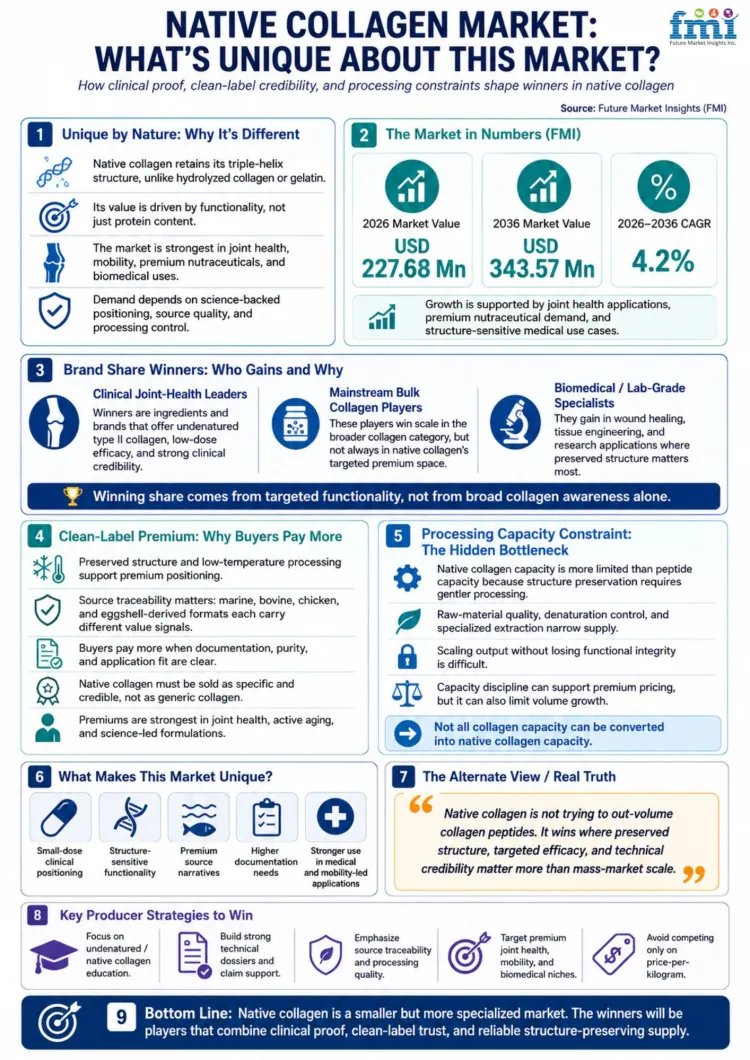
Native collagen is no longer a simple “collagen ingredient” market. The competitive question is now sharper: which suppliers are gaining specification share in nutraceuticals, healthcare, pharmaceuticals, cosmetics, food, beverages, laboratory use, and biomedical applications, and which suppliers are losing relevance because they are trapped between commodity collagen peptides and high-documentation medical-grade requirements?
FMI’s Native Collagen Market shows why this question matters. The category is segmented by source, application, and region, with marine, bovine, poultry, porcine, and other sources competing across nutraceuticals and dietary supplements, healthcare and pharmaceuticals, food products, beverages, cosmetics and personal care, animal feed, laboratory tests, and other uses. FMI estimates the market at USD 227.68 million in 2026, rising to USD 343.57 million by 2036 at a 4.2% CAGR. FMI also identifies Rousselot, Weishardt, GELITA AG, Tessenderlo Group NV, LAPI GELATINE S.p.a., Nitta Gelatin Inc., ITALGELATINE S.p.A., REINERT GRUPPE Ingredients GmbH, Ewald-Gelatine GmbH, GELNEX, TrobasGelatine B.V., JuncàGelatines SL, Collagen Solutions Plc, HolistaCollTech Ltd., and Advanced BioMatrix, Inc. within the competitive landscape. This confirms that the market is already supplier-led, even when finished-product branding sits closer to the consumer.
In the nutraceutical tier, the clearest gainers are companies that sell native collagen as a targeted structure-retaining ingredient, not as a broad beauty powder. Native collagen must compete against hydrolyzed collagen peptides in consumer awareness, but it should not compete on the same story. Peptides win on solubility, powder formats, and high-volume daily consumption. Native collagen wins when the buyer understands why intact triple-helix structure, type specificity, and controlled processing matter for joint health, cartilage support, connective tissue support, and premium dietary supplement claims.
GELITA, Rousselot, Weishardt, Nitta Gelatin, and similar established collagen suppliers fit the application-tier winner profile because they can combine scale, collagen know-how, regulatory support, and source documentation. In a market where the buyer is often a supplement brand, pharmaceutical company, cosmetic formulator, food ingredient processor, or research laboratory, the winning supplier is not only the one with material availability. It is the one that helps the buyer pass internal qualification, label review, compliance screening, and performance validation.
In the healthcare and pharmaceutical tier, the share winners are structurally different from mainstream supplement suppliers. Native collagen used in wound dressings, collagen membranes, collagen sponges, tissue engineering scaffolds, and injectable aesthetic formulations requires stronger quality assurance and technical documentation. Here, the selling point is not flavor, scoop size, or influencer visibility. It is grade, purity, sterility route, biodegradation behavior, batch consistency, regulatory support, and application know-how.
Advanced BioMatrix and Collagen Solutions-style specialists sit closer to this specification-led space because laboratory, cell-culture, matrix, and biomedical users often need standardized native collagen rather than mass-market collagen ingredients. These suppliers may not always lead in consumer awareness, but they can win where purchasing decisions are technical and repeat demand is tied to protocol reliability.
Marine native collagen sits between premium supplement positioning and source-led differentiation. FMI expects marine to lead the source segment with 18.5% share in 2026, supported by demand for non-bovine and non-porcine options. This matters because source is now part of the purchase decision. Marine positioning can appeal to pescatarian, halal, kosher, clean-source, and sustainability-sensitive buyers, especially where fish skin and scale origin stories are easier to communicate than animal hide or bone sourcing. However, marine sourcing alone is not enough. The supplier still has to prove native structure, consistent quality, and application suitability.
The brands most at risk are those stuck in the middle: too technical for mainstream peptide buyers, not documented enough for healthcare and pharmaceutical buyers, and not differentiated enough for marine, poultry, bovine, or porcine source-specific procurement. Suppliers that sell native collagen using the same language as collagen peptides may struggle because buyers will compare them against larger, faster-growing, and often easier-to-formulate peptide categories.
The misconception to avoid is that brand share in native collagen will follow general collagen awareness. Awareness creates interest. Application tier, source qualification, technical documentation, and structure preservation create repeat procurement.
Bottom line: the winners in native collagen will not be the suppliers with the broadest collagen claim. They will be the suppliers that win their application tier clearly, either through nutraceutical positioning, healthcare-grade documentation, marine/source differentiation, or laboratory and biomedical reliability.
FMI Related Reports
- Native Collagen Market: Primary interlink in introduction and conclusion
- Collagen Supplement Market: Use when comparing native collagen with mainstream supplement formats
- Collagen Peptide Market: Use when discussing peptide scale and consumer awareness competition
- Collagen Hydrolysates Market: Use when explaining why hydrolyzed collagen is a separate high-volume category
- Marine Collagen Market: Use when discussing marine source differentiation and non-bovine positioning
- Nutraceuticals Market: Use when linking native collagen to joint health, active aging, and supplement demand

