


- Citrus ingredient winners are not only flavor suppliers. They include citrus oil producers, pectin suppliers, citrus fiber processors, flavor houses, and integrated citrus processors.
- Winning suppliers combine sourcing control, extraction quality, formulation support, food-grade documentation, and application-specific technical service.
- Citrus flavor suppliers gain where beverage, confectionery, dairy, bakery, and snack brands need natural, familiar, and stable sensory profiles.
- Citrus fiber suppliers gain where brands need clean-label texture, water binding, moisture retention, and stabilizer replacement.
- Citrus pectin suppliers gain where brands need gelling, stabilization, fruit preparation performance, and scalable functional grades.
- The biggest misconception is that citrus ingredient competition is only about price. Buyers increasingly select suppliers that reduce reformulation risk.
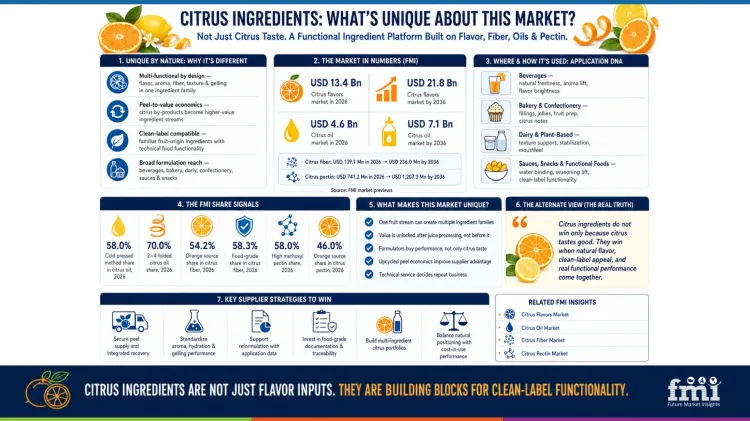
Solution-oriented competition for citrus ingredients is on the rise. Food and beverage companies do not just buy orange flavor, lemon oil, citrus fiber, or pectin as stand-alone ingredients anymore. They buy a system for formulating products based on natural flavor and functional attributes, along with shelf stability and sensory performance.
FMI’s Citrus Flavors Market shows that citrus flavor demand is tied to resilience, naturalness, and high-value ingredient systems. This creates opportunities for suppliers that can deliver stable citrus profiles across beverages, confectionery, bakery, dairy, sauces, snacks, and functional foods. A citrus flavor supplier must do more than provide a generic orange or lemon note. It must help brands manage freshness, bitterness, aroma stability, acidity balance, and label expectations.
First category of winners among suppliers is that of flavor house and aroma experts. These benefit when brands require flavors for citrus that remain stable even under conditions of volatile crops. Flavors of citrus are dependent on factors like seasonality of supply, oil availability, citrus greening problem, weather conditions, and fluctuations in prices. Formulation, natural flavor skills, masking abilities, and alternative supply methods can help keep customer formulations safe from volatility.
The Citrus Oil Market is relevant because citrus oils are key natural aroma inputs. FMI identifies cold pressing and 2–4 folded oil as important commercial anchors. Suppliers that control extraction quality, folding, terpene balance, and oxidation risk can gain preference among flavor houses and beverage manufacturers. Aroma consistency is a major competitive advantage.
The second winner group is the citrus fiber specialist. The Citrus Fiber Market shows that citrus fiber demand is supported by clean-label reformulation, synthetic stabilizer replacement, water binding, texture improvement, and upcycled peel use. Suppliers win when they can prove performance in bakery, sauces, plant-based meat, dairy alternatives, dressings, and processed foods.
Competing on the basis of being a source of citrus fiber is not all there is to this battle. Competing on the basis of function means that consumers will require uniform particle size, water binding capacity, sensory neutrality, etc. Being able to do something for one type of product does not mean the citrus fiber can do the same for other products.
The third winner group is the pectin supplier. The Citrus Pectin Market identifies high methoxyl pectin as the leading product and oranges as a leading source. Citrus pectin suppliers gain where food companies need reliable gelling and stabilization in jams, jellies, fruit preparations, confectionery, beverages, dairy systems, and bakery fillings.
It is better for the pectin suppliers having excellent grade portfolio and technical service because pectin selection is very application specific. High methoxyl and low methoxyl pectins have different characteristics. Sugar concentration, calcium content, pH, temperature and process conditions influence the effectiveness of pectin. It is much easier for the supplier who assists in the right selection to justify the value.
The Natural Food Flavors Market is useful for understanding broader supplier positioning. Food brands are increasingly seeking familiar natural flavor systems, but they also want performance. Citrus suppliers that combine naturalness with consistency are better placed than suppliers that rely only on label appeal.
The Food Ingredients Market gives the broader procurement lens. Ingredient buyers are selecting partners based on documentation, traceability, supply resilience, formulation support, and cost-in-use. Citrus ingredient suppliers that can support regulatory documentation, allergen statements, non-GMO claims, organic options, clean-label positioning, and application data will be more competitive.
There could be an inherent strength in terms of structure for integrated citrus processors. Since these companies are associated with the processing of citrus juice, they could get access to the peel streams for extraction of oils, fibers, and pectin. But just being integrated may not suffice; the suppliers require process discipline and customer support.
Suppliers of winners would be different according to their applications as well. Beverage brands may have priorities in citrus oils and flavors. Brands in bakery and plant-based products may have priorities for citrus fibers. Jam, jelly, fruit preparation, and confectionary brands may have priorities in citrus pectins. Snack and seasoning brands may have priorities in citrus flavors and powders.
Suppliers are at risk for commoditization. In the absence of value added through performance evidence and faster time to market, suppliers who provide merely generic citrus oils, pectin grades, or citrus fibers are at risk to be replaced by other suppliers due to cost alone.
What should be avoided here is the idea that the winners among citrus ingredient suppliers are simply those whose raw materials are the least expensive. It is important, however, that the food brands are now purchasing more than just cost.
Bottom line: Citrus ingredient winners will be the suppliers that help food and beverage brands reformulate around natural flavor, texture, gelling, and clean-label functionality. The strongest players will combine sourcing control, processing quality, technical service, and application-specific performance.
FMI Related Links
- Citrus Flavors Market: Primary link for natural citrus taste, beverage use, and flavor demand
- Citrus Oil Market: Use when discussing peel-derived aroma and natural citrus oil inputs
- Citrus Fiber Market: Use when discussing clean-label texture, water binding, and stabilizer replacement
- Citrus Pectin Market: Use when discussing gelling, fruit preparations, jams, confectionery, and stabilization
- Natural Food Flavors Market: Use when discussing natural flavor demand and reformulation
- Clean Label Ingredients Market: Use when discussing broader clean-label ingredient substitution

