

- Market Size (2026)
- USD 836.9 Mn
- Forecast (2036)
- USD 2355.0 Mn
- CAGR (2026 to 2036)
- 10.9%
How big is Citrus Fiber & Functional Fiber Texturants Market in 2026?
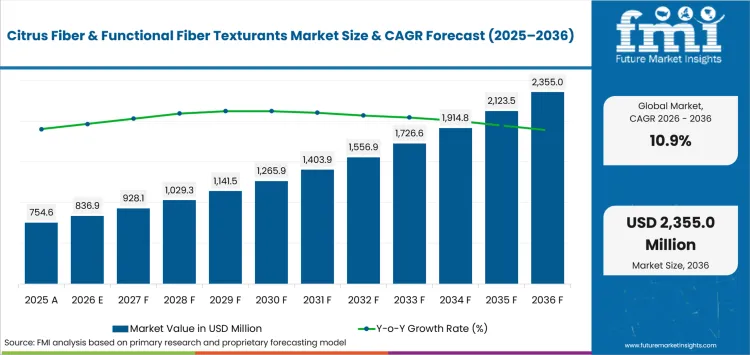
USD 836.9 million in 2026 and USD 2355.0 million by 2036 at a 10.9% CAGR.
Sales of citrus fiber & functional fiber texturants are estimated to rise at 10.9% CAGR through 2036, increasing valuation from USD 836.9 million in 2026 to USD 2355.0 million by 2036. Food manufacturers are expected to improve nutritional profiles without compromising product texture, stability or consumer acceptance. In September 2025, French ministries set a benchmark allowing a 5% increase in average fiber content for priority food families. The target puts citrus fiber and related food texturing agents into trials that must raise fiber content without weakening sensory performance.
German and USA reformulation routes diverge at the point where recipe work meets label requirements. In March 2025, BMLEH retained a 1.1 g per 100 g average salt target for packaged bakery assortments in Germany. That target can require bakery hydration adjustments while USA dietary fiber projects face a separate federal nutrition-labeling route. Clean-label ingredients therefore need country-specific application evidence before a reformulated product reaches routine commercial approval.
Key Takeaways of Citrus Fiber & Functional Fiber Texturants Market
- Food manufacturers increase functional fiber trials as nutrition-led reformulation changes moisture behavior and texture across bakery and dairy products alongside meat and sauce applications.
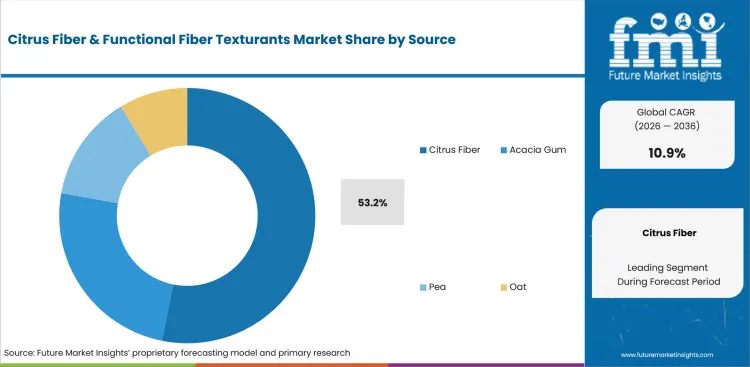
- By source, citrus fiber is estimated to hold 53.2% in 2026 owing to combined water-binding and emulsification across reformulated food products.
- In 2026, water-binding is expected to lead function with 45.4% share as moisture control affects processability and finished texture across multiple applications.
- Bakery is set to lead the application category with 30.9% share in 2026 due to recurring hydration adjustments during recipe reformulation.
- Recipe-specific qualification remains a material restraint as dosage changes can alter viscosity and sensory quality during label review and commercial approval.
- The profiled company set includes Fiberstar, Inc. (Citri-Fi), Nexira, CP Kelco, Herbafood Ingredients GmbH, Cargill, Ingredion, CEAMSA and J. Rettenmaier & Söhne GmbH + Co KG (JRS).
Analyst Perspective
"Functional fiber offers should be compared at the dose that preserves texture on the customer’s production line, not at the quoted price per kilogram. The stronger commercial case comes from documented water binding or emulsion control that reduces reformulation work and lowers qualification risk."
- Nandini Roy Choudhury, Principal Consultant, Future Market Insights
How is the Citrus Fiber & Functional Fiber Texturants Market segmented?
The citrus fiber & functional fiber texturants market is segmented by source, function, application and region.
Market taxonomy covers source, function, application and region. Source includes citrus fiber, acacia gum, pea and oat. Function covers water-binding, fat replacement and stabilizing, while application covers bakery, dairy, meat and sauces. Region follows the standard geographic taxonomy used throughout the report.
Why does citrus fiber lead demand within the source category?
Citrus fiber combines soluble and insoluble fractions with residual pectin, giving food developers water control and emulsion support from one botanical source. Reformulation teams compare it with food hydrocolloids at practical use rates because texture gains must survive commercial processing.
- Based on source, citrus fiber is projected to account for 53.2% in 2026 due to multifunctional performance across processed food systems.
- Commercial scale requires stable ingredient specifications across recipe trials, production runs and different manufacturing conditions. CEAMSA acquired PeelPioneers’ fiber line and intellectual property in January 2026, adding its technology to the CEAMFIBRE platform and widening the citrus-fiber supply route available for formulation work.
Why does water-binding lead demand within the function category?
Water-binding sits upstream of several quality checks because retained moisture changes dough handling, cooked yield and separation risk during processing. Tate & Lyle presented a NUTRAVA citrus-fibre ice-cream prototype at IFT FIRST in July 2025 to demonstrate mouthfeel and stability under high-moisture conditions.
- By function, water-binding is forecast to represent 45.4% in 2026 driven by moisture control requirements across the core food applications.
- High-moisture foods expose weak food stabilizers during storage as separation or ice-crystal changes become visible. Commercial approval therefore depends on testing the fiber in the full recipe under the intended production conditions and settings.
Why does bakery lead demand within the application category?
Bakery exposes hydration changes early because added fiber can alter mixing behavior, proofing and finished softness before a recipe reaches routine production. Formulators therefore compare bakery ingredients under process conditions that reproduce the intended bread or sweet-goods line.
- The application category is forecast to be led by bakery at 30.9% share in 2026 due to frequent hydration adjustments during recipe reformulation.
- Nexira obtained Fair For Life certification in November 2025 for four acacia gum references including Fibregum. The certification gives bakery teams a documented sourcing route, while recipe trials determine whether the fiber meets texture and handling requirements.
What are the drivers, restraints and opportunities in the Citrus Fiber & Functional Fiber Texturants Market?
Reformulation increases demand for texture control, but recipe qualification limits switching while lower-dose multifunctional fibers offer a route to simpler formulations.
- Driver: Food manufacturers require moisture and texture control as nutrition-led reformulation changes the physical balance of established recipes.
- Restraint: Application trials and labeling review can delay commercial conversion even when laboratory tests show acceptable functional performance.
- Opportunity: Multifunctional fibers can capture more formulation value by replacing part of higher-dose gum or starch systems.
Reformulation Programs Increase Demand for Functional Texture Control
Lowering sugar or salt can change water activity and finished structure, so food developers must rebuild texture without reversing the nutrition target. Max Rubner-Institut reported in July 2026 that its 2025 monitoring covered more than 7,000 processed foods and found significant nutrient changes in nearly every tracked group. Functional fibers compete with food emulsifiers and other texturizers when a reformulated recipe needs added body or moisture control.
Recipe Qualification and Label Changes Increase Switching Costs
Bench tests do not complete qualification if the selected fiber dose changes viscosity or requires another label review. FDA quantified the wider reformulation burden in January 2025 with a primary annualized cost estimate of USD 227 million under its proposed front-of-package rule. That cost makes gum arabic substitution and fiber trials more sensitive to validation time and plant testing before commercial approval.
Lower-Dose Multifunctional Fibers Can Reduce Formula Complexity
Lower-dose systems can earn a larger share of the formula if they replace part of a gum or starch package without weakening emulsion stability. Fiberstar launched Citri-Fi Pro in February 2026 for beverage emulsions and specified replacement of up to 75% of acacia gum or modified food starch. Other citrus pectin alternatives require their own recipe-level cost and processing tests before routine purchasing.
Which country CAGRs are profiled in the Citrus Fiber & Functional Fiber Texturants Market?
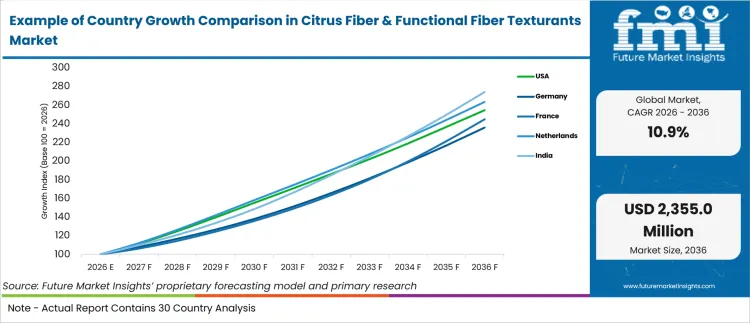
| Country | CAGR |
|---|---|
| India | 10.6% |
| Netherlands | 10.2% |
| USA | 9.8% |
| France | 9.4% |
| Germany | 9.0% |
How do country-level CAGRs compare in the Citrus Fiber & Functional Fiber Texturants Market?
A 1.6 percentage-point range separates the five profiled CAGRs and forms one compact growth band. India and the Netherlands make the upper pair as processing expansion and retailer-led reformulation broaden trial activity. USA, France and Germany remain close as labeling systems and mature sensory expectations add qualification work that delays routine commercial volume.
- India pairs processing expansion with uneven formulation resources across different processor sizes.
- Dutch retailer programs spread recipe changes across broad private-label food portfolios nationwide.
- USA label proposals tie plant validation to federal documentation requirements during reformulation.
- France combines Nutri-Score changes with packaging deadlines and sensory qualification during reformulation.
- Germany pairs voluntary labeling with demanding texture expectations in mature packaged-food categories.
Similar forecasts mask different qualification costs and technical-service requirements across these countries.
The full report provides country-level CAGR analysis across North America, Latin America, Europe, East Asia, South Asia, Oceania and the Middle East and Africa.
Country-wise Analysis
- American food manufacturers face a proposed federal label timeline, as FDA stated in May 2025 that businesses above USD 10 million in annual food sales receive three years after a final rule takes effect. Citrus fiber & functional fiber texturants demand in USA is forecast to rise at 9.8% CAGR over the forecast period owing to application laboratories that can test moisture control under repeatable commercial processing conditions. Commercial approval remains costly because every reformulated recipe needs plant-scale sensory evidence and defensible United States labeling records before national packaged-food manufacturers release repeat orders across retail programs and established brand portfolios nationwide.
- German food companies combine voluntary nutrition labeling with strict expectations for familiar texture across bakery and dairy categories sold through mature retail channels, where established brand portfolios leave little room for sensory drift. BMLEH recorded around 1,420 Nutri-Score brands in Germany by April 2025, giving formulation teams recurring nutrition and packaging work across major retail portfolios and established packaged-food lines nationwide with repeated package review cycles. Germany is estimated to post 9.0% CAGR over the forecast period owing to packaged-food recipe renovation, but repeat orders require side-by-side application evidence and clear label documentation that preserve expected flavor and texture.
- French manufacturers now formulate within the revised Nutri-Score system while category teams protect familiar texture across bakery and dairy products sold widely under established national brands, private labels and major regional retail programs nationwide. The citrus fiber & functional fiber texturants outlook in France is anticipated to advance at 9.4% CAGR over the assessment period supported by recurring composition review and package renovation across participating national food portfolios. Santé publique France stated in March 2025 that participating companies receive two years to update packaging, tying label timing to recipe trials that must preserve sensory quality before national commercial food distribution.
- Dutch supermarkets provide a reformulation channel across private-label portfolios, and RIVM reported in June 2026 that brown bread sold in 2025 contained 0.3 g more fiber per 100 g than comparable 2020 products. Adoption of citrus fiber & functional fiber texturants in the Netherlands is estimated to expand at 10.2% CAGR through 2036 supported by retailer-led recipe improvement across several product formats and supermarket product-renovation programs nationwide. Portfolio breadth remains the main friction as one functional fiber must perform consistently across production processes, so manufacturers require repeatable hydration protocols and local technical support for routine commercial approvals across related private-label recipes.
- Indian food processors operate across an expanding national processing base that adds commercial sites, but formulation resources remain uneven between large manufacturers and smaller regional enterprises serving packaged-food categories across national and regional portfolios. Citrus fiber & functional fiber texturants sales in India are forecast to expand at 10.6% CAGR by 2036 aided by processing infrastructure and packaged-food production across national manufacturing networks and emerging regional product lines. The Ministry of Food Processing Industries reported in January 2026 that 1,196 PMKSY projects were completed or operationalized by December 2025, while statutory-clearance delays keep local technical support central to repeatable plant-scale orders.
Who are the notable companies in the Citrus Fiber & Functional Fiber Texturants Market?
Fiberstar, Inc. (Citri-Fi), Nexira, CP Kelco, Herbafood Ingredients GmbH, Cargill, Ingredion, CEAMSA and J. Rettenmaier & Söhne GmbH + Co KG (JRS) are the notable companies profiled in this market.
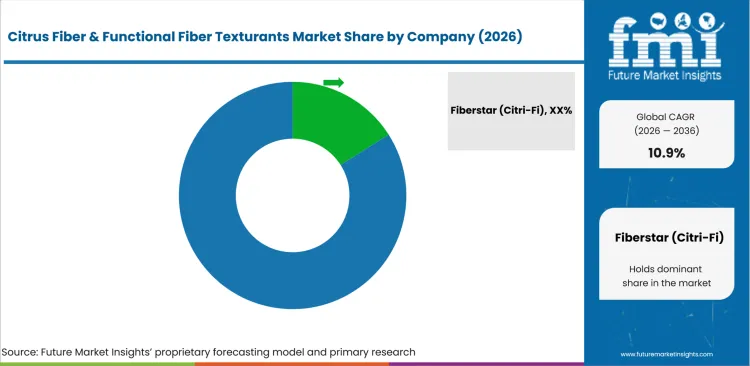
The competitive field is fragmented between fruit-fiber specialists and broader hydrocolloid groups that solve different formulation problems. New entrants need repeatable application data, reliable specifications and enough technical depth to reproduce texture performance on a customer’s production line.
- Fiberstar, Inc. (Citri-Fi), Herbafood Ingredients GmbH, CEAMSA and JRS compete around plant-fiber functionality with citrus or fruit-fiber options for formulation work.
- Nexira and CP Kelco compete from natural hydrocolloid portfolios that place fibers beside emulsifiers and stabilizers for food formulation.
- Cargill and Ingredion combine functional fibers with broader texture portfolios during multi-ingredient reformulation programs.
Competitive Benchmarking: Citrus Fiber & Functional Fiber Texturants Market
| Company | Application Breadth | Functional Breadth | Technical Support | Geographic Reach |
|---|---|---|---|---|
| Fiberstar, Inc. (Citri-Fi) | High | High | High | United States manufacturing with international distribution |
| Nexira | High | High | Medium | Europe, Africa and international food markets |
| CP Kelco | High | High | High | Americas, EMEA and Asia Pacific via Tate & Lyle |
| Herbafood Ingredients GmbH | High | High | Medium | Germany-based with international food applications |
| Cargill | High | High | High | Global food-ingredient network with Asian application centers |
| Ingredion | High | High | High | Global network serving more than 120 countries |
| CEAMSA | High | High | High | Europe with global food-industry activity |
| J. Rettenmaier & Söhne GmbH + Co KG (JRS) | High | High | Medium | Europe with multi-region food applications |
Key Developments in the Citrus Fiber & Functional Fiber Texturants Market
- In July 2026, Nexira launched Eficacia Advanced as a natural acacia-gum emulsifier designed for lower dosage in food and beverage formulations.
- In December 2025, Herbafood Ingredients GmbH received an updated FSSC 22000 Certificate of Approval covering apple and citrus fiber production plus food texturizers at its Werder sites.
Key Players in the Citrus Fiber & Functional Fiber Texturants Market
Citrus and Fruit-Fiber Specialists
- Fiberstar, Inc. (Citri-Fi)
- Herbafood Ingredients GmbH
- CEAMSA
- J. Rettenmaier & Söhne GmbH + Co KG (JRS)
Natural Hydrocolloid and Fiber Platforms
- Nexira
- CP Kelco
Integrated Ingredient-System Providers
- Cargill
- Ingredion
Citrus Fiber & Functional Fiber Texturants Market - Report Scope
| Coverage field | Report scope |
|---|---|
| Market breakdown | By source, function, application and region. |
| Quantitative Units | Revenue in USD million and CAGR in %. |
| Market Definition | Commercial plant-derived functional fiber texturants used to manage moisture, emulsification, stabilization and texture across food formulations. |
| Regions Covered | North America, Latin America, Europe, East Asia, South Asia and Pacific and Middle East and Africa. |
| Countries Covered | India, Netherlands, USA, France, Germany, and 20+ countries included in the full report. |
| Key Companies Profiled | Fiberstar, Inc. (Citri-Fi), Nexira, CP Kelco, Herbafood Ingredients GmbH, Cargill, Ingredion, CEAMSA and J. Rettenmaier & Söhne GmbH + Co KG (JRS). |
| Forecast Period | 2026 to 2036. |
| Approach | Primary and secondary research with market triangulation. |
Citrus Fiber & Functional Fiber Texturants Market - Research Methodology
| Method | Approach |
|---|---|
| Primary Research | FMI analysts gathered input from manufacturers, service providers, technology developers, distributors, end users, procurement teams, and subject-matter experts. Interviews examined purchasing decisions, product or service evaluation, adoption barriers, approval requirements, pricing considerations, and expectations for technical or commercial support. Respondents were also asked what evidence is required before a trial, pilot, or initial order develops into regular purchasing. |
| Desk Research | Desk research covered government statistics, regulatory publications, trade data, industry associations, technical literature, standards, company filings, product information, and official corporate announcements. Sources were reviewed for relevance, publication date, geographic coverage, and consistency with the defined market scope. Claims relating to performance, applications, approvals, capacity, investment, and commercial activity were retained only when supported by credible public evidence. |
| Market Sizing and Forecasting | The market model combined the baseline value with historical performance, segment structure, pricing and volume indicators, adoption levels, company participation, and country-level demand conditions. Forecast assumptions considered economic activity, investment trends, regulatory developments, technology adoption, purchasing cycles, supply availability, and barriers to wider market use. Segment and regional estimates were reconciled before the final market total was calculated. |
| Data Validation | Estimates were checked against multiple independent indicators, including public data, company activity, trade patterns, industry developments, and findings from primary interviews. Validation also tested whether products, services, applications, and company revenues fell within the defined market boundaries. Adjacent categories, unsupported claims, overlapping revenues, and activities without direct market relevance were excluded to reduce double counting and maintain consistency across segments and countries. |
Citrus Fiber & Functional Fiber Texturants Market by Segments
Citrus Fiber & Functional Fiber Texturants Market segmented by Source:
- Citrus Fiber
- Acacia Gum
- Pea
- Oat
Citrus Fiber & Functional Fiber Texturants Market segmented by Function:
- Water-binding
- Fat Replacement
- Stabilizing
Citrus Fiber & Functional Fiber Texturants Market segmented by Application:
- Bakery
- Dairy
- Meat
- Sauces
Citrus Fiber & Functional Fiber Texturants Market by Region:
- North America
- United States
- Canada
- Latin America
- Brazil
- Mexico
- Chile
- Rest of Latin America
- Western Europe
- Germany
- United Kingdom
- Italy
- Spain
- France
- Nordics
- Benelux
- Rest of Western Europe
- Eastern Europe
- Russia
- Poland
- Hungary
- Balkan and Baltic States
- Rest of Eastern Europe
- East Asia
- China
- Japan
- South Korea
- South Asia and Pacific
- India
- ASEAN
- Australia and New Zealand
- Rest of South Asia and Pacific
- Middle East and Africa
- Kingdom of Saudi Arabia
- Other GCC Countries
- Türkiye
- South Africa
- Other African Union Countries
- Rest of Middle East and Africa
Research Sources and Bibliography
- Ministère de l’Agriculture, de l’Agro-alimentaire et de la Souveraineté alimentaire. (2025, September 6). Lancement du nouveau référentiel des accords collectifs pour améliorer la qualité nutritionnelle et la durabilité de l’offre alimentaire.
- Bundesministerium für Landwirtschaft, Ernährung und Heimat. (2025, March 24). Nationale Reduktions- und Innovationsstrategie für Zucker, Fette und Salz in Fertigprodukten.
- CEAMSA. (2026, January 27). CEAMSA expands its fibre portfolio with the acquisition of PeelPioneers’ fibre line.
- Tate & Lyle. (2025, July 7). Tate & Lyle debuts expanded portfolio and mouthfeel leadership at IFT FIRST 2025.
- Nexira. (2025, December 1). Nexira launches a Fair For Life certified acacia gum range.
- Max Rubner-Institut. (2026, July 17). Ergebnisse des Produktmonitorings 2025 veröffentlicht.
- USA Food and Drug Administration. (2025, January 16). Food Labeling: Front-of-Package Nutrition Information (Proposed Rule).
- Fiberstar, Inc. (2026, February 4). A Natural Alternative to Acacia Gum in Beverages.
- USA Food and Drug Administration. (2025, May 8). FDA Issues Proposed Rule on Front-of-Package Nutrition Labeling.
- Bundesministerium für Landwirtschaft, Ernährung und Heimat. (2025, June 4). Hilfestellung für Unternehmen - Verwendung des Nutri-Score.
- Santé publique France. (2025, March 17). Signature de l’arrêté Nutri-Score : un pas de plus vers une meilleure information nutritionnelle des consommateurs.
- Rijksinstituut voor Volksgezondheid en Milieu. (2026, June 26). Monitor van de Nationale Aanpak Productverbetering 2025.
- Press Information Bureau, Government of India. (2026, January 29). Projects Approved under Pradhan Mantri Kisan SAMPADA Yojana.
- Fiberstar, Inc. (2025, June 11). Efficient Food Ingredient - Citrus Fiber.
- Fiberstar, Inc. (n.d.). About the Fiberstar Company - Citri-Fi Natural Citrus Fiber Retrieved August 11, 2026.
- Nexira. (2025, November 17). Nexira Showcases Natural Innovations for Functional Beverages at Food Ingredients Europe 2025.
- Nexira. (2025, April 4). Nexira celebrates 130 years of innovation inspired by nature.
- Tate & Lyle. (2025, November 17). Reflections on the progress of the Tate & Lyle and CP Kelco combination.
- Herbafood Ingredients GmbH. (2025, June 17). Optimized and sugar-reduced orange juice drinks - Perfect mouthfeel using multifunctional fruit fibers.
- Herbafood Ingredients GmbH. (n.d.). About us Retrieved August 11, 2026.
- Cargill. (2025, March 4). Cargill Showcases Full Range of Innovative Food Solutions at AAHAR 2025.
- Cargill. (n.d.). About our purpose, employees, history and culture Retrieved August 11, 2026.
- Ingredion. (2025, October 24). Citrus fibre gains ground as clean label solution to complex challenges.
- Ingredion. (n.d.). Meet Ingredion Retrieved August 11, 2026.
- CEAMSA. (2025, June 4). Citrus Fibre: Nature’s Smart Solution for Clean Label Innovation.
- CEAMSA. (n.d.). We are Compañia española de algas marinas Retrieved August 11, 2026.
- J. Rettenmaier & Söhne GmbH + Co KG. (2026, May 15). Sweet Kaya Spread (coconut jam) VITACEL® Citrus Fiber.
- J. Rettenmaier & Söhne GmbH + Co KG. (n.d.). JRS Worldwide Retrieved August 11, 2026.
- Nexira. (2026, July 6). Introducting Eficacia™ Advanced: High-performance natural acacia gum emulsifier for food & beverage.
- CEAMSA. (2026, January 22). CEAMSA joins European innovation project to develop plastic-free coffee cups.
- LRQA Limited. (2025, December 3). Certificate of Approval.
- Nexira. (2026, July 9). Nexira renforce sa position de leader mondial dans les ingrédients végétaux naturels grâce à l’acquisition de Keragum.
- Ingredion Incorporated. (2025, February 4). Ingredion Invests $100 Million in Indianapolis Plant to Improve Efficiency and Enable Future Texture Solutions Growth.
- Cargill. (2025, April 10). Cargill unveils transformed Innovation Center in Singapore to advance food innovation, for Asia from Asia.
- Fiberstar, Inc. (2025, July 23). 2025 IFT Market Trends: Healthy Five Ways.
- Herbafood Ingredients GmbH. (2025, February 14). Vegan emulsions with lower fat content - For mayonnaises, salad creams & dressings.
- Tate & Lyle PLC. (2025, May 22). Tate & Lyle PLC 2025 Full Year Results Statement.
- CEAMSA. (2025, July 18). CEAMSA at IFT FIRST 2025: Innovation with Texturizing Solutions.
- J. Rettenmaier & Söhne GmbH + Co KG. (2026, January 9). Plant based Beverage.
- Herbafood Ingredients GmbH. (n.d.). Info center Retrieved August 11, 2026.
This bibliography is provided for reader reference and is not exhaustive. The full report contains the complete reference list and detailed citations
This Report Answers
- How does the 10.9% forecast affect formulation priorities?
- Why does citrus fiber lead the source category?
- How does water-binding shape ingredient qualification?
- Why does bakery hold the largest application share?
- How do country growth rates change entry conditions?
- How do specialist and integrated suppliers compete?
- Which technical criteria matter in supplier comparisons?
- Which recent developments change competitive access?
Frequently Asked Questions
How big is the Citrus Fiber & Functional Fiber Texturants Market in 2026?
The citrus fiber & functional fiber texturants market is expected to be valued at USD 836.9 million in 2026. Food manufacturers use these ingredients to restore moisture control and texture as established recipes undergo nutrition-led or label-driven reformulation.
What is the CAGR of the Citrus Fiber & Functional Fiber Texturants Market from 2026 to 2036?
The citrus fiber & functional fiber texturants market is forecast to expand at 10.9% CAGR from 2026 to 2036. Growth reflects recurring formulation work that requires measurable water-binding or stabilization performance before commercial approval.
Which source is projected to account for 53.2% of the Citrus Fiber & Functional Fiber Texturants Market?
The citrus fiber & functional fiber texturants market is led by citrus fiber within the source category at 53.2% share in 2026. Its position reflects combined moisture and emulsion performance across food applications that require repeatable texture control.
Which function has the leading share in the Citrus Fiber & Functional Fiber Texturants Market?
The citrus fiber & functional fiber texturants market is led by water-binding within the function category at 45.4% share in 2026. Moisture control affects process stability across bakery and dairy products alongside meat and sauce formulations.
Which companies are active in the Citrus Fiber & Functional Fiber Texturants Market?
The citrus fiber & functional fiber texturants market profiles Fiberstar, Inc. (Citri-Fi), Nexira, CP Kelco, Herbafood Ingredients GmbH, Cargill, Ingredion, CEAMSA and J. Rettenmaier & Söhne GmbH + Co KG (JRS). These companies span fruit-fiber specialists, natural hydrocolloid groups and integrated texture portfolios.
Preview the report firsthand - request a free sample
Get SampleGet the brochure for pricing and purchase details.
Get PDFTable of Content
- Key Takeaways
- Market Size and CAGR
- Top Growth Driver
- Fastest Growing Segment
- Leading Region
- Key Companies
- Emerging Opportunities
- Executive Summary
- Global Market Outlook
- Demand-side Trends
- Supply-side Trends
- Technology Roadmap Analysis
- Analysis and Recommendations
- Analyst Perspective (What is happening? Why now? What should investors know?)
- Key Questions Answered
- How large is the market?
- What is the CAGR?
- What are key trends?
- Which region dominates?
- Who are the leaders?
- Market Overview
- Market Coverage / Taxonomy
- Market Definition / Scope / Limitations
- Research Methodology
- Chapter Orientation
- Analytical Lens and Working Hypotheses
- Market Structure, Signals, and Trend Drivers
- Benchmarking and Cross-market Comparability
- Market Sizing, Forecasting, and Opportunity Mapping
- Research Design and Evidence Framework
- Desk Research Programme (Secondary Evidence)
- Expert Input and Fieldwork (Primary Evidence)
- Tooling, Models, and Reference Databases
- Data Engineering and Model Build
- Quality Assurance and Audit Trail
- Market Background
- Market Dynamics (Drivers, Restraints, Opportunity, Trends)
- Scenario Forecast (Optimistic, Likely, Conservative)
- Impact Analysis
- AI Impact
- Sustainability Impact
- Regulatory Impact
- Technology Impact
- Consumer / Buyer Analysis
- Purchase Drivers
- Adoption Barriers
- Buyer Journey
- Opportunity Map Analysis
- Product Life Cycle Analysis
- Supply Chain Analysis
- Investment Feasibility Matrix
- Value Chain Analysis
- PESTLE and Porter's Analysis
- Regulatory Landscape
- Regional Parent Market Outlook
- Production and Consumption Statistics
- Import and Export Statistics
- Global Market Analysis and Forecast, 2021 to 2036
- Historical Market Size Value (USD Million) Analysis, 2021 to 2025
- Current and Future Market Size Value (USD Million) Projections, 2026 to 2036
- Y-o-Y Growth Trend Analysis
- Absolute $ Opportunity Analysis
- Global Market Pricing Analysis, 2021 to 2036
- Global Market Analysis and Forecast, By Source, 2021 to 2036
- Introduction / Key Findings
- Historical Market Size Value (USD Million) Analysis By Source, 2021 to 2025
- Current and Future Market Size Value (USD Million) Analysis and Forecast By Source, 2026 to 2036
- Citrus Fiber
- Acacia Gum
- Pea
- Oat
- Citrus Fiber
- Y-o-Y Growth Trend Analysis By Source, 2021 to 2025
- Absolute $ Opportunity Analysis By Source, 2026 to 2036
- Global Market Analysis and Forecast, By Function, 2021 to 2036
- Introduction / Key Findings
- Historical Market Size Value (USD Million) Analysis By Function, 2021 to 2025
- Current and Future Market Size Value (USD Million) Analysis and Forecast By Function, 2026 to 2036
- Water-binding
- Fat Replacement
- Stabilizing
- Water-binding
- Y-o-Y Growth Trend Analysis By Function, 2021 to 2025
- Absolute $ Opportunity Analysis By Function, 2026 to 2036
- Global Market Analysis and Forecast, By Application, 2021 to 2036
- Introduction / Key Findings
- Historical Market Size Value (USD Million) Analysis By Application, 2021 to 2025
- Current and Future Market Size Value (USD Million) Analysis and Forecast By Application, 2026 to 2036
- Bakery
- Dairy
- Meat
- Sauces
- Bakery
- Y-o-Y Growth Trend Analysis By Application, 2021 to 2025
- Absolute $ Opportunity Analysis By Application, 2026 to 2036
- Global Market Analysis and Forecast, By Region, 2021 to 2036
- Introduction
- Historical Market Size Value (USD Million) Analysis By Region, 2021 to 2025
- Current Market Size Value (USD Million) Analysis and Forecast By Region, 2026 to 2036
- North America
- Latin America
- Western Europe
- Eastern Europe
- East Asia
- South Asia and Pacific
- Middle East & Africa
- Market Attractiveness Analysis By Region
- North America Market Analysis and Forecast, By Country, 2021 to 2036
- Historical Market Size Value (USD Million) Trend Analysis By Market Taxonomy, 2021 to 2025
- Market Size Value (USD Million) Forecast By Market Taxonomy, 2026 to 2036
- By Country
- USA
- Canada
- By Source
- By Function
- By Application
- By Country
- Market Attractiveness Analysis
- By Country
- By Source
- By Function
- By Application
- Key Takeaways
- Latin America Market Analysis and Forecast, By Country
- Historical Market Size Value (USD Million) Trend Analysis By Market Taxonomy, 2021 to 2025
- Market Size Value (USD Million) Forecast By Market Taxonomy, 2026 to 2036
- By Country
- Brazil
- Mexico
- Chile
- Rest of Latin America
- By Source
- By Function
- By Application
- By Country
- Market Attractiveness Analysis
- By Country
- By Source
- By Function
- By Application
- Key Takeaways
- Western Europe Market Analysis and Forecast, By Country
- Historical Market Size Value (USD Million) Trend Analysis By Market Taxonomy, 2021 to 2025
- Market Size Value (USD Million) Forecast By Market Taxonomy, 2026 to 2036
- By Country
- Germany
- UK
- Italy
- Spain
- France
- Nordic
- BENELUX
- Rest of Western Europe
- By Source
- By Function
- By Application
- By Country
- Market Attractiveness Analysis
- By Country
- By Source
- By Function
- By Application
- Key Takeaways
- Eastern Europe Market Analysis and Forecast, By Country
- Historical Market Size Value (USD Million) Trend Analysis By Market Taxonomy, 2021 to 2025
- Market Size Value (USD Million) Forecast By Market Taxonomy, 2026 to 2036
- By Country
- Russia
- Poland
- Hungary
- Balkan & Baltic
- Rest of Eastern Europe
- By Source
- By Function
- By Application
- By Country
- Market Attractiveness Analysis
- By Country
- By Source
- By Function
- By Application
- Key Takeaways
- East Asia Market Analysis and Forecast, By Country
- Historical Market Size Value (USD Million) Trend Analysis By Market Taxonomy, 2021 to 2025
- Market Size Value (USD Million) Forecast By Market Taxonomy, 2026 to 2036
- By Country
- China
- Japan
- South Korea
- By Source
- By Function
- By Application
- By Country
- Market Attractiveness Analysis
- By Country
- By Source
- By Function
- By Application
- Key Takeaways
- South Asia and Pacific Market Analysis and Forecast, By Country
- Historical Market Size Value (USD Million) Trend Analysis By Market Taxonomy, 2021 to 2025
- Market Size Value (USD Million) Forecast By Market Taxonomy, 2026 to 2036
- By Country
- India
- ASEAN
- Australia & New Zealand
- Rest of South Asia and Pacific
- By Source
- By Function
- By Application
- By Country
- Market Attractiveness Analysis
- By Country
- By Source
- By Function
- By Application
- Key Takeaways
- Middle East & Africa Market Analysis and Forecast, By Country
- Historical Market Size Value (USD Million) Trend Analysis By Market Taxonomy, 2021 to 2025
- Market Size Value (USD Million) Forecast By Market Taxonomy, 2026 to 2036
- By Country
- Kingdom of Saudi Arabia
- Other GCC Countries
- Türkiye
- South Africa
- Other African Union
- Rest of Middle East & Africa
- By Source
- By Function
- By Application
- By Country
- Market Attractiveness Analysis
- By Country
- By Source
- By Function
- By Application
- Key Takeaways
- Key Countries Market Analysis
- USA
- Pricing Analysis
- Market Share Analysis, 2025
- By Source
- By Function
- By Application
- Canada
- Pricing Analysis
- Market Share Analysis, 2025
- By Source
- By Function
- By Application
- Mexico
- Pricing Analysis
- Market Share Analysis, 2025
- By Source
- By Function
- By Application
- Brazil
- Pricing Analysis
- Market Share Analysis, 2025
- By Source
- By Function
- By Application
- Chile
- Pricing Analysis
- Market Share Analysis, 2025
- By Source
- By Function
- By Application
- Germany
- Pricing Analysis
- Market Share Analysis, 2025
- By Source
- By Function
- By Application
- UK
- Pricing Analysis
- Market Share Analysis, 2025
- By Source
- By Function
- By Application
- Italy
- Pricing Analysis
- Market Share Analysis, 2025
- By Source
- By Function
- By Application
- Spain
- Pricing Analysis
- Market Share Analysis, 2025
- By Source
- By Function
- By Application
- France
- Pricing Analysis
- Market Share Analysis, 2025
- By Source
- By Function
- By Application
- India
- Pricing Analysis
- Market Share Analysis, 2025
- By Source
- By Function
- By Application
- ASEAN
- Pricing Analysis
- Market Share Analysis, 2025
- By Source
- By Function
- By Application
- Australia & New Zealand
- Pricing Analysis
- Market Share Analysis, 2025
- By Source
- By Function
- By Application
- China
- Pricing Analysis
- Market Share Analysis, 2025
- By Source
- By Function
- By Application
- Japan
- Pricing Analysis
- Market Share Analysis, 2025
- By Source
- By Function
- By Application
- South Korea
- Pricing Analysis
- Market Share Analysis, 2025
- By Source
- By Function
- By Application
- Russia
- Pricing Analysis
- Market Share Analysis, 2025
- By Source
- By Function
- By Application
- Poland
- Pricing Analysis
- Market Share Analysis, 2025
- By Source
- By Function
- By Application
- Hungary
- Pricing Analysis
- Market Share Analysis, 2025
- By Source
- By Function
- By Application
- Kingdom of Saudi Arabia
- Pricing Analysis
- Market Share Analysis, 2025
- By Source
- By Function
- By Application
- Türkiye
- Pricing Analysis
- Market Share Analysis, 2025
- By Source
- By Function
- By Application
- South Africa
- Pricing Analysis
- Market Share Analysis, 2025
- By Source
- By Function
- By Application
- USA
- Market Structure Analysis
- Competition Dashboard
- Competition Benchmarking
- Market Share Analysis of Top Players
- By Regional
- By Source
- By Function
- By Application
- Emerging Startups
- Innovation Benchmarking
- Competition Analysis
- Competition Deep Dive
- Fiberstar (Citri-Fi)
- Overview
- Product Portfolio
- Profitability by Market Segments
- Sales Footprint
- Strategy Overview
- Marketing Strategy
- Product Strategy
- Channel Strategy
- Nexira (acacia)
- CP Kelco
- Herbafood
- Cargill
- Ingredion
- Fiberstar (Citri-Fi)
- Case Studies
- Success Stories
- Recent Developments
- Competition Deep Dive
- Assumptions & Acronyms Used


