


- Chitin’s clean-label opportunity in Food & Beverage is mainly linked to chitosan-based preservation, edible coatings, natural films, and shelf-life extension.
- The market is not driven by sustainability alone. Buyers need antimicrobial performance, coating functionality, barrier properties, and food waste reduction.
- Chitosan’s leading derivative share shows that downstream functionality is more commercially important than raw chitin alone.
- Food & Beverage’s strong end-use share confirms that natural preservation and coating applications are becoming practical demand drivers.
- The clean-label premium is strongest where chitin-based systems can replace synthetic preservatives, reduce spoilage, or support bio-based packaging.
- The biggest misconception is that natural origin automatically creates a premium. Food companies pay more only when the system protects shelf life and product quality.
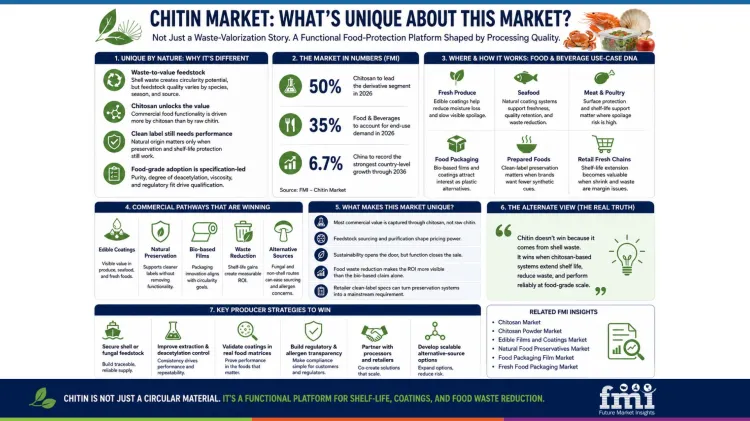
Clean label is reshaping Food & Beverage, but the Chitin Market shows why clean-label adoption is rarely about removing functionality. Food manufacturers still need preservation, coating performance, texture protection, microbial control, and shelf-life stability. Chitin and chitosan become relevant because they can help deliver these functions through a natural and bio-based platform.
The clean-label opportunity is mainly unlocked through chitosan. FMI identifies chitosan as the leading derivative with 50% share in 2026, which shows that chitin’s commercial value is often created through functional derivatives. The Chitosan Market is important because chitosan offers broader practical use than raw chitin, especially in natural preservation, antimicrobial systems, edible coatings, films, and packaging applications.
Food & Beverages constitutes 35% of end-use demand in the Chitin Market forecast by FMI. This shows that chitin systems cannot be solely limited to water purification, agricultural or health care purposes. The demand for chitin systems in the food & beverages sector comes from its need in spoilage prevention, reduced wastage, and preservation.
The premium opportunity begins with preservation. Consumers may not want artificial-sounding preservatives, but they still expect food to remain fresh, safe, and visually acceptable. This is where the Natural Food Preservatives Market helps support the broader clean-label substitution story. Food companies do not remove preservation needs; they look for preservation systems that fit cleaner labels and consumer expectations.
Chitosan-based coatings can support this transition. In fresh produce, seafood, meat, and minimally processed foods, coatings can help slow quality degradation, reduce moisture loss, and support shelf-life extension. The Edible Films and Coatings Market is a relevant adjacent market because edible coatings are increasingly discussed as tools for protecting food quality without relying only on conventional packaging or synthetic additives.
Post-harvest food protection is another practical route. The Food-Grade Post-Harvest Decay Control Coating Market connects directly with the use of coating systems to reduce spoilage in fruits, vegetables, and other fresh categories. Chitin-derived coatings can become valuable when they help extend selling windows and reduce waste.
Food packaging is also part of the clean-label value proposition. Chitin and chitosan-based films may support bio-based packaging strategies where conventional plastics face pressure. The Food Packaging Film Market is useful when discussing food-contact films, barrier performance, packaging sustainability, and shelf-life protection.
Clean-label premium is higher when there is a measureable impact created by it. In case a coating reduces the wastage in fruits and fish due to their increased lifespan, then the premium can be attributed to it and explained clearly. In case the use of the chitosan system reduces reliance on chemical preservatives without affecting the shelf life of the products, then the justification becomes much easier.
When it comes to performance, the value-added effect is diminished. While a natural coating might sound like an interesting idea, when it is unable to perform under actual distribution scenarios, its scaling up becomes unlikely. While a chitosan-based solution performs well in lab settings, when it starts affecting sensory, allergenic, viscosity, or regulatory parameters, there is going to be opposition from the market.
Source transparency is another factor to consider. Chitin sourced from crustaceans could present issues relating to allergies or positioning in certain uses. The use of fungal chitosan or other sources may prove appealing when brands wish to position themselves as being either animal-free or suitable for vegans or allergy sufferers.
The story about clean label must thus be told carefully. Chitin is more than a substitute for artificial preservatives. It is an innovative platform with functions such as preservation, coating, and packaging applications. The best manufacturers will assist clients in verifying its particular use, including antimicrobial properties, coating strength, film neutrality, extended shelf life, or packaging application.
The mistake to be avoided is believing that natural source equals added value. In Food & Beverage, added value is derived through performance. Consumers will pay for it where chitosan-based technologies help reduce waste and maintain product quality, keep labels clean, or achieve packaging objectives.
Bottom line: Chitin’s clean-label premium comes from functional preservation and coating value, not from sustainability messaging alone. The winners will be products that combine natural positioning with measurable shelf-life, safety, and packaging performance.

