


- Clean-label growth does not automatically reduce food additive use. It usually shifts demand from conventional additive systems toward natural, fermentation-derived, plant-based, or label-friendly alternatives.
- Food manufacturers rarely remove functionality. They replace one additive system with another to preserve shelf life, texture, color, taste, safety, and processing stability.
- The strongest clean-label premium sits in natural preservatives, natural colors, natural flavors, hydrocolloids, texturizers, functional starches, natural emulsifiers, and fermentation-based systems.
- The premium weakens when natural alternatives fail to match the performance, cost-in-use, shelf-life protection, or sensory consistency of established additives.
- Consumers may dislike certain additive names, but they still expect freshness, softness, color stability, creamy texture, taste consistency, and convenience.
- The biggest misconception is that clean label means additive-free. In practice, clean label often means additive substitution, not additive disappearance.
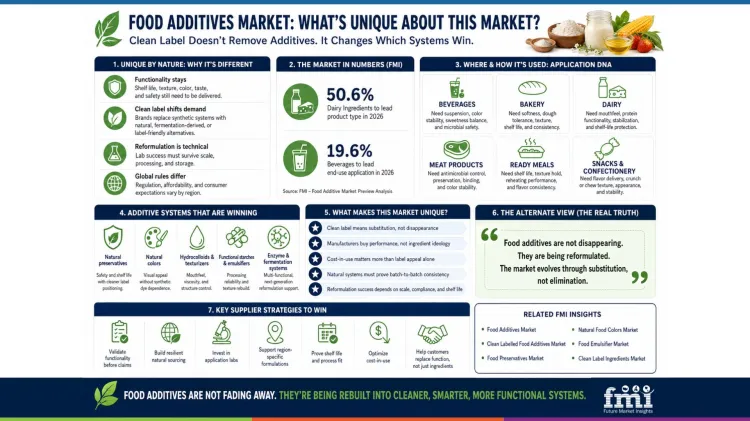
The clean label is the most misunderstood driving force in the food additive market. It’s a simple assumption that consumers don’t like additives, which means that there will be less and less use of additives in time. It might sound reasonable, but it overlooks some fundamental aspects of modern food manufacturing process. Food additives aren’t added simply to make the marketing more efficient or to make our lives easier.
In the case where a food company stops using an artificial preservative, there remains the need for microbial control. Where a bakery does away with artificial emulsifiers, there is still the need to achieve softness, dough tolerance, volume, and shelf life performance. In the situation where a drinks manufacturer eliminates artificial coloring, there is still the need for shade stability.
This is why FMI’s Food Additives Market is important for reading the clean-label shift correctly. The market is not simply about adding artificial ingredients into processed food. It includes functional compounds and ingredient systems used to support sensory quality, shelf stability, processing performance, and structural consistency across beverages, bakery, confectionery, dairy, snacks, sauces, soups, pasta, noodles, baby food, supplements, and other applications.
The clean label value proposition works best when consumers don’t make trade-offs between performance and the ability to switch to another ingredient that’s not favored by them. Preservatives based on clean labels would have an advantage as they would provide microbial stability without using any of the ingredients that sound artificial. Colorants based on the clean-label strategy would have an edge since they would offer visual stability without the use of any artificial colors. Hydrocolloids and texture enhancers would also find favor since they deliver sensory attributes while being positioned as clean-label ingredients.
FMI’s Clean Labelled Food Additives Market supports this logic because it covers natural flavors, natural colors, natural preservatives, natural sweeteners, hydrocolloids and texturizers, functional native starches, natural emulsifiers, and other clean-label additive systems. These are not examples of additive elimination. They are examples of additive replacement.
The preservative category shows the point clearly. FMI’s Food Preservatives Market identifies both clean-label preservatives and synthetic preservatives as relevant. This means the market is not moving in one straight line from synthetic to natural. It is balancing food safety, shelf-life protection, clean-label pressure, and cost. In high-risk applications such as bakery, meat, dairy, sauces, and ready meals, manufacturers cannot simply remove preservation systems and hope consumers accept shorter shelf life.
Natural color conversion follows the same pattern. FMI’s Natural Food Colors Market shows that food and beverage reformulation is pushing manufacturers toward plant and fermentation pigments. But color replacement is technically difficult. Natural colors can be sensitive to heat, pH, oxidation, light exposure, and ingredient interactions. A successful clean-label color system must protect the same visual cues consumers expect from beverages, confectionery, dairy, bakery, and snacks.
The premium, therefore, is pragmatic, rather than aesthetic. Consumers might prefer straightforward labeling; however, manufacturers are willing to pay a premium price only if the new system performs as required. The preservative that is natural and reduces shelf life would not be commercially viable. The coloring agent derived from plants and fades even before the product hits the shelves is risky for brands. The emulsifier that fails under high-speed manufacturing conditions could hamper productivity.
Cost-in-use represents the main limitation. Natural sources tend to be more expensive compared to traditional additives in situations where they need agricultural extraction, fermentation, or purification. It will be up to food producers to determine whether the premium will pay off due to higher product prices, retailer adoption, claims benefit, or reduced risk. Consumers may have different perspectives even when talking about mainstream categories.
Regional factors are also critical. The consumer vigilance and retailer standards of North America and Western Europe accelerate reformulation, but in other regions such as Asia-Pacific, Latin America, and the Middle East, the demand for affordability, logistics, and shelf life is greater. This means that even a globally operating food business would have to develop different formulations for different markets, with some requiring labeling-based and others cost-conscious approaches.
The best suppliers of clean-label additives will not position “natural” as a stand-alone benefit. They will show how stable, functional, shelf-stable, legally compliant, and processable their products are. They derive their value from enabling food producers to substitute a function without harming the product.
The misconception to avoid is that clean-label growth automatically means declining food additive demand. It does not. It changes which additive systems win.
Bottom line: The food additives market is not shrinking because consumers want cleaner labels. It is transforming because manufacturers must deliver the same food performance outcomes through ingredient systems that satisfy changing consumer, regulatory, and retailer expectations.

