


- Clean-label claims can support premium pricing in pet milk replacers, but only when the formula is trusted for digestibility, neonatal growth, and species-specific nutrition.
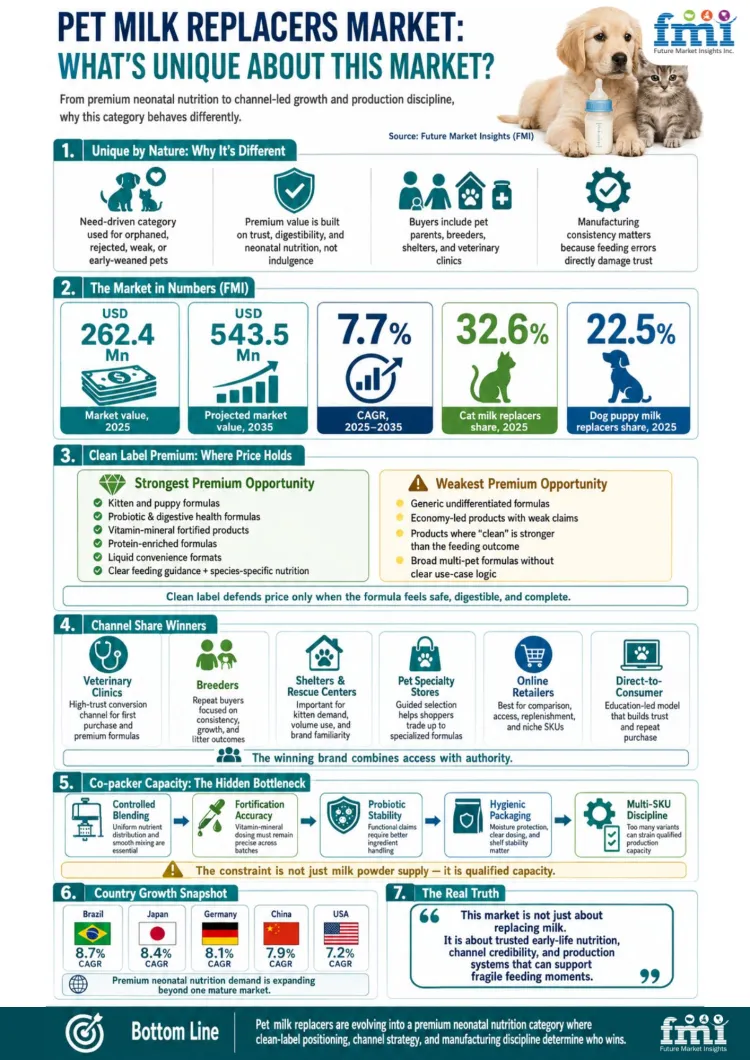
- FMI estimates the pet milk replacers market at USD 262.4 Mn in 2025, reaching USD 543.5 Mn by 2035 at a 7.7% CAGR.
- Cat milk replacers hold the strongest pet type position with 32.6% share in 2025, supported by kitten rescue, adoption, and early-life nutrition needs.
- Dog puppy milk replacers account for 22.5% share in 2025, driven by breeder, veterinary clinic, shelter, and pet parent demand for fortified neonatal formulas.
- Clean label helps brands defend premium pricing. It does not replace the need for easy digestion, complete nutrition, safe formulation, and clear feeding guidance.
Clean label is becoming a stronger premium lever in the pet milk replacers market, but it works differently from clean label in regular pet food, treats, or supplements. In this category, the buyer is not only looking for a better ingredient list. The buyer is often feeding a newborn, weak, orphaned, rejected, or early-weaned puppy or kitten. That makes trust, safety, digestibility, and nutritional completeness more important than lifestyle claims alone.
That distinction matters because pet milk replacers are not routine pantry products. They are need-based early-life nutrition products. A pet parent, breeder, shelter, or veterinary clinic does not pay more simply because the pack says “clean” or “natural.” They pay more when the product feels safer, easier to digest, more suitable for newborn pets, and more likely to support healthy growth during a sensitive stage.
FMI’s view of the pet milk replacers market supports this premiumization direction. The market is valued at USD 262.4 Mn in 2025 and is projected to reach USD 543.5 Mn by 2035, expanding at a 7.7% CAGR. This growth shows that the category is moving beyond emergency feeding into specialized neonatal pet nutrition. The premium opportunity is not only about selling more milk replacers. It is about repositioning the product as a trusted early-life care solution.
The clean-label premium is strongest where feeding risk is highest. Kittens and puppies are the clearest examples. FMI indicates that cat milk replacers account for 32.6% share of the pet type segment in 2025, while dog puppy milk replacers account for 22.5%. These two segments are highly sensitive to formulation quality because buyers associate the product with survival, growth, immunity, and digestive tolerance.
For cat milk replacers, the premium logic is especially strong. Kitten milk replacers are often used for rescued, abandoned, orphaned, or underweight kittens. These buyers are less likely to treat the purchase as a low-involvement decision. They want reassurance that the formula is gentle, nutritionally balanced, and suitable for fragile digestion. A clean-label proposition can work well when it is linked to kitten-specific growth support, easy mixing, vitamin-mineral fortification, and digestive health.
For dog puppy milk replacers, the premium opportunity is slightly different but equally important. Demand is linked to breeders, clinics, shelters, and pet owners caring for puppies that are rejected, weak, early-weaned, or require supplemental feeding. Here, the premium is connected with healthy weight gain, energy support, bone development, immune support, and feeding consistency. A cleaner formula can justify a higher price when it also communicates completeness and reliability.
FMI’s segmentation also explains why clean label should not be treated as one broad claim. The market is segmented by product type, pet type, form, nutritional content, distribution channel, and region. This means premiumization must be built around specific use cases. A kitten formula, puppy formula, senior pet formula, powdered product, liquid product, probiotic formula, and vitamin-mineral fortified formula should not all communicate the same clean-label message.
Nutritional content is central to the premium. FMI identifies protein-enriched formulas, fortified with vitamins and minerals formulas, and probiotic and digestive health formulas as key nutritional content segments. This shows that buyers are not only looking for a substitute for mother’s milk. They are looking for added functional support. Clean label becomes more valuable when it works together with functional nutrition.
The strongest clean-label claims in this market are not vague claims. They are practical claims. “Gentle digestion,” “fortified with vitamins and minerals,” “supports healthy growth,” “for orphaned or early-weaned pets,” “species-specific nutrition,” and “probiotic digestive support” are more meaningful than broad language such as “premium” or “natural.” In a neonatal feeding category, the buyer wants clarity, not decoration.
Form also affects willingness to pay. Powdered milk replacers are important because they offer shelf stability, flexible preparation, and better storage convenience. For powdered products, clean label should be linked with easy mixing, consistent feeding, safe storage, and economical usage. Liquid milk replacers can carry a different premium because they reduce preparation effort and support quick feeding. For liquid formats, the value proposition should focus on convenience, ready-to-feed support, and reduced preparation error.
The premium is strongest in specialized and functional formulas. Kitten-specific formulas, puppy-specific formulas, probiotic and digestive health formulas, protein-enriched products, and vitamin-mineral fortified products can support better price defense because the buyer sees a clear reason to pay more. The premium is weaker in broad, generic, or low-differentiation formulas where shoppers compare pack size and price more directly.
Distribution channel also shapes clean-label pricing power. FMI includes retail channels such as pet specialty stores, supermarkets, online retailers, veterinary clinics, and direct-to-consumer, along with B2B channels such as pet food manufacturers, private label producers, contract manufacturers, and bulk suppliers. Each channel needs a different clean-label message.
Veterinary clinics need credibility. Pet specialty stores need clear product differentiation. Online retailers need comparison-friendly claims and strong product education. Direct-to-consumer channels need trust-building content, feeding guidance, and repeat purchase logic. B2B buyers need formulation reliability, supply consistency, and scalable quality control. A single clean-label message will not work equally across all channels.
The clean-label premium is also likely to be stronger in countries where pet humanization, pet adoption, and premium pet care are expanding. FMI identifies Brazil as the fastest-growing country-level market with an 8.7% CAGR through 2035. Japan follows with 8.4%, Germany with 8.1%, China with 7.9%, and the USA with 7.2%. These growth rates suggest that premium neonatal nutrition is not limited to one market. It can expand wherever pet owners are becoming more willing to spend on early-life care.
However, the category also has a pricing limit. Clean label cannot compensate for poor product performance. If a formula causes feeding difficulty, poor mixing, weak digestion, unclear preparation, or low confidence, the buyer will not continue paying a premium. In pet milk replacers, repeat purchase and recommendation depend on outcome. The product must help the user feel that the newborn pet is feeding better, growing better, and tolerating the formula well.
This is why brands should avoid over-positioning clean label as a standalone benefit. A pet milk replacer is not purchased only because it is clean. It is purchased because it is trusted. Clean label is one layer of trust, but the full trust equation includes formulation quality, nutritional completeness, preparation ease, species suitability, digestive support, and professional credibility.
The most defensible clean-label premium sits in kitten milk replacers, puppy milk replacers, probiotic and digestive health formulas, vitamin-mineral fortified products, protein-enriched products, convenient liquid formats, and well-positioned powdered formulas with clear feeding guidance. The weakest premium sits in generic milk replacers, undifferentiated economy products, unclear multi-pet formulas, and products that use clean-label language without explaining neonatal benefits.
For brands, the practical lesson is clear. Clean label should be used to defend premium positioning, not to create it from nothing. A higher-priced pet milk replacer must make the buyer believe that the product is safer, more digestible, more complete, and more suitable for the pet’s life stage. The claim must reduce anxiety at the point of purchase.
The misconception to avoid is that pet parents will automatically pay more for cleaner claims. They will not. They will pay more when cleaner claims are connected to a real early-life nutrition outcome. In this market, clean label becomes powerful only when it supports the core promise: helping newborn pets survive, feed, grow, and develop with confidence.
Bottom line: consumers will pay more for clean-label pet milk replacers, but only when clean formulation is tied to digestibility, neonatal care, species-specific nutrition, and trusted growth support. In this market, premium does not mean indulgent. Premium means safe, functional, easy to feed, and suitable for the earliest stage of pet life.

