

- Market Size (2026)
- 640.7 Mn
- Forecast (2036)
- 2396.1 Mn
- CAGR (2026 to 2036)
- 14.1%
How big is PET Glycolysis Catalysts Market in 2026?
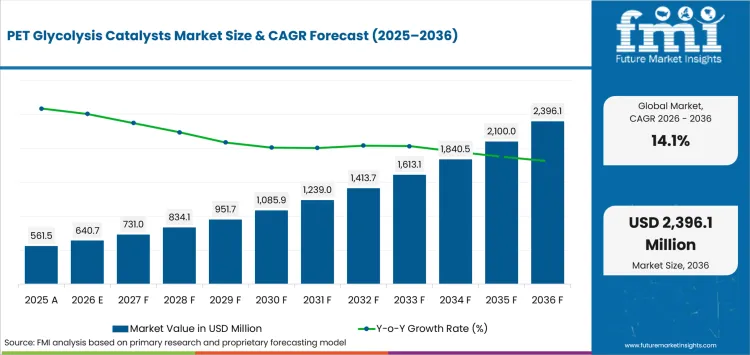
USD 640.7 million in 2026 and USD 2396.1 million by 2036 at a 14.1% CAGR.
Demand for pet glycolysis catalysts is projected to expand at 14.1% CAGR between 2026 and 2036, pushing the valuation from USD 640.7 million in 2026 and USD 2396.1 million by 2036 as recycled PET packaging requires more verified recycled content. Regulation (EU) 2025/40 sets a 30% recycled-content minimum for major contact-sensitive PET packaging by 2030. The rule strengthens the case for depolymerization routes that return purified BHET to PET packaging production.
Country conditions differ as collection quality determines which PET streams enter chemical recycling instead of established mechanical routes. France collected an estimated 58.2% of plastic beverage bottles in 2024, leaving a larger recovery gap than several high-collection European systems. Catalyst demand depends on whether PET bottles and recycled plastic packaging streams can justify the extra purification cost.
Key Takeaways of PET Glycolysis Catalysts Market
- Recycled-content rules increase demand for pet glycolysis catalysts by raising the value of purified monomers recovered from hard-to-recycle polyester feedstocks.
- By catalyst chemistry, metal acetates are estimated to hold 32.0% in 2026 owing to familiar transesterification kinetics that reduce formulation risk during plant qualification.
- In 2026, batch glycolysis is expected to lead process type with 39.0% share because campaign flexibility lets plants adjust catalyst conditions across variable PET feedstocks.
- The bottle flakes segment is likely to capture 46.0% share in 2026 attributable to consistent particle geometry that improves heat transfer and catalyst contact.
- Purification cost and mechanical-recycling competition delay catalyst adoption for clean PET streams that already have efficient material-recycling outlets.
- Axens, JEPLAN, Inc., Saipem S.p.A., Garbo S.r.l., Reju, Ioniqa Technologies B.V., Koch Technology Solutions and VTA Verfahrenstechnische Anlagen GmbH & Co. KG are active across glycolysis, purification and scale-up roles.
Analyst Perspective
"PET glycolysis catalyst offers should be compared on purified BHET yield, stable residence time and cleanup burden at target plant throughput. A lower catalyst price matters less if residual metals or feedstock impurities raise separation cost before repolymerization."
- Nikhil Kaitwade, Principal Consultant, Future Market Insights
How is the PET Glycolysis Catalysts Market segmented?
Market segmentation covers catalyst chemistry, process type, PET feedstock, application, end use, sales model and region.
Catalyst chemistry: metal acetates, ionic liquid catalysts, organocatalysts, heterogeneous catalysts, enzyme-assisted catalysts. Process type: batch glycolysis, continuous glycolysis, microwave/assisted glycolysis, hybrid depolymerization. PET feedstock: bottle flakes, textile polyester waste, film/sheet scrap, mixed PET waste. Application: BHET/oligomer production, unsaturated polyester resins, polyol production, recycled PET intermediates. End use: chemical recycling plants, resin producers, packaging recyclers, textile recyclers, pilot/R&D facilities. Sales model: catalyst supply, process package, toll/licensing support.
What supports BHET or oligomer production in the application category?
BHET quality ties catalyst performance directly to repolymerization because residual color and catalyst species can disrupt recycled thermoplastics processing. Separation performance therefore becomes part of catalyst qualification instead of a separate downstream commercial decision.
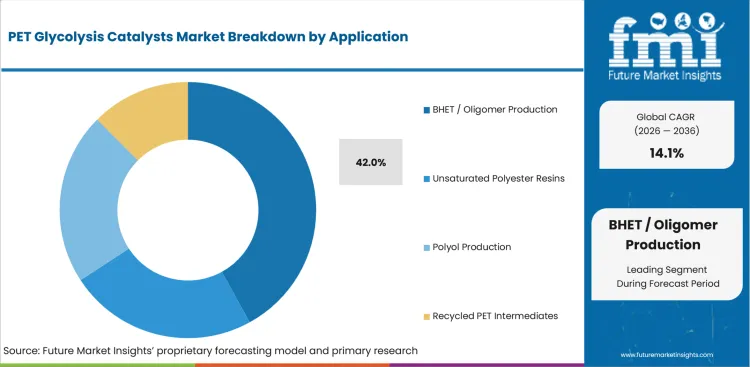
- By application, BHET or oligomer production is forecast to represent 42.0% in 2026 driven by direct reuse of glycolysis intermediates in polyester synthesis.
- Commercial BHET routes require separation systems that recover monomer and ethylene glycol without transferring excessive cost downstream. In February 2025, VTA documented continuous vacuum distillation that obtains purified BHET and recovered ethylene glycol from PET recycling streams.
What makes metal acetates central to the catalyst chemistry category?
Metal acetates give process engineers a familiar transesterification route for PET reacting with ethylene glycol, so catalyst loading can be qualified against established operating chemistry. In June 2025, JEPLAN and TAIYO YUDEN confirmed that chemical recycling removed PET-film impurities and yielded high-purity BHET for reuse.
- By catalyst chemistry, metal acetates are estimated to hold 32.0% share in 2026 owing to established kinetics and accessible operating knowledge.
- Commercial use depends on residual-metal control during repolymerization because faster conversion adds little value if downstream BHET purification becomes more demanding.
Why does batch glycolysis lead the process type category?
Batch reactors let plant teams adjust catalyst loading and residence time between feedstock campaigns without redesigning the surrounding chemical recycling services package. Continuous routes become more attractive once feed composition and purification behavior remain stable during sustained operation.
- Batch glycolysis is set to lead the process type category with 39.0% share in 2026 due to controllable campaign changes during catalyst qualification.
- Continuous systems need stable feed composition and purification for higher throughput to become a commercial advantage. In April 2026, Axens joined IFPEN and JEPLAN in validating Rewind PET at a 1,000-tonne-per-year Japanese demonstration unit.
How do bottle flakes anchor the PET feedstock category?
Bottle flakes give process engineers a consistent chemical recycling feedstock for stabilizing heat transfer and catalyst contact across qualified lots. In February 2026, PET REFINE TECHNOLOGY signed a Bibai City agreement with Asahi Soft Drinks and Japan Tech to expand bottle-to-bottle recycling.
- In 2026, bottle flakes are expected to lead PET feedstock with 46.0% share because sorting and size reduction narrow reaction variability.
- Glycolysis becomes more attractive for colored or off-spec flakes with weak mechanical outlets as clean transparent bottles often retain established recycling value without depolymerization.
What are the drivers, restraints and opportunities in the PET Glycolysis Catalysts Market?
Recycled-content requirements raise demand for molecular PET recovery as purification economics limit adoption and integrated cleanup broadens the usable feedstock range.
- Driver: Recycled-content obligations raise the value of purified PET monomers from feedstocks that mechanical recycling cannot return to required product quality.
- Restraint: Established mechanical outlets and added BHET polishing costs weaken the economic benefit of faster catalyst-assisted depolymerization.
- Opportunity: Catalyst systems paired with reliable impurity removal can qualify difficult PET feedstocks for reusable monomer production and larger process packages.
Recycled-Content Rules Raise the Value of Molecular Recovery
Recycled-content rules raise the commercial value of PET recovery routes that return purified material to sustainable plastic packaging applications. In June 2026, the European Commission established calculation and verification rules for recycled plastic content in single-use beverage bottles. The rules give project developers a clearer basis for valuing molecular routes that recover usable PET intermediates from difficult feedstocks.
Mechanical Recycling and Purification Costs Limit the Addressable Feedstock
Clean PET competes directly with glycolysis as established bottle collection preserves feedstock value for mechanical routes. In April 2026, the European Commission reported that Germany had already exceeded the 90% single-use beverage-bottle collection target using 2022 data. Catalyst formulators must justify purification expense on polyester fiber streams that established collection systems do not return efficiently to material recycling.
Integrated Purification Offers a Feedstock-Expansion Route
Feedstock expansion requires catalyst systems that maintain conversion as purification removes pigments, metals and other contaminants from recovered intermediates. In December 2025, JEPLAN and Asahi Soft Drinks reported recycled PET resin production using only used PET bottles as feedstock. Formulators that qualify reaction control and cleanup together can compete for larger process packages.
Which country CAGRs are profiled in the PET Glycolysis Catalysts Market?
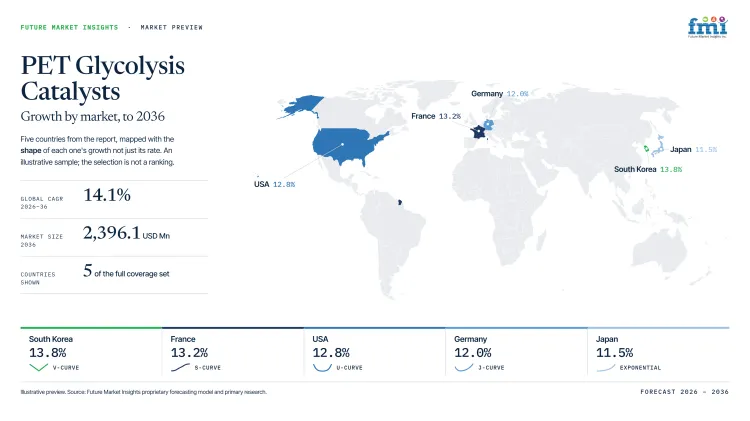
| Country | CAGR |
|---|---|
| South Korea | 13.8% |
| France | 13.2% |
| USA | 12.8% |
| Germany | 12.0% |
| Japan | 11.5% |
How do country-level CAGRs compare in the PET Glycolysis Catalysts Market?
The forecasts span 2.3 percentage points and form one compact growth band with two distinct commercial groups. South Korea and France face stronger recycled-content or monomer-recovery triggers. The USA, Germany and Japan remain slightly lower because project approval depends more heavily on feedstock contracts, mature mechanical recycling or long demonstration records.
- South Korea ties catalyst qualification to a national clear-PET recycled-resin mandate.
- France links planned rBHET capacity with difficult textile-feedstock recovery.
- USA projects require contracted feedstock and credible regenerated-polyester outlets.
- Germany makes glycolysis compete against mature bottle-recycling infrastructure.
- Japan places greater weight on demonstration history and monomer quality.
Similar growth rates therefore produce different qualification costs and purchase timing. The full report provides country-level CAGR analysis across North America, Latin America, Europe, East Asia, South Asia, Oceania and the Middle East and Africa.
Country-wise Analysis
- South Korean beverage producers now have a defined recycled-resin route that ties clear-PET bottle volumes to certified circular feedstock under national resource-recycling rules for domestic beverage and bottle supply chains and food-contact packaging programs. The environment ministry confirmed in September 2025 that beverage companies using at least 5,000 tonnes of clear PET bottles each year enter the mandate and must use 10% recycled material from January 2026. Adoption of pet glycolysis catalysts in South Korea is estimated to expand at 13.8% CAGR through 2036, supported by a bottle-resin outlet although food-contact approval and stable resin quality still limit repeat catalyst orders.
- French polyester recyclers can place chemical recovery beside established petrochemical assets that give difficult textile feedstocks a local monomer outlet and service base across the Lacq industrial cluster for local polyester production and downstream polymer qualification. Reju selected Lacq in February 2026 for a planned industrial hub converting post-consumer textiles into rBHET on the Induslacq platform, but final investment approval remains pending before construction can support recurring local catalyst orders. Pet glycolysis catalyst demand in France is forecast to rise at 13.2% CAGR over the forecast period owing to local chemical-processing skills despite variable textile contamination and demanding impurity controls.
- United States project developers test molecular recycling against feedstock contracts and credible regenerated-polyester outlets as dispersed textile and packaging streams can weaken utilization at large facilities and raise regional collection costs across states. Reju selected an 18.9-acre Rochester site in January 2026 for a planned rBHET hub at Eastman Business Park inside established chemical infrastructure, with construction still subject to final investment approval. By 2036, the USA is projected to grow at 12.8% CAGR supported by established chemical infrastructure as purification economics and capital approval remain the main barriers to sustained catalyst orders and technical-service commitments across planned commercial facilities.
- German recyclers operate within a mature mechanical-recovery system that preserves value from clean packaging and raises the economic threshold for chemical depolymerization across domestic bottle-return networks and commercial qualification programs for glycolysis. Germany's environment agency reported in January 2026 that more than 70% of plastic packaging entered material recycling during 2024, confirming the strength of established recovery routes for clean packaging streams and bottle feedstock. Germany is estimated to post 12.0% CAGR over the forecast period influenced by opportunities in colored PET and polyester textiles, yet deeper purification must beat existing recovery economics for clean bottle feedstock at commercial scale.
- Japanese PET operators place strong weight on demonstration history and coordinated industrial partnerships before approving changes to established polyester production and bottle-recycling systems, especially where BHET quality and catalyst management require extended validation. Pet glycolysis catalyst sales in Japan are forecast to expand at 11.5% CAGR by 2036 supported by engineering experience around BHET purification, commercial chemical-recycling operations and coordinated beverage demand for local polymer production and bottle applications. JEPLAN signed a March 2026 memorandum with Sumitomo Mitsui Financial Group and Asahi Soft Drinks to expand chemical-recycling cooperation, yet long proof cycles continue to slow purchasing and larger licensing decisions.
Who are the notable companies in the PET Glycolysis Catalysts Market?
Axens, JEPLAN, Inc., Saipem S.p.A., Garbo S.r.l., Reju, Ioniqa Technologies B.V., Koch Technology Solutions and VTA Verfahrenstechnische Anlagen GmbH & Co. KG are the notable companies serving this market.
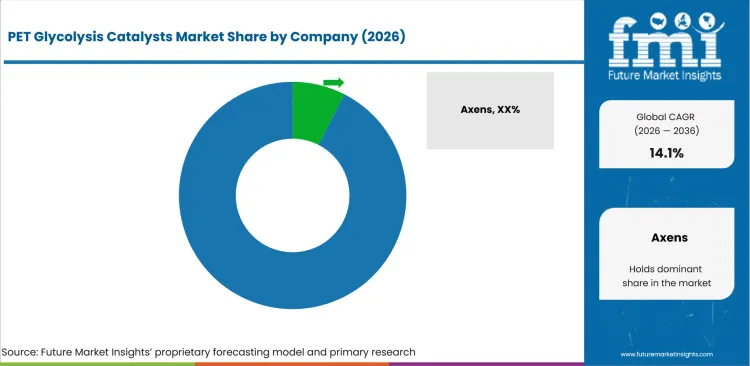
Competition remains fragmented across glycolysis licensors, polyester-regeneration platforms and BHET purification specialists with different revenue models. Plant operators compare feedstock tolerance, monomer purity and scale-up support during capital approval.
- Axens and JEPLAN, Inc. combine Rewind PET glycolysis with BHET purification and licensing around demonstrated operating units.
- Saipem S.p.A. and Garbo S.r.l. commercialize ChemPET glycolysis, and Reju develops polyester regeneration as Ioniqa Technologies B.V. prepares PET upcycling technology for licensing.
- Koch Technology Solutions contributes partial-glycolysis rPET technology and polyester scale-up expertise while VTA Verfahrenstechnische Anlagen GmbH & Co. KG concentrates on BHET and ethylene-glycol purification.
Competitive Benchmarking: PET Glycolysis Catalysts Market
| Company | Direct PET Glycolysis Relevance | BHET / Purification Integration | Licensing / Scale-up Support | Geographic Reach |
|---|---|---|---|---|
| Axens | High | High | High | Global |
| JEPLAN, Inc. | High | High | High | Japan and global licensing |
| Saipem S.p.A. | High | Medium | High | Europe and global licensing |
| Garbo S.r.l. | High | Medium | High | Italy and international licensing |
| Reju | Medium | Medium | Medium | Europe and United States |
| Ioniqa Technologies B.V. | Medium | High | Medium | Netherlands and international licensing |
| Koch Technology Solutions | High | Low | High | Global |
| VTA Verfahrenstechnische Anlagen GmbH & Co. KG | Low | High | Medium | Germany and international equipment sales |
Key Developments in the PET Glycolysis Catalysts Market
- In April 2026, Reju advanced its planned Chemelot regeneration hub as Dutch NIKI support moved the textile-recycling project toward final investment decision.
- In November 2025, Saipem S.p.A. and Garbo S.r.l. advanced ReNova ChemPET following European Commission selection for a planned Cerano industrial PET chemical-recycling plant using their glycolysis technology.
- In October 2025, JEPLAN, Inc. reported a Suita City agreement combining chemical and mechanical bottle-to-bottle recycling with Asahi Soft Drinks and Far East Ishizuka Green PET.
Key Players in the PET Glycolysis Catalysts Market
Direct Glycolysis and Licensing Platforms
- Axens
- JEPLAN, Inc.
- Saipem S.p.A.
- Garbo S.r.l.
Polyester Regeneration and Scale-up Platforms
- Reju
- Ioniqa Technologies B.V.
- Koch Technology Solutions
BHET Purification Equipment
- VTA Verfahrenstechnische Anlagen GmbH & Co. KG
PET Glycolysis Catalysts Market - Report Scope
| Coverage field | Report scope |
|---|---|
| Market breakdown | By catalyst chemistry, process type, PET feedstock, application, end use, sales model and region. |
| Quantitative Units | Revenue in USD million and CAGR in %. |
| Market Definition | Catalysts and catalyst-enabled process support used to depolymerize PET with ethylene glycol into BHET or lower oligomers for subsequent purification and reuse. |
| Regions Covered | North America, Latin America, Europe, East Asia, South Asia and Pacific and Middle East and Africa. |
| Countries Covered | South Korea, France, USA, Germany, Japan, and 20+ countries included in the full report. |
| Key Companies Profiled | Axens, JEPLAN, Inc., Saipem S.p.A., Garbo S.r.l., Reju, Ioniqa Technologies B.V., Koch Technology Solutions, VTA Verfahrenstechnische Anlagen GmbH & Co. KG. |
| Forecast Period | 2026 to 2036. |
| Approach | Primary and secondary research with market triangulation. |
PET Glycolysis Catalysts Market - Research Methodology
| Method | Approach |
|---|---|
| Primary Research | FMI analysts gathered input from manufacturers, service providers, technology developers, distributors, end users, procurement teams, and subject-matter experts. Interviews examined purchasing decisions, product or service evaluation, adoption barriers, approval requirements, pricing considerations, and expectations for technical or commercial support. Respondents were also asked what evidence is required before a trial, pilot, or initial order develops into regular purchasing. |
| Desk Research | Desk research covered government statistics, regulatory publications, trade data, industry associations, technical literature, standards, company filings, product information, and official corporate announcements. Sources were reviewed for relevance, publication date, geographic coverage, and consistency with the defined market scope. Claims relating to performance, applications, approvals, capacity, investment, and commercial activity were retained only when supported by credible public evidence. |
| Market Sizing and Forecasting | The market model combined the baseline value with historical performance, segment structure, pricing and volume indicators, adoption levels, company participation, and country-level demand conditions. Forecast assumptions considered economic activity, investment trends, regulatory developments, technology adoption, purchasing cycles, supply availability, and barriers to wider market use. Segment and regional estimates were reconciled before the final market total was calculated. |
| Data Validation | Estimates were checked against multiple independent indicators, including public data, company activity, trade patterns, industry developments, and findings from primary interviews. Validation also tested whether products, services, applications, and company revenues fell within the defined market boundaries. Adjacent categories, unsupported claims, overlapping revenues, and activities without direct market relevance were excluded to reduce double counting and maintain consistency across segments and countries. |
PET Glycolysis Catalysts Market by Segments
PET Glycolysis Catalysts Market segmented by Catalyst Chemistry:
- Metal Acetates
- Ionic Liquid Catalysts
- Organocatalysts
- Heterogeneous Catalysts
- Enzyme-assisted Catalysts
PET Glycolysis Catalysts Market segmented by Process Type:
- Batch Glycolysis
- Continuous Glycolysis
- Microwave / Assisted Glycolysis
- Hybrid Depolymerization
PET Glycolysis Catalysts Market segmented by PET Feedstock:
- Bottle Flakes
- Textile Polyester Waste
- Film / Sheet Scrap
- Mixed PET Waste
PET Glycolysis Catalysts Market segmented by Application:
- BHET / Oligomer Production
- Unsaturated Polyester Resins
- Polyol Production
- Recycled PET Intermediates
PET Glycolysis Catalysts Market segmented by End Use:
- Chemical Recycling Plants
- Resin Producers
- Packaging Recyclers
- Textile Recyclers
- Pilot / R&D Facilities
PET Glycolysis Catalysts Market segmented by Sales Model:
- Catalyst Supply
- Process Package
- Toll / Licensing Support
PET Glycolysis Catalysts Market by Region:
- North America
- United States
- Canada
- Latin America
- Brazil
- Mexico
- Chile
- Rest of Latin America
- Western Europe
- Germany
- United Kingdom
- Italy
- Spain
- France
- Nordics
- Benelux
- Rest of Western Europe
- Eastern Europe
- Russia
- Poland
- Hungary
- Balkan and Baltic States
- Rest of Eastern Europe
- East Asia
- China
- Japan
- South Korea
- South Asia and Pacific
- India
- ASEAN
- Australia and New Zealand
- Rest of South Asia and Pacific
- Middle East and Africa
- Kingdom of Saudi Arabia
- Other GCC Countries
- Türkiye
- South Africa
- Other African Union Countries
- Rest of Middle East and Africa
Research Sources and Bibliography
- European Parliament and Council of the European Union. (2025, January 22). Regulation (EU) 2025/40 of the European Parliament and of the Council of 19 December 2024 on packaging and packaging waste, amending Regulation (EU) 2019/1020 and Directive (EU) 2019/904, and repealing Directive 94/62/EC (Text with EEA relevance).
- Ministères Transition écologique, Aménagement du Territoire, Transports, Ville et Logement. (2026, June 30). Plan plastique : Mathieu Lefèvre poursuivra la mise en œuvre du plan malgré la stratégie de la chaise vide des associations de collectivités.
- JEPLAN, INC. (2025, June 12). JEPLAN /TAIYO YUDEN: Recycling PET raw material (BHET) through chemical recycling of PET films in multilayer ceramic capacitors.
- JEPLAN, INC. (2026, April 22). A new textile-to-textile recycling process validated on an industrial scale.
- JEPLAN, INC. (2026, March 9). JEPLAN Group’s PET REFINE TECHNOLOGY Signs Agreement with Bibai City, Asahi Soft Drinks, and Japan Tech on the Implementation of Horizontal Recycling of PET Bottles.
- VTA Verfahrenstechnische Anlagen GmbH & Co. KG. (2025, February 14). New Case Study: PET Recycling.
- European Commission, Directorate-General for Environment. (2026, June 30). Implementing Decision on the calculation, verification and reporting of data on recycled plastic content in single-use plastic beverage bottles.
- European Commission, Directorate-General for Environment. (2026, April 16). Single-use plastics: Ten countries ahead of schedule on collection targets.
- JEPLAN, INC. (2025, December 17). JEPLAN Group and Asahi Soft Drinks to Produce Recycled PET Resin from 100% Used PET Bottles Manufactured by Chemical Recycling.
- Ministry of Environment, Republic of Korea. (2025, September 16). 2026년 1월부터 무색페트병에 재생원료 의무적으로 사용.
- Reju. (2026, February 12). Reju Announces Site Selection for French Regeneration Hub in Lacq Advancing Europe’s Circular Textile Infrastructure.
- Reju. (2026, January 20). Reju Announces Site Selection for First USA Industrial Sized Facility Regeneration Hub in Rochester, New York.
- German Environment Agency. (2026, January 27). Facts against myths: Packaging waste recycling in Germany is working.
- JEPLAN, INC. (2026, March 27). JEPLAN, Sumitomo Mitsui Financial Group, and Asahi Soft Drinks Announce Memorandum of Understanding to Promote Chemical Recycling.
- Saipem S.p.A. (Retrieved August 11, 2026). Biodiversity and pollution prevention.
- Reju. (2026, June 18). Reju joins Recycling Europe’s Textiles branch.
- Ioniqa Technologies B.V. (2025, July 1). Senior Process Engineer - PET Upcycling Technology.
- Koch Technology Solutions. (2025, September 2). PolyReVolve™: Beyond Mechanical - A Scalable Path to 100% rPET Integration.
- Technip Energies. (2026, April 1). Reju secures €135 Million in Dutch NIKI Funding for Industrial-Scale Textile-to-textile Regeneration Hub at Chemelot Industrial Park, the Netherlands.
- Saipem S.p.A. (2025, November 18). Saipem and Garbo’s PET Chemical Recycling Project selected to receive approximately 15.5 million euro in EU Innovation Fund Financing.
- JEPLAN, INC. (2025, October 20). JEPLAN Group: PET REFINE TECHNOLOGY signs “Agreement on Bottle to Bottle (Horizontal Recycling) Promotion Project” with Suita City, Osaka Prefecture, Asahi Soft Drinks, and Far East Ishizuka Green PET.
- Garbo S.r.l. (2026, May 19). Garbo expands storage capacity at its Cerano industrial hub.
- JEPLAN, INC. (2026, April 2). Syre and JEPLAN Announce Strategic Partnership to Accelerate Textile-to-Textile Recycling.
- Reju. (2025, April 29). Reju Announces Strategic Partnerships with Utexa in Central America and Antex in Europe, Leading Manufacturers of Filament Yarns, to Use REJU Polyester™.
- Axens. (2025, March 3). Axens and SOREMA sign partnership for providing advanced plastic recycling integrated solutions.
- JEPLAN, INC. (Retrieved August 11, 2026). PET REFINE TECHNOLOGY.
- Saipem S.p.A. (Retrieved August 11, 2026). ChemPET, next generation of PET recycling.
- Ioniqa Technologies B.V. (Retrieved August 11, 2026). Projects.
- Ioniqa Technologies B.V. (Retrieved August 11, 2026). Partnerships.
- Koch Technology Solutions. (Retrieved August 11, 2026). PET.
This bibliography is provided for reader reference and is not exhaustive. The full report contains the complete reference list and detailed citations
This Report Answers
- How large is the pet glycolysis catalysts market in 2026 and 2036?
- Which recycled-content requirements strengthen the commercial case for PET molecular recycling?
- Why do metal acetates account for 32.0% of catalyst chemistry demand in 2026?
- How does batch operation change catalyst qualification and scale-up decisions?
- Why do bottle flakes account for 46.0% of PET feedstock demand in 2026?
- How do country growth rates differ across the five profiled pet glycolysis catalysts markets?
- Which companies combine direct glycolysis, BHET purification and industrial scale-up support?
- What limits wider adoption when mechanical recycling already retains clean PET value?
Frequently Asked Questions
How big is the PET Glycolysis Catalysts Market in 2026?
The pet glycolysis catalysts market is expected to be valued at USD 640.7 million in 2026. Recycled-content requirements raise demand for catalyst systems that produce repeatable purified BHET from difficult PET feedstocks.
What is the CAGR of the PET Glycolysis Catalysts Market from 2026 to 2036?
The pet glycolysis catalysts market is projected to expand at 14.1% CAGR from 2026 to 2036. Chemical-recycling projects need purified intermediates from difficult polyester waste before renewed polymer production can scale.
Which catalyst chemistry segment is projected to account for 32.0% of the PET Glycolysis Catalysts Market?
The pet glycolysis catalysts market is estimated to derive 32.0% share in 2026. Established transesterification kinetics reduce formulation risk although commercial qualification still requires careful residual-metal control.
Which process type segment has the largest 2026 share in the PET Glycolysis Catalysts Market?
The pet glycolysis catalysts market is projected to derive 39.0% of demand from batch glycolysis in 2026. Adjustable catalyst loading and residence time help plants manage feedstock variability during early commercial qualification programs.
Which companies are active in the PET Glycolysis Catalysts Market?
The pet glycolysis catalysts market includes Axens, JEPLAN, Inc., Saipem S.p.A., Garbo S.r.l., Reju, Ioniqa Technologies B.V., Koch Technology Solutions and VTA Verfahrenstechnische Anlagen GmbH & Co. KG. Their roles cover glycolysis, BHET purification, technology licensing and industrial scale-up for commercial recycling plants.
Preview the report firsthand - request a free sample
Get SampleGet the brochure for pricing and purchase details.
Get PDFTable of Content
- Key Takeaways
- Market Size and CAGR
- Top Growth Driver
- Fastest Growing Segment
- Leading Region
- Key Companies
- Emerging Opportunities
- Executive Summary
- Global Market Outlook
- Demand-side Trends
- Supply-side Trends
- Technology Roadmap Analysis
- Analysis and Recommendations
- Analyst Perspective (What is happening? Why now? What should investors know?)
- Key Questions Answered
- How large is the market?
- What is the CAGR?
- What are key trends?
- Which region dominates?
- Who are the leaders?
- Market Overview
- Market Coverage / Taxonomy
- Market Definition / Scope / Limitations
- Research Methodology
- Chapter Orientation
- Analytical Lens and Working Hypotheses
- Market Structure, Signals, and Trend Drivers
- Benchmarking and Cross-market Comparability
- Market Sizing, Forecasting, and Opportunity Mapping
- Research Design and Evidence Framework
- Desk Research Programme (Secondary Evidence)
- Expert Input and Fieldwork (Primary Evidence)
- Tooling, Models, and Reference Databases
- Data Engineering and Model Build
- Quality Assurance and Audit Trail
- Market Background
- Market Dynamics (Drivers, Restraints, Opportunity, Trends)
- Scenario Forecast (Optimistic, Likely, Conservative)
- Impact Analysis
- AI Impact
- Sustainability Impact
- Regulatory Impact
- Technology Impact
- Consumer / Buyer Analysis
- Purchase Drivers
- Adoption Barriers
- Buyer Journey
- Opportunity Map Analysis
- Product Life Cycle Analysis
- Supply Chain Analysis
- Investment Feasibility Matrix
- Value Chain Analysis
- PESTLE and Porter's Analysis
- Regulatory Landscape
- Regional Parent Market Outlook
- Production and Consumption Statistics
- Import and Export Statistics
- Global Market Analysis and Forecast, 2021 to 2036
- Historical Market Size Value (USD Million) Analysis, 2021 to 2025
- Current and Future Market Size Value (USD Million) Projections, 2026 to 2036
- Y-o-Y Growth Trend Analysis
- Absolute $ Opportunity Analysis
- Global Market Pricing Analysis, 2021 to 2036
- Global Market Analysis and Forecast, By Catalyst Chemistry, 2021 to 2036
- Introduction / Key Findings
- Historical Market Size Value (USD Million) Analysis By Catalyst Chemistry, 2021 to 2025
- Current and Future Market Size Value (USD Million) Analysis and Forecast By Catalyst Chemistry, 2026 to 2036
- Metal Acetates
- Ionic Liquid Catalysts
- Organocatalysts
- Heterogeneous Catalysts
- Enzyme-Assisted Catalysts
- Metal Acetates
- Y-o-Y Growth Trend Analysis By Catalyst Chemistry, 2021 to 2025
- Absolute $ Opportunity Analysis By Catalyst Chemistry, 2026 to 2036
- Global Market Analysis and Forecast, By Process Type, 2021 to 2036
- Introduction / Key Findings
- Historical Market Size Value (USD Million) Analysis By Process Type, 2021 to 2025
- Current and Future Market Size Value (USD Million) Analysis and Forecast By Process Type, 2026 to 2036
- Batch Glycolysis
- Continuous Glycolysis
- Microwave / Assisted Glycolysis
- Hybrid Depolymerization
- Batch Glycolysis
- Y-o-Y Growth Trend Analysis By Process Type, 2021 to 2025
- Absolute $ Opportunity Analysis By Process Type, 2026 to 2036
- Global Market Analysis and Forecast, By PET Feedstock, 2021 to 2036
- Introduction / Key Findings
- Historical Market Size Value (USD Million) Analysis By PET Feedstock, 2021 to 2025
- Current and Future Market Size Value (USD Million) Analysis and Forecast By PET Feedstock, 2026 to 2036
- Bottle Flakes
- Textile Polyester Waste
- Film / Sheet Scrap
- Mixed PET Waste
- Bottle Flakes
- Y-o-Y Growth Trend Analysis By PET Feedstock, 2021 to 2025
- Absolute $ Opportunity Analysis By PET Feedstock, 2026 to 2036
- Global Market Analysis and Forecast, By Application, 2021 to 2036
- Introduction / Key Findings
- Historical Market Size Value (USD Million) Analysis By Application, 2021 to 2025
- Current and Future Market Size Value (USD Million) Analysis and Forecast By Application, 2026 to 2036
- BHET / Oligomer Production
- Unsaturated Polyester Resins
- Polyol Production
- Recycled PET Intermediates
- BHET / Oligomer Production
- Y-o-Y Growth Trend Analysis By Application, 2021 to 2025
- Absolute $ Opportunity Analysis By Application, 2026 to 2036
- Global Market Analysis and Forecast, By End Use, 2021 to 2036
- Introduction / Key Findings
- Historical Market Size Value (USD Million) Analysis By End Use, 2021 to 2025
- Current and Future Market Size Value (USD Million) Analysis and Forecast By End Use, 2026 to 2036
- Chemical Recycling Plants
- Resin Producers
- Packaging Recyclers
- Textile Recyclers
- Pilot / R&D Facilities
- Chemical Recycling Plants
- Y-o-Y Growth Trend Analysis By End Use, 2021 to 2025
- Absolute $ Opportunity Analysis By End Use, 2026 to 2036
- Global Market Analysis and Forecast, By Sales Model
- Introduction / Key Findings
- Historical Market Size Value (USD Million) Analysis By Sales Model, 2021 to 2025
- Current and Future Market Size Value (USD Million) Analysis and Forecast By Sales Model, 2026 to 2036
- Catalyst Supply
- Process Package
- Toll / Licensing Support
- Catalyst Supply
- Y-o-Y Growth Trend Analysis By Sales Model, 2021 to 2025
- Absolute $ Opportunity Analysis By Sales Model, 2026 to 2036
- Global Market Analysis and Forecast, By Region, 2021 to 2036
- Introduction
- Historical Market Size Value (USD Million) Analysis By Region, 2021 to 2025
- Current Market Size Value (USD Million) Analysis and Forecast By Region, 2026 to 2036
- North America
- Latin America
- Western Europe
- Eastern Europe
- East Asia
- South Asia and Pacific
- Middle East & Africa
- Market Attractiveness Analysis By Region
- North America Market Analysis and Forecast, By Country, 2021 to 2036
- Historical Market Size Value (USD Million) Trend Analysis By Market Taxonomy, 2021 to 2025
- Market Size Value (USD Million) Forecast By Market Taxonomy, 2026 to 2036
- By Country
- USA
- Canada
- By Catalyst Chemistry
- By Process Type
- By PET Feedstock
- By Application
- By End Use
- By Sales Model
- By Country
- Market Attractiveness Analysis
- By Country
- By Catalyst Chemistry
- By Process Type
- By PET Feedstock
- By Application
- By End Use
- By Sales Model
- Key Takeaways
- Latin America Market Analysis and Forecast, By Country
- Historical Market Size Value (USD Million) Trend Analysis By Market Taxonomy, 2021 to 2025
- Market Size Value (USD Million) Forecast By Market Taxonomy, 2026 to 2036
- By Country
- Brazil
- Mexico
- Chile
- Rest of Latin America
- By Catalyst Chemistry
- By Process Type
- By PET Feedstock
- By Application
- By End Use
- By Sales Model
- By Country
- Market Attractiveness Analysis
- By Country
- By Catalyst Chemistry
- By Process Type
- By PET Feedstock
- By Application
- By End Use
- By Sales Model
- Key Takeaways
- Western Europe Market Analysis and Forecast, By Country
- Historical Market Size Value (USD Million) Trend Analysis By Market Taxonomy, 2021 to 2025
- Market Size Value (USD Million) Forecast By Market Taxonomy, 2026 to 2036
- By Country
- Germany
- UK
- Italy
- Spain
- France
- Nordic
- BENELUX
- Rest of Western Europe
- By Catalyst Chemistry
- By Process Type
- By PET Feedstock
- By Application
- By End Use
- By Sales Model
- By Country
- Market Attractiveness Analysis
- By Country
- By Catalyst Chemistry
- By Process Type
- By PET Feedstock
- By Application
- By End Use
- By Sales Model
- Key Takeaways
- Eastern Europe Market Analysis and Forecast, By Country
- Historical Market Size Value (USD Million) Trend Analysis By Market Taxonomy, 2021 to 2025
- Market Size Value (USD Million) Forecast By Market Taxonomy, 2026 to 2036
- By Country
- Russia
- Poland
- Hungary
- Balkan & Baltic
- Rest of Eastern Europe
- By Catalyst Chemistry
- By Process Type
- By PET Feedstock
- By Application
- By End Use
- By Sales Model
- By Country
- Market Attractiveness Analysis
- By Country
- By Catalyst Chemistry
- By Process Type
- By PET Feedstock
- By Application
- By End Use
- By Sales Model
- Key Takeaways
- East Asia Market Analysis and Forecast, By Country
- Historical Market Size Value (USD Million) Trend Analysis By Market Taxonomy, 2021 to 2025
- Market Size Value (USD Million) Forecast By Market Taxonomy, 2026 to 2036
- By Country
- China
- Japan
- South Korea
- By Catalyst Chemistry
- By Process Type
- By PET Feedstock
- By Application
- By End Use
- By Sales Model
- By Country
- Market Attractiveness Analysis
- By Country
- By Catalyst Chemistry
- By Process Type
- By PET Feedstock
- By Application
- By End Use
- By Sales Model
- Key Takeaways
- South Asia and Pacific Market Analysis and Forecast, By Country
- Historical Market Size Value (USD Million) Trend Analysis By Market Taxonomy, 2021 to 2025
- Market Size Value (USD Million) Forecast By Market Taxonomy, 2026 to 2036
- By Country
- India
- ASEAN
- Australia & New Zealand
- Rest of South Asia and Pacific
- By Catalyst Chemistry
- By Process Type
- By PET Feedstock
- By Application
- By End Use
- By Sales Model
- By Country
- Market Attractiveness Analysis
- By Country
- By Catalyst Chemistry
- By Process Type
- By PET Feedstock
- By Application
- By End Use
- By Sales Model
- Key Takeaways
- Middle East & Africa Market Analysis and Forecast, By Country
- Historical Market Size Value (USD Million) Trend Analysis By Market Taxonomy, 2021 to 2025
- Market Size Value (USD Million) Forecast By Market Taxonomy, 2026 to 2036
- By Country
- Kingdom of Saudi Arabia
- Other GCC Countries
- Türkiye
- South Africa
- Other African Union
- Rest of Middle East & Africa
- By Catalyst Chemistry
- By Process Type
- By PET Feedstock
- By Application
- By End Use
- By Sales Model
- By Country
- Market Attractiveness Analysis
- By Country
- By Catalyst Chemistry
- By Process Type
- By PET Feedstock
- By Application
- By End Use
- By Sales Model
- Key Takeaways
- Key Countries Market Analysis
- USA
- Pricing Analysis
- Market Share Analysis, 2025
- By Catalyst Chemistry
- By Process Type
- By PET Feedstock
- By Application
- By End Use
- By Sales Model
- Canada
- Pricing Analysis
- Market Share Analysis, 2025
- By Catalyst Chemistry
- By Process Type
- By PET Feedstock
- By Application
- By End Use
- By Sales Model
- Mexico
- Pricing Analysis
- Market Share Analysis, 2025
- By Catalyst Chemistry
- By Process Type
- By PET Feedstock
- By Application
- By End Use
- By Sales Model
- Brazil
- Pricing Analysis
- Market Share Analysis, 2025
- By Catalyst Chemistry
- By Process Type
- By PET Feedstock
- By Application
- By End Use
- By Sales Model
- Chile
- Pricing Analysis
- Market Share Analysis, 2025
- By Catalyst Chemistry
- By Process Type
- By PET Feedstock
- By Application
- By End Use
- By Sales Model
- Germany
- Pricing Analysis
- Market Share Analysis, 2025
- By Catalyst Chemistry
- By Process Type
- By PET Feedstock
- By Application
- By End Use
- By Sales Model
- UK
- Pricing Analysis
- Market Share Analysis, 2025
- By Catalyst Chemistry
- By Process Type
- By PET Feedstock
- By Application
- By End Use
- By Sales Model
- Italy
- Pricing Analysis
- Market Share Analysis, 2025
- By Catalyst Chemistry
- By Process Type
- By PET Feedstock
- By Application
- By End Use
- By Sales Model
- Spain
- Pricing Analysis
- Market Share Analysis, 2025
- By Catalyst Chemistry
- By Process Type
- By PET Feedstock
- By Application
- By End Use
- By Sales Model
- France
- Pricing Analysis
- Market Share Analysis, 2025
- By Catalyst Chemistry
- By Process Type
- By PET Feedstock
- By Application
- By End Use
- By Sales Model
- India
- Pricing Analysis
- Market Share Analysis, 2025
- By Catalyst Chemistry
- By Process Type
- By PET Feedstock
- By Application
- By End Use
- By Sales Model
- ASEAN
- Pricing Analysis
- Market Share Analysis, 2025
- By Catalyst Chemistry
- By Process Type
- By PET Feedstock
- By Application
- By End Use
- By Sales Model
- Australia & New Zealand
- Pricing Analysis
- Market Share Analysis, 2025
- By Catalyst Chemistry
- By Process Type
- By PET Feedstock
- By Application
- By End Use
- By Sales Model
- China
- Pricing Analysis
- Market Share Analysis, 2025
- By Catalyst Chemistry
- By Process Type
- By PET Feedstock
- By Application
- By End Use
- By Sales Model
- Japan
- Pricing Analysis
- Market Share Analysis, 2025
- By Catalyst Chemistry
- By Process Type
- By PET Feedstock
- By Application
- By End Use
- By Sales Model
- South Korea
- Pricing Analysis
- Market Share Analysis, 2025
- By Catalyst Chemistry
- By Process Type
- By PET Feedstock
- By Application
- By End Use
- By Sales Model
- Russia
- Pricing Analysis
- Market Share Analysis, 2025
- By Catalyst Chemistry
- By Process Type
- By PET Feedstock
- By Application
- By End Use
- By Sales Model
- Poland
- Pricing Analysis
- Market Share Analysis, 2025
- By Catalyst Chemistry
- By Process Type
- By PET Feedstock
- By Application
- By End Use
- By Sales Model
- Hungary
- Pricing Analysis
- Market Share Analysis, 2025
- By Catalyst Chemistry
- By Process Type
- By PET Feedstock
- By Application
- By End Use
- By Sales Model
- Kingdom of Saudi Arabia
- Pricing Analysis
- Market Share Analysis, 2025
- By Catalyst Chemistry
- By Process Type
- By PET Feedstock
- By Application
- By End Use
- By Sales Model
- Türkiye
- Pricing Analysis
- Market Share Analysis, 2025
- By Catalyst Chemistry
- By Process Type
- By PET Feedstock
- By Application
- By End Use
- By Sales Model
- South Africa
- Pricing Analysis
- Market Share Analysis, 2025
- By Catalyst Chemistry
- By Process Type
- By PET Feedstock
- By Application
- By End Use
- By Sales Model
- USA
- Market Structure Analysis
- Competition Dashboard
- Competition Benchmarking
- Market Share Analysis of Top Players
- By Regional
- By Catalyst Chemistry
- By Process Type
- By PET Feedstock
- By Application
- By End Use
- By Sales Model
- Emerging Startups
- Innovation Benchmarking
- Competition Analysis
- Competition Deep Dive
- Axens
- Overview
- Product Portfolio
- Profitability by Market Segments
- Sales Footprint
- Strategy Overview
- Marketing Strategy
- Product Strategy
- Channel Strategy
- JEPLAN Inc.
- Saipem S.p.A.
- Garbo S.r.l.
- Reju
- Ioniqa Technologies B.V.
- Koch Technology Solutions
- VTA Verfahrenstechnische Anlagen GmbH & Co. KG
- Axens
- Case Studies
- Success Stories
- Recent Developments
- Competition Deep Dive
- Assumptions & Acronyms Used


