


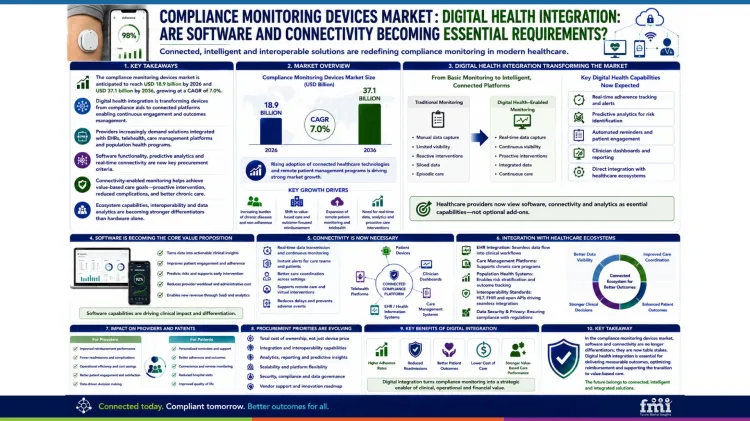
- The industry is anticipated to reach USD 18.9 billion by 2026. The industry is projected to grow at a CAGR of 7.0% through the forecast period to reach USD 37.1 billion by 2036 owing to the rising adoption of connected healthcare technologies and remote patient management programs.
- The integration of digital health is transforming compliance monitoring devices from compliance aids to connected devices that facilitate continuous patient engagement and outcomes management.
- Healthcare providers are increasingly looking for monitoring solutions that are integrated with electronic health records, telehealth systems, care management platforms and population health programs.
- With providers seeking measurable improvement in adherence and treatment outcomes, software functionality, predictive analytics and real-time connectivity are emerging as key procurement criteria.
- One way to realize value-based care goals such as proactive intervention, reduction of preventable complications and improved chronic disease management is through connectivity-enabled compliance monitoring.
- Ecosystem capabilities, interoperability and data analytics are becoming more important for differentiation from competitors than just hardware functionality.
Introduction
Digital transformation is changing the delivery of care in almost every care setting. As providers strive to improve patient outcomes and manage the escalating cost of treatment, connected technologies are emerging as an increasingly important part of long-term care management strategies. The environment is shifting compliance monitoring devices from basic adherence tracking devices to integrated digital health platforms.
The industry is expected to reach USD 37.1 billion by 2036 from USD 18.9 billion in 2026, at a CAGR of 7.0%. This growth is attributed to the increasing demand of technologies that improve treatment compliance, remote monitoring of patients and constant interaction between healthcare providers and patients.
With healthcare systems investing heavily in digital infrastructure the need for software functionality, interoperability, and connectivity is growing rapidly. For manufacturers and healthcare providers, the question isn’t if digital integration adds value. Monitoring functionalities enabled by software are becoming an increasingly minimum requirement to participate in modern healthcare delivery ecosystems.
Market Background
Treatment compliance still remains the biggest challenge in healthcare management. Major drivers of healthcare costs, preventable complications, and disease progression include missed medications, non-completion of treatment plans, and non-adherence to physician recommendations.
Typical compliance monitoring methods include patient self-reporting, scheduled follow-up visits and manual monitoring. The methods provide a limited window into patient behavior between healthcare visits and often miss adherence problems before adverse clinical outcomes.
The advent of digital health technologies has completely altered this dynamic. Healthcare providers now have tools that can track patient behavior on a continuous basis, send alerts in real-time, and allow for proactive intervention strategies.
The industry is evolving significantly with increased investments in software development, connectivity infrastructure and inter-operability capabilities.
Software Is Becoming the Core Value Proposition
In the past, compliance monitoring devices were primarily useful as tools for recording and reporting information about adherence. Monitoring capabilities are important, but healthcare providers are asking for more software tools that can turn data into actionable clinical insight.
More modern compliance monitoring platforms are incorporating patient engagement tools, automated reminders, adherence analytics, predictive risk assessment capabilities, and clinician dashboards. Software features enable healthcare organizations to identify emerging adherence problems and intervene before treatment outcomes deteriorate.
The role of software becomes more important as chronic disease management takes center stage. Successful care management programs require the ability to automate communication and analyze adherence because chronic conditions demand ongoing patient engagement.
Healthcare providers want platforms that provide measurable improvements in treatment adherence and reduce administrative burden. And so software development is becoming a key competitive priority for manufacturers.
The move to software-centric solutions also creates new revenue streams through subscription services, analytics platforms and ongoing support contracts.
Connectivity Is Now Necessary
Connectivity has become a fundamental requirement in the compliance monitoring devices market.
Healthcare providers are looking for monitoring systems that integrate reliably with clinical workflows, patients, and healthcare information systems. Manual data collection and reporting processes are not sustainable in modern healthcare workflows.
Connected compliance monitoring devices provide real-time compliance monitoring, automated alerts and constant patient engagement. These capabilities allow healthcare organizations to identify compliance risks earlier and implement corrective actions before problems emerge.
Connectivity is particularly important when it comes to remote care. Fast, secure transmission of patient information is vital to home healthcare programs, virtual care initiatives, and chronic disease management services.
The growth of telehealth services has only further increased the need for connected compliance monitoring solutions. There's a growing demand from providers to see how patients are doing between virtual visits, and there is a lot of interest in technology for continuous remote monitoring.
With the growth of digital healthcare delivery, connectivity is shifting from being a differentiator to being an expectation.
Procurement priorities are being changed by interoperability
Healthcare organizations are facing increasingly complex technology environments such as electronic health records, telehealth platforms, clinical decision support tools, population health management systems and patient engagement applications.
Compliance monitoring devices need to work well in these ecosystems to get the most out of them.
To make these ecosystems effective, compliance monitoring devices must be effective in these ecosystems.
Integrated monitoring systems improve clinician productivity by incorporating patient information into existing workflows. They also allow for more holistic patient management by linking adherence data with larger clinical information.
As healthcare organizations begin to digitally transform they are finding themselves sourcing vendors that can support enterprise-wide integration needs. This trend is putting more pressure on manufacturers to develop open, scalable and interoperable technology platforms.
As healthcare information systems mature, interoperability will continue to be a key market differentiator.
End-User Insights
Hospitals are among the largest users of compliance monitoring technologies as they seek to reduce readmissions, improve treatment outcomes and facilitate post-discharge care management.
What adds value to these deployments is the digital integration, which allows clinicians to monitor patient adherence remotely while still having the real-time information. This is particularly true for patients who are on complex medication regimens or who have chronic health conditions.
Outpatient providers are also accelerating adoption, as digital health technologies become a staple of chronic disease management strategies. Continuous adherence monitoring enables improved management of treatment and fewer in-person visits.
Another large growth segment is home health care providers. Connected monitoring technologies allow care teams to remotely monitor patients, offering a higher level of oversight and enabling cost-effective models of care delivery.
Software functionality and connectivity are becoming increasingly must-have deployment requirements for all classes of end-user.
Buyer Behaviour and Procurement
As compliance monitoring devices are embedded in the digital health infrastructure, healthcare procurement strategies are rapidly evolving.
As companies evaluate technology, they are increasingly looking at software capabilities, analytics functionality, interoperability, cybersecurity protections and long-term scalability. The device’s performance still matters, but the decision to buy it is increasingly driven by factors other than the hardware specifications.
The information technology departments are more involved in purchasing decisions. Healthcare organizations want assurance that monitoring solutions can be integrated with existing clinical systems and support future technology initiatives.
They’re also seeking vendors who are able to offer ongoing software updates, technical support, cybersecurity upgrades, and platform innovation.
Such considerations reflect the increasing recognition that compliance monitoring technologies are no longer just simple medical devices but rather long-term digital healthcare investments.
Effects on competition
The convergence of digital health is inherently changing the competitive market for compliance monitoring devices.
Manufacturers are increasingly competing on ecosystem capabilities rather than just monitoring functionality. Companies that combine adherence monitoring with analytics, predictive modeling, patient engagement tools and interoperability support are gaining stronger positions in The industry.
The stakes of partnering with health tech providers are rising. Manufacturers can extend the capabilities of their solutions and increase the value they provide to customers through partnerships with telehealth platforms, electronic health record vendors and population health management companies.
At the same time, barriers to entry are rising. Creating digital health platforms that are secure, scalable and interoperable takes a lot of investment in software engineering, cybersecurity, regulatory compliance and data management infrastructure.
As digital health takes off, competition will be more about the platform capabilities rather than just the device hardware.
Strategic Implications
The industry is transforming into a digitally connected healthcare technology space where software and connectivity are becoming more and more prominent. Healthcare providers want solutions that improve adherence, increase patient engagement and support broader care management goals.
Manufacturers that only focus on monitoring functionality will find it increasingly difficult to compete as provider expectations change. The ability to deliver integrated digital ecosystems that deliver clinical, operational and financial value will be an increasingly important driver of future growth opportunities.
The likely strategic priorities across The industry will be investments in interoperability, analytics, artificial intelligence and patient engagement platforms. The organizations that can capitalize on product development aligned with healthcare digitalization trends will be best positioned to seize long-term growth opportunities.
Bottom Line
Software integration and connectivity are becoming standard in The industry. Digital health programs such as remote patient monitoring programs and value-based care strategies are advancing in the healthcare industry, with interoperability, analytics and ecosystem capabilities increasingly driving purchasing decisions. Manufacturers that employ adherence monitoring with comprehensive digital platforms will be best positioned to improve competitive positions and address the shifting needs of healthcare organizations looking for connected, outcome-driven care solutions.

