


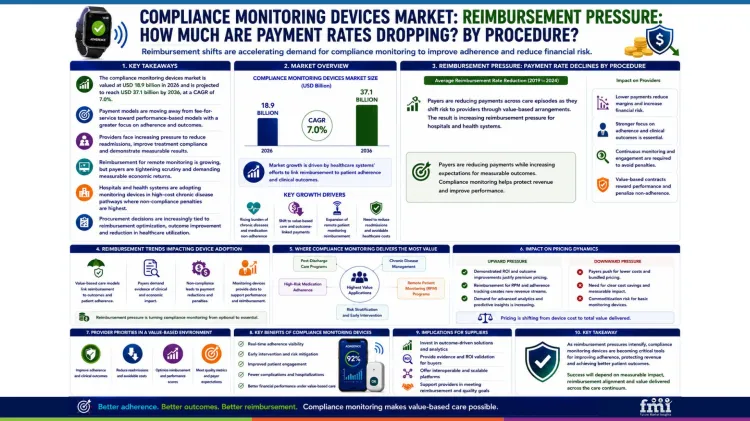
- The market size is valued at USD 18.9 billion in 2026 and is expected to reach USD 37.1 billion by 2036, exhibiting a CAGR of 7.0%. This is attributed to the increasing efforts by the healthcare systems to link reimbursement to patient adherence and clinical outcomes.
- Payment models are moving away from fee-for-service toward performance-based models with greater focus on medication adherence, post-discharge adherence, and chronic disease management.
- With increasing pressure on health care providers to reduce readmissions, improve treatment compliance and show measurable outcomes, the strategic importance of compliance monitoring technologies grows.
- Reimbursement for remote patient monitoring is growing, creating new revenue opportunities, but payment scrutiny is raising provider demands for measurable economic returns from monitoring programs.
- Hospitals and health systems are increasingly adopting compliance monitoring devices in high-cost chronic disease pathways where the reimbursement penalties for non-compliance are highest.
- Procurement decisions are increasingly associated with reimbursement optimization, outcome improvement and reduction of healthcare utilization and not only with device acquisition costs.
Introduction
Healthcare reimbursement systems are undergoing major structural changes as payers work to improve the quality of care and manage long-term healthcare expenditures. In many healthcare markets, reimbursement structures are increasingly shifting towards outcomes and away from volume of services, adding new pressures on providers to increase patient adherence and treatment compliance.
Compliance monitoring devices have become important tools to tackle one of the most persistent problems in healthcare: ensuring that patients follow their prescribed treatment plan after a diagnosis or discharge. The ability to track adherence, identify the risk of non-compliance and intervene before complications occur is becoming more valuable as reimbursement models evolve.
The market is valued at USD 18.9 billion in 2026 and is estimated to reach USD 37.1 billion in 2036 with a CAGR of 7.0%. Growth is closely linked to the efforts of healthcare systems to improve treatment outcomes while reducing avoidable healthcare utilization and reimbursement penalties.
As reimbursement pressures mount, compliance monitoring devices are being increasingly seen as strategic assets to support provider financial performance, not just monitoring tools.
Market Context
The economic burden of patient noncompliance is increasingly challenging for healthcare providers. Missed medications, noncompliance with discharge instructions, and poor adherence to chronic disease management protocols are often the cause of avoidable hospitalizations, emergency department visits, and treatment failures.
Historically, reimbursement structures have rewarded providers based on the volume of treatment delivered, regardless of patient adherence outcomes. This dynamic has dramatically shifted with the growth of value-based reimbursement models.
Providers are increasingly being measured on things like readmission rates, management outcomes for chronic disease and long-term treatment efficacy. In many health care systems these performance measures directly determine how much reimbursement is paid.
Compliance monitoring technologies give providers insight into patient behavior beyond traditional care settings. Such systems can help reduce financial exposure due to poor patient adherence by enabling earlier intervention and better care coordination.
Thus, reimbursement policy changes are emerging as a key driver of compliance monitoring technology adoption.
Reimbursement Pressure Is Reshaping Compliance Monitoring Demand
The extent of reimbursement reductions varies with the healthcare system and the type of procedure, but the general tendency is obvious: healthcare providers are facing increasing pressure to achieve better outcomes with fixed or limited reimbursement amounts.
Readmissions and treatment failures that are preventable can often result in significant financial consequences for hospitals and physician groups. Increasingly, compliance monitoring technologies are being deployed in care pathways where adherence failures have the greatest economic impact.
Chronic disease control programs are particularly important. Patients with conditions such as hypertension, diabetes, cardiovascular disease and heart failure require long-term engagement and adherence to medication. Poor compliance often leads to disease progression, higher treatment costs and penalties related to reimbursement.
The growth of reimbursement for remote monitoring in several healthcare markets has provided incentives for providers to deploy compliance monitoring devices. But reimbursement opportunities often come with stricter documentation requirements and closer scrutiny of demonstrated clinical value.
Consequently, healthcare organizations are pressured to ensure monitoring programs make a meaningful impact on patient outcomes and financial performance.
Procedure Economics and Compliance Monitoring
Compliance monitoring devices are increasingly integrated into healthcare pathways with especially high reimbursement sensitivity.
One of the most important fields of application is care after discharge. Readmission penalties still affect provider behavior, leading healthcare organizations to invest in technologies that incentivize compliance after hospitalization.
Similarly, chronic disease management programs depend on patient compliance to achieve desired outcomes. Payment systems are moving toward rewarding good management of chronic disease and penalizing preventable complications.
Another area of increasing attention is medication adherence programs. Poor adherence to prescribed treatment regimens often leads to higher utilization of health care services and higher payer expenditures. Compliance monitoring technologies can identify at-risk patients before expensive interventions are necessary.
The economic drivers for these deployments are progressively tied to optimizing reimbursement rather than simply improving monitoring capabilities.
Regional Reimbursement Dynamics
Market demand is increasingly affected by regional reimbursement environments.
United States is projected to grow at a CAGR of 6.9% through 2036, supported by Medicare readmission penalties and continued proliferation of remote patient monitoring reimbursement pathways. Compliance monitoring technologies are being deployed more and more by healthcare providers to improve outcomes and reduce financial risk around reimbursement.
The European Union is projected to register a 7.0% CAGR through 2036, driven by initiatives to manage chronic diseases and strategies to control healthcare costs. Technologies for compliance monitoring are increasingly being integrated into structured care pathways to improve treatment adherence and resource utilization.
South Korea is projected to grow at a CAGR of 7.4% through 2036, driven by digital health integration initiatives and reimbursement support for remote monitoring technologies deployed in chronic disease management programs.
Regional variation illustrates the increasing impact of reimbursement policy on the pattern of technology adoption.
End-User Insights
Hospitals continue to be the most visible users of compliance monitoring technologies, since they are directly exposed to reimbursement pressures associated with readmissions and outcomes following discharge.
Healthcare systems are increasingly deploying compliance monitoring devices in transitional care programs to keep patients engaged after they are discharged from the hospital. The intention of these initiatives is to reduce preventable complications while protecting reimbursement performance.
Outpatient care providers also are seeing increased adoption as chronic disease management programs become more closely tied to reimbursement structures linked to outcomes. Continuous patient engagement and adherence monitoring serve clinical and financial purposes.
Another important growth opportunity is the home healthcare setting. When healthcare systems are looking for ways to provide care at a lower cost, compliance monitoring technologies can provide ways to maintain oversight while reducing reliance on care delivered in facilities.
Procurement and Buyer Behavior
Reimbursement considerations are increasingly taking on an important role in procurement strategies.
Healthcare purchasers are evaluating compliance monitoring technologies for their potential for measurable clinical and economic benefit. The purchase decision is increasingly based on return on investment, and not only on costs of the device acquisition.
Providers are looking for proof that monitoring programs can improve compliance, reduce healthcare utilization, and boost reimbursement performance. Procurement advantages are being gained by technologies that make explicit links between monitoring activities and better outcomes.
Financial stakeholders are taking a more active role in purchase decisions, showing the increasing link between monitoring technologies and reimbursement optimization strategies.
Hence, vendors are increasingly required to demonstrate both clinical efficacy and economic value in procurement evaluations.
Competitive Implications
Reimbursement pressure is reshaping the competitive dynamics of the compliance monitoring devices industry.
Manufacturers that are able to demonstrate their impact on adherence, outcomes and health care utilization are increasingly able to differentiate themselves. To be competitive, a device must not only function well, but also be able to support the provider’s reimbursement objectives.
Software analytics and predictive monitoring capabilities, and integration with care management platforms, are an increasingly key competitive differentiator. Healthcare providers are looking for solutions to identify risks of non-compliance before costly clinical events happen.
Partnerships with healthcare organizations, payers and digital health vendors are also growing in strategic importance as vendors look to shore up their value propositions.
Firms that align product portfolios to shifting reimbursement priorities are likely to see increased adoption and procurement opportunities.
Strategic Implications
During the forecast period, the connection between reimbursement policy and the adoption of compliance monitoring technology will likely get stronger.
The ongoing efforts of healthcare systems to move to outcome-based reimbursement will put pressure on providers to improve adherence and reduce avoidable healthcare use. The implementation of compliance monitoring technologies provides practical means to address these challenges while supporting the objectives of financial performance.
Going forward, market growth will become progressively dependent on the ability of manufacturers to show measurable contributions to outcome improvement and reimbursement optimization. In today’s more value-driven healthcare environments, monitoring capabilities alone are unlikely to be sufficient.
The organizations that are best able to align compliance monitoring strategies with the realities of reimbursement will be best positioned to improve both clinical outcomes and financial sustainability.
Bottom Line
Reimbursement pressure is making compliance monitoring devices strategic healthcare assets, not operational tools. As accountability for patient outcomes, readmission rates and chronic disease management performance grows, compliance monitoring technologies are increasingly driven by their ability to help achieve reimbursement objectives and mitigate financial risk. As the growth of outcome-based health models continues, manufacturers that can clearly demonstrate economic and clinical value will be best positioned to seize long-term growth opportunities.

