


- Digital dentistry is making it possible for engine-driven file systems and connected dental devices to be increasingly compatible and endodontic workflows are changing, too.
- Manufacturers are increasingly designing rotary endodontic platforms that are compatible with torque-controlled motors and digital treatment protocols.
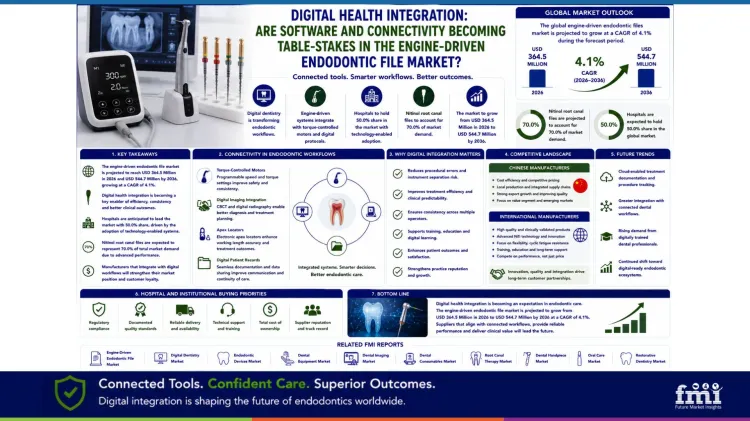
- Hospitals are expected to dominate the engine-driven endodontic file market with a share of 50.0% owing to the adoption of technology-enabled procedural systems
- Nitinol root canal files are projected to account for 70.0% of market demand, showing continued demand for advanced clinical performance.
- The global engine-driven endodontic files market is expected to reach USD 544.7 million by 2036 from USD 364.5 million in 2026, at a CAGR of 4.1% during the forecast period.
Differentiator across modern dentistry, and the engine-driven endodontic file market is heading in the same direction. Endodontic files are still consumable devices but are increasingly used in a connected ecosystem that includes endodontic motors, apex locators, imaging systems and digital patient records.
The Engine-Driven Endodontic File Market is projected to reach USD 364.5 Million by 2026 and grow at a CAGR of 4.1% to USD 544.7 Million by 2036 owing to increasing demand for advanced dental procedures and technology-driven clinical workflows.
One of the most important developments is the compatibility of rotary file systems and electronically controlled motors. Modern motors allow the clinician to program torque limits and rotational speed according to the manufacturer's recommendations, which reduces the risk of procedure and improves consistency during root canal treatment.
Such connectivity is especially useful in hospitals and specialty dental centers that perform large volumes of endodontic procedures. Consistent settings reduce variability between operators and help ensure predictable clinical outcomes among multiple practitioners.
Digital imaging has also been closely related to endodontic treatment planning. Preoperative visualization of root canal anatomy is possible with cone beam computed tomography and advanced radiographic systems. The files are mechanical devices, but their use is increasingly driven by digitally generated diagnostic information.
Manufacturers can also develop integrated product portfolios to increase customer retention. Clinics that buy compatible motors and file systems from one vendor might enjoy simplified training, consolidated service support and streamlined procedural workflows.
Trends in education also support digital adoption. Students in dental schools are being exposed to electronically controlled endodontic systems rather than just manual technique. As these graduates enter the professional world, the demand for digitally compatible equipment continues to grow.
Also, the product mix of the market is assisting this transition. The flexibility and the ability to perform efficiently in modern rotary systems are expected to help Nitinol root canal files to hold 70.0% of the market demand. This is only natural for digitally controlled instrumentation and its widespread use.
Even though direct revenue from the software itself may not be realized within the endodontic file segment, connectivity is emerging as a buying factor. For clinics investing in sophisticated equipment, integrated systems tend to be favored over standalone products that don’t play well with existing digital infrastructure.
The importance of consumable and digital platform compatibility may further increase in the future through the use of cloud-enabled treatment documentation, integrated procedure tracking, and connected dental workflows. Within this larger ecosystem, producers could leverage competitive advantages outside of just product performance.
Bottom Line
Integration of digital health is gradually becoming an expected rather than premium feature of endodontic care. The engine-driven endodontic file market is expected to grow from USD 364.5 Million in 2026 to USD 544.7 Million by 2036. Suppliers of products that are integrated into connected dental workflows will likely strengthen their market position.

