


- E-commerce matters in malt beverages because consumers increasingly discover flavors, formats, bundles, and moderation-led propositions across digital and multi-channel retail environments.
- Individual buyers lead buyer-type revenue, making household penetration, online visibility, direct-to-consumer assortments, and repeat retail availability important.
- Energy drinks lead product type demand because stimulation-led beverages depend on impulse conversion, repeat cadence, flavor cycling, and convenient pack-price access.
- Online channels help brands test limited-edition flavors, direct bundles, loyalty programs, and consumer-specific assortments without relying only on physical shelf space.
- Retail visibility still matters because conventional offerings dominate scale and consumers need broad access to build repeat purchase.
- The biggest misconception is that e-commerce is only a secondary channel. In malt beverages, digital discovery shapes flavor trial, brand engagement, and pack variety even when retail remains the volume engine.
E-commerce is changing the Malt Beverage Market, but not by replacing retail shelves. Instead, it is expanding discovery, comparison, bundle building, loyalty, and occasion-led assortment design. Malt beverages are becoming more varied, with energy-led, health-oriented, alcoholic, non-alcoholic, flavored, and moderation-aligned propositions. The more varied the category becomes, the more digital channels matter.
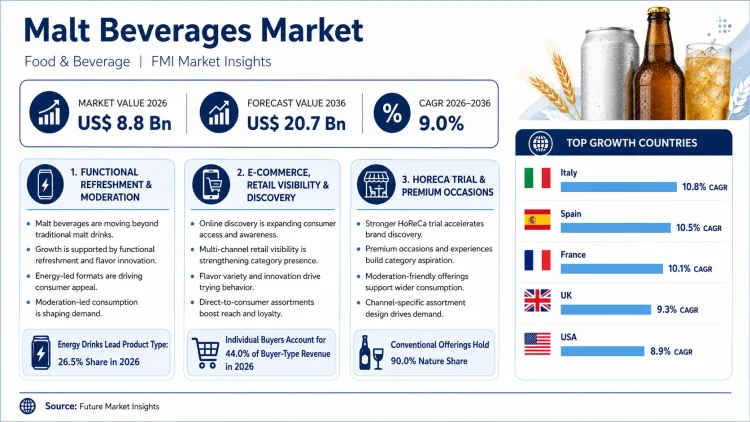
According to FMI, the Malt Beverage Market is anticipated to rise from USD 8.8 Bn in 2026 to reach USD 20.7 Bn by 2036, posting a 9.0% CAGR. Further, FMI suggests that growth in the market has been fueled by better retail visibility and HoReCa experiences through premium offerings, along with flavor revisions and packaging variations for better repurchasing.
The individual purchasers are estimated to contribute 44.0% of buyer-type revenues in 2026. It is the strongest signal for e-commerce. The malt beverages need to target individual buyers and not just institutions. Individual buyers react to taste discovery, pricing, brand story, social situation, functionality, and convenience. E-commerce can play an important role here.
The Online Grocery Market is relevant because beverage consumers increasingly use digital platforms to replenish multipacks, compare prices, browse flavors, and discover new brands. Malt beverages can benefit when they are easy to add to routine grocery baskets, party orders, wellness beverage selections, or alcohol-adjacent social occasion purchases.
The energy drink segment is predicted to take top billing with 26.5% market share by 2026. This is significant since the consumer energy-driven drinking behavior is highly dependent on convenience, visibility, and repeat consumption. The consumer purchases energy drinks for a very predictable occasion of use which is: working, studying, gaming, traveling, exercise, socializing, and afternoon energy. Hence, malt beverage brands based on energy need to be visible everywhere.
The Energy Drinks Market helps explain this behavior. Energy drink brands use flavor rotation, limited-edition launches, multipacks, convenience-store availability, and online buzz to drive trial. Malt beverage brands entering energy-led spaces must manage similar dynamics: strong core flavors, rapid innovation, and pack-price accessibility.
The digital medium is highly advantageous for testing flavors. According to FMI, flavor innovation is expected to become more prevalent in the portfolios of malt beverages through refreshing high-velocity SKUs. Physical stores cannot have SKUs beyond their carrying capacity. E-commerce enables testing of seasonal flavors, variety packs, bundled SKUs, and limited editions. Successful testing in e-commerce could allow the flavor to expand to other media.
The Functional Beverages Market is relevant because online channels are useful for explaining functional cues. A malt beverage positioned around energy, wellness, nutrition, moderation, or lifestyle benefits may need more explanation than a standard soft drink. Product pages, videos, reviews, and influencer content can communicate the use case better than a shelf label.
Visibility through the retail route is still important. According to FMI, traditional products rule the roost by virtue of their 90.0% natural share due to the fact that they enable broader pricing, wider distribution, and larger SKU handling capacity. This implies that e-commerce should not be considered a substitute for retail execution.
The Non-Alcoholic RTD Beverages Market is useful because malt beverages increasingly compete in ready-to-consume behavior. Online channels help consumers discover alcohol-free, low-alcohol, functional, and lifestyle-linked ready beverages. This is especially relevant for moderation-led consumers who are comparing beverages across multiple categories.
Direct to consumer can even assist brands in having control over the packs and stories. The brand will be able to sell trial packs, mixed packs, subscription packs, season drops, and occasion packs. The brand will be able to collect data about the flavors, frequency of ordering, pack size, and occasion usage.
The E-commerce Packaging Market is relevant because beverages face packaging constraints in online channels. Malt beverage multipacks must survive shipping, avoid leakage, protect bottles or cans, and meet fulfillment requirements. A strong e-commerce product strategy needs packaging built for delivery, not only shelf display.
Growth in countries also contributes to the expansion of channels. According to FMI, Italy has been rated as the fastest growing country at 10.8% CAGR, followed by Spain at 10.5%, France at 10.1%, UK at 9.3%, and the USA at 8.9%. The mentioned countries illustrate how growth is influenced by premiumization, flavors, lifestyle offers, retail modernization, on premise and multi-channel activation.
The misconception to avoid is that e-commerce is only a sales channel for malt beverages. It is also a demand-shaping channel. It influences how consumers discover flavors, understand functional cues, compare packs, and decide whether a beverage fits a specific occasion.
Bottom line: E-commerce and retail visibility work together in malt beverages. The strongest brands will use online channels for discovery, flavor testing, bundles, and loyalty while using retail distribution to convert awareness into repeat purchase.
FMI Related Links
- Malt Beverage Market: Primary link for market value, buyer-type share, energy drinks share, channel roles, nature share, and country growth
- Online Grocery Market: Use when discussing online beverage discovery, digital grocery platforms, multipacks, and e-commerce purchasing trends
- Energy Drinks Market: Use when discussing stimulation-led consumption, repeat purchases, flavor innovation, and active lifestyle beverages
- Functional Beverages Market: Use when discussing functional ingredients, wellness positioning, health claims, and digital consumer education
- Non-Alcoholic RTD Beverages Market: Use when discussing ready-to-consume beverage behavior, convenience, and on-the-go refreshment
- E-commerce Packaging Market: Use when discussing shipping-ready beverage packaging, online fulfillment, and protective pack design

