


- Food additive capacity is not only about production volume. It is about whether suppliers can deliver consistent functionality, regulatory documentation, and application performance at industrial scale.
- Clean-label reformulation increases pressure on natural extraction, fermentation, enzyme systems, plant-based stabilizers, natural colors, and naturally sourced preservatives.
- The real bottleneck is not always raw material availability. It is batch consistency, formulation validation, cost-in-use, regional compliance, and supply reliability.
- Natural additives can face agricultural variability, weather-related supply risk, color or flavor inconsistency, and higher processing costs.
- Synthetic additives remain relevant where standardization, affordability, pathogen control, and long shelf life are critical.
- The biggest misconception is that once a natural additive works in the lab, it can be scaled easily. Commercial food production exposes stability, cost, processing, and supply-chain limits.
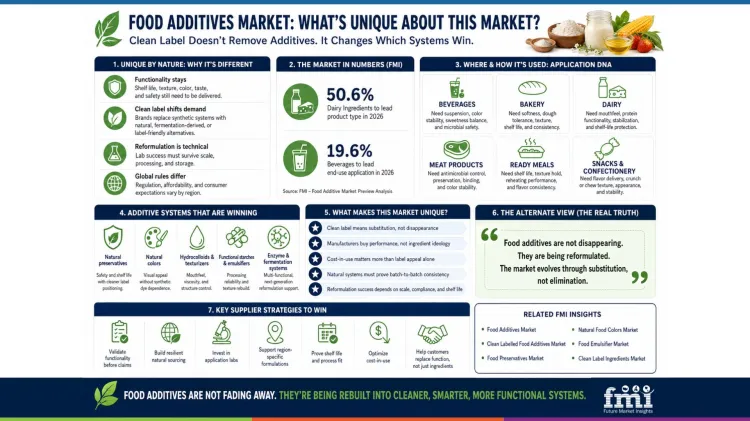
The capacity of a food additive tends to be considered very narrowly. Most firms think that the primary question is the ability to produce sufficient quantities of a clean, natural, or fermentate additive. But that is not the whole story. Capacity within a food production facility is repeatability of function over and over again, regardless of location or storage.
This becomes all the more pertinent when we consider that many food companies are working to reformulate their products to exclude some of the synthetic additives in them. The reason for this is that there are no easy swaps for preservatives, colors, emulsifiers, stabilizers, sweeteners, and texturizers. They need to be compatible with manufacturing processes and have the potential to last as long while meeting the same requirements.
FMI’s Food Additives Market highlights food additives as compounds that serve specific technical functions during processing, packaging, or storage. This definition matters because the market is not defined only by ingredient volume. It is defined by whether a supplier can deliver qualified, application-ready functionality.
Additive capacity issues vary based on additive type. Natural colorings rely on sources from plants, fruits, vegetables, spices, minerals, algaes, or fermentation. Natural coloring agents need to be standardized regarding hue, strength, solubility, thermal stability, pH stability, and photostability. Natural preservatives have to provide microbial inhibition without developing adverse flavors or causing regulatory problems. Enzymes need to behave predictably under processing conditions. Emulsifiers and hydrocolloids should help with texture, suspension, and mouthfeel.
FMI’s Natural Food Colors Market shows why supplier capability matters. Food and beverage manufacturers require repeatable color batches, especially in beverages, dairy, confectionery, and bakery. A natural red, yellow, or blue that looks good in a pilot batch may behave differently under heat, acidity, light, or long storage. That creates formulation risk.
Preservatives create a different kind of capacity pressure. FMI’s Food Preservatives Market reinforces the continued relevance of antimicrobial and antioxidant systems for spoilage inhibition and food safety. Clean-label alternatives may gain attention, but synthetic preservatives can remain important in applications where pathogen control, mold prevention, and long distribution cycles are non-negotiable. Capacity must therefore be read by function and application, not by clean-label preference alone.
The same applies to emulsifiers. FMI’s Food Emulsifier Market connects emulsifier demand with texture stability, shelf-life improvement, powder formats, and packaged food manufacturing. Bakery, dairy, sauces, spreads, and convenience foods depend on emulsifier systems that can support consistent processing. A label-friendly emulsifier that fails under high heat, freezing, thawing, mixing, or storage conditions will not scale.
Natural additive capacity also depends on raw material risk. Natural colorants, flavoring agents, and preservatives derived from plant sources are subject to fluctuations in terms of crop availability, seasonality, weather conditions in a specific region, disease incidence, and extraction yield. While fermentation systems have lower dependency on agriculture, they add other risks such as fermentation yield, purification capacity, energy requirements, and cost of operation.
That is why cost-in-use considerations are more important than the list price of an ingredient. Even if the natural color costs more per kilo, it can still be considered a good choice if it works well with just a small amount and does not compromise product aesthetics. Similarly, the preservative might cost more, but it can be considered an important ingredient since it helps avoid wastage. In the same way, the emulsifier and stabilizer can justify its price in terms of the savings from process or storage losses.
This is further complicated by regional regulations. Food additive regulations vary by region. A food additive that is allowed in one country might have to be listed under a different name, at different quantities, or through a different regulatory process, or using different documentation in another country. Multinational food companies may require separate formulas for North America, Europe, Asia-Pacific, Latin America, and the Middle East.
Capacity decisions also break during scale-up. A reformulated product may perform well in a pilot plant but fail in continuous production, long-distance transport, freezer storage, hot-fill processing, or extended ambient distribution. Natural systems can be more sensitive to processing conditions than conventional additives. This is why application labs, plant trials, and shelf-life validation are becoming essential parts of additive supplier value.
The most effective suppliers will be those that can balance the combination of availability of materials, manufacturing capability, documentation capabilities, testing applications, and regulatory capability for their region. Food companies require more than just ingredient suppliers. They require suppliers that can assist them in reformulating their products without compromising cost, taste, safety, shelf-life, or efficiency.
The common myth to debunk is that of the ease of scaling supply of clean-label additive capabilities after demand has been realized.
Bottom line: Food additive capacity is not just about producing more natural alternatives. It is about producing consistent, validated, cost-effective, and regulation-ready systems that protect food performance at industrial scale.

