


- Food additive “brand share” should be read as supplier positioning, not consumer brand share.
- Public supplier-level share varies by additive type, but competitive strength can be judged through portfolio breadth, application support, regulatory documentation, manufacturing scale, and customer access.
- FMI identifies Cargill, ADM, Ingredion, Associated British Foods, and Novonesis among key companies in the Food Additive Market.
- Premium-positioned suppliers win where manufacturers need clean-label reformulation, texture systems, natural preservatives, enzyme solutions, sugar reduction, and application-specific technical support.
- Value-positioned suppliers win where buyers prioritize cost, large-volume supply, standard additives, and predictable performance, but they are exposed if they lack documentation or reformulation support.
- The biggest misconception is that additive suppliers win only by selling cheaper ingredients. In food additives, the real winners reduce formulation risk.
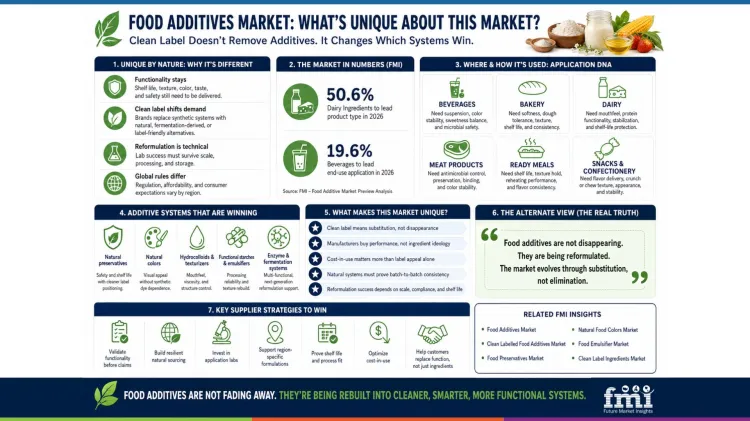
The competition for food additives is not based merely on quantity. The best suppliers of food additives are not merely the ones who can provide the lowest cost preservatives, sweeteners, stabilizers, emulsifiers, or colors. They are those who assist food processors to keep their products performing well, while adapting to new consumer demands, regulations, retailer specifications, and costs.
This is why “brand share” when it comes to food additives needs to be interpreted differently from consumer packaged foods. It is rare for the ultimate consumer to make a selection of which additive manufacturer to use based on its brand name. It takes place within the R&D, procurement, quality control, regulatory and manufacturing departments of the food company.
FMI’s Food Additives Market identifies Cargill, Archer Daniels Midland Company, Ingredion, Associated British Foods, and Novonesis among key companies. FMI also positions the market around diversified suppliers with broad additive portfolios, application capabilities, and relationships with packaged food and beverage companies. That supplier profile is important because additive demand is becoming more solution-led.
Cargill is well positioned because of its scale across food ingredients, sweeteners, texturizers, and formulation support. The reason behind this is that the number of suppliers that could handle various issues is decreasing for manufacturers of foods. The requirement of a drinks manufacturer is sweetness, stability, mouthfeel, and positioning. On the other hand, a baker requires functionality like moisture control, softness, and shelf life.
ADM is well-positioned because of its strengths in human nutrition and ingredient technology. Its importance rests on the trend moving away from commoditized raw materials towards integrated food and beverages value chain systems. With clean-label reformulation becoming increasingly common, companies whose technologies can provide flavor, texture, nutrition, color, and functionality across various applications will be important going forward.
Ingredion is particularly relevant in specialty starches, sweetener systems, texture systems, and clean-label reformulation. Ingredion’s importance comes from its ability to help manufacturers replace their existing artificial or unknown ingredients with functional starches, fibers, hydrocolloids, and textures systems. In many cases, the problem does not lie in taking out the ingredient but rather in building back its structure.
Novonesis fits a different winner profile. Enzyme and biosolution capabilities are increasingly important as food companies seek processing efficiency, cleaner formulations, sugar reduction, fermentation-derived functionality, and ingredient systems that do more than one job. As the additive market shifts toward biological and fermentation-enabled systems, bioscience suppliers can gain relevance.
Associated British Foods should be read carefully. It has credible exposure through sugar and ingredients businesses, but it is more diversified across grocery, retail, agriculture, sugar, and ingredients than some of the more directly additive-focused suppliers. This means its competitive role may vary by application and region.
The first category of winners is the premium solution provider. Their advantage stems from the fact that the customer is looking for technical reformulation, testing, confidence regarding regulation, and multifunctional systems. Such businesses can sustain their margins since they minimize risk. The food producer will end up paying extra to secure the supplier that proves success within the product matrix.
The second type includes suppliers of scale and reliability. It is beneficial for suppliers in situations when the customer requires continuous supply and standardization of ingredients at the same time as cost savings. The relevance of scale and reliability can be seen in such food categories as drinks, bakery, dairy products, snacks, meat products, sauce, and processed food items.
The third group is the specialist additive supplier. These companies may not have the broadest portfolio, but they can win in natural colors, clean-label preservatives, enzymes, hydrocolloids, emulsifiers, sweeteners, or specialty flavor systems. Specialists are valuable where the application is technically difficult or where the buyer needs a very specific function.
The suppliers most at risk are those that sell additives generically. A supplier offering only a low-cost ingredient without application support, regulatory documentation, or formulation guidance may remain in commodity segments but struggle in premium reformulation. As clean-label requirements become more complex, food companies increasingly need technical partners, not just ingredient vendors.
FMI’s Clean Labelled Food Additives Market reinforces the competitive shift because it covers supplier activity across natural flavors, natural colors, natural preservatives, sweeteners, hydrocolloids, starches, and emulsifiers. The strongest companies are those that combine scale with reformulation capability.
The misconception to be avoided in this scenario is the assumption that successful suppliers will be either large or cheap. The size or cost will make a difference but will not necessarily define a winner. Success in this industry is measured by portfolio synergy, technical proof, regulatory confidence, and problem-solving skills for food performance issues.
Bottom line: The winners in food additives will be the suppliers that help manufacturers move from additive removal to functionality replacement. They will win by combining scale, technical service, regulatory support, and reformulation intelligence.

