


- Frame mounted end suction pumps fit industrial buyers better when maintenance access, motor flexibility, higher power ratings, and long service life matter.
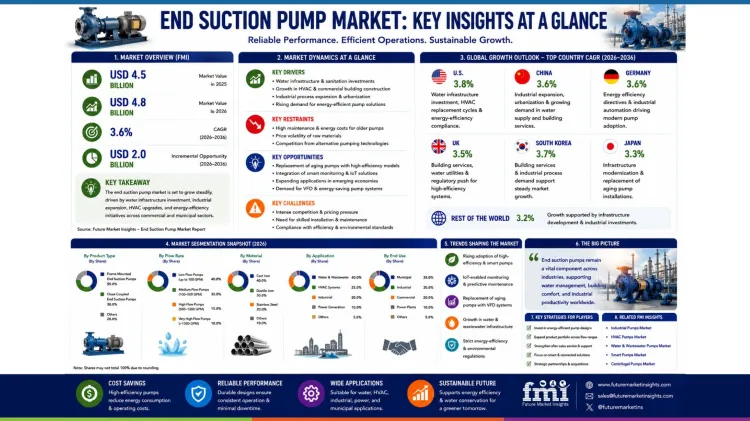
- FMI identifies frame mounted end suction pumps as the leading product segment with 50.0% share in 2026.
- Close coupled pumps are better suited to compact commercial buildings, small utility rooms, packaged HVAC systems, and lower-duty installations where footprint and simple installation are more important.
- Industrial buyers usually evaluate pump configuration by lifecycle cost, serviceability, alignment, downtime exposure, spare motor availability, and operating duty.
- Frame mounted designs are more attractive where the pump needs back pull-out service, motor replacement flexibility, and compatibility with variable speed drives.
- The buying pattern suggests frame mounted designs lead in industrial and utility settings, while close coupled designs hold a practical position in space-constrained building services.
End suction pumps are a mature product category, and the design choice still matters. A frame mounted pump and a close coupled pump may both move water or process fluid, and they fit different operating environments. The decision is rarely about which design is universally better. It is about how much the buyer values service access, installation space, motor flexibility, efficiency upgrades, and downtime control.
FMI places the end suction pump market at USD 4.8 billion in 2026 and forecasts it to reach USD 6.8 billion by 2036 at a 3.6% CAGR. The report identifies frame mounted end suction pumps as the leading product segment with 50.0% share in 2026. That leadership is not surprising because many industrial, municipal, and building-service users continue to prefer designs that are easier to maintain over long operating lives.
A frame mounted end suction pump has a pump and motor mounted on a common baseframe, typically connected through a coupling. This layout provides more flexibility in motor selection, alignment, service access, and replacement. FMI notes that frame mounted designs allow the motor to be replaced without disassembling the pump, and that built-in back pull-out capability allows impeller and mechanical seal service without disturbing piping connections.
That back pull-out feature is important for industrial buyers. In a plant, a pump is not just a piece of equipment. It is part of a connected fluid system. Disturbing suction and discharge piping can add labour, risk alignment problems, and extend downtime. If maintenance crews can access the impeller, seal, and rotating assembly without moving piping, the service event becomes more predictable.
This is why frame mounted pumps fit many industrial buyers better. Process water transfer, cooling water circulation, water boosting, fire protection support, utility systems, and general industrial services often require equipment that can be maintained repeatedly over many years. A pump used in a manufacturing facility, water-treatment site, chemical plant, or large commercial mechanical room may operate for long periods. Serviceability becomes part of the purchase decision.
Motor flexibility is another advantage. A frame mounted design makes it easier to select or replace a motor suited to duty, efficiency level, voltage, speed, or variable frequency drive operation. FMI states that frame mounted pumps offer flexibility for efficiency upgrades and variable speed drive installations. This matters because energy efficiency is increasingly part of pump procurement, particularly in HVAC, water utility, and industrial process applications.
Close coupled pumps serve a different need. They are compact because the pump is directly mounted to the motor without a separate base-mounted coupling arrangement. This reduces footprint, simplifies installation, and can lower the number of alignment steps. For smaller commercial buildings, packaged systems, booster sets, light-duty water transfer, and space-limited mechanical rooms, that simplicity is valuable.
A close coupled pump can be the better choice when the equipment is smaller, access is straightforward, the installation space is tight, and the service risk is manageable. Building owners and contractors may prefer this design when they need a compact unit that can be installed quickly without a large baseplate and coupling alignment process.
The trade-off is maintenance flexibility. If the motor or seal needs service, access may be more constrained than with a frame mounted back pull-out pump. For low-criticality applications, that may be acceptable. For higher-duty industrial applications, the maintenance penalty can outweigh the footprint benefit.
Industrial buyers usually think in terms of total ownership cost. The purchase price is only one element. A pump that is cheaper to install may become expensive if it is difficult to service or creates downtime during seal replacement. A pump with a higher initial cost may be justified if it allows faster maintenance, motor upgrades, and better operating efficiency.
The broader FMI market explanation supports this lifecycle view. The report states that end suction pumps are sustained by water infrastructure investment, HVAC system installation, energy-efficiency standards, and replacement of older constant-speed pumps with high-efficiency motor and VFD-equipped alternatives. This means the market is not just replacing like-for-like equipment. Buyers are using replacement cycles to improve efficiency and reliability.
Material selection also interacts with configuration. FMI states that cast iron pumps hold 40.0% material share in 2026 because gray cast iron provides cost-effective service for clean water and HVAC applications. Ductile iron is used where higher strength or pressure capability is needed, while stainless steel is selected for chemical, pharmaceutical, and food-grade applications where iron corrosion products are not acceptable. Frame mounted designs are often more visible in these more demanding service settings because they can be specified with broader motor and material combinations.
Close coupled designs remain attractive in building services. Smaller HVAC loops, chilled and hot water circulation, domestic water boosting, and commercial utility applications may not require the same service flexibility as a large industrial process pump. If the building has limited space and standardized duty, compactness can win.
The distinction can be made through buyer type.
- A municipal utility engineer may prefer frame mounted pumps for water treatment, distribution, and boosting because maintenance access and long service life matter.
- An industrial plant maintenance manager may prefer frame mounted pumps because the equipment can be repaired without disturbing connected piping.
- An HVAC contractor working in a constrained mechanical room may select close coupled pumps because installation speed and compactness matter.
- A commercial building owner may choose close coupled pumps for smaller systems and frame mounted pumps for larger central plant equipment.
The growth opportunity also differs by channel. FMI identifies established pump distribution through industrial and HVAC wholesale channels as important in the U.S., while direct procurement remains relevant for larger systems. Frame mounted pumps may benefit more from engineered sales and utility or industrial specifications. Close coupled pumps may move more through contractor-led channels and packaged system sales.
The market also rewards suppliers that can offer both. Xylem, Grundfos, Flowserve, KSB, and Sulzer are identified by FMI as leading companies because they provide broad pump portfolios, energy-efficient technology platforms, and established distribution. A supplier that offers only one configuration may miss part of the buying logic.
For industrial buyers, frame mounted pumps appear to be the better fit in most medium-duty and heavy-duty applications. They support maintenance access, motor flexibility, back pull-out service, and efficiency upgrades. Close coupled pumps are not losing relevance, since they are winning in smaller and space-constrained applications where compactness and installation simplicity are more important than long-term service flexibility.
The design choice is therefore not a simple product preference. It reflects how the buyer expects to operate the pump over its life. Industrial buyers tend to reward serviceability and upgrade flexibility, which explains why frame mounted end suction pumps remain the leading configuration.

