


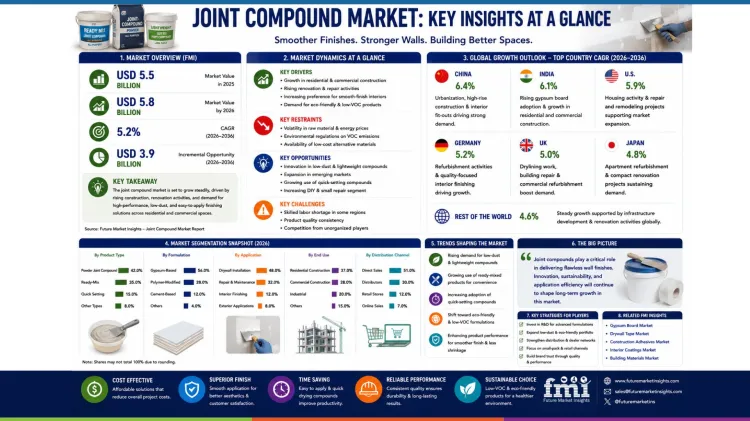
- Gypsum-based joint compound remains the material anchor, with FMI forecasting 56.0% formulation demand share in 2026.
- Gypsum-based products work well with standard drywall boards, which keeps them embedded in mainstream residential and commercial finishing.
- Polymer-modified compounds are gaining where contractors need smoother finish quality, easier sanding, lower shrinkage, and better workability before painting.
- Cement-based compounds serve tougher repair areas and applications that require harder surface strength, and they are less central to standard interior drywall finishing.
- Material selection is increasingly influenced by low-dust performance, VOC documentation, worker safety, and project submittal requirements.
- The market is changing through formulation upgrades rather than a large-scale exit from gypsum-based compounds.
Drywall finishing is often judged only after paint goes on. A wall can look acceptable during compound application and still reveal defects later through ridges, shrinkage, rough sanding, pinholes, uneven texture, or visible joint lines. That is why formulation matters. The chemistry behind a joint compound influences how it spreads, dries, bonds, sands, shrinks, and accepts paint.
Gypsum-based compounds continue to dominate because they match the logic of standard drywall construction. Drywall boards are gypsum-based, widely used in interior partitions and ceilings, and need compatible joint finishing materials. FMI projects gypsum-based formulations to account for 56.0% of formulation demand in 2026. This makes gypsum the core formulation platform for the market rather than a legacy material losing relevance.
The reason is practical. Gypsum-based compounds are familiar to applicators, compatible with standard boards, workable in common interior conditions, and supported by established system suppliers. FMI states that gypsum-based compound works well with standard drywall boards and helps applicators achieve smoother finishes. In high-volume residential and commercial interiors, that combination is difficult to displace.
The formulation debate becomes more interesting when performance demands rise. Contractors are not asking only whether a compound contains gypsum. They are asking whether it sands easily, holds tape, resists cracking, shrinks less, dries predictably, handles well on the knife, and produces a smooth surface before primer and paint. This is where polymer-modified formulations create value.
Polymer-modified products can improve workability, adhesion, flexibility, surface finish, and sanding behaviour, depending on the formulation. FMI notes that polymer-modified products are used in jobs requiring a finer surface before painting. That is an important phrase. Many interiors now use higher-quality paints, sharper lighting, smoother wall designs, and premium finishes. These conditions make small imperfections more visible.
A low-cost basic compound can become expensive if it adds another coat, another sanding pass, or another round of paint correction. Labour is often the larger cost than material. For that reason, a formulation that reduces rework can justify a higher unit price.
Cement-based compounds occupy a narrower but useful position. FMI states that cement-based products fit tougher repair areas that need harder surface strength. These products may be more suitable for specific repair, patching, moisture-exposed, or durability-led areas where a standard gypsum-based compound is not the best choice. They are less central to everyday drywall joint finishing in interior board systems because workability, sanding, and board compatibility often favour gypsum-based products.
Material choice is also being shaped by dust-control and low-emission documentation requirements. Renovation work often happens in homes, offices, schools, healthcare spaces, and occupied commercial interiors. Sanding dust can create cleanup burden and worker exposure concerns. FMI identifies low-dust products as a better-value opportunity, particularly in occupied spaces where cleaner sanding reduces cleanup pressure.
This links formulation to worker safety. The OSHA respirable crystalline silica rule for construction sets a permissible exposure limit of 50 micrograms per cubic metre of air as an 8-hour time-weighted average and an action level of 25 micrograms per cubic metre. Joint compound itself is not the same exposure issue in every formulation or application, and sanding, demolition, patching, and associated drywall work can create dust-control expectations on job sites. Products that reduce sanding dust or simplify finishing can therefore fit broader safety and housekeeping priorities.
Indoor emissions are becoming another specification layer. FMI notes that EPA Indoor AirPlus Version 2 requires interior gypsum board and joint compound used in projects under the programme to meet CDPH Standard Method V1.2-2017 VOC emission limits. The EPA official Indoor AirPlus Version 2 specifications confirm this requirement for interior gypsum board and joint compound. This means formulation is no longer only about spread and sand. It also affects project documentation and acceptance in certified housing or low-emission building programmes.
Suppliers are responding through documented product claims. FMI refers to UL Verification Services listing USG Sheetrock Brand Midweight Joint Compound under UL 2818-2022 with a TVOC limit. It also notes the Knauf Fill & Finish ready-mixed compound sheet listing ASTM C475M-17 compliance and low VOC and formaldehyde testing. These examples show that professional procurement is moving toward evidence. Contractors may still choose based on feel and finish, while architects and builders increasingly ask for documentation.
The drywall system supplier has an advantage in this environment. A company selling board, tape, compound, finishing products, and technical documentation can offer a more complete specification package than a standalone compound supplier. FMI states that system suppliers have an advantage because they sell plasterboard and compound as one finishing package. This matters when builders want fewer compatibility questions and faster submittals.
Gypsum-based products can evolve within this system. The choice is not fixed gypsum versus modern non-gypsum. Gypsum-based formulations can be made lighter, smoother, lower-dust, lower-VOC, easier to sand, and more consistent. The material platform remains gypsum, while the performance envelope improves through additives, binders, fillers, polymers, and processing.
Non-gypsum formulations gain where the application genuinely needs something different. Polymer modification supports finer finishing and better handling. Cement-based compounds support tougher repair and harder surfaces. Specialty products may serve moisture-prone areas, faster setting, improved adhesion, or specific finishing requirements. These products expand the market performance range rather than replacing the gypsum mainstream.
The direction of material choice can be read through the application mix. FMI expects drywall installation to represent 48.0% of application demand in 2026. Standard drywall installation naturally supports gypsum-based compounds because board joints need tape and compound before painting. Repair and maintenance, interior finishing, and exterior applications introduce more variation. A patch job, premium finish, occupied-space renovation, or tougher repair area may push the contractor toward modified or specialty formulations.
End-use mix reinforces this. Residential construction is forecast to hold 37.0% end-use demand in 2026. Homes and apartments need joint compound during new drywall work and later repair jobs. Commercial construction uses ready-mixed and topping compounds for offices and retail interiors. Industrial buildings use compound in staff areas and partitioned spaces. Different end uses do not require a single formulation, so suppliers benefit from offering a range.
Material choice is also affected by geography. In China and India, where large urban buildings and office fit-outs support drywall adoption, gypsum-based and powder formats can fit organized construction. In the USA, home repair and remodeling create demand for ready-mix, lightweight, and low-dust joint compounds. In Germany, refurbishment and quality-focused interiors support low-emission documentation and smooth sanding. In Japan, compact renovation spaces make low shrinkage and easier sanding valuable.
The more useful interpretation is that gypsum-based compounds are not being displaced. They are being upgraded and surrounded by more specialized alternatives. Gypsum remains the base for standard drywall finishing because it matches the board system and contractor workflow. Polymer-modified and cement-based products gain where performance requirements move beyond ordinary joint treatment.
For suppliers, the opportunity is formulation segmentation. A basic gypsum-based compound serves volume work. A lightweight low-dust gypsum compound targets renovation and professional finishing. A polymer-modified compound targets smoother premium interiors. A cement-based compound targets tougher repair zones. A quick-setting formulation targets patching and faster turnaround.
The material story is therefore not gypsum versus non-gypsum as a simple contest. It is a shift from one-size-fits-most compound to task-specific finishing materials. Gypsum remains the foundation, while non-gypsum and modified formulations expand the contractor toolbox where finish quality, dust control, durability, or documentation justifies the switch.

