


- High-protein dairy ingredients are gaining pricing power because buyers are no longer evaluating only dairy solids; they are evaluating protein density, amino acid quality, digestibility, processing behavior, and finished-product claim support.
- Milk powder remains the scale backbone of the dairy ingredients market, but whey protein, milk protein concentrates, isolates, casein, and hydrolyzed dairy proteins are becoming higher-value growth pockets where brands need differentiation.
- Sports nutrition, dietary supplements, clinical nutrition, infant nutrition, active aging, meal replacement, and high-protein food and beverage formats are creating stronger demand for advanced dairy protein systems.
- The high-protein premium is strongest when the ingredient improves both nutritional positioning and finished-product performance; poor solubility, chalky texture, heat instability, or off-notes can weaken the value of a protein claim.
- The biggest risk is treating high protein as a simple fortification add-on. In dairy ingredients, high protein must be supported by processing consistency, technical documentation, sensory quality, and application fit.
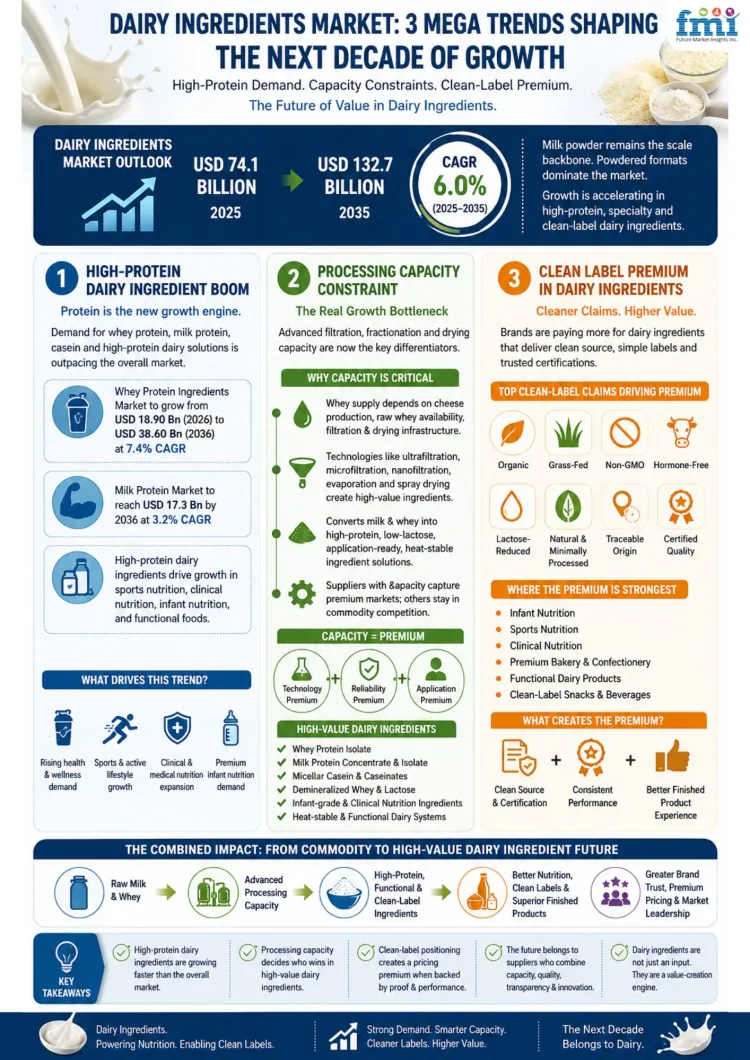
Dairy ingredients are entering a more disciplined phase of growth. The market is no longer driven only by the need to supply milk solids, lactose, fat, or standard powders to food processors. The sharper question is now: which dairy ingredients can justify a premium because they deliver both high-protein nutrition and reliable functional performance?
This is an important shift. In the earlier stage of dairy ingredient procurement, buyers often focused on availability, price, fat content, solids-not-fat, and basic nutritional contribution. Today, food, beverage, supplement, and nutrition brands are more selective. They want dairy ingredients that support protein claims, clean and familiar formulation, better mouthfeel, stronger solubility, and stable performance across demanding applications. This is why the high-protein dairy ingredient boom is becoming one of the most important pricing questions in the dairy ingredients market.
FMI's Dairy Ingredients Market shows that the category is already moving at scale, with the market valued at USD 74.1 billion in 2025 and projected to reach USD 132.7 billion by 2035, expanding at a 6.0% CAGR. FMI also identifies milk powder as a key product segment and powdered formats as the dominant form. That definition matters because dairy ingredients are not only bulk nutritional inputs. They are increasingly functional formulation ingredients, especially where protein quality, digestibility, texture, and processing stability influence finished-product value.
Milk powder remains central to the market because it offers cost efficiency, shelf stability, broad availability, and processing familiarity. FMI identifies milk powder as likely to hold 28% of the product-type segment in 2025, while powdered formats are projected to account for 78% of form-type revenue in 2025. This leadership is logical. Skimmed milk powder, whole milk powder, whey powder, lactose, and other dairy solids are widely used in bakery, confectionery, dairy products, infant formulations, beverages, soups, sauces, and prepared foods. For many processors, standard dairy powders provide the best balance between cost, availability, nutrition, and industrial handling.
However, milk powder leadership does not eliminate the high-protein opportunity. In fact, it helps define it. Because standard dairy powders form the scalable base, the premium opportunity sits in the gap between commodity dairy solids and differentiated dairy proteins such as whey protein isolate, whey protein concentrate, milk protein concentrate, milk protein isolate, casein, caseinates, and hydrolyzed whey proteins. Buyers are willing to evaluate higher-priced dairy proteins when the finished product needs stronger nutrition positioning or when the brand must deliver a better sensory and functional experience.
This is where whey protein becomes strategically important. FMI's Whey Protein Ingredients Market is projected to expand from USD 18.90 billion in 2026 to USD 38.60 billion by 2036, registering a 7.4% CAGR. This is faster than the broader dairy ingredients market, confirming that whey protein is one of the higher-growth pockets within dairy-derived ingredients. For food and nutrition buyers, whey offers several advantages: it is dairy-derived, familiar, widely accepted in protein products, supported by strong amino acid quality, and suitable for sports nutrition, supplements, beverages, bakery, dairy products, and infant nutrition formulations.
Whey protein isolate is one of the clearest examples of premiumization. FMI indicates that whey protein isolate is expected to contribute 42.7% of whey protein ingredients market revenue in 2025. The segment has gained traction because isolate products offer higher protein purity and reduced lactose levels. For sports nutrition and premium high-protein products, this matters because brands often need higher protein per serving without excessive carbohydrates, fat, lactose, or heavy mouthfeel. Whey protein isolate can therefore command a premium when it supports a cleaner, more concentrated, and better-performing protein claim.
Milk protein also fits the premium logic. FMI's Milk Protein Market is projected to grow from USD 12.6 billion in 2026 to USD 17.3 billion by 2036, expanding at a 3.2% CAGR. The market covers milk protein concentrates, milk protein isolates, whey proteins, and casein, serving food manufacturing, sports nutrition, infant nutrition, and clinical nutrition applications. For dairy ingredient buyers, milk proteins are valuable because they combine nutritional value with formulation benefits such as texture improvement, emulsification, gelation, viscosity management, and creaminess.
Milk protein concentrates are especially important because they give brands a practical route to high-protein formulation without immediately moving to the highest-cost isolates. FMI identifies concentrates as expected to dominate the milk protein product segment with a 42.0% share, while powder is expected to lead with a 68.0% share. This reflects buyer preference for shelf-stable, precise-dosing protein ingredients that can be used across dairy beverages, high-protein yogurts, bakery, snacks, meal replacements, and nutritional powders.
The high-protein premium is also linked to the wider protein ingredients market. FMI's Protein Ingredients Market was valued at USD 88.6 billion in 2025 and is projected to reach USD 123.9 billion by 2036. This wider market is important because dairy proteins are competing not only with other dairy ingredients but also with plant proteins, collagen, egg proteins, and alternative proteins. Dairy ingredients therefore need to prove why they offer better nutrition, taste, solubility, digestibility, processing reliability, or finished-product positioning.
Sports nutrition is one of the strongest demand engines. FMI's Sports Nutrition Market is expected to grow from USD 29.6 billion in 2026 to USD 65.6 billion by 2036, registering an 8.3% CAGR. FMI also identifies protein supplements as accounting for 46.0% of the product segment, supported by the established role of protein in muscle recovery, body composition management, and mainstream daily protein consumption. This directly supports demand for whey protein, milk protein, casein, and high-protein dairy systems because sports nutrition brands rely heavily on protein quality, rapid solubility, clean taste, and consumer trust in dairy-based proteins.
Protein powder demand reinforces the same point. FMI's Protein Powder Market is projected to expand from USD 28.8 billion in 2025 to USD 59.9 billion by 2035, growing at a 7.5% CAGR. FMI identifies whey protein as likely to lead with a 48% share of the type segment in 2025. This confirms that whey continues to hold a strong position in protein powder formulations despite rising competition from plant-based sources. For dairy ingredient suppliers, this creates a clear premium opportunity in whey protein concentrate, whey protein isolate, hydrolyzed whey protein, micellar casein, milk protein concentrate, and milk protein isolate.
However, the high-protein opportunity is not limited to sports nutrition. Active aging is becoming a major growth area because older consumers are paying more attention to muscle maintenance, strength, mobility, and daily protein intake. Clinical nutrition also requires high-quality protein systems for patients who need controlled nutrition, digestibility, and reliable formulation performance. Infant nutrition remains another high-value application where dairy proteins must meet strict safety, quality, and compositional requirements.
This is why high-protein dairy ingredients should be measured through three lenses: nutrition premium, functionality premium, and application premium. Nutrition premium comes from protein concentration, amino acid quality, digestibility, and compatibility with protein claims. Functionality premium comes from solubility, emulsification, gelation, foaming, viscosity control, heat stability, and mouthfeel. Application premium comes from the ability to perform in protein shakes, high-protein yogurts, bars, powders, meal replacements, bakery, infant formula, and clinical nutrition formats.
Price premium versus baseline should therefore be calculated carefully. The baseline is usually conventional skimmed milk powder, whole milk powder, whey powder, or lower-protein dairy solids because these ingredients are scalable, familiar, and cost-efficient. A high-protein dairy ingredient should be evaluated against that baseline not only by price per kilogram but also by protein yield, finished-product economics, formulation efficiency, claim value, and ability to reduce the need for additional stabilizers, flavor maskers, or texture enhancers.
For brands, this creates a clear segmentation strategy. Mass-market and value products may continue to rely heavily on standard dairy powders because cost, supply, and functional dependability remain critical. Premium and better-for-you products may use whey protein isolate, milk protein isolate, micellar casein, or hydrolyzed dairy proteins to support stronger claims and higher-quality sensory performance. Hybrid products may use a cost-balanced approach, combining baseline dairy solids with differentiated proteins where claim value or processing benefits justify the added cost.
For suppliers, the opportunity is to avoid selling high protein as a vague promise. Buyers need proof. They need documentation, specification control, protein content validation, amino acid profile, allergen statements, solubility data, heat-stability guidance, flavor performance, origin traceability, and application testing. The winning suppliers will not simply say their ingredient is high protein. They will show how it performs in RTD shakes, dry mixes, high-protein yogurts, bars, bakery systems, infant nutrition, and clinical nutrition formats.
For dairy processors, high-protein demand creates a different type of capacity challenge. Producing advanced dairy proteins is not only a milk collection decision. It requires membrane filtration, ultrafiltration, microfiltration, ion exchange, evaporation, spray drying, instantization, agglomeration, protein standardization, lactose management, and strong quality control. This means high-protein dairy ingredients are not only a sourcing decision. They are also a processing capability decision. Suppliers with advanced separation and drying infrastructure will be better placed to capture premium demand.
For co-manufacturers and nutrition brands, supplier selection also becomes more technical. A low-cost dairy powder supplier may not be the right partner for a high-protein RTD beverage, clear protein drink, clinical powder, or premium sports nutrition blend. These products need ingredients that remain stable during processing, avoid sedimentation, minimize chalkiness, maintain taste quality, and deliver consistent protein levels across production batches. This is where application-tested dairy protein systems gain pricing power.
For food processors, the key question is whether the high-protein premium can be passed through to the customer. In premium sports nutrition, active lifestyle products, high-protein yogurts, medical nutrition, and meal replacement formats, the premium may be easier to justify. In value bakery, confectionery, or institutional foodservice, the premium may be harder to recover unless the ingredient also improves yield, reduces waste, improves texture, or supports broader procurement goals.
The regional angle also matters. North America and Europe are likely to remain important high-protein dairy ingredient markets because sports nutrition, protein powders, fortified dairy, and premium nutrition formats are already well developed. Asia-Pacific is likely to offer strong growth potential as urban consumers adopt protein-enriched beverages, supplements, and functional dairy products. In emerging markets, affordability will remain important, but premium urban segments can still support higher-value whey and milk protein formats.
High-protein dairy ingredients also intersect with the mainstreaming of functional food and beverage. As protein moves from gyms and bodybuilding into everyday snacking, breakfast, weight management, active aging, and convenience nutrition, dairy proteins gain more formulation opportunities. This supports a broader interpretation: dairy protein demand is not isolated. It is linked to the wider consumer shift toward foods and beverages that deliver measurable nutrition without sacrificing taste and texture.
The misconception to avoid is that high protein automatically means high value. A dairy protein ingredient can still struggle if it creates poor solubility, chalky mouthfeel, bitterness, sedimentation, heat instability, or batch inconsistency. Protein content can increase trial, but sensory quality and processing reliability protect repeat purchase. In finished products, consumers do not buy protein grams alone. They buy taste, texture, convenience, trust, and visible wellness benefit.
Another misconception is that plant protein growth weakens the dairy protein opportunity. Plant proteins increase competition, but they also make protein more mainstream. Dairy proteins can still win where brands need complete protein quality, clean taste, creamy texture, digestibility, and strong performance in beverages and powders. The market is likely to move toward a layered structure: standard dairy powders as the scalable base, whey and milk proteins as premium performance ingredients, and plant-dairy blends as application-specific options where cost, label, and sensory balance are required.
Bottom line: the high-protein boom in dairy ingredients will not be captured by every supplier that offers milk powder, whey powder, or generic dairy solids. It will be captured by suppliers that combine protein concentration with processing consistency, sensory performance, documentation, and application support. In dairy ingredients, the premium is not paid for protein content alone. It is paid when the protein helps the brand sell a better finished product.
FMI Related Reports
- Dairy Ingredients Market: Primary interlink in the introduction and conclusion
- Whey Protein Ingredients Market: Use when discussing whey protein as the strongest high-protein dairy ingredient growth pocket
- Milk Protein Market: Use when discussing milk protein concentrates, isolates, casein, and dairy protein fortification
- Protein Ingredients Market: Use when positioning dairy proteins within the wider global protein ingredients ecosystem
- Sports Nutrition Market: Use when explaining demand from sports nutrition, active lifestyle, and performance nutrition products
- Protein Powder Market: Use when discussing protein powder demand and whey protein share
- Dietary Supplements Market: Use when discussing supplement demand, active aging, and daily protein intake
- Clinical Nutrition Market: Use when discussing medical nutrition and protein quality requirements
- Infant Formula Ingredients Market: Use when discussing infant nutrition as a high-value dairy protein application

