


- Human milk oligosaccharides are not a simple functional ingredient category. Commercial adoption depends on precision fermentation, downstream purification, regulatory approval, and qualified infant-nutrition-grade supply.
- HMO growth is led by infant formula, but the real bottleneck is not demand interest. It is the ability to produce bio-identical HMOs consistently, safely, and at a cost that formula and nutrition brands can justify.
- Fucosylated HMOs, especially 2’-FL, are the most commercially advanced because they have stronger regulatory familiarity, broader formulation experience, and more established production pathways.
- Powder formats are commercially important because infant formula and pediatric nutrition brands depend heavily on dry blending, stability, and final-stage ingredient integration.
- Cost-in-use matters more than ingredient price per kilogram because HMO inclusion level, purity, formulation compatibility, and regulatory confidence decide commercial feasibility.
- The biggest misconception is that HMO adoption will scale automatically because parents and brands want nutrition closer to breast milk. In reality, scale depends on fermentation yield, purification economics, dossier readiness, and long-term supply reliability.
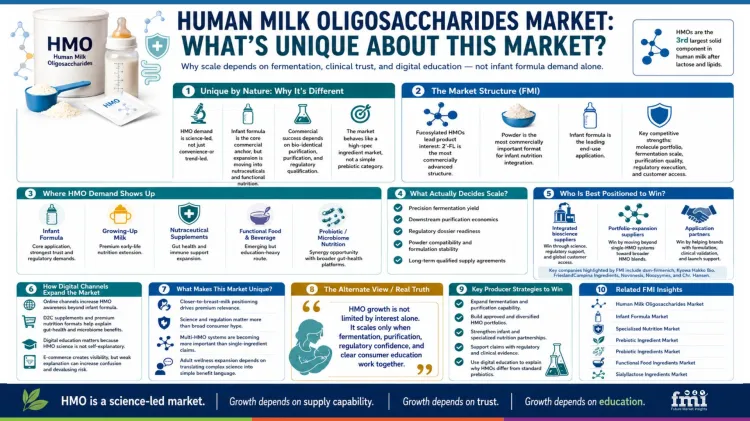
HMOs are some of the most research-based groups of ingredients currently available in the food & beverages sector. HMOs are strongly associated with infant nutrition due to their natural presence in breast milk. This has piqued interest in formula manufacturers; however, this alone cannot define a market. Rather, the key question that must be addressed is whether there are supply chain partners able to deliver approved and identical HMO ingredients on a commercial basis.
This is why FMI’s Human Milk Oligosaccharides Market is important for understanding the category. FMI segments the market by fucosylated HMOs, sialylated HMOs, and non-fucosylated neutral HMOs, with forms including powder and liquid. End uses include infant formula, growing-up milk, infant cereals, baby foods, nutraceutical supplements, functional food and beverage, probiotic yogurt and dairy products, functional beverages, snacks, baked goods, and other specialized applications. This structure shows that HMO demand is broadening, but infant nutrition remains the core commercial anchor.
Production is where the problem with scale starts. Commercially-available HMOs are not derived from breast milk. They are manufactured using advanced biotechnology processes, specifically precision fermentation and associated biological manufacturing platforms. The technology behind the creation of these products is completely unique from existing prebiotic ingredients. A firm cannot simply increase its production by acquiring additional agricultural feedstock.
The downstream process is particularly vital. The requirements around HMOs for baby food are extremely high with respect to their purity and safety. While fermentation might generate the desired molecule, the raw material needs to be isolated, purified, stabilized, tested, documented, and made ready to be integrated into the formula. It could be what determines the cost structure, capacity, delivery time, and supplier risk. The fermentation expert who cannot make a good case economically for purification would face difficulties.
2'-FL is the easier example in explaining the first commercial wave. In terms of HMO structure, 2'-fucosyllactose is already one of the most recognized HMO components that have been developed commercially since it is one of the more recognized HMOs present in breast milk. But the market in the future will not revolve around only one component. LNT, LNnT, 3-FL, 3'-SL, 6'-SL, and many other HMO components are now being recognized for their importance, as companies venture into the realm of replicating human milk composition.
This change generates a capacity issue. Making one single approved HMO at scale is different from making multiple products at scale all at once. Multi-HMO systems complicate processes from production planning to purification, regulatory filing, quality control, mixing, and cost. The more a formula brand asks for a full HMO profile, the more a supplier will need to show that it can achieve molecular diversity without supply inconsistency.
Form also matters. Powdered form becomes even more essential, as infant formula makers and growing-up milk producers use a lot of dry mixing in their processes. Powdered HMOs should integrate well into current processes without causing problems like degradation, clumping, moisture sensitivity, or uneven distribution in the formula itself. Liquid forms might have value in some cases, but infant formula production scales best using powders.
Regulatory qualification is another capacity gate. HMOs used in infant formula need extensive safety, toxicology, and intended-use documentation. Different markets have different approval pathways. The United States, European Union, China, Japan, and other major nutrition markets do not move at the same speed or use identical regulatory logic. A supplier that is qualified in one region may still need additional dossiers, approvals, or customer-specific documentation elsewhere.
That is why long-term supply contracts are essential. Formula companies cannot afford to run into supply disruptions in an industry segment that is heavily regulated. If one of the infant formula brands wants to add HMOs to their lineup, they need assurance that the supply chain will be able to sustain itself without interruption throughout the production process. This presents an opportunity for suppliers to develop a market that revolves around more than just the innovation of molecules.
Cost-in-use is also central. HMOs are typically used at low inclusion levels compared with bulk ingredients, but that does not make cost irrelevant. Infant formula has a sensitive cost architecture. Brands must decide whether HMO inclusion supports premium positioning, clinical credibility, or differentiation strongly enough to justify formulation cost. The price per kilogram is only one part of the equation. Purity, dosage, claim support, regulatory certainty, and consumer communication all influence commercial value.
The same logic applies beyond infant formula. In nutraceutical supplements, functional beverages, probiotic dairy, and adult gut health formats, HMO adoption must compete against established prebiotics and probiotics. FMI’s Prebiotic Ingredient Market and Probiotic Ingredients Market are relevant because buyers already have many gut-health ingredient options. HMOs can offer a more advanced, human-milk-inspired story, but they must justify their cost and documentation burden.
The misconception to avoid is that HMO adoption is inevitable because the ingredient is closer to breast milk biology. That biology creates the reason to care. It does not automatically solve production, purification, approval, or pricing challenges.
Bottom line: HMO growth depends on more than infant nutrition interest. It depends on whether suppliers can deliver approved, purified, stable, and cost-viable HMO ingredients at commercial scale. In this market, fermentation and purification capacity decide how fast science becomes supply.
Reference
- Human Milk Oligosaccharides Market
- Infant Formula Market
- Specialized Nutrition Market
- Prebiotic Ingredient Market
- Probiotic Ingredients Market
- Functional Food Ingredients Market
- Sialyllactose Ingredients Market

