


Executive Summary: From energy tracking to load orchestration
Energy has become a controllable production variable in high-load manufacturing. Companies that can optimize energy use in real time are better positioned to protect margins, improve efficiency, and meet growing sustainability demands. This is driving a shift from static reporting to dynamic load orchestration.
This detailed report examines Industrial Energy Intelligence for High-Load Manufacturing, covering the needs of key B2B decision-makers across CTO, CIO, CEO, and Marketing/Sales roles. We integrate market figures from Future Market Insights with concrete evidence from Schneider Electric, Siemens, ABB, and Rockwell Automation to construct detailed customer personas and journey maps.
This report provides a unique perspective, based on vendor developments and market realities, to guide product planning and market positioning for B2B SaaS providers in industrial energy intelligence. Load orchestration shows why B2B SaaS solutions must connect production plans, power quality, tariff exposure, carbon reporting, and equipment performance in one operating layer.
Market Overview: The Imperative for Industrial Load Orchestration
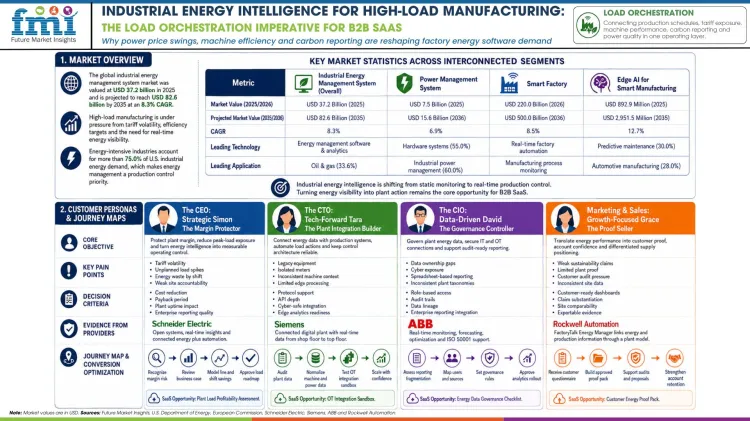
The global industrial energy management system market was valued at USD 37.2 billion in 2025 and is projected to reach USD 82.6 billion by 2035 at an 8.3% CAGR [1]. This expansion reflects rising energy cost pressure, tighter efficiency expectations and higher power intensity across manufacturing plants.
A major operating driver is the energy burden of heavy industry. The USA Department of Energy states that energy-intensive industries account for more than 75.0% of USA industrial energy demand [6]. These industries also employ roughly 13 million Americans and contribute about USD 27.0 trillion to USA gross domestic product [6]. This level of exposure changes energy management from a utility cost review into a production control requirement.
Key Market Statistics Across Industrial Energy Intelligence Segments:
| Metric | Industrial Energy Management System (Overall) [1] | Power Management System [2] | Smart Factory [3] | Edge AI for Smart Manufacturing [4] |
|---|---|---|---|---|
| Market Value (2025/2026) | USD 37.2 Billion (2025) | USD 7.5 Billion (2025) | USD 220.0 Billion (2026) | USD 892.9 Million (2025) |
| Projected Market Value (2035/2036) | USD 82.6 Billion (2035) | USD 15.6 Billion (2036) | USD 500.0 Billion (2036) | USD 2,951.5 Million (2035) |
| CAGR | 8.3% | 6.9% | 8.5% | 12.7% |
| Leading Technology | Energy management software and analytics | Hardware systems (55.0%) | Real-time factory automation | Predictive maintenance (30.0%) |
| Leading Application | Oil and gas (33.6%) | Industrial power management (60.0%) | Manufacturing process monitoring | Automotive manufacturing (28.0%) |
These figures show the connected structure of the industrial energy intelligence market. For example, industrial energy management systems are the core market layer and are projected to reach USD 82.6 billion by 2035 at an 8.3% CAGR [1]. This segment is shaped by the need to link energy visibility with production decisions. Power management systems were valued at USD 7.5 billion in 2025 and are projected to reach USD 15.6 billion by 2036 [2]. The smart factory market is projected to reach USD 500.0 billion by 2036 as manufacturers expand real-time monitoring across plant operations [3]. Edge AI for smart manufacturing is projected to reach USD 2,951.5 million by 2035, with predictive maintenance accounting for 30.0% of demand [4].
Customer Personas: Decision makers behind industrial load intelligence
The CEO: Strategic Simon - The margin protector
Strategic Simon treats energy as a board-level operating risk. A high-load plant can lose margin even when production volume looks stable. Energy price spikes, demand charges, and downtime penalties can change plant economics within a quarter. He sees Load Orchestration as a way to protect throughput and defend cost discipline.
- Core Objective: To protect plant margin, reduce peak-load exposure, and convert energy intelligence into measurable operating control.
- Pain Points: tariff volatility, unplanned load spikes, energy waste by shift, and weak site-level accountability.
- Decision Criteria: cost reduction, payback period, plant uptime impact, and enterprise reporting quality.
- Touchpoints: board reviews, plant performance meetings, energy procurement briefings, and sustainability updates.
Evidence from Providers: Schneider Electric frames energy intelligence as part of a wider shift toward software-defined automation. Its 2026 article states that manufacturers need open systems, real-time insights, and energy-efficient digital transformation. Schneider also argues that energy and automation systems must be connected for unified orchestration. This aligns with Simon’s concern because board-level energy control requires more than utility bill analysis. It needs operational proof that energy actions do not weaken production performance.
Journey Map & Conversion Optimization: Simon’s journey begins when energy cost begins moving faster than production revenue. He asks for a business case before reviewing technical detail. A B2B SaaS provider can convert him through a Plant Load Profitability Assessment. The best proof is a model that shows cost savings by line, shift, and load event.
The CTO: Tech-Forward Tara - The plant integration builder
Tech-Forward Tara owns the technical challenge behind energy intelligence. She must connect meters, programmable controllers, manufacturing execution systems, historians, and enterprise systems. High-load manufacturing plants often carry mixed equipment generations across many lines. Load Orchestration depends on her ability to make plant data readable and usable.
- Core Objective: To connect energy data with production systems, automate load actions, and keep control architecture reliable.
- Pain Points: legacy equipment, isolated meters, inconsistent machine context, and limited edge processing.
- Decision Criteria: protocol support, API depth, cyber-safe integration, and edge analytics readiness.
- Touchpoints: architecture reviews, controls engineering meetings, vendor workshops, and automation events.
Evidence from Providers: Siemens positions industrial energy management software around the connected digital plant. Siemens states that its software helps manufacturers use real-time data through integration from the shop floor to the top floor. The company also links energy management with manufacturing execution systems and industrial Internet of Things platforms. This directly matches Tara’s integration problem because energy intelligence must travel across machines and enterprise systems. A dashboard is not enough when the plant needs line-level context.
Journey Map & Conversion Optimization: Tara’s journey starts with a technical audit of plant data sources. She looks for a platform that can normalize machine, line, and power data without forcing a full control-system replacement. A B2B SaaS provider can convert her through an OT Integration Sandbox. The sandbox should show meter data moving into production context with minimal disruption.
The CIO: Data-Driven David - The governance controller
Data-Driven David sees industrial energy intelligence as a data governance problem. He must protect system access, maintain data lineage, and support reporting across sites. Energy data becomes sensitive when it reveals production output, downtime, and site economics. Load Orchestration needs trusted data rules before it can guide operational decisions.
- Core Objective: To govern plant energy data, secure IT and OT connections, and support audit-ready reporting.
- Pain Points: data ownership gaps, cyber exposure, spreadsheet-based reporting, and inconsistent plant taxonomies.
- Decision Criteria: role-based access, audit trails, data lineage, and enterprise reporting integration.
- Touchpoints: cybersecurity reviews, enterprise architecture councils, compliance meetings, and ESG reporting programs.
Evidence from Providers: ABB Ability Energy Management System is presented as a real-time solution for monitoring, forecasting, and optimizing energy consumption across a facility or enterprise. ABB states that the platform supports data-driven decisions about environmental, financial, and operational cost trade-offs. The same source notes automated reporting, decision support, and ISO 50001 support. This fits David’s priorities because governed energy intelligence must produce usable records for compliance and management review.
Journey Map & Conversion Optimization: David’s journey begins with reporting fragmentation across sites. He looks for data controls before approving operational analytics. A B2B SaaS provider can convert him through an Energy Data Governance Checklist. The checklist should map users, data sources, retention rules, and reporting outputs.
Marketing & Sales: Growth-Focused Grace - The proof seller
Growth-Focused Grace uses industrial energy intelligence as customer-facing proof. Large manufacturers sell to buyers that now ask for energy performance, carbon data, and supply reliability. A plant that can prove energy discipline can use that proof in account development. Load Orchestration becomes a sales enablement tool when it supports credible claims.
- Core Objective: To translate energy performance into customer proof, account confidence, and differentiated supply positioning.
- Pain Points: weak sustainability claims, limited plant proof, customer audit pressure, and inconsistent site data.
- Decision Criteria: customer-ready dashboards, claim substantiation, site comparability, and exportable evidence.
- Touchpoints: key account reviews, customer audits, sustainability questionnaires, and trade events.
Evidence from Providers: Rockwell Automation describes FactoryTalk Energy Manager as an IT and OT convergence platform. The product provides energy and production information based on a plant model. Rockwell states that manufacturers can understand where, when, and how facilities use energy. This matters for Grace because customer-facing proof needs line and process context. General energy totals rarely satisfy sophisticated industrial customers.
Journey Map & Conversion Optimization: Grace’s journey begins with a customer questionnaire or supplier audit. She needs energy data that can be turned into approved customer proof. A B2B SaaS provider can convert her through a Customer Energy Proof Pack. The pack should translate plant data into account-safe evidence for audits and proposals.
Key Market Research Pointers: Future Outlook for B2B SaaS in Industrial Energy Intelligence
To provide a specific perspective beyond standard syndicated research, consider these five evidence-based pointers for the future of Industrial Energy Intelligence for High-Load Manufacturing, specifically for B2B SaaS providers:
Predictive load planning will become the first commercial wedge.
Manufacturers will expect energy intelligence platforms to forecast load before production begins. The mechanism will combine production schedules, machine history, tariff windows, and utility constraints. SaaS providers can help plants shift load without interrupting committed output. CEOs will value the capability because it connects energy savings with margin protection. CTOs will require proof that predictive recommendations do not create control instability.
Energy audits will move toward continuous compliance.
The EU Energy Efficiency Directive gives energy efficiency first legal standing across major investment decisions. This changes how plants document energy decisions. Energy audits will become less periodic and more data-driven. SaaS providers can build compliance workflows around energy baselines, action logs, and verified improvement records. CIOs will need governance features that make the data defensible during audits.
Edge AI will make machine-level energy control practical.
Edge AI for smart manufacturing is expected to expand at a 12.7% CAGR through 2035. The practical use case is machine-level detection of abnormal energy draw. Plants can use edge models to identify compressed-air leaks, furnace inefficiency, motor stress, and cooling drift. SaaS platforms can combine these alerts with work orders and production context. This moves energy intelligence from reporting into daily plant action.
Customer-facing energy proof will support account retention.
Manufacturers increasingly need credible evidence for customers that track supplier energy performance. Marketing and sales teams will need controlled views of plant energy data. SaaS providers can offer customer-ready proof packs that avoid exposing sensitive production detail. These packs can support audits, proposals, and sustainability questionnaires. Grace’s role becomes stronger when energy data supports commercial trust.
Energy intelligence will consolidate with smart factory platforms.
The smart factory market is projected to reach USD 500.0 billion by 2036. Energy intelligence will not stay isolated from manufacturing execution, maintenance, and quality systems. B2B SaaS providers will need stronger connectors across ERP, MES, SCADA, meters, and asset-management tools. The winning architecture will treat energy as a production variable. This makes Load Orchestration a core layer of smart manufacturing.
Uniqueness Explanation: These pointers move beyond simple market size projections. They explain how Load Orchestration changes plant economics, compliance readiness, IT governance, and customer proof. The practical opportunity for B2B SaaS is to connect energy data with production actions.
Conclusion: Load intelligence becomes plant intelligence
Industrial Energy Intelligence for High-Load Manufacturing has reached a turning point. B2B SaaS providers that address the needs of CEOs, CTOs, CIOs, and Marketing/Sales leaders through Load Orchestration will hold stronger positions. The next phase of industrial competitiveness will depend on how quickly plants convert energy visibility into operating decisions.
Are you ready to turn high-load manufacturing energy data into operating control with a Load Orchestration Intelligence Platform that reduces peak exposure, improves plant visibility, and strengthens customer proof?
References
- [1] Future Market Insights. "Industrial Energy Management System Market | Global Market Analysis Report - 2035."
- [2] Future Market Insights. "Power Management System Market | Global Market Analysis Report - 2036."
- [3] Future Market Insights. "Smart Factory Market Size, Share & Forecast to 2036."
- [4] Future Market Insights. "Edge AI for Smart Manufacturing Market | Global Market Analysis Report - 2035."
- [5] Future Market Insights. "Industrial IoT Market | Global Market Analysis Report - 2035."
- [6] USA Department of Energy. "Energy-Intensive Industries."
- [7] European Commission. "Energy Efficiency Directive."
- [8] Schneider Electric. "Energy intelligence meets automation: Building AI factories." April 7, 2026.
- [9] Siemens. "Industrial energy management software."
- [10] ABB. "Industrial Energy Management and Optimization."
- [11] Rockwell Automation. "FactoryTalk Energy Manager Application."

