

- Market Size (2026)
- USD 400 Mn
- Forecast (2036)
- USD 1400 Mn
- CAGR (2026 to 2036)
- 13.3%
How big is Nickel Zinc Rechargeable Battery Market in 2026?
USD 400 million in 2026 and USD 1400 million by 2036 at a 13.3% CAGR.
Sales of nickel zinc rechargeable batteries are estimated to rise at 13.3% CAGR through 2036, increasing valuation from USD 400 million in 2026 to USD 1400 million by 2036. Deployment in large-scale data center infrastructure is strengthening confidence in nickel-zinc batteries as a proven backup power solution. ZincFive reported in April 2026 that delivered or contracted nickel-zinc power had exceeded 2 GW across global data center projects. The milestone confirms commercial use in data center UPS systems and separates current demand from laboratory interest in rechargeable zinc chemistry. Data center operators value compact cabinets that deliver rapid power without cell-level thermal runaway inside occupied technical facilities. Orders expand through repeat installations that prove discharge performance and regional service coverage under each site’s operating profile.
Data center operators require backup systems that respond to rapid workload changes without consuming excessive technical floor space. Lawrence Berkeley National Laboratory reported in June 2026 that data centers could account for 11.8% of United States electricity use by 2030. Higher facility loads strengthen the case for compact immediate-power cabinets across sites with limited space for additional equipment. Battery management systems coordinate connected strings and create operating records that support warranty review across large installations. Portable-device programs follow a different commercial route based on voltage compatibility and chemistry-specific charging requirements across approved equipment. Industrial users place greater weight on replacement intervals and accessible field service across distributed sites.
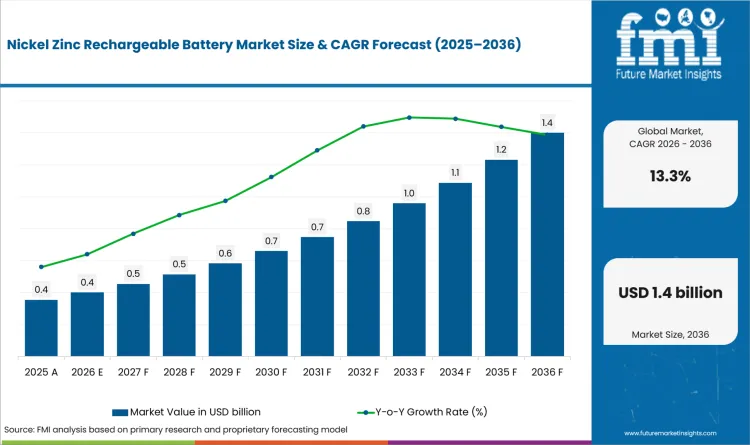
Key Takeaways of Nickel Zinc Rechargeable Battery Market
- Immediate-power requirements support nickel-zinc demand across data centers and critical facilities that value compact discharge capability without cell-level thermal runaway exposure.
- By product type, AAA nickel zinc batteries are projected to account for 31.0% share in 2026 owing to standardized dimensions and higher nominal voltage.
- Consumer electronics is estimated to hold 29.0% share of application demand in 2026 because selected devices benefit from strong pulse delivery.
- Consumer electronics manufacturers are forecast to represent 27.0% share by end-user in 2026, reflecting their control over voltage limits and charger specifications.
- Zinc deposition behavior and material redistribution can weaken capacity retention across repeated cycling unless electrode design and charging protocols remain tightly controlled.
- ZincFive and Æsir address engineered systems while Vertiv supports UPS integration and Gold Peak adds dedicated nickel-zinc manufacturing for immediate-power applications.
Analyst Perspective
“Nickel-zinc creates value through rapid power delivery rather than broad claims that one chemistry suits every storage duty. Data center cabinets need compact output and dependable field support, while portable cells require verified device voltage and matched charging. The commercial test is retained performance across the intended duty cycle with a clear replacement plan. Providers that connect chemistry control with application engineering can convert qualification into repeat orders without shifting risk to the equipment operator.”
- Sudip saha, Principal Analyst, Future Market Insights
How is the Nickel Zinc Rechargeable Battery Market segmented?
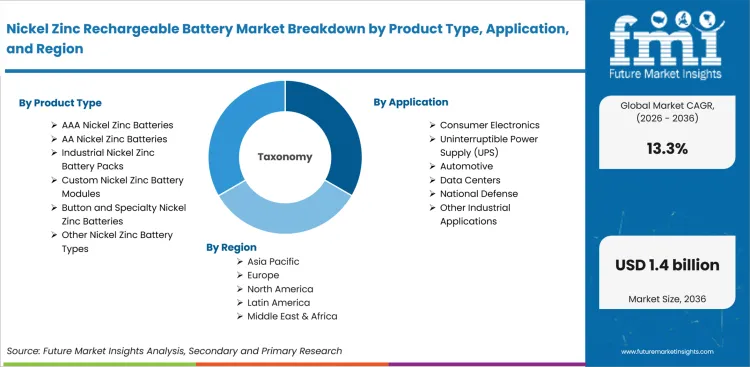
The Nickel Zinc Rechargeable Battery Market is segmented by Product Type, Application, End User, Distribution Channel, Battery Capacity, and Region.
The segmentation framework separates battery format, operating use, customer group, sales route, stored charge, and geography. Product type covers standardized AA and AAA cells alongside industrial cells, packs, and complete modules. Application distinguishes consumer electronics, backup power, data centers, telecommunications, defense, and equipment with different discharge profiles. End-user analysis identifies the organization that controls product qualification and accepts warranty responsibility across each commercial application. Distribution channel separates direct technical contracts from distributor, retail, and online routes with different service responsibilities. Battery capacity groups products by rated charge storage without assuming that a larger rating provides better performance. Regional analysis examines regulations, service access, and manufacturing reach across every profiled country and operating environment.
How do AAA Nickel Zinc Batteries shape demand in the Product Type category?
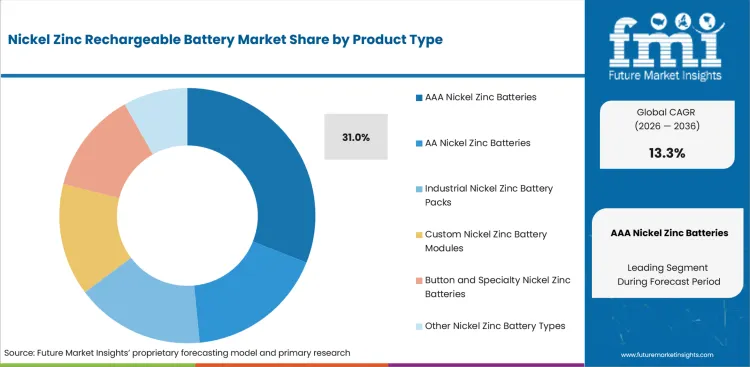
AAA nickel-zinc cells fit compact products that use standardized battery compartments and short high-power discharge events. The European Commission published replacement guidelines in January 2025 that define compatible portable batteries and require clear technical specifications for safe substitution. The guidance strengthens the commercial value of accurate voltage and charger information across replaceable consumer cells. AAA programs therefore depend on device approval and matched charging rather than broad claims about rechargeable chemistry. Industrial battery systems follow a separate commercial route through engineered enclosures and monitoring controls with accountable field service.
- AAA nickel zinc batteries are projected to hold 31.0% share in 2026 owing to standardized dimensions and compatibility with selected high-drain devices. The format allows electronics brands to test a higher-voltage rechargeable option without redesigning the battery compartment. Its position depends on stable output and clear charger requirements across approved device families during repeated qualification tests.
- Consumer brands support AAA adoption through matched chargers and device-specific compatibility guidance across packaged battery sets. Clear instructions reduce incorrect substitution with lower-voltage rechargeable formats and protect warranty decisions during field returns. Repeat demand develops through consistent runtime and acceptable storage performance across the named device category rather than initial voltage alone.
What keeps consumer electronics ahead within the application category?
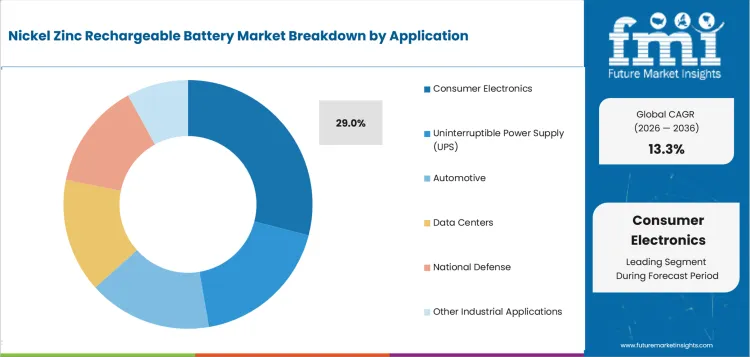
Consumer electronics programs assess the complete device before approving a rechargeable battery technology with a different voltage profile. The European Commission adopted Regulation 2025/2052 in October 2025 with interoperability and information requirements for chargers used with portable AA and AAA batteries. The regulation confirms that charger design and product guidance remain part of the operating system rather than a separate accessory decision. Commercial acceptance therefore requires approved device lists and charging instructions across cameras and other portable electronics.
- The consumer electronics segment is likely to capture 29.0% share in 2026 attributable to applications that value strong pulse delivery from compact cells. Device engineers must confirm that the higher nominal voltage remains inside approved operating limits across the complete discharge profile. The segment retains its position through documented compatibility and reliable runtime across named product families during normal operating conditions.
- Retail conversion improves through battery-and-charger kits that simplify chemistry selection for the end user across supported portable devices. Packaged sets reduce confusion between nickel-zinc cells and lower-voltage rechargeable alternatives across common portable products. Recurring purchases depend on stable device performance and clear warranty guidance across each approved application rather than unrestricted substitution claims.
Which buying mechanism supports consumer electronics manufacturers in the end user category?
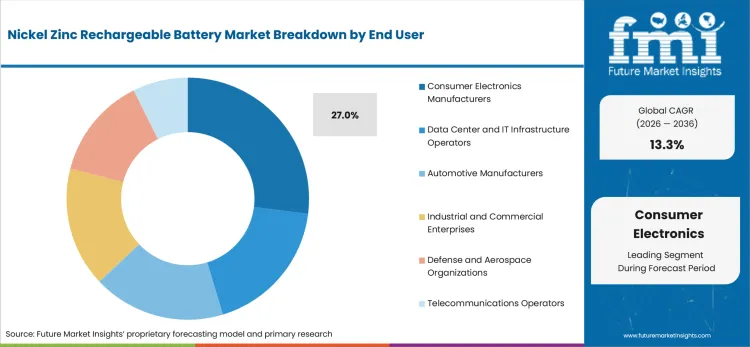
Consumer electronics manufacturers control voltage windows and charging specifications during device design and production qualification. The July 2025 consolidated European Union Batteries Regulation requires capacity labels for rechargeable portable batteries and assigns accurate product information to economic operators. The labeling rules connect battery selection with traceable product records across every approved portable-device family. Manufacturer-led programs therefore need controlled cell lots and documented charging limits because open-market substitution weakens warranty review across production runs.
- The end-user category is forecast to be led by consumer electronics manufacturers at 27.0% share in 2026 due to direct control over electrical design. Early qualification connects the selected cell with approved component records and charger limits across contracted production programs. Manufacturer control reduces redesign risk across device families that share one electrical architecture and common warranty requirements.
- Electronics manufacturers expand adoption through approved cell lots and production testing across contracted assembly plants. Traceable records help warranty teams separate battery defects from charging misuse or assembly variation during returns. Contract manufacturers gain a defined acceptance route that supports recurring orders across compatible devices without depending on uncontrolled replacement choices.
What supports the position of direct sales within the distribution channel category?
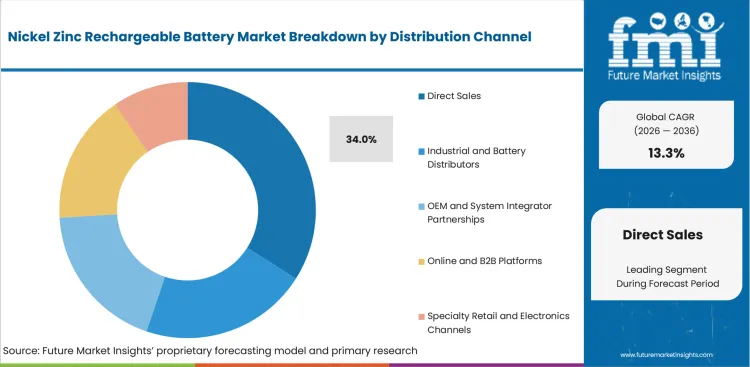
Industrial nickel-zinc installations require technical proposals that combine batteries and controls with commissioning and regional service. ZincFive opened an EMEA warehouse and service depot with Akkuteam in May 2025 to improve battery delivery and spare-parts access. The development directly strengthens project execution across critical-power installations that need accountable support and dependable replacement-part access. Direct sales therefore fits systems that require site engineering and coordinated maintenance responsibility across multiple commercial locations. Modular UPS architectures also demand verified cabinet compatibility during retrofit planning for operating facilities with limited shutdown windows.
- By distribution channel, direct sales is estimated to hold 34.0% in 2026 owing to project-specific engineering and service commitments. Large installations need one accountable commercial route for sizing and commissioning decisions across the complete deployment schedule. Direct contracts assign responsibility for installation schedules and field performance across mission-critical facilities with defined support requirements.
- Technical sales teams improve conversion through cabinet-compatibility records and confirmed spare-parts availability across each service region. Standard distributors remain suitable for packaged cells but provide less control over infrastructure commissioning and field-service accountability. Regional depots become decisive for operators that require rapid replacements and chemistry-specific support across several critical sites.
Why does low capacity (<1,000 mAh) lead the battery capacity category?
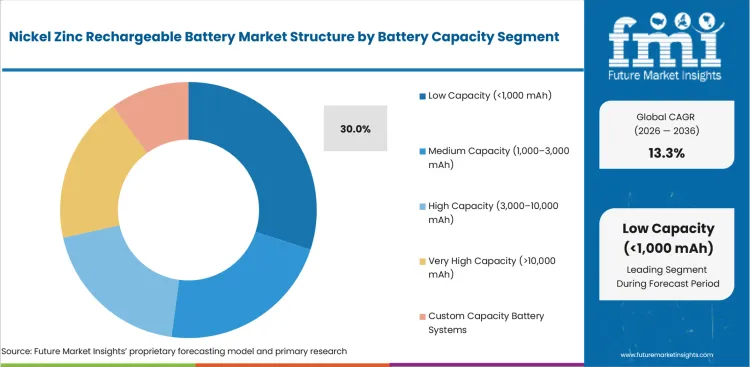
Low-capacity cells fit compact products that value voltage and pulse power more than extended runtime across portable applications. The European Commission notified draft harmonized battery-label specifications in December 2025 for requirements under the European Union Batteries Regulation. The notification directly affects small cylindrical formats through limited labeling space and defined packaging information duties. Small-cell programs therefore need packaging and charger instructions that preserve chemistry identification throughout retail distribution. The commercial case remains tied to retained performance inside the intended portable equipment throughout normal use.
- Based on battery capacity, low capacity batteries below 1,000 mAh are projected to account for 30.0% in 2026 due to compact-device requirements. Smaller cells support controlled qualification without committing manufacturers to large pack-development budgets during early application testing. Their position depends on adequate pulse output and acceptable storage performance across the approved device.
- Manufacturers support low-capacity adoption through matched chargers and documented performance across defined portable applications and expected storage periods. Qualification teams compare watt-hours and nominal voltage rather than using milliampere-hours alone across different chemistries. Expansion into larger battery systems requires separate evidence on balancing and lifetime performance instead of extrapolation from small cylindrical cells.
What are the drivers, restraints, and opportunities in the Nickel Zinc Rechargeable Battery Market?
Immediate-power requirements support nickel-zinc systems across compact critical-power installations. Zinc deposition instability can reduce usable cycle life. Retrofit and AI-load applications create a defined commercial opening for integrated cabinets with verified service support.
- Driver: Data centers need compact batteries that respond to rapid load changes without cell-level thermal runaway exposure across occupied technical facilities.
- Restraint: Zinc deposition and material redistribution can reduce capacity retention across repeated high-rate duty cycles without disciplined charge control.
- Opportunity: Retrofit and AI-load projects can use integrated nickel-zinc cabinets when immediate power and floor-space efficiency justify chemistry-specific qualification.
Immediate-power duty is one of the factor driving demand for industrial nickel-zinc systems across data centers and other critical facilities. ZincFive reported in April 2025 that 54% of surveyed data center professionals identified higher power density and smaller footprints as an AI-related requirement. The survey supports compact power architecture without proving that facilities selected nickel-zinc battery systems commercially. Data center operators compare nickel-zinc with stationary lead-acid storage through floor-space use and planned replacement requirements. Commercial orders require site testing that separates rapid load support from the longer runtime needed during sustained outages.
Zinc electrode behavior remains the technical restraint during repeated charging and high-rate discharge across commercial duty profiles. A Brookhaven-supported study published in August 2025 found that zinc deposition conditions can create dense layers or porous dendritic growth. The research explains cycling control without proving commercial nickel-zinc adoption across operating battery systems independently. Cell manufacturers must translate those findings into stable production lots and documented charging limits for each intended duty cycle. Project teams should compare retained capacity at a stated discharge depth rather than relying on initial power ratings.
Stationary battery storage projects is expected to offer an opportunity for nickel-zinc providers that combine cells with controls and regional service. Japan’s Ministry of Economy, Trade and Industry revised its battery strategy in June 2026 to include power-control needs from AI data centers. The policy identifies an infrastructure requirement without selecting one battery chemistry for adoption or public support. Nickel-zinc systems can compete through rapid discharge and nonflammable aqueous chemistry across defined immediate-power duties. Providers must state the intended duty cycle clearly since these systems do not replace every long-duration storage design.
Which country CAGRs are profiled in the Nickel Zinc Rechargeable Battery Market?
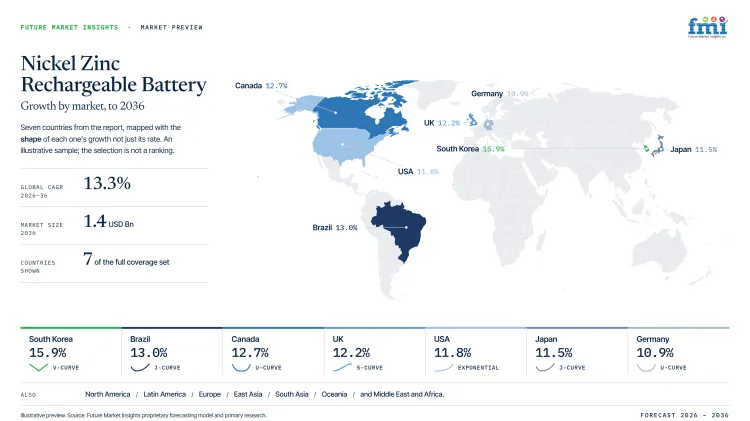
| Country | CAGR |
|---|---|
| South Korea | 15.9% |
| Brazil | 13.0% |
| Canada | 12.7% |
| UK | 12.2% |
| USA | 11.8% |
| Japan | 11.5% |
| Germany | 10.9% |
How do country-level CAGRs compare in the Nickel Zinc Rechargeable Battery Market?
The seven forecasts form a gradual progression with one visible gap between South Korea and Brazil. Brazil and Canada remain closely aligned despite different purchasing routes for critical-power equipment and portable rechargeable cells. Canada connects the middle of the comparison with the UK through formal replacement programs and regional service requirements. The USA and Japan show similar momentum despite different purchasing routes across defense manufacturing and battery traceability programs. Germany remains near Japan but relies more heavily on portable-battery collection duties and established retail compliance.
- South Korea combines established electronics channels with strict charger certification and detailed documentation expectations across portable rechargeable products.
- Brazil presents a critical-power route through concentrated data center projects and local engineering partners across major metropolitan areas.
- Canada relies on formal critical-power contracts and planned equipment replacement across public and defense facilities.
- The UK combines resilience requirements with constrained grid-access schedules across planned new data center capacity.
- The USA has direct nickel-zinc activity across data centers and defense manufacturing programs with different qualification routes.
- Japan places greater emphasis on battery traceability and documented lifecycle responsibility across commercial power systems.
- Germany combines mature electronics channels with formal collection obligations for portable batteries and packaged charging products.
Comparable CAGRs can produce different commercial returns as qualification duties and service coverage change national expansion costs. The full report provides country-level CAGR analysis across North America, Latin America, Europe, East Asia, South Asia, Oceania and the Middle East and Africa.
Country-wise Analysis
- South Korean market entry requires certified charging equipment and clear Korean-language instructions across portable rechargeable products. The Korean Agency for Technology and Standards published revised household battery-charger safety requirements in July 2025 under KC 60335-2-29. Nickel-zinc rechargeable battery sales in South Korea are forecast to expand at 15.9% CAGR by 2036, reinforced by strict charger and product-safety expectations. The standard supports a defined compliance route but does not remove device-level voltage testing across approved consumer equipment. Local electronics channels enable packaged cell-and-charger launches through established retail and online sales networks across major cities. Certification expense and strict return policies remain material frictions for manufacturers without reliable local technical support.
- Brazilian critical-power projects face imported-equipment exposure and long service distances beyond major metropolitan engineering hubs. Adoption of nickel-zinc rechargeable batteries in Brazil is estimated to expand at 13.0% CAGR through 2036, shaped by concentrated infrastructure projects. Local engineering partners can support cabinet trials at facilities with defined maintenance ownership and accessible replacement parts. The Ministry of Communications reported in May 2026 that approved funding would expand fiber and data center infrastructure across five states. The investment establishes an infrastructure route rather than direct evidence of nickel-zinc selection across funded facilities. Customs timing and regional spare-parts coverage remain material frictions for expansion outside established service hubs.
- Canadian critical-power projects require dependable support across widely separated facilities and severe winter operating conditions. Canada’s nickel-zinc rechargeable battery outlook is anticipated to advance at 12.7% CAGR over the assessment period, linked to formal replacement programs. CanadaBuys recorded an April 2025 contract for a backup-power supply refit at Canadian Forces Base Halifax. The contract establishes a documented route for qualified critical-power equipment without serving as evidence of nickel-zinc battery selection. Regional service agreements can enable chemistry trials across facilities with defined maintenance responsibility and scheduled replacement support. Long travel distances and stocked-parts requirements remain material commercial frictions outside major Canadian cities and established service hubs.
- UK data center projects operate within a constrained grid-connection process and demanding resilience expectations across planned capacity programs. The government reported in March 2026 that the demand-connection queue had grown 460% within six months. Approved grid access enables new UPS installations across sites with confirmed operating schedules and funded construction programs. The UK nickel-zinc rechargeable battery sector is projected to record 12.2% CAGR during the assessment period, supported by critical-power replacement activity. Retrofit-compatible systems can preserve existing cabinets and reduce construction work during planned data center capacity upgrades. Grid delays remain a material timing friction for providers that need coordinated service coverage across operating facilities.
- United States demand combines hyperscale data centers with defense programs that require domestic qualification and manufacturing assurance. Nickel-zinc rechargeable battery demand in the USA is forecast to rise at 11.8% CAGR over the forecast period, influenced by immediate-power and resilience projects. The Defense Logistics Agency documented a March 2026 project that advances nickel-zinc manufacturing for subsurface naval applications. Domestic production enables defense qualification and reduces dependence on imported critical-power components across protected military supply chains. Battery energy storage systems provide a broader purchasing route across critical facilities with defined resilience and maintenance budgets. Lengthy validation remains the main commercial friction despite local engineering support and documented domestic manufacturing activity.
- Japanese purchasers emphasize traceability and dependable product records across individual cells and complete commercial power systems. Behind-the-meter storage programs create an adjacent route for battery controls and lifecycle documentation across commercial facilities. In Japan, nickel-zinc rechargeable battery demand is predicted to advance at 11.5% CAGR through 2036. The Ministry of Economy, Trade and Industry opened a battery-passport demonstration project in May 2025. Detailed records enable manufacturers to document chemistry and replacement responsibility across every qualified commercial battery system throughout planned service intervals. Extended approval remains a material friction for companies without stable lifecycle data and dependable local technical support.
- Germany combines mature electronics channels with strict expectations for product safety and recycling documentation across portable battery categories. The Federal Environment Ministry reported in December 2025 that national rules retained a 50% portable-battery collection rate through 2026. Defined take-back obligations enable packaged nickel-zinc cells and matched chargers across consumer categories with established collection routes. By 2036, Germany’s nickel-zinc rechargeable battery market is projected to grow at 10.9% CAGR due to standardized formats and industrial backup applications. Retail launches require German-language compatibility guidance across approved devices and established regional after-sales service channels. Strong incumbent brands and accessible returns remain material commercial frictions for new entrants without recognized local distribution partners.
Who are the notable companies in the Nickel Zinc Rechargeable Battery Market?
The competitive set includes ZincFive, Inc., Æsir Technologies, Inc., Vertiv Holdings Co., ANSMANN AG, Henan Chaoli New Energy Co., Ltd., Shenzhen Better Power Battery Co., Ltd., Shenzhen Melasta Battery Co., Ltd., and Gold Peak Technology Group Limited
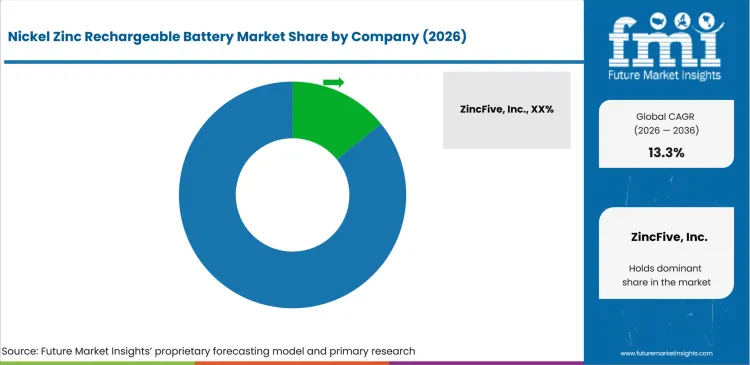
System-scale specialists in the industry are focusing on proprietary nickel-zinc engineering for critical infrastructure and defense programs with extended qualification requirements. UPS platform companies integrate partner-owned cabinets with qualified power systems and regional service networks across established customer channels. ZincFive and Æsir address projects requiring chemistry control and manufacturing responsibility across critical-power or defense applications. Vertiv integrates ZincFive cabinets with selected UPS platforms across North America and EMEA through regional technical service. Gold Peak adds dedicated nickel-zinc manufacturing through GP Energy Tech and a planned multi-region production route. ANSMANN serves packaged consumer formats, while Henan Chaoli and Better Power provide cells alongside Melasta’s customized configurations. Commercial comparisons must separate chemistry ownership from application engineering and regional delivery responsibility across each customer program.
- ZincFive and Æsir Technologies hold system-level positions through documented nickel-zinc engineering for critical infrastructure and defense applications. Their offers require extended qualification and support higher-value contracts that include installation or manufacturing responsibility. Data center operators and defense program managers compare demonstrated power delivery and accountable service across defined commercial programs.
- Gold Peak combines dedicated nickel-zinc manufacturing with a multi-country battery business through GP Energy Tech. Henan Chaoli and Better Power compete with Melasta through cell production and customized battery configurations for commercial equipment programs. Equipment manufacturers prioritize lot consistency and responsive engineering before approving wider purchasing across portable or industrial product lines.
- ANSMANN provides packaged consumer formats while Vertiv offers ZincFive cabinets through selected UPS platforms across critical-power installations. Vertiv’s current product listing confirms commercial availability with warranty terms and regional service contacts for qualified deployments. Their roles depend on compatibility guidance and support coverage rather than independent control of nickel-zinc chemistry.
Competitive Benchmarking: Nickel Zinc Rechargeable Battery Market
| Company | Nickel-Zinc Technology Control | Application Engineering | Commercial Delivery Support | Geographic Reach |
|---|---|---|---|---|
| ZincFive, Inc. | High | High | High | Global |
| Æsir Technologies, Inc. | High | High | Medium | North America |
| ANSMANN AG | Low | Medium | High | Europe and international subsidiaries |
| Henan Chaoli New Energy Co., Ltd. | Medium | Medium | Medium | Asia and export channels |
| Shenzhen Better Power Battery Co., Ltd. | Medium | High | High | Global |
| Shenzhen Melasta Battery Co., Ltd. | Medium | High | High | Global |
| Vertiv Holdings Co. | Low | High | High | North America and EMEA |
| Gold Peak Technology Group Limited | High | Medium | High | Global |
Key Developments in the Nickel Zinc Rechargeable Battery Market
- In April 2026, ZincFive announced a nickel-zinc retrofit kit that replaces valve-regulated lead-acid batteries inside existing UPS cabinet enclosures. The design targets operating data centers that need a chemistry upgrade without cabinet replacement or major disruption during scheduled maintenance. The development lowers an installation barrier by preserving existing infrastructure and defining nickel-zinc performance and service requirements across qualified commercial sites.
- In January 2026, Gold Peak Technology Group launched GP Energy Tech’s first nickel-zinc battery manufacturing facility in Dongguan. The site has an initial capacity target of 20 million cells per year by the end of 2026. Dedicated production gives the group direct control over manufacturing scale and creates another commercial supply route for data center UPS systems and other immediate-power applications.
- In January 2025, Æsir Technologies announced a firm-fixed-price production contract through BlueForge Alliance for naval nickel-zinc batteries in Missouri. The project requires new equipment and qualification for large-format 1,100 Ah cells used in subsurface naval applications. The investment links dedicated manufacturing capacity with a documented domestic route for defense programs that require high-rate performance and controlled production standards across protected supply chains.
- In May 2025, Hindustan Zinc reported that its collaboration with Æsir Technologies would provide technical input and specialized commercial alloys for nickel-zinc commercialization. The arrangement connects material consistency with cell manufacturing requirements rather than a general research program. The partnership gives industrial producers a defined route for improving battery materials as Æsir scales systems for defense and critical-infrastructure applications across qualified production programs.
Key Players in the Nickel Zinc Rechargeable Battery Market
Core Technology and Product Providers
- ZincFive, Inc.
- Æsir Technologies, Inc.
- Gold Peak Technology Group Limited
Integrated Service and Platform Participants
- Vertiv Holdings Co.
- Shenzhen Better Power Battery Co., Ltd.
- Shenzhen Melasta Battery Co., Ltd.
Specialist and Regional Challengers
- ANSMANN AG
- Henan Chaoli New Energy Co., Ltd.
Nickel Zinc Rechargeable Battery Market - Report Scope
| Coverage field | Report scope |
|---|---|
| Market breakdown | Product Type, Application, End User, Distribution Channel, Battery Capacity, and Region. |
| Market Definition | Rechargeable nickel-zinc cells, industrial packs, chargers, battery controls, and integrated systems used across consumer electronics, backup power, data centers, automotive auxiliaries, defense, telecommunications, and industrial equipment. |
| Regions Covered | North America, Latin America, Europe, East Asia, South Asia, Oceania, and Middle East and Africa. |
| Countries Covered | South Korea, Brazil, Canada, UK, USA, Japan, and Germany. |
| Key Companies Profiled | ZincFive, Inc., Æsir Technologies, Inc., Vertiv Holdings Co., ANSMANN AG, Henan Chaoli New Energy Co., Ltd., Shenzhen Better Power Battery Co., Ltd., Shenzhen Melasta Battery Co., Ltd., and Gold Peak Technology Group Limited |
| Forecast Period | 2026 to 2036. |
| Approach | Hybrid bottom-up and top-down market sizing supported by primary interviews and official desk research. |
Nickel Zinc Rechargeable Battery Market - Research Methodology
| Method | Approach |
|---|---|
| Primary Research | FMI analysts gathered input from manufacturers, service providers, technology developers, distributors, end users, procurement teams, and subject-matter experts. Interviews examined purchasing decisions, product or service evaluation, adoption barriers, approval requirements, pricing considerations, and expectations for technical or commercial support. Respondents were also asked what evidence is required before a trial, pilot, or initial order develops into regular purchasing. |
| Desk Research | Desk research covered government statistics, regulatory publications, trade data, industry associations, technical literature, standards, company filings, product information, and official corporate announcements. Sources were reviewed for relevance, publication date, geographic coverage, and consistency with the defined market scope. Claims relating to performance, applications, approvals, capacity, investment, and commercial activity were retained only when supported by credible public evidence. |
| Market Sizing and Forecasting | The market model combined the baseline value with historical performance, segment structure, pricing and volume indicators, adoption levels, company participation, and country-level demand conditions. Forecast assumptions considered economic activity, investment trends, regulatory developments, technology adoption, purchasing cycles, supply availability, and barriers to wider market use. Segment and regional estimates were reconciled before the final market total was calculated. |
| Data Validation | Estimates were checked against multiple independent indicators, including public data, company activity, trade patterns, industry developments, and findings from primary interviews. Validation also tested whether products, services, applications, and company revenues fell within the defined market boundaries. Adjacent categories, unsupported claims, overlapping revenues, and activities without direct market relevance were excluded to reduce double counting and maintain consistency across segments and countries. |
Nickel Zinc Rechargeable Battery Market by Segments
Nickel Zinc Rechargeable Battery Market segmented by Product Type:
- AAA Nickel Zinc Batteries
- Standard AAA Nickel Zinc Batteries
- High-Capacity AAA Nickel Zinc Batteries
- AA Nickel Zinc Batteries
- Standard AA Nickel Zinc Batteries
- High-Capacity AA Nickel Zinc Batteries
- Industrial Nickel Zinc Battery Packs
- Stationary Battery Packs
- High-Power Industrial Packs
- Custom Nickel Zinc Battery Modules
- Custom-Designed Battery Modules
- Integrated Battery Modules
- Button and Specialty Nickel Zinc Batteries
- Button Cell Batteries
- Specialty Form-Factor Batteries
- Other Nickel Zinc Battery Types
- Rechargeable Nickel Zinc Cells
- Prototype and Emerging Battery Formats
Nickel Zinc Rechargeable Battery Market segmented by Application:
- Consumer Electronics
- Remote Controls and Portable Electronics
- Cordless Devices and Accessories
- Uninterruptible Power Supply (UPS)
- Small-Scale UPS Systems
- Data Center UPS Systems
- Automotive
- Auxiliary Vehicle Systems
- Automotive Electronic Systems
- Data Centers
- Data Center Backup Power
- Server and Network Infrastructure
- National Defense
- Military Electronics
- Defense Communication Systems
- Other Industrial Applications
- Telecommunications Backup
- Industrial Equipment and Controls
Nickel Zinc Rechargeable Battery Market segmented by End User:
- Consumer Electronics Manufacturers
- Portable Electronics Manufacturers
- Consumer Device OEMs
- Data Center and IT Infrastructure Operators
- Data Center Operators
- Cloud and Network Infrastructure Providers
- Automotive Manufacturers
- Passenger Vehicle OEMs
- Commercial Vehicle OEMs
- Industrial and Commercial Enterprises
- Industrial Equipment Manufacturers
- Commercial Facility Operators
- Defense and Aerospace Organizations
- Defense Contractors
- Aerospace Systems Manufacturers
- Telecommunications Operators
- Telecom Network Operators
- Communication Infrastructure Providers
Nickel Zinc Rechargeable Battery Market segmented by Distribution Channel:
- Direct Sales
- Direct Manufacturer Sales
- Long-Term Enterprise Contracts
- Industrial and Battery Distributors
- Regional Battery Distributors
- Specialized Energy Storage Distributors
- OEM and System Integrator Partnerships
- Battery System Integrators
- Equipment OEM Partnerships
- Online and B2B Platforms
- Industrial E-Commerce Platforms
- B2B Purchasing Portals
- Specialty Retail and Electronics Channels
- Electronics Retailers
- Specialty Battery Retailers
Nickel Zinc Rechargeable Battery Market segmented by Battery Capacity:
- Low Capacity (<1,000 mAh)
- Standard Low-Capacity Cells
- High-Performance Low-Capacity Cells
- Medium Capacity (1,000-3,000 mAh)
- Standard Medium-Capacity Cells
- High-Capacity Medium Cells
- High Capacity (3,000-10,000 mAh)
- Standard High-Capacity Cells
- High-Power High-Capacity Cells
- Very High Capacity (>10,000 mAh)
- Industrial High-Capacity Packs
- Stationary Storage Packs
- Custom Capacity Battery Systems
- Custom Battery Modules
- Application-Specific Battery Packs
Nickel Zinc Rechargeable Battery Market by Region:
- North America
- United States
- Canada
- Europe
- Germany
- United Kingdom
- France
- Italy
- Spain
- Asia Pacific
- India
- China
- Japan
- South Korea
- Australia
- Latin America
- Brazil
- Argentina
- Mexico
- Chile
- Middle East & Africa
- UAE
- Saudi Arabia
- South Africa
Research Sources and Bibliography
- ZincFive, Inc. (2026, April 14).
- Smith, S. J., Hubbard, A., Newkirk, A., Ganeshalingam, M., Holecek, B., Sartor, D. A., Mills, M., & Shehabi, A. (2026, June).
- European Commission. (2025, January 10).
- European Commission. (2025, October 13).
- European Parliament and Council of the European Union. (2025, July 31).
- ZincFive, Inc. (2025, May 22)
- European Commission. (2025, December 22).
- Ma, Y., Pepas, J., Zhang, G., Liu, Z., Su, Y., Bai, J., Zhong, H., Li, T., Xu, W., Kang, M., Carsley, J., Kacher, J., & Chen, H. (2025, August 12).
- Ministry of Economy, Trade and Industry. (2026, June 2).
- Korean Agency for Technology and Standards. (2025, July 7).
- Ministry of Communications. (2026, May 22).
- Government of Canada. (2025, April 14).
- Department for Energy Security and Net Zero. (2026, March 11)
- Defense Logistics Agency. (2026, March 4).
- Ministry of Economy, Trade and Industry. (2025, May 9).
- Federal Ministry for the Environment, Climate Action, Nature Conservation and Nuclear Safety. (2025, December 10).
- Shenzhen Better Power Battery Co., Ltd.
- Shenzhen Melasta Battery Co., Ltd.
- Shenzhen Melasta Battery Co., Ltd.
- Vertiv Holdings Co.
- ZincFive, Inc. (2026, April 8).
- Gold Peak Technology Group Limited. (2026, January 9).
- Æsir Technologies, Inc. (2025, June 4)
- Hindustan Zinc Limited. (2025, May 6).
This bibliography is provided for reader reference and is not exhaustive. The full report contains the complete reference list and detailed citations.
This Report Answers
- How large is the Nickel Zinc Rechargeable Battery Market in 2026 and 2036?
- Which operating needs support investment in nickel-zinc cells and immediate-power systems?
- Why do AAA nickel zinc batteries leads by product type in 2026?
- How does Consumer Electronics influence qualification and charger requirements?
- Why does Direct Sales account for leading share in 2026?
- How do commercial growth routes differ across the seven profiled countries?
- Which companies provide system-scale solutions, industrial cells, or packaged consumer products?
- What technical conditions limit cycle life across rechargeable nickel-zinc batteries?
- How do stationary applications support wider adoption without overstating long-duration storage capabilities?
Frequently Asked Questions
How big is the Nickel Zinc Rechargeable Battery Market in 2026?
The nickel zinc rechargeable battery market is valued at USD 400 million in 2026 and is forecast to reach USD 1,400 million by 2036, reflecting growing deployment in data center UPS systems that require compact immediate-power cabinets without cell-level thermal runaway exposure.
What is the CAGR of the Nickel Zinc Rechargeable Battery Market from 2026 to 2036?
The nickel zinc rechargeable battery market is projected to grow at a CAGR of 13.3% between 2026 and 2036, supported by expanding data center infrastructure that values rapid discharge performance and compact power delivery across occupied technical facilities.
Which product type leads the Nickel Zinc Rechargeable Battery Market?
AAA nickel zinc batteries account for 31.0% of the nickel zinc rechargeable battery market by product type in 2026, driven by standardized dimensions and higher nominal voltage that allow electronics brands to test a rechargeable option without redesigning existing battery compartments.
Who are the leading companies in the Nickel Zinc Rechargeable Battery Market?
Leading companies in the nickel zinc rechargeable battery market include ZincFive Inc., Æsir Technologies Inc., Vertiv Holdings Co., ANSMANN AG, Henan Chaoli New Energy Co. Ltd., Shenzhen Better Power Battery Co. Ltd., Shenzhen Melasta Battery Co. Ltd., and Gold Peak Technology Group Limited, spanning system-scale critical-power engineering, UPS integration, and packaged consumer cell manufacturing.
Preview the report firsthand - request a free sample
Get SampleGet the brochure for pricing and purchase details.
Get PDFTable of Content
- Key Takeaways
- Market Size and CAGR
- Top Growth Driver
- Fastest Growing Segment
- Leading Region
- Key Companies
- Emerging Opportunities
- Executive Summary
- Global Market Outlook
- Demand-side Trends
- Supply-side Trends
- Technology Roadmap Analysis
- Analysis and Recommendations
- Analyst Perspective (What is happening? Why now? What should investors know?)
- Key Questions Answered
- How large is the market?
- What is the CAGR?
- What are key trends?
- Which region dominates?
- Who are the leaders?
- Market Overview
- Market Coverage / Taxonomy
- Market Definition / Scope / Limitations
- Research Methodology
- Chapter Orientation
- Analytical Lens and Working Hypotheses
- Market Structure, Signals, and Trend Drivers
- Benchmarking and Cross-market Comparability
- Market Sizing, Forecasting, and Opportunity Mapping
- Research Design and Evidence Framework
- Desk Research Programme (Secondary Evidence)
- Expert Input and Fieldwork (Primary Evidence)
- Tooling, Models, and Reference Databases
- Data Engineering and Model Build
- Quality Assurance and Audit Trail
- Market Background
- Market Dynamics (Drivers, Restraints, Opportunity, Trends)
- Scenario Forecast (Optimistic, Likely, Conservative)
- Impact Analysis
- AI Impact
- Sustainability Impact
- Regulatory Impact
- Technology Impact
- Consumer / Buyer Analysis
- Purchase Drivers
- Adoption Barriers
- Buyer Journey
- Opportunity Map Analysis
- Product Life Cycle Analysis
- Supply Chain Analysis
- Investment Feasibility Matrix
- Value Chain Analysis
- PESTLE and Porter's Analysis
- Regulatory Landscape
- Regional Parent Market Outlook
- Production and Consumption Statistics
- Import and Export Statistics
- Global Market Analysis and Forecast, 2021 to 2036
- Historical Market Size Value (USD billion) Analysis, 2021 to 2025
- Current and Future Market Size Value (USD billion) Projections, 2026 to 2036
- Y-o-Y Growth Trend Analysis
- Absolute $ Opportunity Analysis
- Global Market Pricing Analysis, 2021 to 2036
- Global Market Analysis and Forecast, By Product Type, 2021 to 2036
- Introduction / Key Findings
- Historical Market Size Value (USD billion) Analysis By Product Type, 2021 to 2025
- Current and Future Market Size Value (USD billion) Analysis and Forecast By Product Type, 2026 to 2036
- AAA Nickel Zinc Batteries
- Standard AAA Nickel Zinc Batteries
- High-Capacity AAA Nickel Zinc Batteries
- AA Nickel Zinc Batteries
- Standard AA Nickel Zinc Batteries
- High-Capacity AA Nickel Zinc Batteries
- Industrial Nickel Zinc Battery Packs
- Stationary Battery Packs
- High-Power Industrial Packs
- Custom Nickel Zinc Battery Modules
- Custom-Designed Battery Modules
- Integrated Battery Modules
- Button and Specialty Nickel Zinc Batteries
- Button Cell Batteries
- Specialty Form-Factor Batteries
- Other Nickel Zinc Battery Types
- Rechargeable Nickel Zinc Cells
- Prototype and Emerging Battery Formats
- AAA Nickel Zinc Batteries
- Y-o-Y Growth Trend Analysis By Product Type, 2021 to 2025
- Absolute $ Opportunity Analysis By Product Type, 2026 to 2036
- Global Market Analysis and Forecast, By Application, 2021 to 2036
- Introduction / Key Findings
- Historical Market Size Value (USD billion) Analysis By Application, 2021 to 2025
- Current and Future Market Size Value (USD billion) Analysis and Forecast By Application, 2026 to 2036
- Consumer Electronics
- Remote Controls and Portable Electronics
- Cordless Devices and Accessories
- Uninterruptible Power Supply (UPS)
- Small-Scale UPS Systems
- Data Center UPS Systems
- Automotive
- Auxiliary Vehicle Systems
- Automotive Electronic Systems
- Data Centers
- Data Center Backup Power
- Server and Network Infrastructure
- National Defense
- Military Electronics
- Defense Communication Systems
- Other Industrial Applications
- Telecommunications Backup
- Industrial Equipment and Controls
- Consumer Electronics
- Y-o-Y Growth Trend Analysis By Application, 2021 to 2025
- Absolute $ Opportunity Analysis By Application, 2026 to 2036
- Global Market Analysis and Forecast, By End User, 2021 to 2036
- Introduction / Key Findings
- Historical Market Size Value (USD billion) Analysis By End User, 2021 to 2025
- Current and Future Market Size Value (USD billion) Analysis and Forecast By End User, 2026 to 2036
- Consumer Electronics Manufacturers
- Portable Electronics Manufacturers
- Consumer Device OEMs
- Data Center and IT Infrastructure Operators
- Data Center Operators
- Cloud and Network Infrastructure Providers
- Automotive Manufacturers
- Passenger Vehicle OEMs
- Commercial Vehicle OEMs
- Industrial and Commercial Enterprises
- Industrial Equipment Manufacturers
- Commercial Facility Operators
- Defense and Aerospace Organizations
- Defense Contractors
- Aerospace Systems Manufacturers
- Telecommunications Operators
- Telecom Network Operators
- Communication Infrastructure Providers
- Consumer Electronics Manufacturers
- Y-o-Y Growth Trend Analysis By End User, 2021 to 2025
- Absolute $ Opportunity Analysis By End User, 2026 to 2036
- Global Market Analysis and Forecast, By Distribution Channel, 2021 to 2036
- Introduction / Key Findings
- Historical Market Size Value (USD billion) Analysis By Distribution Channel, 2021 to 2025
- Current and Future Market Size Value (USD billion) Analysis and Forecast By Distribution Channel, 2026 to 2036
- Direct Sales
- Direct Manufacturer Sales
- Long-Term Enterprise Contracts
- Industrial and Battery Distributors
- Regional Battery Distributors
- Specialized Energy Storage Distributors
- OEM and System Integrator Partnerships
- Battery System Integrators
- Equipment OEM Partnerships
- Online and B2B Platforms
- Industrial E-Commerce Platforms
- B2B Procurement Portals
- Specialty Retail and Electronics Channels
- Electronics Retailers
- Specialty Battery Retailers
- Direct Sales
- Y-o-Y Growth Trend Analysis By Distribution Channel, 2021 to 2025
- Absolute $ Opportunity Analysis By Distribution Channel, 2026 to 2036
- Global Market Analysis and Forecast, By Battery Capacity, 2021 to 2036
- Introduction / Key Findings
- Historical Market Size Value (USD billion) Analysis By Battery Capacity, 2021 to 2025
- Current and Future Market Size Value (USD billion) Analysis and Forecast By Battery Capacity, 2026 to 2036
- Low Capacity (<1,000 mAh)
- Standard Low-Capacity Cells
- High-Performance Low-Capacity Cells
- Medium Capacity (1,000-3,000 mAh)
- Standard Medium-Capacity Cells
- High-Capacity Medium Cells
- High Capacity (3,000-10,000 mAh)
- Standard High-Capacity Cells
- High-Power High-Capacity Cells
- Very High Capacity (>10,000 mAh)
- Industrial High-Capacity Packs
- Stationary Storage Packs
- Custom Capacity Battery Systems
- Custom Battery Modules
- Application-Specific Battery Packs
- Low Capacity (<1,000 mAh)
- Y-o-Y Growth Trend Analysis By Battery Capacity, 2021 to 2025
- Absolute $ Opportunity Analysis By Battery Capacity, 2026 to 2036
- Global Market Analysis and Forecast, By Region, 2021 to 2036
- Introduction
- Historical Market Size Value (USD billion) Analysis By Region, 2021 to 2025
- Current Market Size Value (USD billion) Analysis and Forecast By Region, 2026 to 2036
- North America
- Latin America
- Western Europe
- Eastern Europe
- East Asia
- South Asia and Pacific
- Middle East & Africa
- Market Attractiveness Analysis By Region
- North America Market Analysis and Forecast, By Country, 2021 to 2036
- Historical Market Size Value (USD billion) Trend Analysis By Market Taxonomy, 2021 to 2025
- Market Size Value (USD billion) Forecast By Market Taxonomy, 2026 to 2036
- By Country
- USA
- Canada
- By Product Type
- By Application
- By End User
- By Distribution Channel
- By Battery Capacity
- By Country
- Market Attractiveness Analysis
- By Country
- By Product Type
- By Application
- By End User
- By Distribution Channel
- By Battery Capacity
- Key Takeaways
- Latin America Market Analysis and Forecast, By Country
- Historical Market Size Value (USD billion) Trend Analysis By Market Taxonomy, 2021 to 2025
- Market Size Value (USD billion) Forecast By Market Taxonomy, 2026 to 2036
- By Country
- Brazil
- Mexico
- Chile
- Rest of Latin America
- By Product Type
- By Application
- By End User
- By Distribution Channel
- By Battery Capacity
- By Country
- Market Attractiveness Analysis
- By Country
- By Product Type
- By Application
- By End User
- By Distribution Channel
- By Battery Capacity
- Key Takeaways
- Western Europe Market Analysis and Forecast, By Country
- Historical Market Size Value (USD billion) Trend Analysis By Market Taxonomy, 2021 to 2025
- Market Size Value (USD billion) Forecast By Market Taxonomy, 2026 to 2036
- By Country
- Germany
- UK
- Italy
- Spain
- France
- Nordic
- BENELUX
- Rest of Western Europe
- By Product Type
- By Application
- By End User
- By Distribution Channel
- By Battery Capacity
- By Country
- Market Attractiveness Analysis
- By Country
- By Product Type
- By Application
- By End User
- By Distribution Channel
- By Battery Capacity
- Key Takeaways
- Eastern Europe Market Analysis and Forecast, By Country
- Historical Market Size Value (USD billion) Trend Analysis By Market Taxonomy, 2021 to 2025
- Market Size Value (USD billion) Forecast By Market Taxonomy, 2026 to 2036
- By Country
- Russia
- Poland
- Hungary
- Balkan & Baltic
- Rest of Eastern Europe
- By Product Type
- By Application
- By End User
- By Distribution Channel
- By Battery Capacity
- By Country
- Market Attractiveness Analysis
- By Country
- By Product Type
- By Application
- By End User
- By Distribution Channel
- By Battery Capacity
- Key Takeaways
- East Asia Market Analysis and Forecast, By Country
- Historical Market Size Value (USD billion) Trend Analysis By Market Taxonomy, 2021 to 2025
- Market Size Value (USD billion) Forecast By Market Taxonomy, 2026 to 2036
- By Country
- China
- Japan
- South Korea
- By Product Type
- By Application
- By End User
- By Distribution Channel
- By Battery Capacity
- By Country
- Market Attractiveness Analysis
- By Country
- By Product Type
- By Application
- By End User
- By Distribution Channel
- By Battery Capacity
- Key Takeaways
- South Asia and Pacific Market Analysis and Forecast, By Country
- Historical Market Size Value (USD billion) Trend Analysis By Market Taxonomy, 2021 to 2025
- Market Size Value (USD billion) Forecast By Market Taxonomy, 2026 to 2036
- By Country
- India
- ASEAN
- Australia & New Zealand
- Rest of South Asia and Pacific
- By Product Type
- By Application
- By End User
- By Distribution Channel
- By Battery Capacity
- By Country
- Market Attractiveness Analysis
- By Country
- By Product Type
- By Application
- By End User
- By Distribution Channel
- By Battery Capacity
- Key Takeaways
- Middle East & Africa Market Analysis and Forecast, By Country
- Historical Market Size Value (USD billion) Trend Analysis By Market Taxonomy, 2021 to 2025
- Market Size Value (USD billion) Forecast By Market Taxonomy, 2026 to 2036
- By Country
- Kingdom of Saudi Arabia
- Other GCC Countries
- Türkiye
- South Africa
- Other African Union
- Rest of Middle East & Africa
- By Product Type
- By Application
- By End User
- By Distribution Channel
- By Battery Capacity
- By Country
- Market Attractiveness Analysis
- By Country
- By Product Type
- By Application
- By End User
- By Distribution Channel
- By Battery Capacity
- Key Takeaways
- Key Countries Market Analysis
- USA
- Pricing Analysis
- Market Share Analysis, 2025
- By Product Type
- By Application
- By End User
- By Distribution Channel
- By Battery Capacity
- Canada
- Pricing Analysis
- Market Share Analysis, 2025
- By Product Type
- By Application
- By End User
- By Distribution Channel
- By Battery Capacity
- Mexico
- Pricing Analysis
- Market Share Analysis, 2025
- By Product Type
- By Application
- By End User
- By Distribution Channel
- By Battery Capacity
- Brazil
- Pricing Analysis
- Market Share Analysis, 2025
- By Product Type
- By Application
- By End User
- By Distribution Channel
- By Battery Capacity
- Chile
- Pricing Analysis
- Market Share Analysis, 2025
- By Product Type
- By Application
- By End User
- By Distribution Channel
- By Battery Capacity
- Germany
- Pricing Analysis
- Market Share Analysis, 2025
- By Product Type
- By Application
- By End User
- By Distribution Channel
- By Battery Capacity
- UK
- Pricing Analysis
- Market Share Analysis, 2025
- By Product Type
- By Application
- By End User
- By Distribution Channel
- By Battery Capacity
- Italy
- Pricing Analysis
- Market Share Analysis, 2025
- By Product Type
- By Application
- By End User
- By Distribution Channel
- By Battery Capacity
- Spain
- Pricing Analysis
- Market Share Analysis, 2025
- By Product Type
- By Application
- By End User
- By Distribution Channel
- By Battery Capacity
- France
- Pricing Analysis
- Market Share Analysis, 2025
- By Product Type
- By Application
- By End User
- By Distribution Channel
- By Battery Capacity
- India
- Pricing Analysis
- Market Share Analysis, 2025
- By Product Type
- By Application
- By End User
- By Distribution Channel
- By Battery Capacity
- ASEAN
- Pricing Analysis
- Market Share Analysis, 2025
- By Product Type
- By Application
- By End User
- By Distribution Channel
- By Battery Capacity
- Australia & New Zealand
- Pricing Analysis
- Market Share Analysis, 2025
- By Product Type
- By Application
- By End User
- By Distribution Channel
- By Battery Capacity
- China
- Pricing Analysis
- Market Share Analysis, 2025
- By Product Type
- By Application
- By End User
- By Distribution Channel
- By Battery Capacity
- Japan
- Pricing Analysis
- Market Share Analysis, 2025
- By Product Type
- By Application
- By End User
- By Distribution Channel
- By Battery Capacity
- South Korea
- Pricing Analysis
- Market Share Analysis, 2025
- By Product Type
- By Application
- By End User
- By Distribution Channel
- By Battery Capacity
- Russia
- Pricing Analysis
- Market Share Analysis, 2025
- By Product Type
- By Application
- By End User
- By Distribution Channel
- By Battery Capacity
- Poland
- Pricing Analysis
- Market Share Analysis, 2025
- By Product Type
- By Application
- By End User
- By Distribution Channel
- By Battery Capacity
- Hungary
- Pricing Analysis
- Market Share Analysis, 2025
- By Product Type
- By Application
- By End User
- By Distribution Channel
- By Battery Capacity
- Kingdom of Saudi Arabia
- Pricing Analysis
- Market Share Analysis, 2025
- By Product Type
- By Application
- By End User
- By Distribution Channel
- By Battery Capacity
- Türkiye
- Pricing Analysis
- Market Share Analysis, 2025
- By Product Type
- By Application
- By End User
- By Distribution Channel
- By Battery Capacity
- South Africa
- Pricing Analysis
- Market Share Analysis, 2025
- By Product Type
- By Application
- By End User
- By Distribution Channel
- By Battery Capacity
- USA
- Market Structure Analysis
- Competition Dashboard
- Competition Benchmarking
- Market Share Analysis of Top Players
- By Regional
- By Product Type
- By Application
- By End User
- By Distribution Channel
- By Battery Capacity
- Emerging Startups
- Innovation Benchmarking
- Competition Analysis
- Competition Deep Dive
- ZincFive, Inc.
- Overview
- Product Portfolio
- Profitability by Market Segments
- Sales Footprint
- Strategy Overview
- Marketing Strategy
- Product Strategy
- Channel Strategy
- ZAF Energy Systems
- ANSMANN AG
- Chilwee Group
- PKCELL
- BetterPower Battery Co., Ltd.
- Turnigy
- Energizer Holdings, Inc.
- GP Batteries International Limited
- PowerGenix
- ZincFive, Inc.
- Case Studies
- Success Stories
- Recent Developments
- Competition Deep Dive
- Assumptions & Acronyms Used


