

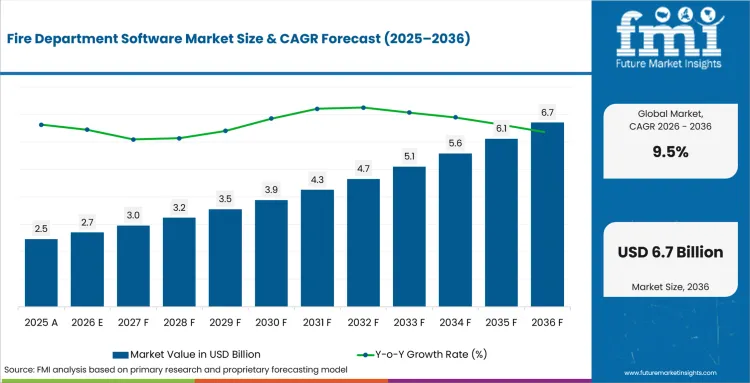
- Market Size (2026)
- USD 2.7 Bn
- Forecast (2036)
- USD 6.7 Bn
- CAGR (2026 to 2036)
- 9.5%
How big is Fire Department Software Market size?
USD 2.7 billion in 2026 and USD 6.7 billion by 2036 at a 9.5% CAGR.
Demand for fire department software is projected to expand at 9.5% CAGR between 2026 and 2036, increasing valuation from USD 2.7 billion in 2026 to USD 6.7 billion by 2036. Emergency fire crews rely heavily on electronic records and analytical tools to manage their daily operations. CentralSquare Technologies reported in October 2025 for more than 8,000 public-sector agencies actively being depended on its software platform. Such widespread technology adoption confirms a strong industry demand for integrated dispatch systems and reliable records administration. Connecting station databases directly with field devices eliminates duplicate data entry and keeps vital incident logs accurate for every firefighter on duty.
Software sourcing teams in the United States and Germany prioritize seamless reporting continuity and smooth dispatch integration during their platform reviews. Fire organizations in Japan and Australia demand mobile device reliability and responsive local support to assist their dispersed response teams. ESO announced in November 2025 claiming for over 6,000 emergency agencies across 33 states to have utilized its NERIS reporting platform. An extensive track record of successful deployments helps department leadership plan seamless system migrations. Final purchasing approval requires thorough training documentation and proven data transfer capabilities.
Key Takeaways for the Fire Department Software Market
- Demand for fire department software is supported by replacement of legacy records platforms, with departments seeking faster incident documentation and dependable operational records.
- Cloud-based deployment is likely to garner 43.0% share of deployment model in 2026, supported by shared access across stations and centrally managed updates.
- Municipal fire departments are estimated to lead end user with 42.0% share in 2026, backed by recurring incident and compliance duties.
- Public purchasing cycles and dispatch integration represent primary barriers limiting timely migration and multi-station implementation.
- Competition focuses on ESO Solutions, ImageTrend, Tyler Technologies, Hexagon, CentralSquare Technologies, Vector Solutions, ZOLL Data Systems, First Due, Versaterm, and Motorola Solutions, with providers differentiated based on fire-specific workflows and implementation support.
Analyst Perspective
“Fire department software earns long-term trust based on dependable field use and consistent records. Platform review tests data continuity and evidence required for municipal oversight. Lasting adoption follows systems helping chiefs make clearer decisions on readiness and workforce planning.”
- Sudip Saha, Principal Analyst at Future Market Insights
How is Fire Department Software Market segmented?
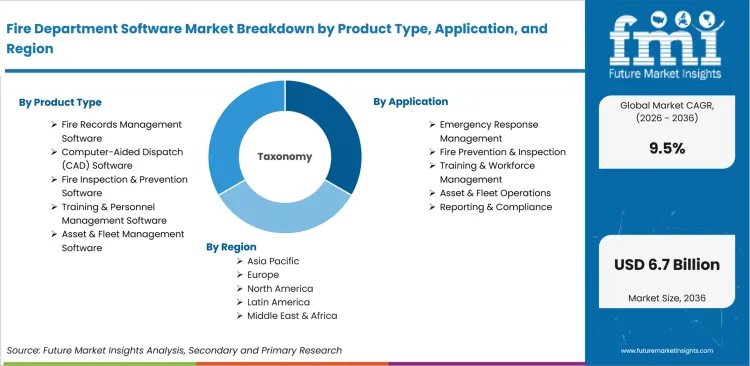
The fire department software industry is segmented by product type, application, end user, distribution channel, deployment model, and region.
The fire department software market is segmented by product type, application, end user, distribution channel, deployment model, and region. Product type coverage includes records management, incident reporting, inspection, dispatch, training, personnel, asset, and fleet software. Application coverage addresses emergency response, prevention, workforce management, asset operations, reporting, and compliance. End-user coverage spans municipal, volunteer, airport, industrial, government, and defense services. Distribution coverage includes direct sales, subscriptions, integrators, resellers, and online platforms. Deployment coverage includes cloud, on-premise, hybrid, mobile, edge, and connected-station systems. Regional assessment covers North America, Europe, East Asia, South Asia and Pacific, Latin America, Middle East and Africa, linking fire operations with crisis management requirements.
What supports fire records management software across product type demand?
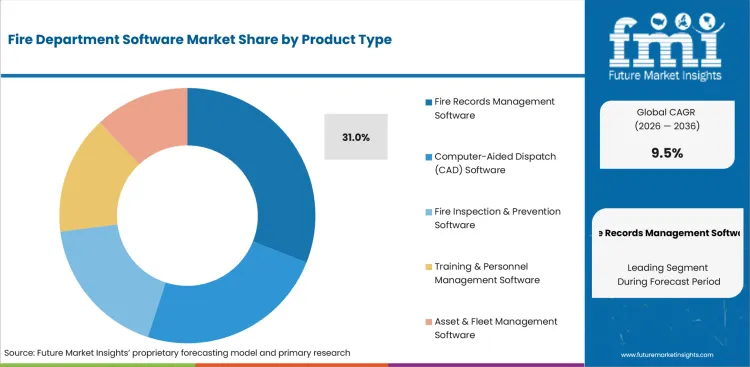
Fire records management software consolidates incident narratives and submission records. USA Fire Administration outlined Phase 1 onboarding for 100 selected departments in October 2024, demonstrating the operational scale required for standardized national reporting. Migration success rests on preserved historical files and accepted data exchange across safety reporting systems. Fire records management software remains central as chiefs require one auditable record from dispatch import through final submission.
- In 2026, fire records management software is projected to represent 31.0% share as it is driven by recurring reporting duties across incidents and compliance review. Department acceptance rises as implementation teams preserve historical records and reduce repeated entry across connected tools.
- Incident reporting and asset applications address narrower operating tasks across fire services. Buyers evaluate separate modules through report completion time and support obligations prior to expanding coverage.
Why does emergency response management lead application demand?
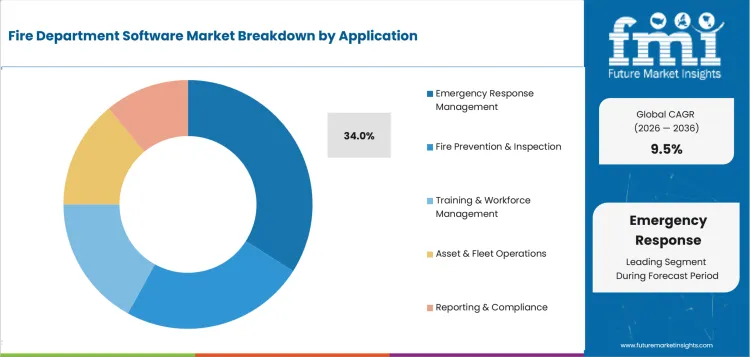
Emergency response management connects dispatch information and post-incident reporting. ESO reported analysis covering more than 10.2 million incidents in June 2026, illustrating the record volume produced across fire operations. Large incident datasets increase requirements for structured classifications and consistent workflows across emergency medical services and fire responses. Software selection centers on reliable synchronization and complete records under operating pressure.
- By application, emergency response management is anticipated to account for 34.0% share since being influenced by immediate coordination needs across resource status and reporting. Field teams favor systems presenting current incident information without separate manual updates across station and mobile interfaces.
- Prevention and compliance applications support recurring work beyond active response operations. Their value increases as departments connect inspections and performance analysis with incident records already used by command staff.
What supports municipal fire departments across end user demand?
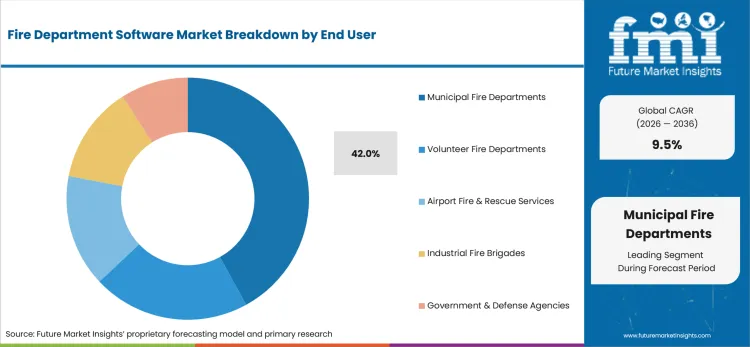
Municipal fire departments manage recurring incidents and city reporting obligations. USA Fire Administration reported almost 70% of American firefighters serving as volunteers in May 2026, underscoring the mixed personnel structures surrounding local fire service administration. Mixed career and volunteer structures require simple mobile workflows and consistent training records. Local departments also review interoperability with law enforcement software and municipal technology systems during final approval.
- Municipal fire departments are likely to hold 42.0% share of end user in 2026, driven by continuous incident reporting and city accountability requirements. Platform adoption improves as chiefs receive dependable records supporting operational review and public-information responses.
- Volunteer and defense fire services apply distinct staffing and risk controls across software selection. Suppliers serving those users need specialized inspection forms and support suited to each operating environment.
What keeps direct sales ahead within distribution channel?
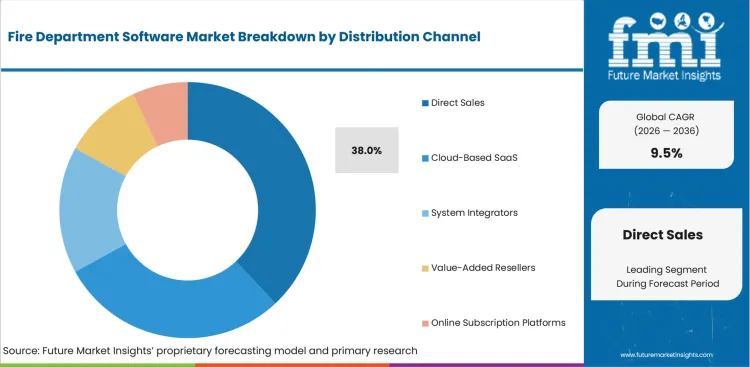
Direct sales supports detailed contract negotiation and implementation scoping. USA Fire Administration listed 3 Assistance to Firefighters Grants programs in May 2026, showing how public funding routes interact with department purchasing. Direct vendor engagement helps buyers align integration duties and training requirements prior to award. Resellers and integrators remain useful for municipal technology coordination and automated fire protection system connections.
- Based on distribution channel, direct sales are estimated to capture 38.0% share in 2026 owing to complex implementation reviews and negotiated service obligations. Fire departments commonly require demonstrations using sample data transfers and named implementation responsibilities prior to contract approval.
- Cloud subscriptions and online portals extend access across smaller or geographically dispersed departments. Channel participation succeeds through clear support ownership and accurate transfer of configuration requirements from buyer review into deployment.
Which buying mechanism supports cloud-based in deployment model?
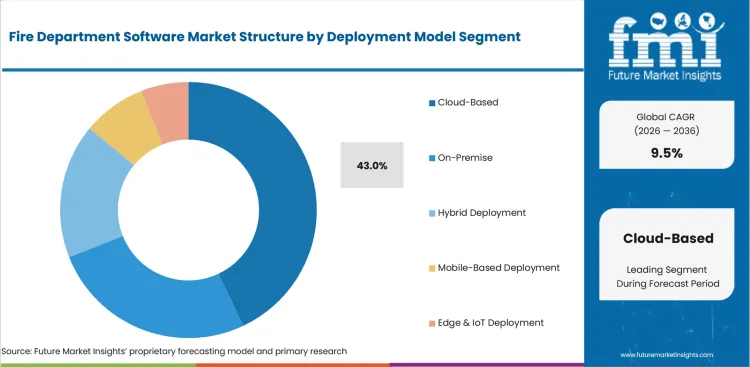
Cloud-based systems provide shared access across stations, mobile crews, administrators, and regional partners. USA Fire Administration outlined onboarding for 50 test departments in August 2024, reflecting controlled implementation needs surrounding new reporting structures. Central updates reduce local maintenance duties and help suppliers apply revised forms across participating agencies. Buyers continue to examine fire alarm systems connections and offline operation.
- Cloud-based deployment is predicted to represent 43.0% share in 2026, aided by central maintenance and multi-station access. Departments assess mobile synchronization and archived record access during enterprise platform reviews.
- On-premise and connected-station deployments address local control or specialized connectivity requirements. Selection reflects integration architecture and staff capacity for software maintenance across operating locations.
What are drivers, restraints, and opportunities in Fire Department Software Market?
Legacy replacement supports platform adoption across fire services and lengthy public purchasing cycles delay conversion. Unified station and asset records create expansion potential across approved department workflows.
- Driver: Fire departments need coordinated records platforms reducing duplicate entry between incident reporting and station administration. Mobile access supports record completion near field activity, strengthening submission consistency across command review and municipal oversight.
- Restraint: Municipal purchasing reviews require operational approval together with information-security assessment across separate departments. Dispatch connections demand careful migration testing, extending implementation schedules during simultaneous protection of historical records and live response data.
- Opportunity: Unified fire software connects prevention work with response records, providing chiefs a clearer view of staffing and asset readiness. Suppliers offering simple field entry and dependable offline access are positioned to expand adoption among departments managing dispersed stations or limited technical support.
Mobile response and shared records strengthen demand for cloud replacement across fire services. AT&T reported more than 7 million FirstNet public-safety connections in March 2025, showing substantial connectivity available to field personnel. Reliable network access supports mobile incident updates and synchronized unit information across public safety and security operations. Department investment remains linked to accepted reporting and measured reductions in repeated data entry.
Data migration and reporting redesign create material implementation risk across department systems. USA Fire Administration received nearly 1,400 comments on draft NERIS schemas during its 2024 engagement period, demonstrating extensive review surrounding field definitions and submission requirements. Suppliers reduce adoption resistance through staged migration and direct testing with department records.
Connected operational records create room for cross-module expansion following initial deployment. First Responder Network Authority reported interoperable coverage across all 50 states in December 2025, illustrating a national communications base for connected response applications. Providers extend adopted incident platforms into fire suppression system inspection evidence and performance analysis. Commercial expansion requires maintained permissions and traceable movement between operational modules.
How are country CAGRs aligned in Fire Department Software Market?
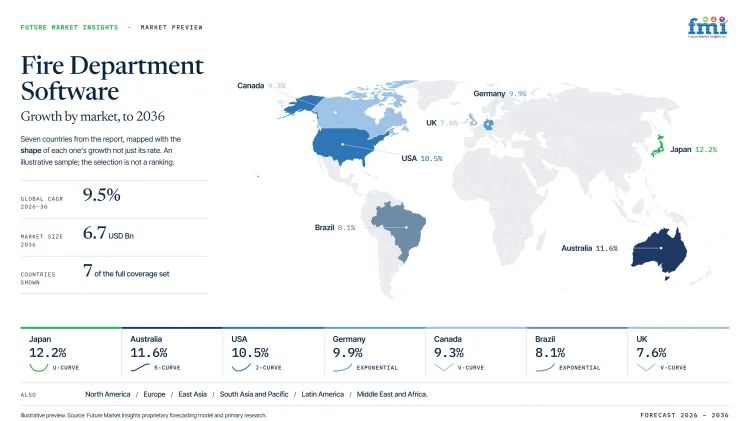
| Country or Market | CAGR |
|---|---|
| Japan | 12.2% |
| Australia | 11.6% |
| USA | 10.5% |
| Germany | 9.9% |
| Canada | 9.3% |
| Brazil | 8.1% |
| UK | 7.6% |
Source: Future Market Insights analysis, 2026.
How do country-level CAGRs compare in Fire Department Software Market?
Country comparison shows a gradual step-down across profiled markets. Japan occupies the upper position, followed by Australia. The United States and Germany form the middle forecast group. Canada, Brazil, and UK complete the disclosed comparison. A 4.6 percentage-point spread separates Japan from the United Kingdom. Country rates reflect differing reporting transitions and implementation conditions.
- Japan is anticipated to lead the comparison and place East Asia at the upper forecast position.
- Australia is likely to follow Japan through dispersed service coverage and extensive emergency response activity.
- The United States is expected to occupy the next band under national reporting migration and established fire software participation.
- Germany and Canada form an adjacent group based on structured public-service technology review and local implementation requirements.
- Brazil and United Kingdom complete the profiled range under different incident patterns and public-sector purchasing arrangements.
Country-wise Analysis
- Adoption in Japan is estimated to progress at 12.2% CAGR during the forecast period as departments prioritize standardized records and service continuity across local fire organizations. Statistics Bureau of Japan listed 1,716 fire departments for 2024 in Japan Statistical Yearbook 2026, supporting demand for consistent administration across numerous operational units. Local implementation favors controlled migration and dependable permissions. Supplier selection benefits from reference deployments proving historical record transfer and reliable incident synchronization.
- Productivity Commission reported 472,361 emergency incidents attended by fire service organizations during 2024-25 in February 2026, creating substantial records volume across fire and non-fire events. Distance between agencies increases interest in centrally maintained platforms and mobile access. Field support and offline procedures remain important during remote operations. Sales in Australia are projected to rise at 11.6% CAGR between 2026 and 2036, led by distributed response coverage and multi-jurisdiction reporting needs.
- Sector in the United States is set to expand at 10.5% CAGR over the study period, backed by national reporting transition and a deep supplier base. USA Fire Administration recorded 26,771,008 incidents submitted for 2025 as of January 2026, placing considerable emphasis on scalable reporting and data-quality controls. Department reviews examine NERIS compatibility and state submission processes. Successful deployment requires training plans addressing operational change across stations.
- Bundeswehr reported control of 58 fire stations through its Firefighting and Fire Protection Office in October 2025, illustrating specialized multi-site administration under centralized oversight. German buyers commonly examine data hosting and implementation accountability. Multi-site consistency creates opportunities for configurable records and asset systems. Industry in Germany is projected to record 9.9% CAGR by 2036, guided by public organizations applying structured security and documentation reviews.
- The market in Canada is expected to grow at 9.3% CAGR during 2026 to 2036, led by provincial service structures and demand for dependable field information across long distances. Transport Canada documented 1,520 CANUTEC emergency situations during 2025 in its March 2026 statistics, reinforcing the need for accurate hazardous-material information and coordinated records. Provincial requirements increase configuration work across reporting and support. Cloud access gains value as departments coordinate incident information across dispersed communities.
- WWF-Brazil reported 47,531 fire hotspots from January through August 2025 in October 2025, underscoring sustained information demands across prevention and aerial firefighting coordination. Local software adoption favors geographic context and affordable implementation. Regional support partnerships improve training and configuration across varied municipal capacities. Demand in Brazil records an anticipated 8.1% CAGR during the assessment period, influenced by municipal response teams addressing urban incidents and extensive wildland fire activity.
- Sales in the United Kingdom are forecast to progress at 7.6% CAGR by 2036, guided by centralized statistical standards and outcome-focused public service reviews. Ministry of Housing, Communities and Local Government recorded 641,227 incidents attended in England during the year ending March 2026, generating extensive reporting and performance-analysis requirements. Fire and rescue data platform processes heighten attention to submission quality and timely records. Suppliers need clear migration plans and maintained interfaces across local systems.
Who are notable companies in Fire Department Software Market?
Notable companies include ESO Solutions, ImageTrend, Tyler Technologies, Hexagon, CentralSquare Technologies, Vector Solutions, ZOLL Data Systems, First Due, Versaterm, and Motorola Solutions. Providers compete due to incident reporting and public-safety implementation experience.
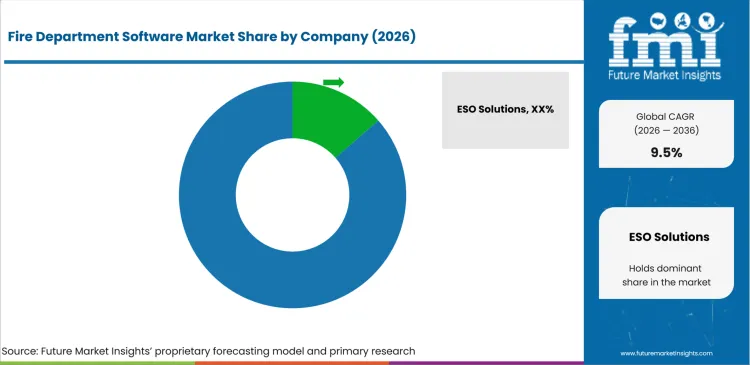
Fire-specific platform providers focus on inspection workflows and NERIS transition support. Municipal public-safety vendors compete based on city-system integration and established government relationships. Training and readiness specialists address certification and equipment checks. Buyers compare implementation responsibility and measurable duplicate-entry reduction.
- ESO Solutions and CentralSquare Technologies combine incident reporting with prevention and administrative modules.
- Tyler Technologies and Motorola Solutions support multi-agency communications and municipal technology coordination.
- Vector Solutions and ZOLL Data Systems address workforce records and clinical or response documentation.
Competitive Benchmarking: Fire Department Software Market
| Company | Portfolio Depth | Fire Department Match | Service Support | Service Reach |
|---|---|---|---|---|
| ESO Solutions | High | High | High | International |
| ImageTrend | High | High | High | North America |
| Tyler Technologies | High | Medium | High | North America |
| Hexagon | High | Medium | High | Global |
| CentralSquare Technologies | High | High | High | North America |
| Vector Solutions | Medium | Medium | High | International |
| ZOLL Data Systems | Medium | High | High | International |
| First Due | High | High | Medium | North America |
Source: Future Market Insights competitive analysis, 2026.
Key Developments in the Fire Department Software Market
- In February 2025, First Due launched its Fire Prevention ITM solution for inspection, testing, and maintenance submissions. Integrated compliance records connect service-provider reports with inspections, permits, preplans, and incident operations, reducing fragmented prevention administration.
- In March 2025, ESO earned a NERIS V1 compatibility badge for its Fire Incident application. Compatibility work preserved CAD file integrity and archived incident searches, supporting department migration toward new national reporting requirements.
- In April 2026, Vector Solutions introduced AI-assisted enhancements across fire training, scheduling, and inspections. Voice documentation, automated callback rules, and assisted checklists target administrative workload across field and workforce records.
Key Players in the Fire Department Software Market
Core Fire Records and Operations Providers
- ESO Solutions
- ImageTrend
- First Due
- CentralSquare Technologies
Integrated Public Safety and Dispatch Providers
- Tyler Technologies
- Hexagon
- Versaterm
- Motorola Solutions
Training and Emergency Data Specialists
- Vector Solutions
- ZOLL Data Systems
Fire Department Software Market Report Scope
| Coverage Field | Report Scope |
|---|---|
| Market Breakdown | Fire department software market breakdown by Product Type, Application, End User, Distribution Channel, Deployment Model, and Region. |
| Market Definition | Software supporting fire records, incident reporting, dispatch connections, inspections, preplans, staffing, training, asset management, fleet oversight, and analytics for fire and rescue services. |
| Regions Covered | North America, Europe, East Asia, South Asia and Pacific, Latin America, Middle East and Africa. |
| Countries Covered | Japan, Australia, USA, Germany, Canada, Brazil, UK, and additional countries covered in full regional assessment. |
| Key Companies Profiled | ESO Solutions, ImageTrend, Tyler Technologies, Hexagon, CentralSquare Technologies, Vector Solutions, ZOLL Data Systems, First Due, Versaterm, and Motorola Solutions. |
| Forecast Period | 2026 to 2036 |
| Approach | Hybrid bottom-up and top-down methodology uses segment shares and country CAGRs. Company activity, public reporting requirements, buyer adoption, and implementation conditions support final reconciliation. |
Source: Future Market Insights analysis, 2026.
Fire Department Software Market - Research Methodology
| Method | Approach |
|---|---|
| Primary Research | FMI analysts gathered input from manufacturers, service providers, technology developers, distributors, end users, procurement teams, and subject-matter experts. Interviews examined purchasing decisions, product or service evaluation, adoption barriers, approval requirements, pricing considerations, and expectations for technical or commercial support. Respondents were also asked what evidence is required before a trial, pilot, or initial order develops into regular purchasing. |
| Desk Research | Desk research covered government statistics, regulatory publications, trade data, industry associations, technical literature, standards, company filings, product information, and official corporate announcements. Sources were reviewed for relevance, publication date, geographic coverage, and consistency with the defined market scope. Claims relating to performance, applications, approvals, capacity, investment, and commercial activity were retained only when supported by credible public evidence. |
| Market Sizing and Forecasting | The market model combined the baseline value with historical performance, segment structure, pricing and volume indicators, adoption levels, company participation, and country-level demand conditions. Forecast assumptions considered economic activity, investment trends, regulatory developments, technology adoption, purchasing cycles, supply availability, and barriers to wider market use. Segment and regional estimates were reconciled before the final market total was calculated. |
| Data Validation | Estimates were checked against multiple independent indicators, including public data, company activity, trade patterns, industry developments, and findings from primary interviews. Validation also tested whether products, services, applications, and company revenues fell within the defined market boundaries. Adjacent categories, unsupported claims, overlapping revenues, and activities without direct market relevance were excluded to reduce double counting and maintain consistency across segments and countries. |
Source: Future Market Insights analysis, 2026.
Fire Department Software Market by Segments
Fire Department Software Market segmented by Product Type:
- Fire Records Management Software
- Computer-Aided Dispatch (CAD) Software
- Fire Inspection & Prevention Software
- Training & Personnel Management Software
- Asset & Fleet Management Software
Fire Department Software Market segmented by Application:
- Emergency Response Management
- Fire Prevention & Inspection
- Training & Workforce Management
- Asset & Fleet Operations
- Reporting & Compliance
Fire Department Software Market segmented by End User:
- Municipal Fire Departments
- Volunteer Fire Departments
- Airport Fire & Rescue Services
- Industrial Fire Brigades
- Government & Defense Agencies
Fire Department Software Market segmented by Distribution Channel:
- Direct Sales
- Cloud-Based SaaS
- System Integrators
- Value-Added Resellers
- Online Subscription Platforms
Fire Department Software Market segmented by Deployment Model:
- Cloud-Based
- On-Premise
- Hybrid Deployment
- Mobile-Based Deployment
- Edge & IoT Deployment
Fire Department Software Market segmented by Region:
- North America
- USA
- Canada
- Europe
- Germany
- UK
- East Asia
- Japan
- South Asia and Pacific
- Australia
- Latin America
- Brazil
- Middle East and Africa
- Additional countries covered in full regional model
Research Sources and Bibliography
- AT&T. (2025, March 31). FirstNet expands coverage for America’s first responders, surpasses 7 million connections.
- Bundeswehr. (2025, October 30). The Bundeswehr Firefighting and Fire Protection Office.
- ESO Solutions, Inc. (2025, March 31). ESO earns NERIS V1 compatibility badge, ensuring compliance, continuity for fire incident customers.
- ESO Solutions, Inc. (2025, November 20). ESO launches NERIS solution with end-to-end workflow integration for fire service.
- ESO Solutions, Inc. (2026, June 3). ESO closes NFIRS era with 2026 Fire Service Index, sets the stage for richer data under NERIS reporting standard.
- First Due. (2025, February 26). First Due launches Fire Prevention ITM solution to streamline compliance and enhance community safety.
- First Responder Network Authority. (2025, December 10). Interoperability: Emergencies cross jurisdictions-so does FirstNet.
- CentralSquare Technologies. (2025, October 16). CentralSquare Technologies’ Centerline AI™ integration revolutionizing RMS and 911 operations.
- Ministry of Housing, Communities and Local Government. (2026, July 22). Fire and rescue incident statistics, year ending March 2026.
- Productivity Commission. (2026, February 3). Report on Government Services 2026: Emergency services for fire and other events.
- Statistics Bureau of Japan. (2026). Japan Statistical Yearbook 2026: Chapter 29, disasters and accidents.
- Transport Canada. (2026, March 31). CANUTEC annual statistics: 2025.
- USA Fire Administration. (2024, March 13). NERIS stakeholder engagement: Community and collaboration.
- USA Fire Administration. (2024, August 1). NERIS next steps: Beta launch, API development and secondary schema release.
- USA Fire Administration. (2024, October 29). NERIS Version 1: Platform launch and national rollout.
- USA Fire Administration. (2026, January 5). National Fire Incident Reporting System (NFIRS).
- USA Fire Administration. (2026, May 1). Fire service grants and funding.
- USA Fire Administration. (2026, May 28). Resources for the volunteer fire service.
- Vector Solutions. (2026, April 2). Vector Solutions introduces AI-powered enhancements to streamline fire department training, scheduling, and inspections.
- WWF-Brazil. (2025, October 1). Brazil records lowest number of fires in the past 12 years.
This bibliography is provided for reader reference and is not exhaustive. The full report contains the complete reference list and detailed citations.
This Report Answers
- How do product type, application, end user, distribution channel, deployment model, and region influence fire department software demand?
- What criteria guide fire departments evaluating records and asset platforms?
- Why do country CAGRs differ across Japan, Australia, USA, Germany, Canada, Brazil, and UK?
- What companies compete through fire records and emergency data capabilities?
- How are forecasts validated through bottom-up and top-down analysis using independent operating indicators?
- What evidence supports department review prior to multi-station software deployment?
- Why do accepted records and dispatch integration influence platform selection?
- How do public purchasing cycles limit return across migration and implementation work?
- What implementation capabilities improve long-term department confidence and recurring platform use?
- How do cloud and local deployments address distinct fire-service operating requirements?
Frequently Asked Questions
How big is the Fire Department Software Market in 2026?
The fire department software market is valued at USD 2.7 billion in 2026 and is forecast to reach USD 6.7 billion by 2036, reflecting growing demand for integrated dispatch systems and reliable records administration across emergency fire services replacing legacy platforms.
What is the CAGR of the Fire Department Software Market from 2026 to 2036?
The fire department software market is projected to grow at a CAGR of 9.5% between 2026 and 2036, supported by coordinated records platforms that reduce duplicate entry between incident reporting and station administration across career and volunteer fire services.
Which product type leads the Fire Department Software Market?
Fire records management software accounts for 31.0% of the fire department software market by product type in 2026, driven by recurring reporting duties across incidents and compliance review that require one auditable record from dispatch import through final submission.
Which country is growing fastest in the Fire Department Software Market?
The fire department software market in Japan is projected to expand at a CAGR of 12.2% through 2036, ahead of Australia at 11.6%, the USA at 10.5%, Germany at 9.9%, Canada at 9.3%, Brazil at 8.1%, and the UK at 7.6%, reflecting demand for standardized records and service continuity across numerous local fire organizations.
Who are the leading companies in the Fire Department Software Market?
Leading companies in the fire department software market include ESO Solutions, ImageTrend, Tyler Technologies, Hexagon, CentralSquare Technologies, Vector Solutions, ZOLL Data Systems, First Due, Versaterm, and Motorola Solutions, competing across fire-specific incident reporting, municipal public-safety integration, and workforce training and readiness platforms.
Preview the report firsthand - request a free sample
Get SampleGet the brochure for pricing and purchase details.
Get PDFTable of Content
- Key Takeaways
- Market Size and CAGR
- Top Growth Driver
- Fastest Growing Segment
- Leading Region
- Key Companies
- Emerging Opportunities
- Executive Summary
- Global Market Outlook
- Demand-side Trends
- Supply-side Trends
- Technology Roadmap Analysis
- Analysis and Recommendations
- Analyst Perspective (What is happening? Why now? What should investors know?)
- Key Questions Answered
- How large is the market?
- What is the CAGR?
- What are key trends?
- Which region dominates?
- Who are the leaders?
- Market Overview
- Market Coverage / Taxonomy
- Market Definition / Scope / Limitations
- Research Methodology
- Chapter Orientation
- Analytical Lens and Working Hypotheses
- Market Structure, Signals, and Trend Drivers
- Benchmarking and Cross-market Comparability
- Market Sizing, Forecasting, and Opportunity Mapping
- Research Design and Evidence Framework
- Desk Research Programme (Secondary Evidence)
- Expert Input and Fieldwork (Primary Evidence)
- Tooling, Models, and Reference Databases
- Data Engineering and Model Build
- Quality Assurance and Audit Trail
- Market Background
- Market Dynamics (Drivers, Restraints, Opportunity, Trends)
- Scenario Forecast (Optimistic, Likely, Conservative)
- Impact Analysis
- AI Impact
- Sustainability Impact
- Regulatory Impact
- Technology Impact
- Consumer / Buyer Analysis
- Purchase Drivers
- Adoption Barriers
- Buyer Journey
- Opportunity Map Analysis
- Product Life Cycle Analysis
- Supply Chain Analysis
- Investment Feasibility Matrix
- Value Chain Analysis
- PESTLE and Porter's Analysis
- Regulatory Landscape
- Regional Parent Market Outlook
- Production and Consumption Statistics
- Import and Export Statistics
- Global Market Analysis and Forecast, 2021 to 2036
- Historical Market Size Value (USD Billion) Analysis, 2021 to 2025
- Current and Future Market Size Value (USD Billion) Projections, 2026 to 2036
- Y-o-Y Growth Trend Analysis
- Absolute $ Opportunity Analysis
- Global Market Pricing Analysis, 2021 to 2036
- Global Market Analysis and Forecast, By Product Type, 2021 to 2036
- Introduction / Key Findings
- Historical Market Size Value (USD Billion) Analysis By Product Type, 2021 to 2025
- Current and Future Market Size Value (USD Billion) Analysis and Forecast By Product Type, 2026 to 2036
- Fire Records Management Software
- Incident Reporting Software
- Fire Inspection Management
- Computer-Aided Dispatch (CAD) Software
- Dispatch Management
- Value (USD Billion) Recommendation Systems
- Fire Inspection & Prevention Software
- Code Enforcement
- Pre-Fire Planning
- Training & Personnel Management Software
- Certification Management
- Scheduling & Training Records
- Asset & Fleet Management Software
- Equipment Tracking
- Vehicle Maintenance Management
- Fire Records Management Software
- Y-o-Y Growth Trend Analysis By Product Type, 2021 to 2025
- Absolute $ Opportunity Analysis By Product Type, 2026 to 2036
- Global Market Analysis and Forecast, By Application, 2021 to 2036
- Introduction / Key Findings
- Historical Market Size Value (USD Billion) Analysis By Application, 2021 to 2025
- Current and Future Market Size Value (USD Billion) Analysis and Forecast By Application, 2026 to 2036
- Emergency Response Management
- Incident Command
- Resource Dispatch
- Fire Prevention & Inspection
- Building Inspections
- Fire Safety Compliance
- Training & Workforce Management
- Firefighter Training
- Certification Tracking
- Asset & Fleet Operations
- Equipment Maintenance
- Fleet Monitoring
- Reporting & Compliance
- Regulatory Reporting
- Performance Analytics
- Emergency Response Management
- Y-o-Y Growth Trend Analysis By Application, 2021 to 2025
- Absolute $ Opportunity Analysis By Application, 2026 to 2036
- Global Market Analysis and Forecast, By End User, 2021 to 2036
- Introduction / Key Findings
- Historical Market Size Value (USD Billion) Analysis By End User, 2021 to 2025
- Current and Future Market Size Value (USD Billion) Analysis and Forecast By End User, 2026 to 2036
- Municipal Fire Departments
- City Fire Departments
- Town Fire Departments
- Volunteer Fire Departments
- Rural Fire Departments
- Community Fire Brigades
- Airport Fire & Rescue Services
- Civil Airport Fire Services
- Military Airbase Fire Services
- Industrial Fire Brigades
- Oil & Gas Fire Units
- Manufacturing Fire Teams
- Government & Defense Agencies
- Defense Fire Services
- Public Safety Agencies
- Municipal Fire Departments
- Y-o-Y Growth Trend Analysis By End User, 2021 to 2025
- Absolute $ Opportunity Analysis By End User, 2026 to 2036
- Global Market Analysis and Forecast, By Distribution Channel, 2021 to 2036
- Introduction / Key Findings
- Historical Market Size Value (USD Billion) Analysis By Distribution Channel, 2021 to 2025
- Current and Future Market Size Value (USD Billion) Analysis and Forecast By Distribution Channel, 2026 to 2036
- Direct Sales
- Enterprise Contracts
- Government Procurement
- Cloud-Based SaaS
- Public Cloud Deployment
- Private Cloud Deployment
- System Integrators
- Public Safety Integrators
- IT Consulting Partners
- Value-Added Resellers
- Authorized Resellers
- Regional Distributors
- Online Subscription Platforms
- Vendor Portals
- Digital Marketplaces
- Direct Sales
- Y-o-Y Growth Trend Analysis By Distribution Channel, 2021 to 2025
- Absolute $ Opportunity Analysis By Distribution Channel, 2026 to 2036
- Global Market Analysis and Forecast, By Deployment Model, 2021 to 2036
- Introduction / Key Findings
- Historical Market Size Value (USD Billion) Analysis By Deployment Model, 2021 to 2025
- Current and Future Market Size Value (USD Billion) Analysis and Forecast By Deployment Model, 2026 to 2036
- Cloud-Based
- Public Cloud
- Private Cloud
- On-Premise
- Local Servers
- Data Center Deployment
- Hybrid Deployment
- Cloud-On-Premise Integration
- Multi-Site Deployment
- Mobile-Based Deployment
- iOS Applications
- Android Applications
- Edge & IoT Deployment
- Connected Fire Stations
- Smart Emergency Devices
- Cloud-Based
- Y-o-Y Growth Trend Analysis By Deployment Model, 2021 to 2025
- Absolute $ Opportunity Analysis By Deployment Model, 2026 to 2036
- Global Market Analysis and Forecast, By Region, 2021 to 2036
- Introduction
- Historical Market Size Value (USD Billion) Analysis By Region, 2021 to 2025
- Current Market Size Value (USD Billion) Analysis and Forecast By Region, 2026 to 2036
- North America
- Latin America
- Western Europe
- Eastern Europe
- East Asia
- South Asia and Pacific
- Middle East & Africa
- Market Attractiveness Analysis By Region
- North America Market Analysis and Forecast, By Country, 2021 to 2036
- Historical Market Size Value (USD Billion) Trend Analysis By Market Taxonomy, 2021 to 2025
- Market Size Value (USD Billion) Forecast By Market Taxonomy, 2026 to 2036
- By Country
- USA
- Canada
- By Product Type
- By Application
- By End User
- By Distribution Channel
- By Deployment Model
- By Country
- Market Attractiveness Analysis
- By Country
- By Product Type
- By Application
- By End User
- By Distribution Channel
- By Deployment Model
- Key Takeaways
- Latin America Market Analysis and Forecast, By Country
- Historical Market Size Value (USD Billion) Trend Analysis By Market Taxonomy, 2021 to 2025
- Market Size Value (USD Billion) Forecast By Market Taxonomy, 2026 to 2036
- By Country
- Brazil
- Mexico
- Chile
- Rest of Latin America
- By Product Type
- By Application
- By End User
- By Distribution Channel
- By Deployment Model
- By Country
- Market Attractiveness Analysis
- By Country
- By Product Type
- By Application
- By End User
- By Distribution Channel
- By Deployment Model
- Key Takeaways
- Western Europe Market Analysis and Forecast, By Country
- Historical Market Size Value (USD Billion) Trend Analysis By Market Taxonomy, 2021 to 2025
- Market Size Value (USD Billion) Forecast By Market Taxonomy, 2026 to 2036
- By Country
- Germany
- UK
- Italy
- Spain
- France
- Nordic
- BENELUX
- Rest of Western Europe
- By Product Type
- By Application
- By End User
- By Distribution Channel
- By Deployment Model
- By Country
- Market Attractiveness Analysis
- By Country
- By Product Type
- By Application
- By End User
- By Distribution Channel
- By Deployment Model
- Key Takeaways
- Eastern Europe Market Analysis and Forecast, By Country
- Historical Market Size Value (USD Billion) Trend Analysis By Market Taxonomy, 2021 to 2025
- Market Size Value (USD Billion) Forecast By Market Taxonomy, 2026 to 2036
- By Country
- Russia
- Poland
- Hungary
- Balkan & Baltic
- Rest of Eastern Europe
- By Product Type
- By Application
- By End User
- By Distribution Channel
- By Deployment Model
- By Country
- Market Attractiveness Analysis
- By Country
- By Product Type
- By Application
- By End User
- By Distribution Channel
- By Deployment Model
- Key Takeaways
- East Asia Market Analysis and Forecast, By Country
- Historical Market Size Value (USD Billion) Trend Analysis By Market Taxonomy, 2021 to 2025
- Market Size Value (USD Billion) Forecast By Market Taxonomy, 2026 to 2036
- By Country
- China
- Japan
- South Korea
- By Product Type
- By Application
- By End User
- By Distribution Channel
- By Deployment Model
- By Country
- Market Attractiveness Analysis
- By Country
- By Product Type
- By Application
- By End User
- By Distribution Channel
- By Deployment Model
- Key Takeaways
- South Asia and Pacific Market Analysis and Forecast, By Country
- Historical Market Size Value (USD Billion) Trend Analysis By Market Taxonomy, 2021 to 2025
- Market Size Value (USD Billion) Forecast By Market Taxonomy, 2026 to 2036
- By Country
- India
- ASEAN
- Australia & New Zealand
- Rest of South Asia and Pacific
- By Product Type
- By Application
- By End User
- By Distribution Channel
- By Deployment Model
- By Country
- Market Attractiveness Analysis
- By Country
- By Product Type
- By Application
- By End User
- By Distribution Channel
- By Deployment Model
- Key Takeaways
- Middle East & Africa Market Analysis and Forecast, By Country
- Historical Market Size Value (USD Billion) Trend Analysis By Market Taxonomy, 2021 to 2025
- Market Size Value (USD Billion) Forecast By Market Taxonomy, 2026 to 2036
- By Country
- Kingdom of Saudi Arabia
- Other GCC Countries
- Türkiye
- South Africa
- Other African Union
- Rest of Middle East & Africa
- By Product Type
- By Application
- By End User
- By Distribution Channel
- By Deployment Model
- By Country
- Market Attractiveness Analysis
- By Country
- By Product Type
- By Application
- By End User
- By Distribution Channel
- By Deployment Model
- Key Takeaways
- Key Countries Market Analysis
- USA
- Pricing Analysis
- Market Share Analysis, 2025
- By Product Type
- By Application
- By End User
- By Distribution Channel
- By Deployment Model
- Canada
- Pricing Analysis
- Market Share Analysis, 2025
- By Product Type
- By Application
- By End User
- By Distribution Channel
- By Deployment Model
- Mexico
- Pricing Analysis
- Market Share Analysis, 2025
- By Product Type
- By Application
- By End User
- By Distribution Channel
- By Deployment Model
- Brazil
- Pricing Analysis
- Market Share Analysis, 2025
- By Product Type
- By Application
- By End User
- By Distribution Channel
- By Deployment Model
- Chile
- Pricing Analysis
- Market Share Analysis, 2025
- By Product Type
- By Application
- By End User
- By Distribution Channel
- By Deployment Model
- Germany
- Pricing Analysis
- Market Share Analysis, 2025
- By Product Type
- By Application
- By End User
- By Distribution Channel
- By Deployment Model
- UK
- Pricing Analysis
- Market Share Analysis, 2025
- By Product Type
- By Application
- By End User
- By Distribution Channel
- By Deployment Model
- Italy
- Pricing Analysis
- Market Share Analysis, 2025
- By Product Type
- By Application
- By End User
- By Distribution Channel
- By Deployment Model
- Spain
- Pricing Analysis
- Market Share Analysis, 2025
- By Product Type
- By Application
- By End User
- By Distribution Channel
- By Deployment Model
- France
- Pricing Analysis
- Market Share Analysis, 2025
- By Product Type
- By Application
- By End User
- By Distribution Channel
- By Deployment Model
- India
- Pricing Analysis
- Market Share Analysis, 2025
- By Product Type
- By Application
- By End User
- By Distribution Channel
- By Deployment Model
- ASEAN
- Pricing Analysis
- Market Share Analysis, 2025
- By Product Type
- By Application
- By End User
- By Distribution Channel
- By Deployment Model
- Australia & New Zealand
- Pricing Analysis
- Market Share Analysis, 2025
- By Product Type
- By Application
- By End User
- By Distribution Channel
- By Deployment Model
- China
- Pricing Analysis
- Market Share Analysis, 2025
- By Product Type
- By Application
- By End User
- By Distribution Channel
- By Deployment Model
- Japan
- Pricing Analysis
- Market Share Analysis, 2025
- By Product Type
- By Application
- By End User
- By Distribution Channel
- By Deployment Model
- South Korea
- Pricing Analysis
- Market Share Analysis, 2025
- By Product Type
- By Application
- By End User
- By Distribution Channel
- By Deployment Model
- Russia
- Pricing Analysis
- Market Share Analysis, 2025
- By Product Type
- By Application
- By End User
- By Distribution Channel
- By Deployment Model
- Poland
- Pricing Analysis
- Market Share Analysis, 2025
- By Product Type
- By Application
- By End User
- By Distribution Channel
- By Deployment Model
- Hungary
- Pricing Analysis
- Market Share Analysis, 2025
- By Product Type
- By Application
- By End User
- By Distribution Channel
- By Deployment Model
- Kingdom of Saudi Arabia
- Pricing Analysis
- Market Share Analysis, 2025
- By Product Type
- By Application
- By End User
- By Distribution Channel
- By Deployment Model
- Türkiye
- Pricing Analysis
- Market Share Analysis, 2025
- By Product Type
- By Application
- By End User
- By Distribution Channel
- By Deployment Model
- South Africa
- Pricing Analysis
- Market Share Analysis, 2025
- By Product Type
- By Application
- By End User
- By Distribution Channel
- By Deployment Model
- USA
- Market Structure Analysis
- Competition Dashboard
- Competition Benchmarking
- Market Share Analysis of Top Players
- By Regional
- By Product Type
- By Application
- By End User
- By Distribution Channel
- By Deployment Model
- Emerging Startups
- Innovation Benchmarking
- Competition Analysis
- Competition Deep Dive
- ESO Solutions
- Overview
- Product Portfolio
- Profitability by Market Segments
- Sales Footprint
- Strategy Overview
- Marketing Strategy
- Product Strategy
- Channel Strategy
- ImageTrend
- Tyler Technologies
- Hexagon AB
- CentralSquare Technologies
- Emergency Reporting
- Vector Solutions
- ZOLL Data Systems
- First Due
- Perimeter Solutions
- ESO Solutions
- Case Studies
- Success Stories
- Recent Developments
- Competition Deep Dive
- Assumptions & Acronyms Used


