


- Animal feed ingredients are not bought only on price per ton; commercial producers judge them by feed conversion, animal performance, mortality risk, nutrient availability, and formulation stability.
- FMI frames animal feed ingredients as functional and nutritional inputs designed to improve feed conversion and gut health, moving the market beyond basic commodity grain logic.
- The strongest value pools sit in amino acids, enzymes, probiotics, organic acids, minerals, premixes, and functional inputs that reduce waste or improve growth consistency.
- Feed mills increasingly compare ingredients through cost-in-use rather than invoice price, because small dosage changes can influence flock or herd economics at scale.
- Supplier advantage depends on species data, dosage guidance, premix compatibility, documentation, and the ability to prove performance under real feed mill conditions.
- The misconception to avoid is that the lowest-cost ingredient is automatically the best procurement choice. In animal feed, the best ingredient is the one that protects total production economics.
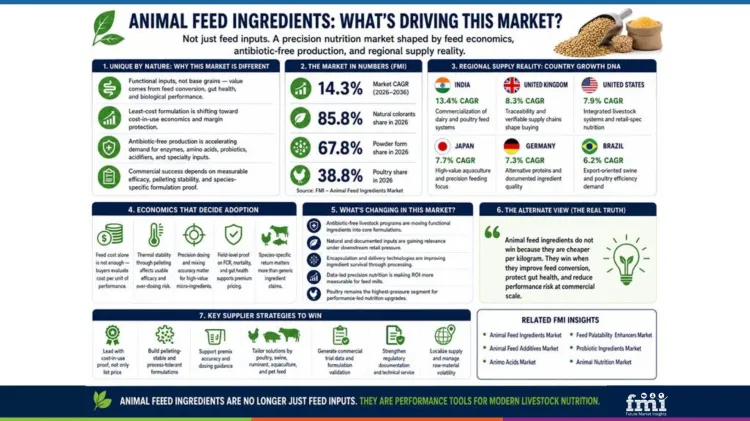
Animal feed ingredient procurement is often described as a cost-management exercise. Feed producers buy soybean meal, corn, grains, oils, amino acids, enzymes, minerals, probiotics, vitamins, and functional additives while trying to keep ration cost under control. That is true, but it is not the whole economic story. In the Animal Feed Ingredients Market, the most important commercial question is not simply which input is cheaper. It is which input improves animal performance, reduces waste, supports feed conversion, and protects margin across the full production cycle.
This is why the best fit for the market is an economic angle. Feed ingredients sit directly inside livestock profitability. A small change in digestibility, amino acid balance, palatability, gut health, nutrient absorption, or feed stability can affect weight gain, milk yield, egg output, survival rate, disease pressure, or harvest efficiency. In a high-volume poultry, swine, dairy, cattle, or aquaculture operation, the economic impact of a feed ingredient is often measured at flock, herd, or pond level rather than only by unit price.
FMI defines the Animal Feed Ingredients Market as a space of functional and nutritional inputs engineered to enhance feed conversion, preserve gut health, and meet specific genetic requirements in commercial livestock production. That definition is important because it separates feed ingredients from basic commodity grains. Corn, soybean meal, wheat, oilseed meals, fishmeal, and forages remain foundational, but the strategic value increasingly sits in ingredients that make the total ration perform better.
The broader Animal Feed Market provides useful context. FMI notes that plant-based sources lead the animal feed source mix, while commercial poultry holds a major species position. This matters because the economics of animal feed are anchored in large-scale, high-turnover livestock systems where feed cost is the largest operating variable. Poultry is especially sensitive because production cycles are short and feed conversion is measured closely. A feed ingredient that improves nutrient use even modestly can create meaningful value when applied across millions of birds.
Amino acids show the logic clearly. The Feed Amino Acids Market is relevant because lysine, methionine, threonine, tryptophan, and related amino acids allow nutritionists to formulate closer to animal requirements rather than relying only on crude protein levels. This can reduce excess protein, improve nitrogen efficiency, and support growth performance. A buyer may compare amino acids by price, but the more important comparison is whether the formulation achieves the required performance at the lowest total ration cost.
Feed enzymes follow the same cost-in-use logic. The Feed Enzymes Market highlights the role of enzymes such as phytase and carbohydrases in improving nutrient release from feed ingredients. Phytase can improve phosphorus availability, while carbohydrases can support digestion of fiber or non-starch polysaccharides depending on the diet. The economic value is not the enzyme cost alone. It is the saving from better nutrient release, reduced inorganic mineral inclusion, improved digestibility, and more flexible use of lower-cost raw materials.
Probiotics, eubiotics, organic acids, and microbial feed additives add a different economic layer. The Animal Feed Probiotic Market, Microbial Feed Additives Market, and Eubiotics Market are relevant because many livestock systems are moving toward gut health management rather than routine antibiotic growth promotion. These ingredients may not always show value through immediate feed cost reduction. Their value often appears through improved health status, lower mortality, more stable growth, better gut integrity, and reduced performance variability.
Premixes are also central to the economics. The Feed Premix Market shows why many producers do not purchase every micronutrient or additive as a standalone input. Premixes help control dosage accuracy, blending uniformity, and operational simplicity. In a feed mill, a small dosing error can have outsized consequences, especially for young animals, high-performance herds, or intensive aquaculture. The value of a premix is partly ingredient value and partly risk reduction.
This is why procurement teams should not evaluate animal feed ingredients only through price per ton. A lower-cost ingredient can be expensive if it creates inconsistent mixing, lowers digestibility, increases anti-nutritional factors, shortens storage stability, or forces higher inclusion of other nutrients. A higher-priced functional ingredient may be economically stronger if it improves feed conversion, reduces wastage, increases growth uniformity, or helps meet retailer or processor requirements.
Ingredient volatility also matters. Feed ingredients are exposed to grain prices, oilseed availability, weather events, freight rates, currency movements, biofuel demand, disease outbreaks, export restrictions, and regional crop cycles. Protein meals, amino acids, vitamins, minerals, fishmeal, fats, oils, and specialty additives can all experience supply swings. Feed mills therefore need flexible formulation capability. The supplier that can help reformulate under changing raw material conditions becomes more valuable than the supplier that only offers a low spot price.
The strongest suppliers combine ingredient supply with technical support. Feed mills and integrators increasingly need species-specific data, dosage curves, stability information, pelleting tolerance, compatibility with premixes, regulatory documentation, and trial support. This is particularly important when using enzymes, probiotics, organic acids, encapsulated nutrients, or novel additives. The buyer is not only asking whether the ingredient is available. The buyer is asking whether it will work in a specific species, life stage, feed form, and production system.
Cost-in-use thinking also changes how premium ingredients are justified. A protected amino acid, encapsulated additive, probiotic blend, enzyme package, or specialty mineral may carry a higher price, but if it improves nutrient delivery or reduces performance variability, it can be justified. The Feed Encapsulation Market is relevant here because encapsulation can protect sensitive ingredients, improve targeted release, and support better delivery in harsh processing or digestive conditions. The premium is accepted only when the performance benefit is measurable.
Species differences make this economic assessment even more important. Broiler diets, layer diets, swine grower-finisher diets, dairy rations, beef feedlot programs, aquaculture feeds, and pet food systems do not respond to ingredients in the same way. Poultry buyers may prioritize feed conversion, gut health, and uniform body weight. Dairy producers may focus on milk yield, rumen stability, mineral balance, and protected nutrients. Aquaculture producers may focus on digestibility, water stability, immune support, and fishmeal substitution. A single ingredient story cannot cover all of these use cases.
Sustainability is also entering the cost equation. Feed ingredients influence nitrogen excretion, phosphorus discharge, methane intensity, land-use pressure, and protein efficiency. This does not mean producers will buy higher-priced ingredients only because they are marketed as sustainable. It means ingredients that reduce nutrient waste or improve conversion can support both economics and sustainability claims. The commercial case is strongest when environmental benefits are tied to measurable production outcomes rather than broad positioning.
Processor and retailer requirements are another economic pressure. Poultry processors, dairy buyers, aquaculture exporters, and meat brands may require antibiotic-reduced production, traceability, animal welfare assurance, or lower-emission supply programs. Feed ingredients that help producers meet those requirements can protect market access. In these cases, the ingredient is not only a farm input; it becomes part of the buyer’s compliance and customer-retention strategy.
A practical evaluation model should therefore include at least five measures: delivered ingredient cost, inclusion rate, expected performance effect, processing stability, and risk reduction. Feed mills should also track whether the ingredient improves formulation flexibility when raw materials change. This is especially important during periods of soybean meal volatility, fishmeal shortages, vitamin supply disruptions, or freight cost increases. Ingredients that expand formulation options can carry hidden economic value.
The strongest commercial relationships are built around trials. Suppliers that help design controlled feeding trials, interpret farm data, and translate results into ration adjustments become embedded in the nutrition program. This makes supplier switching harder and allows premium ingredients to defend value. By contrast, suppliers that cannot show species-specific economics are more likely to be pushed into annual tender price competition.
The misconception to avoid is that animal feed ingredients are mostly commodity inputs. Some high-volume ingredients do behave like commodities, but the market is moving toward performance-managed nutrition. The more feed mills link ingredients to feed conversion, animal health, sustainability, and processor requirements, the more the market shifts from least-cost buying to risk-adjusted formulation economics.
Bottom line: animal feed ingredient value is created when an input improves the economics of the whole ration. Price per ton matters, but feed conversion, health performance, nutrient efficiency, stability, and species-specific proof decide whether the ingredient truly protects producer margin.

