


- Manufacturing regionalization is becoming a major strategic trend in the knee hyaluronic acid injections market as vendors are seeking stronger supply continuity and quicker access to expanding orthopedic markets
- Asia-Pacific has become the main growth hub for production, underpinned by growing domestic demand, affordable manufacturing capacity and government spending on healthcare infrastructure.
- As a result, many companies are now integrating global manufacturing networks with localized formulation and fill-finish capabilities to mitigate logistics risks and enhance market responsiveness.
- Despite increasing interest in regionalization, the rapid changes in production are still constrained by sterile manufacturing requirements, regulatory compliance, and quality assurance.
- Nearshoring does not replace global supply chains, but complements them. It is about resilience, market access and regulatory flexibility.
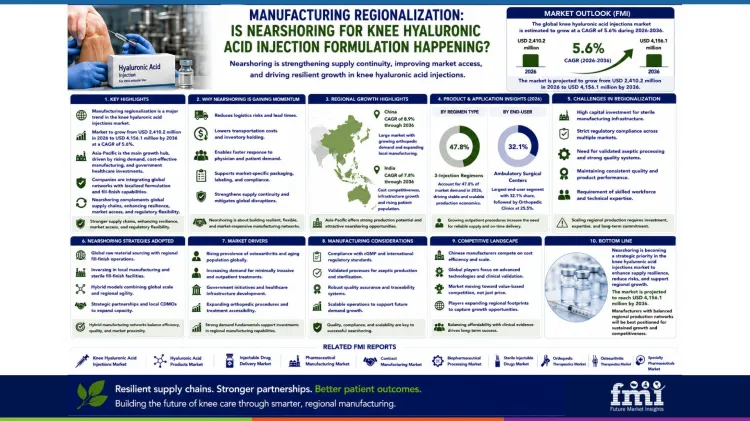
The global knee hyaluronic acid injections market is estimated to grow from USD 2,410.2 million in 2026 to USD 4,156.1 million in 2036 at a CAGR of 5.6% during the forecast period. With manufacturers gearing for ongoing demand growth, production strategy is becoming nearly as important as product innovation.
In the past, many pharmaceutical companies had centralized manufacturing facilities supplying several regions through established distribution networks. This model provides economies of scale, but recent disruptions in the supply chain and changes in regional demand patterns have prompted companies to consider localized production strategies.
According to Future Market Insights, Asia-Pacific is one of the fastest growing regions for knee hyaluronic acid injections. China is expected to witness a CAGR of 8.9% through 2036. China is not only a large consumption market but is also becoming more attractive for investment in formulation and manufacturing.
India offers a similar opportunity. The country’s growing orthopedic care infrastructure and expanding pharmaceutical manufacturing ecosystem, along with a projected 7.8% CAGR, offer cost competitiveness along with access to a fast growing patient population. These factors make local production economically attractive to companies serving domestic and export markets.
Making things in a region has some operational advantages. By locating production closer to end markets, companies can reduce delivery time, transportation costs, inventory management and responsiveness to changing physician demand. Such efficiencies can be key competitive advantages for sterile injectable products such as knee hyaluronic acid formulations.
But nearshoring comes with its own challenges. Knee hyaluronic acid injections require highly controlled manufacturing environments, validated aseptic processing, strict quality management systems and compliance with a range of regulatory standards. Replicating the capacity of production in other regions demands major capital investment and know-how.
The product mix also affects manufacturing decisions. In 2026, 3-injection regimens constitute about 47.8% of the market demand, thus resulting in relatively stable production requirements. At the same time, manufacturers are continuing to invest in single-injection products and advanced formulations that mas that may require specialized production technologies and additional validation prior to regional deployment.
Ability to supply locally is also supported by patterns of distribution. End-user demand will be held by ambulatory surgical centers with ~32.1% share followed by orthopedic clinics with 25.5% in 2026. With the growing focus on outpatient channels, reliable product availability and predictable delivery times are becoming increasingly important. As a result, manufacturers are expanding their regional supply chains and manufacturing networks.
Nearshoring is also better for regulatory nimbleness. Local manufacturing sites often offer market-specific packaging, labeling and compliance requirements, enabling companies to respond more quickly to evolving healthcare regulations without disrupting global supply chains.
The important point is that regionalization of manufacturing is not a retreat from centralized production. Instead, they are opting for hybrid approaches, with global raw material sourcing paired with regional fill-finish and local distribution sites to strike the right balance between efficiency and resilience.
The increasing incidence of osteoarthritis, and the aging population globally, only adds to the rationale for geographically diversified manufacture. As demand rises in both developed and emerging markets, companies that can manufacture regionally at scale and still maintain high quality standards will be better placed to capture future growth opportunities.
Bottom Line
Nearshoring is being increasingly used in the knee hyaluronic acid injections market as a way to strengthen supply resilience and regional growth, not as an alternative to global manufacturing. The market is expected to reach USD 4,156.1 million by 2036. Manufacturers investing in balanced regional production networks are likely to improve operational flexibility and long-term competitiveness.
Related FMI Reports
- Knee Hyaluronic Acid Injections Market
- Hyaluronic Acid Products Market
- Osteoarthritis Gene Therapy Market
- Injectable Drug Delivery Market
- Orthopedic Splints Market
- Pain Management Devices Market
- Regenerative Medicine Market
- Biopharmaceuticals Packaging Market
- Specialty Active Pharmaceutical Ingredient Market
- Musculoskeletal Oncology Therapeutics Market

