


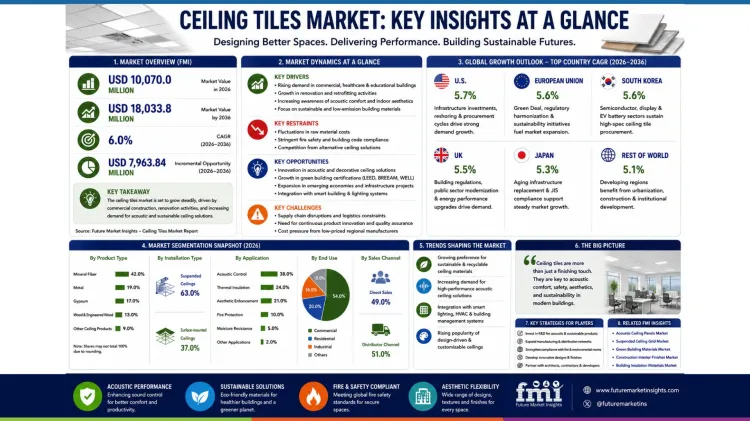
- Mineral fiber remains the demand anchor in ceiling tiles, with FMI estimating a 42.0% product share in 2026.
- Suspended ceiling systems hold 63.0% of installation demand, which supports mineral fiber because it is widely used in grid-based commercial interiors.
- Metal ceiling tiles are gaining relevance where durability, hygiene, fire performance, premium aesthetics, and high-traffic applications matter.
- Gypsum continues to hold a practical role in smooth-finish, fire-rated, and cost-sensitive ceiling applications, particularly where acoustic performance is not the only buying criterion.
- Commercial end use accounts for 54.0% of demand, making offices, institutional buildings, retail, healthcare, education, and public infrastructure central to material selection.
- The material shift appears less like a replacement of mineral fiber and more like a split between value-led mineral fiber volume and project-specific gains for metal and gypsum.
Material competition in ceiling tiles is not moving in one straight line. Mineral fiber continues to carry the largest share because it solves the everyday problem of commercial ceilings at scale. It is light, familiar to installers, broadly distributed, compatible with suspended grid systems, and available across acoustic, fire-rated, moisture-resistant, and aesthetic grades. Metal and gypsum are not replacing it across the market. They are carving out stronger positions where the project requirement is more specific.
The FMI Ceiling Tiles Market places the 2026 market size at USD 10,070.0 million, rising to USD 18,033.8 million by 2036 at a 6.0% CAGR. Mineral fiber leads the product category with 42.0% share in 2026, while suspended installation accounts for 63.0% of installation demand. Commercial applications account for 54.0% of end-use demand. These three figures explain why mineral fiber remains difficult to displace, since the dominant product, installation method, and end-use channel all reinforce one another.
The mineral fiber position is strongest in commercial interiors where acoustic control, cost per square foot, installation speed, and replacement convenience matter. Offices, schools, healthcare facilities, retail stores, public buildings, and institutional spaces often prefer suspended ceiling systems because they hide building services while allowing access to HVAC, wiring, sprinklers, lighting, and maintenance areas. Mineral fiber tiles fit this operating model well because damaged tiles can be replaced without disturbing the full ceiling system.
Acoustic performance also supports mineral fiber. Ceiling tiles are not just surface finishes in commercial buildings, since they help control reverberation, speech privacy, and occupant comfort. Mineral fiber panels can offer sound absorption at accessible price points, which explains their broad use in open offices, education, healthcare, and administrative spaces. When ceiling procurement is tied to acoustic control rather than purely visual finish, mineral fiber stays competitive.
Metal ceiling tiles compete from a different angle. They are selected where durability, cleanability, impact resistance, design value, and fire performance are more important than the lowest installed cost. Airports, transport hubs, hospitals, commercial kitchens, laboratories, premium retail spaces, industrial offices, and high-traffic public buildings may consider metal systems because they can withstand harsher use and support architectural differentiation.
Metal also has an advantage in environments where hygiene and maintenance are important. A perforated or powder-coated metal ceiling can provide durability and cleanable surfaces, and when backed with acoustic material, it can still contribute to sound absorption. This creates a dual-performance proposition in projects that need both aesthetics and functionality.
The limitation is cost. Metal panels usually require higher material and installation budgets. The buyer also needs to consider ceiling weight, corrosion resistance, finishing, suspension requirements, and acoustic backing. For standard commercial interiors, mineral fiber often achieves the required performance at a lower cost. This keeps metal from becoming the broad market leader, even where it gains in premium applications.
Gypsum ceiling tiles and boards have another role. They are commonly selected where smooth finish, fire resistance, rigidity, and design continuity matter. Gypsum performs well in corridors, lobbies, residential buildings, institutional interiors, and spaces where monolithic ceilings are preferred. Moisture-resistant boards can support selected humid areas, and the specification must match the environment.
Gypsum is not always the first choice when modular access and acoustic absorption are top priorities. A suspended mineral fiber ceiling allows frequent access above the ceiling plane. A gypsum ceiling may need access panels or more planned maintenance routing. This makes gypsum more attractive in spaces where visual continuity and fire-rated construction matter more than repeated service access.
The material question also depends on renovation versus new construction. In renovation projects, mineral fiber can gain because it works well as a quick replacement in existing grid systems. An old stained or damaged ceiling can be refreshed by replacing tiles, improving acoustic performance, and upgrading light reflectance without a major structural change. Metal and gypsum may gain more in redesign projects where the ceiling system itself is being re-specified.
The FMI comment that mineral fiber demand is sustained by established buyer specifications, volume-based contract structures, and qualification incumbency is commercially important. Ceiling materials are often written into master specifications, institutional procurement lists, and contractor preferences. Once a material type is trusted and locally available, switching requires more than a small performance improvement. The new product must justify re-specification.
The USA and European Union growth outlook also reinforces this. FMI identifies the USA at 5.7% CAGR and the European Union at 5.6% through 2036. These markets have large commercial building stocks, renovation cycles, public infrastructure programs, and specification-driven procurement. Mineral fiber benefits from this base, while metal and gypsum gain where project-specific requirements raise performance expectations.
A more precise way to read the market is by application layer. In acoustic control, mineral fiber remains strongly positioned. In aesthetic enhancement, metal and wood systems can gain. In fire-rated and smooth-finish construction, gypsum stays relevant. In industrial or hygienic settings, metal can gain. In cost-sensitive commercial grid ceilings, mineral fiber continues to lead.
From a supplier strategy view, mineral fiber producers should not rely only on volume leadership. They need to defend share through improved acoustic ratings, sag resistance, cleanability, recycled content, low-emitting certification, and design variation. Metal ceiling suppliers can grow by combining premium appearance with acoustic backing, easy maintenance, and modular access. Gypsum suppliers can strengthen their position in fire-rated, moisture-resistant, and design-led interiors.
The market signal is not that mineral fiber is losing its place. Its 42.0% share suggests continued leadership. The shift is that buyers are becoming more selective. One building may use mineral fiber in office areas, metal in high-traffic lobbies, gypsum in corridors, and specialty panels in healthcare or clean areas. Ceiling procurement is becoming more segmented by room function.
The practical analyst takeaway is that mineral fiber is still gaining in absolute value because the overall market is expanding, and its share gains may be more moderate than premium niches. Metal and gypsum can grow faster in selected project pockets, particularly where performance or design requirements justify higher cost. Suppliers should avoid treating the product category as a single material contest. The market is moving toward room-by-room specification logic.
Material leadership, in this context, is not a winner-takes-all question. Mineral fiber appears to retain the volume advantage. Metal is gaining in durability and design-led spaces. Gypsum continues to serve fire-rated, smooth-finish, and cost-sensitive construction. The largest commercial opportunity may sit with suppliers that can cover more than one material and help specifiers match ceiling systems to actual building use.

