


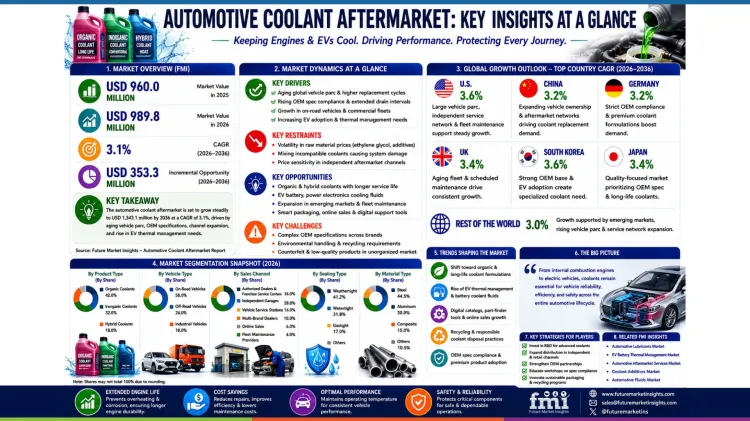
- Organic coolants are gaining the strongest aftermarket preference, with FMI projecting the organic product segment to hold 42.0% share in 2026.
- The preference is driven by extended-life performance, OEM specification alignment, broader application coverage, and growing demand for lower-maintenance cooling systems.
- Inorganic coolants remain relevant in older vehicles, conventional service environments, and price-sensitive repair channels where legacy formulations are still specified.
- Hybrid coolants are gaining practical attention because they bridge organic acid technology and conventional inhibitor systems for mixed vehicle parc applications.
- The aftermarket buying decision is increasingly tied to vehicle manufacturer specifications rather than generic coolant color or lowest price.
- The strongest commercial signal is that organic coolants are leading, and workshops still need formulation discipline because mixing incompatible coolant chemistries can create service risk.
Coolant replacement looks like a simple maintenance job from the outside. A technician drains the old fluid, flushes or tops up the system, and refills the vehicle with the recommended coolant. In the aftermarket, that task has become more technical because coolant chemistry now needs to match vehicle design, materials, service interval, regional climate, and manufacturer specification.
This is why organic coolants are gaining preference.
FMI values the automotive coolant aftermarket at USD 960.0 million in 2025 and USD 989.8 million in 2026, with the market forecast to reach USD 1,343.1 million by 2036 at a 3.1% CAGR. Organic coolants are projected to lead the product segment with 42.0% share in 2026, while on-road vehicles account for 58.0% of vehicle demand. Authorized dealers and franchise service centers lead sales channels with 36.0% share. These figures indicate a market where specification compliance and recurring vehicle maintenance are more important than one-time product novelty.
Organic coolant preference is linked to extended-life coolant technology. Organic acid technology coolants use carboxylate-based corrosion inhibitors designed to protect metals in cooling systems over longer drain intervals than many conventional inorganic formulations. In modern engines, cooling systems may include aluminum radiators, mixed metals, water pumps, gaskets, seals, plastic components, heater cores, and complex flow paths. A coolant has to manage corrosion, freezing, boiling, cavitation risk, scale, and material compatibility.
The aftermarket shift toward organic coolants does not mean every vehicle should be filled with the same product. It means more service providers are moving toward formulation-specific replacement because modern vehicles carry more precise coolant requirements. FMI notes that OEM specification compliance requirements create product differentiation and support premium pricing for specification-compliant fluids. This is an important point, since the premium is not only for the liquid, but for the confidence that the product matches the vehicle required coolant chemistry.
Inorganic coolants still have a defensible role. Older vehicles, legacy cooling systems, some heavy-duty uses, and repair markets with conventional service habits may continue using inorganic additive technology formulations. These products are familiar to many technicians and can be cost-effective where the system was designed for them. The challenge is that the overall vehicle parc is becoming more mixed. A garage may service a twenty-year-old vehicle, a late-model turbocharged passenger car, a hybrid, a diesel truck, and an EV thermal system in the same week. One universal coolant practice no longer works.
Hybrid coolants occupy the middle ground. Hybrid organic acid technology formulations combine elements of organic and inorganic inhibitor systems. They can be useful where vehicle manufacturers specify hybrid chemistry or where regional fleets have mixed technology requirements. The FMI product segmentation includes organic, inorganic, and hybrid coolants, including bio-based, synthetic organic, mineral-based, non-glycol, blended performance, and advanced multipurpose fluids. That scope shows the market is becoming segmented by formulation logic rather than simply by brand.
A major aftermarket problem is incorrect mixing. Coolant color is not a reliable specification guide. Different manufacturers may use similar colors for different chemistries, while different colors can sometimes appear within similar chemistry families. A technician choosing coolant only by red, green, blue, pink, or orange can create compatibility issues. Mixed coolants can reduce corrosion protection, form deposits, shorten drain intervals, or create customer complaints.
The EPA comprehensive procurement guidance for vehicular products makes a related practical point. It does not recommend one engine coolant type over another, and it recommends that procuring agencies purchase engine coolant containing only one base chemical, typically ethylene glycol or propylene glycol, to avoid commingling incompatible coolant types. The guidance is written for procurement, and the operational lesson applies directly to the aftermarket, namely that compatibility discipline matters.
Organic coolants also benefit from vehicle age patterns. Older vehicles require recurring maintenance, while newer vehicles often carry more precise fluid specifications. ACEA 2026 report states that EU cars are on average 12.7 years old and trucks 14 years old. Older vehicles keep the aftermarket active, and their diversity increases the need for correct coolant selection. A service bay cannot assume that an aging vehicle always needs a traditional inorganic product. It must follow the specification.
The USA aftermarket illustrates the same logic. FMI projects the USA automotive coolant aftermarket to grow at 3.6% CAGR through 2036, supported by a large vehicle parc, aging fleet demographics, independent service networks, auto parts retail, and fleet maintenance operators. Older vehicles create replacement frequency, while large service networks create distribution reach. In this environment, organic coolants gain when they are stocked by major retailers, independent garages, and authorized service centers as specification-compliant products.
Authorized dealers have a natural advantage in organic coolant adoption because they service vehicles under warranty and follow OEM-approved fluid specifications. Independent garages need broader product coverage because they handle mixed brands and model years. This can increase demand for multipurpose organic or hybrid formulations, and only when they are legitimately approved for the vehicles being serviced.
Cost still matters. Inorganic coolants can be cheaper, and price-sensitive garages may prefer them for older vehicles where compatible. Organic and hybrid coolants often command a higher price, particularly when sold through authorized channels or premium brands. The buyer willingness to pay depends on the cost of failure. A small saving on coolant is unattractive if it leads to overheating, corrosion, heater-core blockage, water-pump damage, or a return repair.
Packaging also reflects aftermarket behavior. FMI states that bottles lead the packaging segment with 49.0% share, showing that retail and workshop pack sizes remain central to demand. Drums and bulk packs support fleet maintenance and high-volume service operators. Organic coolant suppliers need to compete across both pack formats because professional garages and retail customers buy differently.
Environmental handling is becoming part of procurement. Used coolant can contain ethylene glycol, propylene glycol, metals, and contaminants from vehicle systems. The EPA older evaluation of automotive and heavy-duty engine coolant recycling concluded that coolant recycling has potential as a waste-reduction option. As service providers handle higher coolant volumes, responsible collection, segregation, and recycling can become part of workshop quality.
The competitive landscape also favors companies with formulation breadth and distribution. FMI identifies Valvoline, Shell, ExxonMobil, TotalEnergies, and Prestone as key players. The advantage for these companies is not only brand recognition. It is the ability to supply multiple coolant chemistries, packaging formats, channel partners, and regional specifications.
The strongest aftermarket preference is therefore moving toward organic coolants, and not because inorganic coolants are obsolete in every case. Organic coolants are winning where vehicle design, extended drain intervals, OEM specifications, and service-center confidence matter. Inorganic products remain relevant in older and conventional applications. Hybrid products gain when mixed parc complexity requires broader compatibility.
The practical analyst reading is that coolant choice is becoming specification-led. The winning formulation is the one that fits the vehicle, protects the system, and gives the service provider confidence that the repair will not return as a cooling-system complaint. On that basis, organic coolants are ahead, and the aftermarket still needs disciplined product selection rather than generic substitution.

