


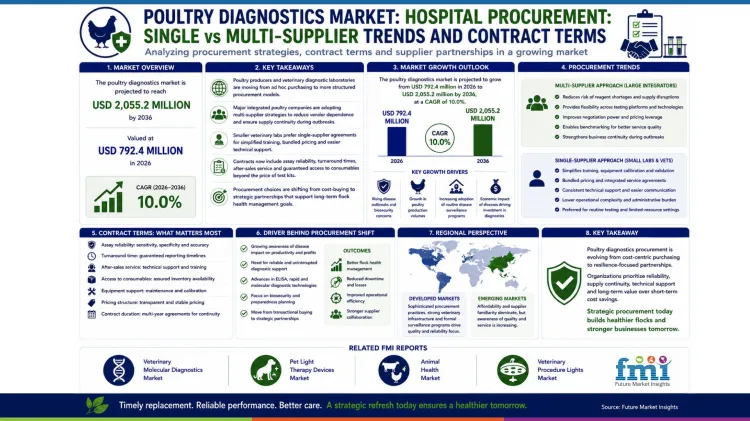
- Poultry diagnostics market is projected to reach USD 792.4 million in 2026 and USD 2,055.2 million in 2036 with a CAGR of 10.0% over the forecast period.
- Poultry producers and veterinary diagnostic laboratories are moving from ad hoc purchasing to more structured procurement models to improve disease surveillance capabilities.
- Major integrated poultry companies are moving toward multi-supplier procurement approaches to reduce reliance on any one diagnostic vendor and to increase supply continuity during disease outbreaks.
- Smaller veterinary labs tend to stick with single-supplier agreements because they reduce the need for training, allow for bundled pricing and simplify technical support.
- Contract negotiations now include assay reliability, turnaround times, after-sales service commitments and guaranteed access to consumables, not just the cost of test kits.
- Procurement choices are shifting from cost-buying to partnerships that will help achieve long-term flock health management goals.
The poultry diagnostics market is experiencing a significant paradigm shift as commercial poultry producers, veterinary laboratories, and integrated poultry companies are altering their procurement strategies. Traditionally sector purchasing decisions have been made primarily on the basis of immediate disease response needs and testing kits and laboratory services have been procured on the basis of availability and cost.
Simultaneously, the increasing economic impact of avian disease outbreaks has elevated diagnostics from an operational expense to a strategic investment.
The market is projected to increase from USD 792.4 million in 2026 to USD 2,055.2 million by 2036, indicating the growing significance of surveillance testing in poultry production systems. The increasing concerns over Avian Influenza, Newcastle disease, Infectious Bronchitis and other infectious diseases are increasing the demand for reliable diagnostic solutions.
Procurement frameworks are getting more sophisticated as diagnostic volumes increase.
Big poultry integrators are increasingly favoring multi-supplier procurement strategies. This diversification of vendor relationships mitigates the risk of issues of reagent availability, manufacturing delays, or logistical constraints that can occur during disease outbreaks. The availability of several testing platforms also provides organizations with the flexibility to tailor diagnostic approaches according to the particular disease, surveillance goals and turnaround time requirements.
From a risk management perspective, supplier diversification is an important component of broader biosecurity planning.
Multi-supplier environments also offer more leverage in negotiations. Poultry companies are able to benchmark performance against vendors, better evaluate pricing structures and encourage ongoing improvements in service quality.
But single supplier models still do.
Smaller diagnostics labs and independent veterinary service providers like things simple and consistent in operation. Opting for a single supplier reduces the operational complexity of training personnel, calibrating equipment, validating assays and managing inventory. Integrated service agreements increase the attractiveness of consolidated procurement arrangements even more. Vendor retention is higher when vendors can provide diagnostic platforms, testing kits, technical support and staff training under one contract.
Contract terms themselves are changing dramatically.
Acquisition price is still important but purchasing decisions are increasingly based on wider performance indicators. Now, diagnostic sensitivity and specificity, laboratory turnaround times, technical responsiveness, availability of inventory and preventive maintenance provisions are more important during vendor evaluations. The growing emphasis on continuity planning is also influencing contract duration.
Short-term purchasing arrangements are gradually giving way to multi-year agreements designed to secure stable pricing structures and ensure uninterrupted access to critical testing resources. Such arrangements provide greater financial predictability for poultry producers operating within highly competitive protein markets.
The procurement requirements are also changing due to technology adoption.
The ELISA test is still widely used because it is scalable and suitable for flock level surveillance. At the same time, molecular diagnostic methods continue to gain in popularity as producers seek faster c
Diagnostic providers that can offer a variety of test methodologies in an integrated service environment can therefore improve their competitive position.
Regional considerations also affect procurement practices.
In developed economies, highly integrated poultry industries tend to be more sophisticated in procurement, supported by dedicated veterinary infrastructure and formalized disease surveillance programs. More diagnostics may not be enough to shift the focus of emerging poultry markets from affordability and familiarity with suppliers.
But a common trend is emerging across geographies.
The purchase of poultry diagnostics is increasingly perceived in terms of resilience, reliability and value of long-term partnership. Organizations are recognizing the substantial operational impact of diagnostic interruptions, which are far greater than just the cost of immediate testing. Confirmation during suspected disease events. One common misconception to avoid is that procurement decisions in poultry diagnostics are transactional.
In reality, supplier selection is increasingly driven by wider strategic priorities, including disease prevention, production continuity, regulatory compliance and export competitiveness.
Bottom Line
Procurement Model Analysis Procurement models in the poultry diagnostics market are becoming more structured as the importance of disease surveillance increases in poultry production systems. Whether it’s a one supplier partnership with an emphasis on operational simplicity or a diversified vendor approach to improve resilience, purchasing decisions are increasingly being made with long term flock health objectives and sustainable business performance in mind.

