


- Condition monitoring is changing motor repair from a breakdown response into a planned maintenance and asset-management service.
- Vibration analysis, thermal imaging, motor current signature analysis, insulation testing, and electrical diagnostics can identify developing motor faults before catastrophic failure.
- FMI identifies predictive maintenance as a distinct service category and links its growth to planned rewind scheduling and reduced unplanned downtime.
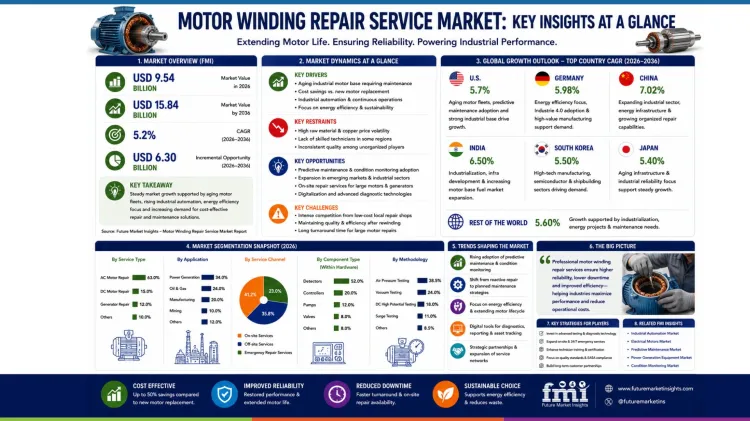
- Power generation leads application demand with 34.0%, where turbine auxiliaries, generators, exciters, pumps, and process motors create strong incentives for early fault detection.
- Predictive maintenance does not eliminate motor rewinding. It changes the timing, scope, documentation, and commercial value of the repair.
- The strongest service providers are likely to combine field diagnostics, root-cause analysis, repair execution, commissioning, and post-repair monitoring.
A motor repair shop traditionally received work after the failure had already happened. The motor arrived hot, damaged, noisy, electrically shorted, or mechanically seized. The customer wanted a quick quote, a fast turnaround, and a repair that could get production moving again.
Condition monitoring changes that relationship.
Instead of waiting for a winding failure, bearing collapse, rotor issue, insulation breakdown, or vibration problem to stop a line, the maintenance team can identify warning signs and plan the intervention. The service provider can prepare materials, reserve workshop capacity, arrange a spare motor, schedule a shutdown, and perform the rewind under controlled conditions. The repair itself may look similar, and the business model is different.
FMI identifies predictive maintenance services as one of the core service types in the motor winding repair market. It states that vibration analysis, thermal imaging, and motor current signature analysis are shifting repair from reactive failure response toward planned rewind programs. The report also links predictive maintenance adoption to improved service-provider utilization and lower emergency repair demand.
This shift is commercially important because emergency repair is expensive for both sides. The industrial customer may pay overtime, freight premiums, production losses, and rapid-response charges. The repair shop may need to disrupt planned work, mobilize technicians at short notice, and source materials quickly. Planned repair can be more efficient, more consistent, and easier to document.
The motor winding repair market is forecast to grow from USD 9.54 billion in 2026 to USD 15.84 billion by 2036. A growing installed base of industrial motors is one reason. The second reason is that more users are trying to manage these motors as monitored assets rather than disposable equipment. This is particularly visible in power generation, oil and gas, mining, chemicals, paper, cement, automotive manufacturing, and heavy process industries.
Power generation leads the market by application with a 34.0% share in 2026. That is logical. Generator stators, rotor fields, exciters, cooling motors, feedwater pumps, circulating-water systems, fans, and auxiliary drives can all affect plant availability. A motor failure in these environments can create costs far beyond the rewind itself. Predictive monitoring is valuable because it gives maintenance teams time to decide whether to repair, replace, rebalance, realign, rewind, or hold a spare.
A useful way to understand predictive maintenance is through fault progression. Most industrial motor failures do not begin as sudden electrical events. They often develop through insulation deterioration, bearing wear, poor lubrication, vibration, thermal stress, rotor-bar damage, shaft misalignment, loose connections, voltage imbalance, contamination, overload, or cooling problems.
Condition monitoring tools can detect some of these trends before they become destructive.
Vibration analysis is useful for identifying imbalance, misalignment, bearing defects, looseness, resonance, and mechanical issues. A motor may continue running while vibration signatures change. Tracking the pattern over time can show whether the problem is stable, worsening, or linked to a particular operating condition.
Thermal imaging can reveal hot bearings, overloaded terminals, poor cooling, insulation stress, or electrical imbalance. It is particularly useful as a screening tool because it can identify abnormal temperature patterns without shutting down the equipment.
Motor current signature analysis examines electrical current patterns to detect electrical and mechanical problems. The USA Department of Energy describes it as a non-intrusive technique that can identify both mechanical and electrical issues in motor-driven equipment. Current variations can reflect the condition of the motor and its driven load, providing early warning of deterioration or process changes.
Insulation resistance and electrical testing can help assess winding health, moisture ingress, contamination, insulation deterioration, and potential turn-to-turn faults. These tests are particularly relevant during planned shutdowns, motor overhauls, and commissioning.
Ultrasound, oil analysis, and acoustic monitoring may add value in specific applications, particularly for bearings, lubrication systems, and large rotating equipment.
The benefit of these tools is not that they predict every failure perfectly. Their value is that they improve maintenance timing. A plant can move from a position where the motor failed unexpectedly to one where the motor showed a deteriorating signature and intervention was scheduled during the next shutdown.
This changes motor repair services in several ways.
First, it makes repair demand more planned. Planned rewinds allow service providers to allocate technicians, copper, insulation systems, bearings, balancing capacity, and test equipment more efficiently. The customer may have time to arrange a spare motor or temporary bypass. Emergency freight and overtime can be reduced.
Second, it raises the technical content of the service relationship. The repair provider is no longer only a workshop. It becomes a diagnostic partner. It may review vibration data, thermal trends, current signatures, historical repair records, operating load, and environmental conditions before recommending action.
Third, it creates recurring revenue. A repair shop that provides condition monitoring contracts, periodic diagnostics, field inspections, and annual motor-health reviews can build a more stable relationship than one that waits for emergency failures.
Fourth, it improves root-cause analysis. A rewind may restore the motor, but it will not solve the underlying problem if the motor is overloaded, misaligned, exposed to contamination, affected by voltage imbalance, or operating with poor lubrication. Predictive maintenance allows the provider to identify and address these causes before or during the repair.
The FMI on-site service share of 41.2% supports this point. Large motors and generators are often not economically transportable. Field diagnostics, vibration checks, thermal inspections, bearing replacement, alignment work, and controlled testing may need to happen at the plant. On-site capability is therefore becoming more important as predictive maintenance expands.
The transformation is particularly relevant for medium- and high-voltage motors. These motors are used in pumps, compressors, crushers, mills, fans, generators, conveyors, and process equipment. They can be expensive to replace and difficult to remove. A condition-based program can give the operator more time to make the right repair decision.
Predictive maintenance also affects repair quality. A motor sent for planned repair can be documented before removal. The provider can record vibration readings, insulation condition, operating temperature, current balance, bearing condition, and process history. After repair, it can compare post-repair performance with the baseline. This creates evidence that the repair improved or restored the condition.
This is particularly useful for EASA-AR or equivalent quality-focused service providers. The customer can see more than a repair invoice. It can receive diagnostic findings, repair procedures, test results, recommendations, and follow-up monitoring. This level of documentation can help justify premium pricing compared with an uncertified low-cost rewind.
There are limits to predictive maintenance. Not every motor needs permanent sensors. Small, low-cost, non-critical motors may be cheaper to replace on failure. Monitoring every asset can create unnecessary cost, data overload, and maintenance complexity. The strongest return comes from criticality-based deployment.
A practical condition-monitoring hierarchy can be organised across three tiers.
Critical motors warrant continuous monitoring, vibration sensors, thermal data, current analysis, alarm thresholds, and planned repair strategies.
Important process motors warrant periodic vibration and thermal routes, electrical testing during shutdowns, and condition trend reviews.
General-purpose motors warrant basic visual inspection, preventive maintenance, lubrication, alignment checks, and replacement-on-failure strategies where appropriate.
The provider's value lies in helping the customer select the appropriate level rather than selling the same monitoring package for every motor.
Industrial users are also starting to connect motor condition monitoring with broader maintenance systems. The data may flow into computerized maintenance management systems, asset management platforms, plant historians, or industrial IoT systems. The repair provider can use this information to recommend shutdown windows, spare-motor plans, repair priorities, and replacement triggers.
Germany is a useful market example. FMI projects growth of 5.98% through 2036 and links it to energy efficiency, Industrie 4.0 predictive maintenance, and high-value generator repair demand. The United States is projected at 5.7%, with demand supported by aging industrial fleets, predictive maintenance adoption, and established independent repair infrastructure. China, at 7.02%, reflects a growing industrial motor base and increased focus on efficiency-preserving repair.
The adoption of predictive maintenance does not mean emergency repair disappears. Unexpected failures will remain part of industrial operations. Electrical faults can develop quickly. Bearings can fail suddenly. Process upsets can overload motors. Environmental incidents can damage equipment. The difference is that a larger share of repair work can be planned, and planned work is typically more efficient for both customer and provider.
Motor repair companies that want to benefit from this shift need more than winding capacity. They need field-service technicians, diagnostic tools, software capability, data interpretation skills, customer reporting, and the ability to connect findings to a repair or replacement recommendation.
The strongest commercial model may combine five elements:
- Asset criticality review identifies which motors justify condition monitoring.
- Routine condition monitoring covers vibration, thermal, electrical, and mechanical checks.
- Fault diagnosis and root-cause analysis distinguishes winding issues from bearing, alignment, load, or process problems.
- Planned repair execution covers rewinding, balancing, bearing replacement, rotor work, insulation improvement, and testing.
- Post-repair validation confirms the motor has returned to acceptable electrical and mechanical condition.
This approach makes the repair provider part of the customer's reliability program. It also gives the provider better visibility into future work, improving workshop planning and reducing dependence on emergency calls.
Condition monitoring can transform motor repair services because it changes the timing and value of the intervention. The repair becomes less about reacting to failure and more about preserving production continuity. For industrial customers, that can reduce unplanned downtime. For service providers, it can create a more stable, technically differentiated, and recurring business model.

