


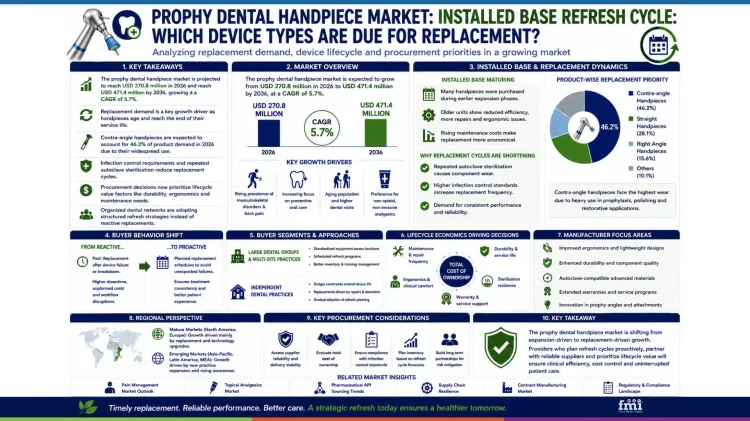
- The prophy dental handpiece market is projected to reach USD 270.8 million in 2026 and reach USD 471.4 million by 2036, growing at a CAGR of 5.7% during the forecast period.
- Replacement demand is becoming an increasingly important driver of growth as handpieces used for routine prophylaxis age and reach the end of their service life.
- Contra-angle dental handpieces are expected to observe demand of 46.2% of the product demand in 2026, owing to their widespread use in prophylaxis, polishing, and restorative workflows.
- Reduced replacement cycles driven by infection control requirements, especially for reusable handpieces exposed to repeated autoclave sterilization.
- Procurement decisions are increasingly geared towards the lifecycle value of products rather than acquisition cost, with factors like durability, ergonomics and maintenance requirements considered.
- More organized networks of dental practices are driving more structured strategies for refreshing equipment, rather than reactive replacement after device failure.
The prophy dental handpiece market is increasingly being defined by a replacement driven growth model as dental providers reassess the age profile and operational efficiency of their installed base of equipment. The opening of new dental clinics is still creating incremental demand, but an increasing portion of market activity is being fueled by the need to replace older handpieces that no longer satisfy modern infection control requirements or clinical performance expectations.
The market was valued at USD 270.8 million in 2026 and USD 471.4 million in 2036, with continued procurement activity in private practices, specialty dental clinics, and institutional dental settings. The increasing number of patients and the growing focus on preventive oral care further highlight the need for effective prophylaxis equipment in daily clinical practice.
The installed base is maturing and is becoming a defining characteristic of the market.
Many of the prophy dental handpieces in use today were purchased during periods of rapid expansion of the dental infrastructure. Many of these units have undergone multiple cycles of sterilization, frequent clinical use and routine wear and tear associated with prophylaxis procedures. Older handpieces still work but may exhibit a decrease in efficiency, an increase in maintenance frequency, and a decrease of ergonomic performance.
As a result, providers are increasingly evaluating the economic viability of keeping legacy equipment.
The priority for replacement depends greatly on the type of device.
Contra-angle dental handpieces are anticipated to witness huge refresh activity, with 46.2% share in 2026. They are heavily used in preventive and restorative procedures and are subject to heavy operational demands, resulting in increased wear and maintenance needs over time. Straight and right angle handpieces also need to be replaced but their refresh cycles are often dictated by the procedures they are used for and how a practice uses them. Infection control considerations also increase the need for replacements.
Repeated autoclaving adds cumulative stress to reusable handpiece components including bearings, seals and device life. As sterilization protocols become more stringent, dental providers are looking for products that can withstand repeated sterilization exposure and maintain their performance integrity. That dynamic is changing buying behavior.
In the past, replacement decisions have frequently been made after device malfunction or clinical failure. Modern purchasing approaches are increasingly revolving around planned replacement schedules designed to minimize disruption and ensure treatment consistency.
This shift is especially striking in the larger dental groups.
Corporate dental groups and multi-site practices are increasingly adopting standardized procurement policies to ensure equipment consistency across their different locations. Scheduled refresh programs can benefit these organizations by improving inventory management, reducing staff training requirements and improving service continuity. Each independent practice has its own purchasing characteristics. Replacement demand is healthy, but as budgets tighten, smaller clinics often squeeze more life out of hand pieces. Procurement activity in this segment is therefore more reactive to repair costs and equipment downtime rather than pre-scheduled replacement.
Lifecycle economics has become a cornerstone of investment choices.
Providers are starting to view handpieces in terms of total cost of ownership, not just the acquisition price. Purchasing evaluations are based on the frequency of maintenance, repair needs, ergonomic benefits, sterilization resilience and expected service life.
To meet these priorities, manufacturers are focusing on improved ergonomics, engineering durability and sterilization compatibility. Extended warranties and service support programs are also becoming critical differentiators in an increasingly competitive procurement environment.
Regional growth dynamics also play a role in replacement dynamics.
Emerging markets continue to grow their installed base of equipment through new practice development, while mature healthcare systems are creating demand largely through replacement activity. Together, these complementary growth mechanisms are conducive to the stable long-term growth of the market.
Bottom line: the prophy dental handpiece market is progressively evolving from a purely expansion-oriented market toward one characterized by structured equipment renewal. As installed bases mature and clinical expectations continue to rise, replacement cycles are expected to become an increasingly important determinant of future procurement activity.

