


- Regional differences in high barrier pharmaceutical packaging films are more than about demand. They are about how regulation changes the cost of selling.
- Europe is the strictest region on packaging circularity, EPR, recyclability, and documentation.
- The United States is fragmented, with federal drug packaging rules, state-level packaging EPR, and China-linked tariff exposure.
- China is more cost-competitive in conversion, but exporters must satisfy the packaging and customs rules of destination markets.
- Tariffs matter most when buyers compare Chinese films with local US or EU converters on landed cost.
- EPR affects pharma films less directly than consumer packaging today, but it is already shaping material choices and supplier qualification.
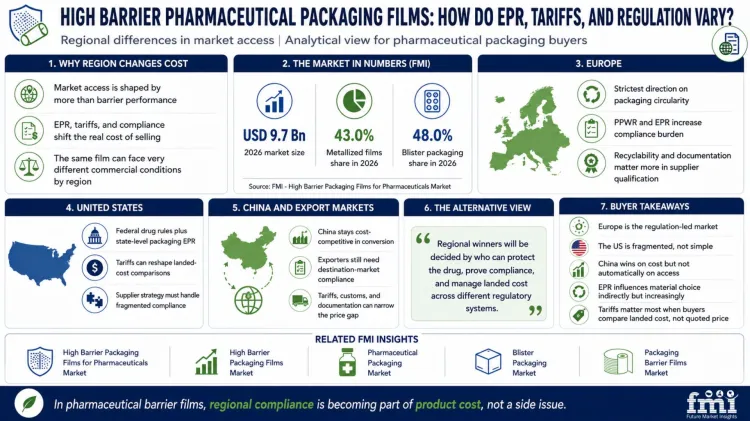
Regional regulation is becoming a hidden cost driver in the high barrier packaging films for pharmaceuticals market. The common assumption is that pharmaceutical packaging films compete on barrier performance, validation, price, and supply continuity. That is still true. But the regional layer is now equally important because EPR, tariffs, recycling rules, and pharmaceutical packaging regulation change the real cost of market access.
FMI estimates the high barrier packaging films for pharmaceuticals market at USD 9.7 billion in 2026, with metallized films expected to account for 43.0% of material demand and blister packaging expected to hold 48.0% of application demand. These figures matter because the largest product pools are also the most exposed to cross-regional regulation. Metallized films, blister films, strip packaging, sachets, and pouches may look like technical packaging choices, but in practice they sit inside very different regulatory systems.
Europe is the most regulation-led region. The EU Packaging and Packaging Waste Regulation entered into force in February 2025 and generally applies from August 2026. It covers all packaging and packaging waste placed on the EU market, regardless of material or origin. Its direction is clear: packaging must become more recyclable, less waste-intensive, and more accountable through the full life cycle. For pharmaceutical film suppliers, this does not mean drug protection becomes less important. It means barrier performance must now be defended alongside recyclability, material minimization, and data-backed compliance.
This creates a specific European tension. Pharma packaging cannot simply follow consumer packaging into simplified recyclable formats if the drug is moisture-sensitive, oxygen-sensitive, or stability-risked. A blister film or high barrier pouch that protects the medicine may use multilayer structures that are harder to recycle. The European buyer therefore needs a better justification file: why the material is necessary, how much material is used, whether alternatives have been assessed, and whether the structure can align with future recyclability requirements. That gives EU converters and suppliers with PVDC-free, recyclable, thinner, or specialty coated structures more relevance in the broader high barrier packaging films market
The United States behaves differently. It does not have one single national packaging EPR framework equivalent to the EU’s harmonized direction. Instead, packaging regulation is fragmented across federal drug packaging requirements and state-level packaging EPR laws. California is especially important because SB 54 creates an EPR program for packaging and single-use plastic food service ware and requires producers to meet major packaging reduction, recyclability, compostability, and recycling targets by 2032. For pharmaceutical packaging film suppliers, the US risk is not one rule. It is the operational complexity of serving a market where California, Oregon, Maine, Colorado, Minnesota, and other states can move faster than federal policy.
This fragmentation changes supplier strategy. A converter selling into the US may not need to redesign every pharmaceutical film immediately, but it does need better material declarations, recyclability logic, customer documentation, and state-by-state compliance awareness. The pharmaceutical packaging market is already shaped by safety, protection, and regulatory requirements. Packaging EPR adds another layer: who pays, who reports, and who carries the burden of proving material responsibility.
Tariffs create the second US difference. Chinese converters may win on factory-gate price, but that advantage narrows when US import duties, Section 301 exposure, freight, customs classification, and lead-time risk are included. Plastic plates, sheets, film, foil, and strip are commonly classified under HTS headings 3920 and 3921, while aluminum-based structures may fall into different tariff logic depending on composition and classification. The practical point is not that every pharma barrier film faces the same tariff. It is that tariff classification can materially change the landed-cost comparison between Chinese and domestic or regional suppliers.
China’s regulatory position is more export-dependent. Domestic pharmaceutical packaging is modernizing quickly, and FMI identifies China as the fastest-growing country market in high barrier pharmaceutical packaging films. But Chinese suppliers face a dual burden when they export: they must compete on price while also satisfying the destination market’s drug packaging, environmental, customs, and documentation requirements. A film that is commercially attractive in China may require additional proof, validation, or compliance support before a US or EU pharmaceutical buyer accepts it.
The Asia-Pacific region outside China is also not one market. India, Japan, South Korea, ASEAN countries, and Australia differ significantly in pharmaceutical regulation, import dependence, domestic converter capability, and packaging waste policy. In some markets, price and availability matter most. In Japan and Australia, documentation, quality systems, and regulatory comfort carry greater weight. In India and Southeast Asia, generic drug growth and export pharmaceutical production can favor cost-efficient high barrier structures, but exporters still need packaging that satisfies US, EU, and WHO-linked expectations.
Sharper read: EPR and tariffs do not simply add cost. They separate suppliers by sophistication. Low-cost converters gain where rules are lighter and specifications are standardized. EU suppliers gain where recyclability, documentation, and sustainability alignment matter. US suppliers gain where local assurance, tariff avoidance, and validation continuity matter. Chinese suppliers gain where landed cost remains attractive after duties, freight, and compliance work.
The categories most exposed to regional regulation are high-volume blister materials, metallized films, sachet films, pouches, and strip packaging used across multiple countries. The least flexible applications are validated blister structures, cold-form aluminum packs, and ultra-high barrier films tied to drug stability files. In these cases, regulation may push improvement, but it rarely allows fast substitution.
Common misread: pharmaceutical packaging regulation is separate from packaging sustainability regulation. That separation is narrowing. Drug safety still comes first, but recyclability, EPR reporting, tariff exposure, and material documentation now influence supplier selection.
Bottom line: regional winners in high barrier pharmaceutical packaging films will not be decided by barrier performance alone. They will be decided by who can protect the drug, prove compliance, manage landed cost, and survive different regulatory systems without forcing the brand into revalidation risk.

