


- Animal feed ingredient demand does not behave the same way across regions because species mix, feed grain availability, regulations, farm scale, and protein strategies differ sharply.
- Asia is shaped by poultry, swine, aquaculture, and feed security pressures; the Americas by grain and oilseed supply, integrated livestock systems, and export-oriented protein production; Europe by regulation, animal welfare, and non-antibiotic feed programs.
- FMI’s animal feed coverage identifies plant-based sources as central to the broader animal feed market, while animal feed additives data shows powder formats and direct technical selling remain structurally important.
- Regional suppliers win when they align ingredient portfolios with local feed mills, livestock genetics, raw material availability, and processor standards.
- The biggest risks are supply concentration, raw material volatility, regulatory approval delays, and assuming that one feed ingredient strategy can scale globally without adaptation.
- The misconception to avoid is that animal feed ingredients are globally uniform. In practice, each region has a different feed economics and specification logic.
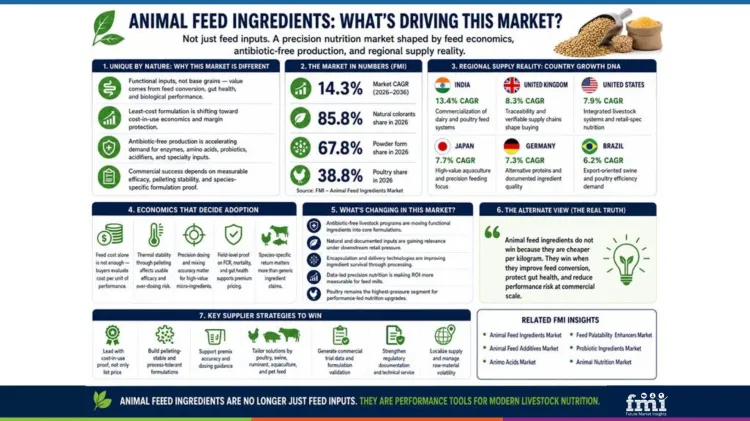
Animal feed ingredients are global, but the market does not behave uniformly. A feed ingredient strategy that works in a U.S. poultry system may not transfer directly to a Chinese swine operation, a European dairy program, a Brazilian broiler exporter, an Indian dairy cooperative, or a Southeast Asian aquaculture producer. This is why the regional angle is important for the Animal Feed Ingredients Market.
The market is shaped by several variables at once: livestock species mix, grain and oilseed availability, animal disease pressure, feed mill scale, consumer protein demand, import dependence, regulatory policy, and processor standards. Feed ingredients are therefore not just traded inputs. They are part of regional food security, farm economics, and protein supply chains.
FMI’s Animal Feed Market identifies plant-based sources as the leading source type in the broader feed market. That reflects the central role of cereals, soybean meal, oilseed meals, and other plant-derived inputs in global feed systems. However, the meaning of plant-based feed supply differs by region. In the Americas, it is linked strongly to corn and soybean production. In Asia, it is tied to import dependence, local grain availability, and feed security. In Europe, it intersects with sustainability, deforestation concerns, non-GMO sourcing, and regulatory scrutiny.
Asia is the most complex regional demand story. China, India, Southeast Asia, and other Asian markets combine fast-growing animal protein consumption with feed security challenges. Poultry, swine, aquaculture, and dairy all create large ingredient demand, but the species mix varies by country. China is heavily influenced by industrial swine and poultry systems, while India has a large dairy base and growing poultry feed demand. Southeast Asia has strong aquaculture and poultry relevance. This makes regional ingredient portfolios more complex than a single Asia strategy suggests.
In Asia, feed mills often need flexible raw material strategies because grain prices, soybean meal availability, fishmeal supply, freight costs, and currency movements can change quickly. Functional ingredients such as amino acids, enzymes, organic acids, probiotics, minerals, and premixes help nutritionists adjust formulas while protecting performance. The Feed Amino Acids Market and Feed Enzymes Market are relevant because precision nutrition allows mills to manage nutrient balance even when base raw materials shift.
Aquaculture is especially important in parts of Asia. Fish and shrimp producers need ingredients that support growth, feed conversion, immune resilience, water stability, and species-specific nutrition. Algae-based inputs, microbial ingredients, enzymes, and specialty protein sources may gain relevance where fishmeal substitution, sustainability, and aquaculture intensification are priorities. The Algae based Animal Feed Market is useful as an adjacent reference for this alternative input direction.
The Americas follow a different logic. North America and Brazil benefit from large-scale grain and oilseed systems, integrated livestock production, and advanced feed mill infrastructure. The availability of corn and soybean meal supports strong compound feed production, while export-oriented poultry, pork, beef, dairy, and aquaculture sectors create demand for performance-oriented inputs. In this region, feed ingredient suppliers must prove value through feed conversion, growth performance, carcass yield, milk productivity, egg output, and processing efficiency.
Brazil deserves separate attention because it is both a major feed ingredient producer and a major animal protein exporter. Export competitiveness creates pressure to manage feed cost while meeting buyer requirements. Feed additives, amino acids, enzymes, and gut-health ingredients are useful when producers need to optimize growth and maintain performance across high-volume systems. Ingredient suppliers that can support poultry, swine, ruminant, and aquaculture programs with local technical teams are better positioned than those selling generic global formulations.
Europe has a different set of decision drivers. Regulation, animal welfare, antibiotic-reduction policies, environmental requirements, and retailer standards strongly influence ingredient selection. The Animal Feed Additives Market and Eubiotics Market are relevant because European feed programs often need alternatives to routine antibiotic growth promotion and greater documentation around ingredient safety. Probiotics, organic acids, phytogenics, enzymes, minerals, and specialty premixes may gain value when they support gut health and compliance-oriented nutrition programs.
Europe also tends to place higher scrutiny on ingredient origin. Soy sourcing, deforestation risk, non-GMO requirements, palm-linked inputs, traceability, and sustainability documentation can influence procurement. This creates opportunities for suppliers with certified, traceable, or locally adapted alternatives. However, the technical performance still has to hold. A sustainable input that weakens feed conversion or raises ration cost too sharply will face resistance unless the processor or retailer is willing to pay for the claim.
The Middle East and Africa present another market reality. Some countries rely heavily on imported grains and feed ingredients due to limited domestic feedstock availability. Feed cost volatility can be severe, making formulation flexibility important. Poultry and dairy demand can grow around urbanization and food security programs, but feed supply infrastructure, cold-chain meat systems, and local production scale vary widely. Suppliers need to consider not only ingredient demand, but also distributor capability and feed mill sophistication.
Latin America beyond Brazil also requires local interpretation. Poultry, dairy, swine, cattle, and aquaculture feed programs vary across Mexico, Argentina, Chile, Colombia, and other markets. Access to grains, soybean meal, fishmeal, and specialty additives differs by country. Feed ingredient suppliers cannot assume that Spanish-speaking markets behave the same. Local species mix and processor structure determine what ingredients gain traction.
Form and channel also vary by region. FMI’s Animal Feed Additives Market indicates powder formats are important because industrial blending lines favor stable dosing and handling. This is especially relevant in regions with large compound feed and premix infrastructure. Direct sales are also important where large feed mills require formulation trials and dosage guidance. In less consolidated markets, distributors, veterinary networks, and local premixers may play a stronger role.
Regional risk is not only about demand. It is also about supply concentration. Amino acids, vitamins, enzymes, phosphates, trace minerals, fishmeal, soybean meal, and specialty additives may depend on specific producing countries or processing hubs. Disruptions from disease, export controls, geopolitics, port congestion, energy prices, or crop failures can move feed ingredient economics quickly. Feed mills increasingly need dual sourcing, local inventory planning, and reformulation capability.
China is a useful example of why regional feed logic matters. Industrial feed production, swine herd restructuring, poultry expansion, and food security policies all influence ingredient needs. Large integrators may demand consistent supply, technical support, and rapid reformulation capability, while disease pressure can increase interest in gut-health and biosecurity-linked nutrition. Imported soybean meal dependence, domestic amino acid capacity, and regulatory approvals all shape the market differently from Western feed systems.
India has another profile. Dairy remains structurally important, while poultry feed demand is growing with urban protein consumption. The feed ingredient opportunity is therefore split between organized compound feed, premix adoption, dairy nutrition, and value-sensitive livestock systems. Ingredients that are technically strong but too expensive or difficult to distribute may struggle outside large integrated buyers. Local education, distributor reach, and farmer economics matter heavily.
Europe’s regional logic is shaped by compliance. Additive approvals, animal welfare standards, antibiotic-reduction programs, sustainability documentation, and retailer pressure create demand for well-documented feed ingredients. However, Europe is also cost-sensitive because livestock producers operate under margin pressure and environmental obligations. Suppliers must demonstrate that cleaner, natural, or functional inputs deliver measurable outcomes rather than simply better label language.
North America has a more technology-driven procurement culture in many integrated systems. Large feed mills and livestock operations can run trials, compare performance data, and adopt specialty ingredients when the economics are clear. The region is also supported by advanced premix, enzyme, amino acid, and technical nutrition networks. Supplier credibility often depends on field evidence, formulation software compatibility, and responsiveness to large accounts.
Regional channel structure also changes supplier strategy. In consolidated markets, direct technical selling to feed mills and integrators is often essential. In fragmented livestock markets, distributors, veterinarians, local premixers, and feed dealers may be the real adoption channel. The same ingredient may require a technical-sales model in one country and a distributor-education model in another. Ignoring this difference can lead to weak conversion even when demand exists.
The misconception to avoid is that animal feed ingredients are globally uniform because animals need the same broad nutrients. The nutritional basics are universal, but commercial reality is regional. A broiler feed mill in Brazil, a dairy nutrition program in Europe, a shrimp feed plant in Vietnam, and a swine integrator in China face different cost structures, regulatory pressures, disease risks, and buyer requirements.
Bottom line: animal feed ingredient strategy must be regional. Suppliers that win will not simply sell the same ingredient everywhere. They will align species data, formulation support, sourcing security, documentation, and cost-in-use logic with the realities of each feed-producing region.

