


- Regulatory approval timelines are becoming a major competitive factor in the Bone Morphogenetic Protein Market as companies seek quicker commercialization in orthopedic and reconstructive applications.
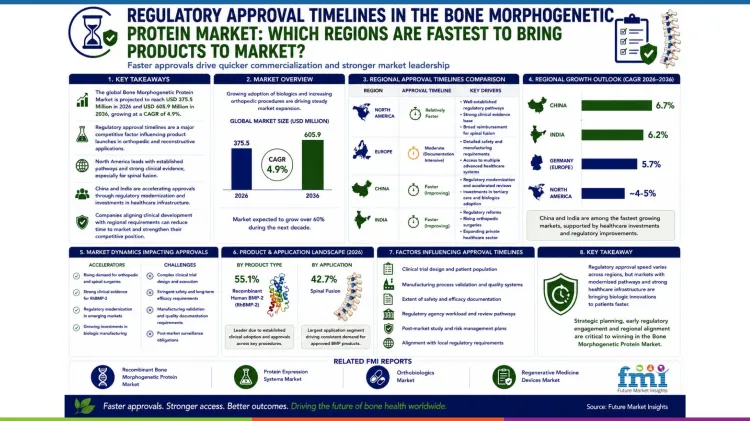
- The global Bone Morphogenetic Protein Market is projected to reach USD 375.5 million in 2026 and USD 605.9 million in 2036, growing at a CAGR of 4.9% over the forecast period.
- North America has well-established regulatory pathways and a large clinical evidence base for recombinant bone morphogenetic proteins, particularly for spinal fusion procedures.
- Regulatory modernization and healthcare infrastructure investments in China and India are facilitating the faster commercialization of biologic products, making these countries attractive markets.
- Companies that succeed in aligning clinical development with regional regulatory requirements are expected to shorten their time to market and improve their competitive position.
The Bone Morphogenetic Protein Market has become a niche biologics segment with regulatory approval strongly linked to commercial success. Unlike traditional orthopedic implants, recombinant bone morphogenetic proteins need to undergo rigorous clinical testing to ensure safety, efficacy and long-term outcomes before clinical application.
The market is estimated to grow from USD 375.5 million in 2026 to USD 605.9 million by 2036. The manufacturers are increasingly evaluating the most conducive regulatory environment for product launches. Innovation still matters, but the faster companies can get approvals, the more money they make and the better they look relative to competitors.
The regulatory environment is quite different across the major markets. Patient safety and innovation are balanced differently across regions, resulting in differences in approval times and commercialization approaches.
North America remains one of the most mature regulatory environments for bone morphogenetic proteins. Recombinant BMP technologies have been widely adopted for orthopedic and spinal procedures as they are supported by established review processes and a large body of clinical evidence. Established review pathways with more predictability for manufacturers often guide products with strong clinical datasets.
The United States also offers broad reimbursement schemes for approved spinal fusion applications. The clarity of regulation and the availability of reimbursement support encourage continued investment in new biologic technologies.
Europe is another key commercialization opportunity. The regulatory systems rely on detailed safety documentation, manufacturing consistency and long-term clinical performance prior to approval. The approval process can be long because of the documentation requirements, but if the application is successful, it will give access to several healthcare systems with advanced orthopedic capabilities.
Germany remains among the strongest European markets for bone morphogenetic proteins due to its established orthopedic practices and favorable reimbursement environment. Germany is projected to grow at a CAGR of 5.7% up to 2036, according to Future Market Insights.
Future Market Insights projects a CAGR of 6.7% for the period 2026-2036 for China, making it one of the fastest growing regions for bone morphogenetic proteins. Government investments in tertiary healthcare facilities and increasing adoption of biologic therapies support greater regulatory activity.
There are opportunities for manufacturers looking to gain access to increasing surgical volumes as the country endeavors to modernize. Accelerated review processes, and expanding hospital infrastructure, make China an increasingly attractive market for future product launches.
India is on a similar trajectory, with growth predicted to be 6.2% through 2036. The higher demand for recombinant protein products is supported by increasing orthopedics surgery volumes, expansion of private hospitals and continuous regulatory modernization.
While cost sensitive relative to mature markets, India is seeing improvements in regulatory frameworks supporting broader commercialization opportunities for advanced biologics.
The Bone Morphogenetic Protein Market itself shows these regional disparities. The type segment is projected to be led by recombinant human BMP-2 (RhBMP-2) in 2026, capturing 55.1% of the market share owing to its well-established clinical adoption and regulatory approvals across key orthopedic procedures.
Similarly, spinal fusion is predicted to account for 42.7% of application demand in 2026, representing the leading clinical use for approved products of bone morphogenetic protein. The concentration of approvals in this application suggests that clinical evidence is important for regulatory success.
Manufacturers also need to understand that approval timelines are not limited to product review. Then there are the timelines related to clinical trial design, manufacturing validation, quality documentation and post-market surveillance requirements.
Companies with integrated manufacturing capabilities and regulatory experience tend to move more quickly through these stages than new entrants who are seeking to build clinical credibility for the first time.
Regional approval strategies are increasingly integrated into broader commercial planning. Some manufacturers target markets with existing reimbursement systems, before expanding into fast-growing emerging economies where healthcare investment is growing.
This stepwise approach allows companies to build clinical experience and commercial revenue while preparing documentation for additional regulatory jurisdictions.
The increasing importance of biologics in orthopedic surgery also ensures that regulators continue to demand comprehensive evidence of product performance. Long-term follow-up data, manufacturing consistency and patient safety are still big evaluation criteria across all major health care systems.
Regulatory approval will be a competitive advantage to the manufacturers who can meet these expectations, not just compliance.
Bottom Line
Regulatory approval timelines are emerging as one of the key factors shaping the competition in the Bone Morphogenetic Protein Market. Established clinical evidence characterizes mature regions, while fast-growing markets such as China and India are strengthening their regulatory frameworks to support broader biologics adoption.
Companies that are able to combine high-quality clinical development with efficient regulatory execution are likely to accelerate commercialization and secure better long-term market positions as the market moves towards USD 605.9 million by 2036.

