


- Nisin demand is not decided only by clean-label interest. It is strongly controlled by approved food categories, maximum-use limits, additive labeling rules, and country-level regulatory acceptance.
- Buyers are willing to pay more for nisin when suppliers provide clear regulatory documentation, dosage guidance, export-market support, and application-specific compliance confidence.
- The strongest regulatory-led opportunity sits in processed cheese, dairy desserts, sauces, heat-treated meat products, ready-to-eat soups, liquid egg products, bakery fillings, and selected refrigerated or heat-processed foods, depending on local approval.
- Nisin is not a universal natural preservative that can be added freely across every food and beverage category. Its commercial use depends on whether the target application, dosage level, and market of sale allow it.
- The biggest mistake suppliers can make is selling nisin only on antimicrobial performance. In this market, regulatory fit is often as important as technical efficacy.
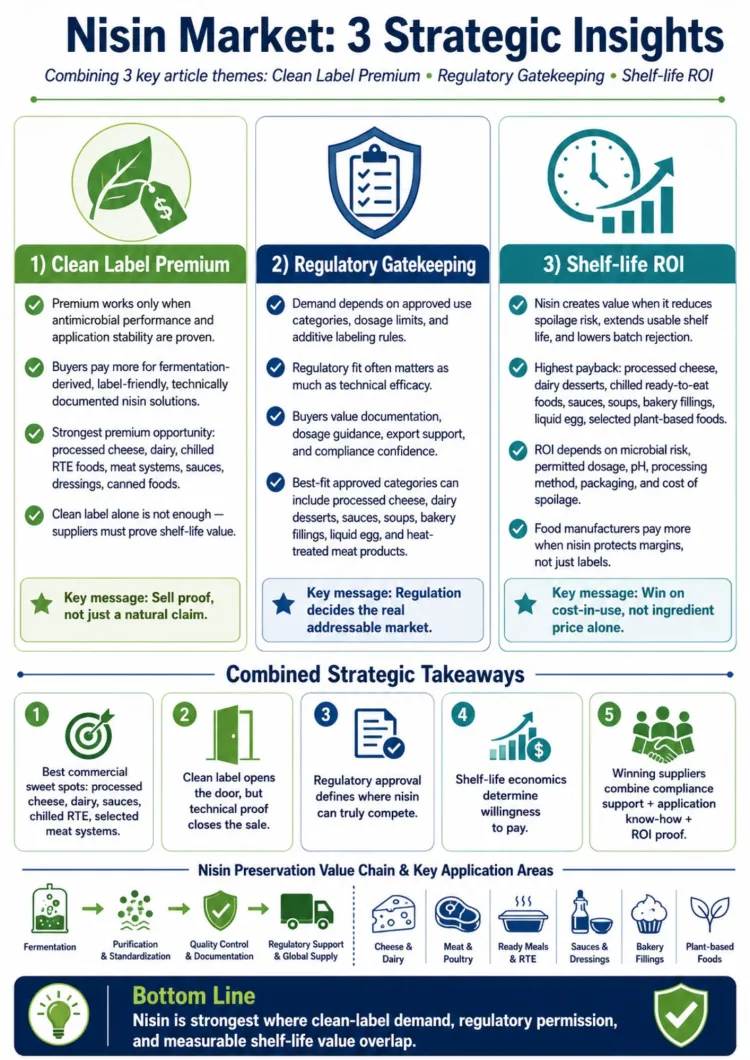
Regulation is one of the most important commercial filters in the Nisin Market. While many natural preservatives compete on clean-label appeal, nisin has an additional layer of complexity: it must fit the permitted use category, maximum-use level, additive declaration requirement, and country-specific food regulation of the market where the finished product is sold.
This makes nisin different from many other shelf-life ingredients. Food manufacturers are not only asking whether nisin works. They are asking whether it is allowed, how much can be used, whether it can be declared acceptably on the label, and whether the same formulation can be exported across multiple markets.
According to Future Market Insights, the Nisin Market is expected to benefit from rising demand for natural antimicrobial preservation, clean-label reformulation, and shelf-life extension in processed and packaged foods. However, the addressable opportunity is narrower than the overall clean-label preservative opportunity because regulatory permission decides where nisin can actually be used.
That is why the core question for Article 2 is simple: in the Nisin Market, does regulation decide the winners more than product performance?
Regulation Turns Nisin from an Ingredient into a Compliance Decision
Nisin is usually positioned as a fermentation-derived antimicrobial preservative. That positioning is commercially attractive, but it does not automatically make nisin usable across all categories. Food additive rules differ by country and by food category. A product that can use nisin in one market may face restrictions, different limits, or different labeling requirements in another.
For manufacturers selling locally, this creates a product development checkpoint. For exporters, it creates a formulation-risk problem. A company producing cheese spread, sauce, RTE food, or meat product for multiple countries must check whether the same nisin-based formulation is permitted in each destination market.
This gives regulatory support a direct commercial value. Buyers are more likely to prefer suppliers that can provide permitted-use guidance, regulatory documentation, product specifications, certificate support, dosage recommendations, and technical justification.
In other words, nisin is not bought only as an antimicrobial ingredient. It is also bought as a compliance-supported preservation solution.
Why Approved Use Categories Matter More Than Broad Market Demand
The clean-label trend may create broad interest in nisin, but approved-use categories create the real commercial boundary. Processed cheese and cheese-based products are among the most established application areas. Dairy desserts, sauces, liquid egg products, bakery products, heat-treated meat products, soups, and selected refrigerated foods may also represent opportunities depending on the regulatory framework.
However, the key phrase is “depending on the regulatory framework.” Nisin cannot be treated as a universal solution for all packaged food categories. If a food category is not permitted, or if the allowed dosage is too low to achieve the desired microbial control, commercial adoption becomes difficult.
This is why suppliers must map opportunity by application and country, not only by total food processing demand. A region with strong processed food consumption may still be difficult if regulatory permission is narrow. A smaller region may be attractive if approvals are clear, buyers are export-oriented, and food manufacturers are under pressure to replace synthetic preservatives.
The winning market strategy is therefore not “sell nisin everywhere.” The winning strategy is “sell nisin where regulation, application need, and shelf-life economics overlap.”
The Export Problem: One Formula May Not Fit Every Market
Export-oriented food manufacturers face one of the biggest regulatory pain points. A manufacturer may develop a nisin-preserved product for one domestic market, but that same product may require review before entering another country. Differences in permitted categories, maximum-use levels, additive codes, ingredient declaration, and customer documentation can delay launches or force reformulation.
This is especially relevant for multinational dairy, cheese, meat, sauce, and ready-meal manufacturers. These companies prefer ingredients that can support multi-country rollout. If nisin use is accepted across the target markets, it becomes more attractive. If approvals differ sharply, the buyer may choose an alternative preservative system or create region-specific formulations.
This creates a premium opportunity for suppliers with strong regulatory intelligence. Companies that can help customers understand where nisin is allowed, what limits apply, and how to document use correctly can become preferred partners.
Regulatory support reduces risk. In the Nisin Market, reduced risk can justify better pricing.
Documentation Becomes a Competitive Advantage
The most successful nisin suppliers are likely to compete not only on price and potency, but also on documentation quality. Food manufacturers increasingly expect complete technical and regulatory files before adopting a preservation ingredient.
Important buyer requirements may include product specification sheets, purity and potency documentation, allergen statements, GMO status, halal and kosher certificates, country-wise regulatory statements, safety documentation, heavy metal limits, microbiological specifications, and recommended application dosage.
For large buyers, documentation depth can matter as much as ingredient cost. A low-priced nisin supplier may lose if the buyer cannot validate compliance quickly. A premium supplier may win if it reduces approval time, supports audits, and provides strong technical service.
This is especially important in regulated applications such as dairy, processed cheese, meat, egg products, and export-oriented processed foods.
Regulatory Gatekeeping Also Shapes Innovation
Regulation does not only restrict the market. It also shapes innovation. Suppliers are increasingly likely to develop formulated nisin systems, blends, encapsulated formats, and application-specific solutions that help customers achieve performance within permitted dosage levels.
For example, if maximum-use levels restrict how much nisin can be added, suppliers may need to improve delivery efficiency, combine nisin with other preservation hurdles, or support formulation changes that improve antimicrobial performance. This creates space for higher-value nisin blends rather than only commodity-grade nisin powder.
Innovation will also be important in plant-based foods, sauces, chilled meals, and active packaging. These areas may offer growth potential, but adoption will depend on regulatory acceptance and technical validation.
Therefore, the next stage of the Nisin Market will not be driven only by more demand for clean labels. It will be driven by better alignment between regulatory permission and application-specific performance.
Where Suppliers Can Win
Suppliers can win in the Nisin Market by building a regulatory-first commercial strategy. This means identifying approved applications, prioritizing food categories with clear use permission, and supporting customers with documentation before the trial stage begins.
The strongest supplier positioning should combine four elements: regulatory confidence, technical efficacy, clean-label value, and cost-in-use justification. If any one of these is missing, adoption becomes harder.
For example, a buyer may like nisin’s clean-label profile, but if regulatory approval is unclear, the project may stop. A buyer may confirm regulatory permission, but if nisin does not perform in the food matrix, adoption may fail. A buyer may confirm both permission and performance, but if the cost is not justified by shelf-life benefit, the project may remain limited.
This makes nisin a consultative ingredient sale. The supplier must help the buyer answer not only “does it work?” but also “can we legally use it, declare it properly, and justify the cost?”
The Strategic Misconception
The biggest misconception is that nisin’s market potential can be estimated only by looking at clean-label food demand. That approach overstates the opportunity. Nisin demand must be filtered through regulatory permission, approved food categories, maximum-use levels, and regional labeling rules.
Another misconception is that every food manufacturer interested in natural preservation is a near-term nisin buyer. In reality, only manufacturers with the right application, microbial challenge, regulatory pathway, and shelf-life economics are likely to convert.
This is why regulatory mapping should be treated as a core part of Nisin Market analysis, not a small compliance note at the end of the report.
Bottom Line
Regulatory gatekeeping is one of the most important forces shaping the Nisin Market. Clean-label demand creates interest, but regulatory approval decides where commercial adoption can happen.
The strongest opportunity sits in applications where nisin is permitted, technically effective, and economically justified. Processed cheese, dairy desserts, sauces, heat-treated meat products, soups, bakery products, liquid egg products, and selected refrigerated foods offer attractive opportunities, but only when local regulations allow use at practical levels.
For suppliers, the winning strategy is clear: do not sell nisin only as a preservative. Sell it as a regulatory-supported antimicrobial system that helps food manufacturers reformulate safely, document compliance, and launch products with confidence.
FMI Related Reports
- Nisin Market: First or second paragraph of the introduction
- Natural Food Preservatives Market: Clean-label preservation discussion
- Food Preservatives Market: Competitive alternatives section
- Dairy Ingredients Market: Dairy and processed cheese opportunity section
- Processed Cheese Market: Application premium opportunity section
- Ready-to-Eat Food Market: Shelf-life and chilled food discussion

