


- Replacement tires appear to offer a more sustainable growth opportunity, with FMI projecting the aftermarket channel to account for 65.0% of off-highway tire demand in 2026.
- OEM demand serves as a key growth driver, as each new tractor, loader, excavator, mining truck, forklift, or material-handling vehicle generates initial tire fitment opportunity and also establishes a long-term replacement tire demand cycle.
- Replacement demand is influenced by a range of operational factors such as operating hours, load, terrain, heat, punctures, tread wear, fleet utilization, and maintenance practices making it less dependent on new equipment sales trends.
- Agriculture is expected to account for 30.0% of end-use demand, while agricultural vehicles lead vehicle-type demand with 33.8%, creating a substantial installed base for recurring tire replacement.
- Mining and construction tires creates significant value which are driven by frequent tire damage, and severe-duty specifications matter more than the initial purchase price.
- OEM fitment creates the installed base, while replacement demand appears to generate more recurring revenue and stronger service-channel value over the equipment lifecycle.
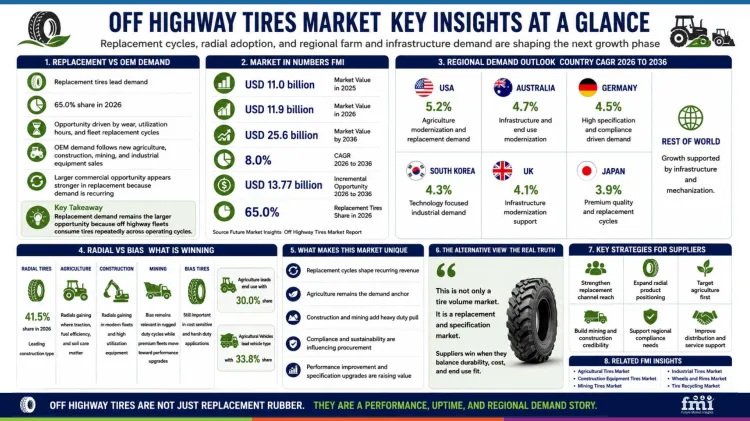
FMI’s Off Highway Tires Market projects replacement tires as the leading sales channel, with a projected 65.0% share in 2026. The market is valued at USD 11.0 billion in 2025, is expected to reach USD 11.9 billion in 2026, and is forecast to reach USD 25.6 billion by 2036 at an 8.0% CAGR. The USD 13.77 billion incremental opportunity between 2026-2036 which highlight expansion across both new fitment and replacement demand, while the channel structure suggests replacement cycles remain the larger revenue base.
The business logic is simple. A new machine requires one initial set of tires while same machine consume several replacement sets during its life of operation. The number of changes is dependent on utilization hours, terrain, load, inflation pressure, speed, maintenance and other factors. Cuts, heat, abrasion and impact damage all affect tire life in mining and construction. In agriculture, replacements are timed according to soil conditions, road travel, traction and sidewall damage and seasonal work patterns.
This creates a frequent demand that differs from equipment production. OEM tire sales associated to new equipment cycles. Replacement tire sales determined by the size and intensity of the installed base. As a result, when construction equipment sales slow, in-service machines continue to generate tire demand. Farmers may delay tractor replacement but still replace worn tires to maintain traction and productivity.
FMI expects agriculture sector to represent majority of end-use demand, while agricultural vehicles are projected to lead vehicle-type demand with 33.8% share. Farm tractors, combines, implements, sprayers, harvesters, and agricultural handling equipment operate across fields, roads, wet soil, hard ground, and seasonal conditions. Their tire requirements vary widely, but replacement demand remains recurring as carcass condition, traction, and soil compaction directly affect operating performance.
The tire replacement opportunity in agriculture is also connected to changing tire specifications. Farmers replace an older bias tire with a radial tire to improve traction, fuel efficiency, ride quality, or soil protection. They move to wider or lower-pressure tires to reduce compaction. As a result, replacement demand is increasingly driven by upgrades in tire technology and performance rather than identical replacements.
Upgrading tires for agricultural use reduces soil compaction while increasing traction, fuel economy, productivity, tire life, and slip performance. Some farm operators are ready to pay extra for radial or premium tires because of these performance considerations, which show improvements in crop protection, field performance, and fuel efficiency.
Another important replacement market is created by construction equipment. Compactors, dump trucks, graders, wheel loaders, backhoe loaders, and excavators all work in rough and uneven conditions. Sharp objects, pebbles, high loads, frequent turning, and unfavorable site conditions can all cause tire damage. The importance of product availability and service response is increased since construction projects also run under time pressure, when tier failure immobilizes equipment and disrupts work.
In construction equipment, OEM demand depends on new machinery sales and infrastructure spending, while replacement demand is determined by the scale and utilization intensity of the active fleet. As a result, markets with moderate new equipment sales can still generate strong replacement demand if the installed base is large and heavily used.
Mining is a high value replacement segment, where specialized tires on haul trucks and loaders operate under extreme conditions and directly influence fleet availability, safety, and productivity. Operators closely monitor key operating parameters due to the high downtime risk from tire failure.
In mining, the distinction between tire product and tire service becomes less clear. Suppliers often provide monitoring, inspection, pressure management, fleet analytics, repair, retreading support, and on-site service. This create a more defensible commercial model than selling replacement units alone. The supplier becomes part of the mine’s productivity system.
Industrial and material-handling applications also support recurring demand. Forklifts, port equipment, terminal tractors, container handlers, and industrial vehicles use pneumatic, solid, or specialized tires depending on the environment. Repeated turning, heavy loads, floor conditions, and operating hours shape replacement frequency. These applications favor suppliers with strong local distribution because fleets need rapid access to correct sizes and compounds.
OEM demand is strategically important, as original fitment establishes brand presence on machine platforms, provides technical validation, and influences future replacement demand. Strong OEM performance leads to brand preservation in the replacement cycle, while also offering volume visibility and access to new technologies.
OEM contracts carry strong price pressure which create challenges in the market. Equipment manufacturers negotiate large volumes and expect long-term supply, engineering support, testing, quality assurance, and cost reduction. Tire suppliers have to customize products to specific load, speed, rim, duty cycle, and application. This creates development cost and warranty exposure.
Replacement channels offer more pricing flexibility and also comes with complexity. Suppliers must manage distributors, dealers, service centers, regional inventory, technical guidance, and a wide range of tire sizes. Demand may be fragmented across machine models and operating environments. However, higher unit margins can be sustained where availability, brand strength, application support, and durability are critical.
According to FMI's replacement share projection of 65.0%, the operational fleet is the market's commercial hub. It also suggests that suppliers of off-highway tires shouldn't base their operations solely on manufacturers of new machinery. They require robust service capabilities, product coverage, aftermarket channels, and local inventory.
The balance between OEM and replacement demand differs by market maturity. In emerging economies, infrastructure development, mechanization, mining, and construction investment support OEM fitment. As the fleet grows, replacement demand follows. In mature markets such as the USA, Japan, Germany, and Australia, replacement cycles account for a larger proportion of demand due to the installed machinery base is already substantial.
Accordingly, the size and nature of the opportunity depend on the supplier’s business model. A manufacturer with strong engineering and global OEM relationships prioritize original fitment. Leading Distributor earn more from replacement demand. Mining-focused specialists combine premium tires with fleet services, while agricultural tire suppliers use OEM supply to create brand recognition and then capture recurring dealer sales.
The idea that replacement demand is an inexpensive aftermarket is false. Replacing tires off-highway can be rather complicated. The right load rating, tread pattern, compound, tire manufacturing, rim fit, operating pressure, and service assistance are all necessary for the customer. A cheaper tire might become costly in mining and construction if it wears out rapidly or limits uptime.
The most effective supplier model integrates OEM and replacement strategies, where OEM fitment establishes the installed base and replacement channels deliver lifecycle-driven recurring demand, connected through data, service, and application capabilities.
Bottom line: replacement tires appear to offer the larger off-highway tire opportunity as they account for 65.0% of the sales channel and generate recurring demand across agriculture, mining, construction, and industrial fleets. OEM demand remains strategically important as it creates the installed base. The strongest supplier model is one that secures early fitment and maintains engagement through replacement cycles, service offerings, and specification upgrades.

