


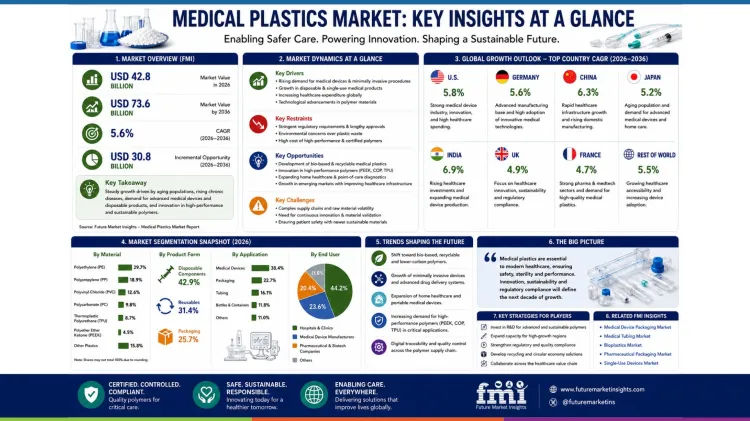
- Disposable components remain the largest medical plastic product form, with a projected 42.9% share in 2026.
- Single-use plastics support sterility, infection control, workflow speed, consistent dosing, and reduced reprocessing burden.
- WHO estimates that 85% of healthcare waste is general non-hazardous waste, while the remaining 15% is hazardous, infectious, chemical, or radioactive.
- Recycled or circular polymers can enter healthcare only when feedstock history, contamination control, sterilization response, and regulatory documentation are sufficiently clear.
- The most workable sustainability gains appear to come from reducing unnecessary material, redesigning packaging, segregating clean waste, using lower-carbon feedstocks, and selecting reuse only where validated reprocessing is practical.
- Healthcare is unlikely to solve its plastic problem through one universal switch from disposable to reusable products.
The sustainability challenges within medical plastics are highly fragmented, as evidenced by the distinct profiles of products like syringe wrappers, IV connectors, diagnostic cartridges, sterile trays, and reusable surgical instruments. These components vary significantly across key operational and regulatory vectors, including risk of contamination, material composition, regulatory oversight, reprocessing protocols, and the nature of patient contact. Consequently, treating healthcare plastics as a single, homogenous waste stream oversimplifies the complexities of implementing a true circular economy. Effective circularity strategies require a segmented approach that accounts for these diverse technical and compliance constraints rather than a one-size-fits-all framework.
Medical plastics have expanded because they solve real clinical problems. They arrive clean, can be sterilized, support complex shapes, reduce device weight, and allow products to be supplied ready for use. Single-use items also reduce reliance on hospital reprocessing, which requires equipment, water, chemicals, validated procedures, trained personnel, and traceable workflows.
FMI expects disposable components to make up 42.9% of medical plastic product-form sales in 2026. End-user Analysis Hospitals and clinics constitute 44.2% of end-user demand. This is consistent with the largest volume being close to daily care, where safety and operating speed are difficult to compromise.
The market is forecast to grow from USD 42.8 billion in 2026 to USD 73.6 billion by 2036. At that scale, even modest improvements in material efficiency could matter. The challenge is determining where reduction, reuse, recycling, or alternative feedstocks can be introduced without creating a larger clinical risk.
WHO’s healthcare waste data helps put the issue into context. About 85% of waste generated by healthcare activities is general non-hazardous waste comparable to domestic waste. The remaining 15% is considered hazardous and may be infectious, chemical, or radioactive. This distinction is critical. A clean secondary package from a hospital storeroom has a different recycling potential from blood-contaminated tubing or a used syringe.
Waste segregation may therefore offer more immediate value than blanket material substitution. Clean packaging films, trays, overwraps, bottles, and administrative plastics can potentially enter recycling systems if they are separated before contamination. Once medical plastic is mixed with infectious waste, recycling becomes more complex, costly, and restricted.
The World Health Organization (WHO) acknowledges the critical role of plastics in medical applications, including packaging, PPE, syringes, and IV administration. While the WHO healthcare plastics dialogue promotes circular economy principles such as reduction, reuse, repair, recycling, and proper disposal, it avoids framing reuse as the sole solution. Crucially, this balanced framework ensures that sustainability initiatives do not compromise patient access to essential medicines and medical devices.
Single-use products remain difficult to replace in several situations. Sterile fluid pathways, injection devices, blood-contact systems, diagnostic consumables, surgical products, and infection-control items may create unacceptable risk if reuse is introduced without validated cleaning and sterilization. Reprocessing can fail when a device is difficult to clean, contains narrow channels, degrades under repeated sterilization, or lacks clear instructions.
FDA guidance on reprocessing reusable medical devices states that cleaning is the first step and highlights risks from chemicals, residues, and material degradation. The regulatory expectation is not simply that a reusable device can survive another cycle. The manufacturer must provide adequate instructions that allow the healthcare facility to clean, disinfect, or sterilize it consistently.
This creates an important sustainability trade-off. A reusable product may reduce the number of discarded units but increase water use, energy consumption, detergent use, sterilization demand, transport, and labor. A single-use product may generate more solid waste but reduce cross-contamination risk and reprocessing complexity. The better environmental option varies by product and healthcare setting.
Lower-carbon feedstocks provide another route. FMI notes that lower-carbon and circular materials create opportunity only when traceability and safety evidence are clear. It cites the expansion of biomass-balanced medical-grade polymer portfolios as an example of suppliers responding to healthcare sustainability targets.
Mass-balance or biomass-balanced polymers may reduce reliance on fossil feedstock without requiring an immediate change in the finished resin’s processing or performance. This can be attractive to device OEMs because it may lower the carbon footprint while preserving the validated material grade. The approach still requires credible chain-of-custody systems and transparent accounting.
Recycled content presents a higher barrier. Post-consumer material can contain unknown additives, contaminants, degradation products, pigments, and mixed polymer streams. These variables are difficult to reconcile with long device approval files and strict medical-grade consistency.
FDA guidance for drug container closure systems states that post-consumer recycled plastic should not be used in primary packaging components. If used in secondary or associated components, safety and compatibility should be addressed. While this guidance is directed at pharmaceutical packaging, the principle illustrates why healthcare is cautious about recycled content in direct-contact applications.
Sterile packaging introduces a further complication. Packaging must maintain barrier integrity through manufacturing, sterilization, transport, storage, and use. Material changes can affect sealing, puncture resistance, microbial barrier, clarity, peel performance, and shelf life. FDA material on medical device shelf life emphasizes that sterilization compatibility must be considered for both the device and package.
The new EU Packaging and Packaging Waste Regulation is likely to increase pressure on healthcare packaging suppliers to improve recyclability and reduce primary material use. The regulation entered into force in February 2025 and covers the full packaging lifecycle. Medical and pharmaceutical packaging will still require careful treatment because patient safety and contamination controls can limit the speed of change.
Design reduction may be the least disruptive sustainability lever. Manufacturers can reduce material gauge, remove unnecessary components, simplify multi-material structures, optimize package size, or combine parts without changing the core patient-contact material. These changes can lower resin use and transport emissions while avoiding a complete material requalification.
Mono-material design is gaining interest because mixed laminates and bonded structures are difficult to recycle. A sterile package may still require barrier layers, seals, labels, and inks, so moving to a truly recyclable structure is not always straightforward. Progress is likely to be application-specific.
Hospital procurement can influence adoption. Large health systems increasingly evaluate supplier sustainability, packaging reduction, take-back options, and waste handling. Their buying power can push manufacturers to provide environmental data or redesign secondary packaging. Cost and safety remain dominant, but sustainability is becoming an additional supplier filter.
Geography also affects what is feasible. High-income healthcare systems may have dedicated waste segregation, sterilization, and recycling infrastructure. Facilities in lower-resource settings may struggle with basic collection and safe disposal. WHO warns that poor healthcare waste management exposes workers and communities to infection, toxic effects, and injury. Introducing complex reuse or recycling schemes without adequate infrastructure can create more risk.
The debate often becomes polarized between the convenience of disposable products and the environmental promise of reusable alternatives. The more useful finding is that both formats will remain necessary. The task is to identify where each one delivers the better combination of safety, cost, and environmental performance.
Products with high infection risk, low unit cost, and difficult geometry are likely to remain single-use. Durable devices with established cleaning pathways may support reuse. Clean secondary packaging may move toward recycling faster than patient-contact plastics. Bio-based or mass-balanced polymers may enter approved applications sooner than mechanically recycled resin.
As per FMI assessment, the about 43% share held by disposable products appears to reflect the operational importance of sterile, ready-to-use solutions rather than a lack of commitment to sustainability. Meaningful waste reduction without compromising patient safety will likely depend on coordinated changes across product design, procurement practices, material selection, collection systems, reprocessing, and end-of-life management.
The emerging direction appears to be a more selective and application-specific use of single-use plastics, rather than their complete elimination.
Healthcare can reduce unnecessary plastic, recover clean streams, improve packaging design, introduce lower-carbon feedstocks, and expand validated reuse where the clinical case allows. The products closest to the patient and most exposed to contamination will remain the hardest to change. That boundary is likely to define the pace of sustainable material adoption.

