


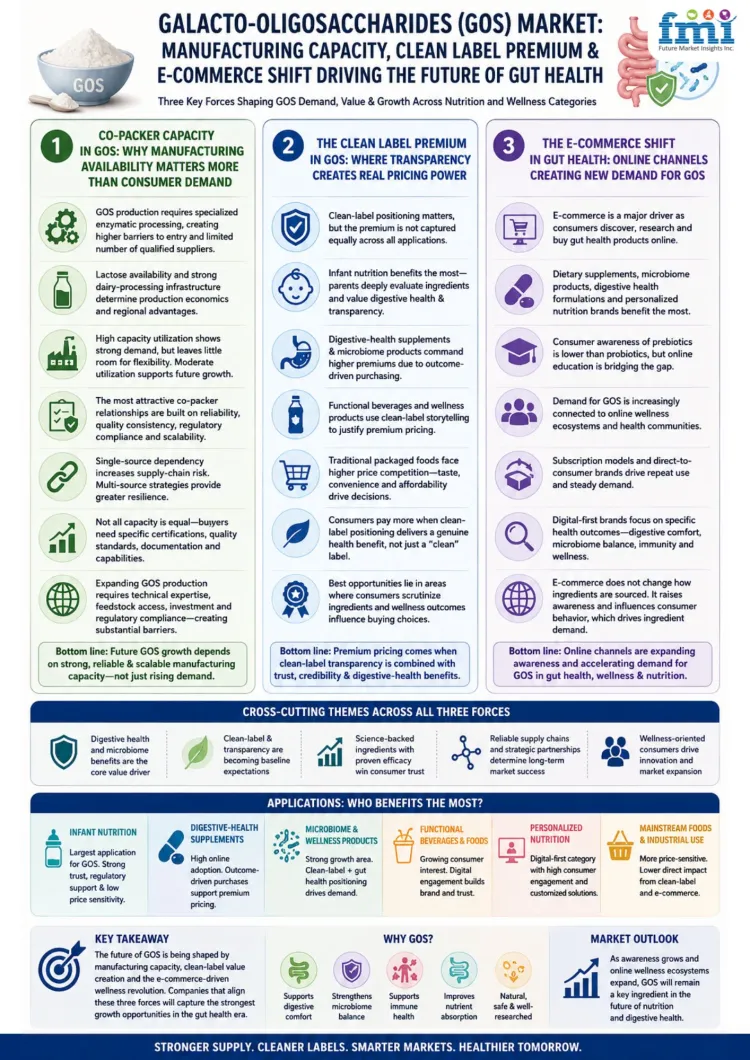
- Clean-label positioning is becoming increasingly important for GOS-containing products, but the premium is not captured equally across all applications.
- Infant nutrition, digestive-health supplements, and functional wellness products benefit the most because consumers actively evaluate ingredient quality before buying.
- The clean-label premium does not come solely from GOS. It appears when digestive-health benefits are paired with transparency, trust, and perceived product quality.
- Products focused on gut health, microbiome support, and wellness typically make better use of clean-label claims than regular food products.
- Traditional packaged foods face more price competition since taste, convenience, and affordability are the key factors in purchasing decisions.
- Many believe consumers pay more just because a label looks cleaner. In truth, consumers are willing to pay more when clean-label positioning highlights a genuine health benefit.
- The best opportunities for GOS suppliers are in areas where consumers closely scrutinize ingredients and wellness outcomes impact buying choices.
Clean-label positioning has become one of the most talked-about topics in the food and nutrition industry. Consumers increasingly check ingredient lists, avoid artificial additives, and search for products that appear transparent and trustworthy. This trend offers significant chances for functional ingredients like Galacto-Oligosaccharides (GOS). However, the link between clean-label positioning and pricing power can often be misunderstood.
The notion that clean-label automatically commands a premium does not align with market behavior. Consumers seldom reward transparency alone. Instead, they favor products that combine ingredient transparency with a clear health benefit. This distinction is crucial because it clarifies why some GOS applications are thriving in the clean-label trend while others are vulnerable to becoming commodities.
We see strong evidence in infant nutrition. Parents are among the most ingredient-focused consumers in the food industry. Their purchasing decisions often involve extensive research, product comparisons, and careful evaluations of nutritional claims. Ingredient transparency is considered a basic expectation, not just a bonus.
This environment fosters favorable conditions for ingredients like GOS. The ingredient is already well-known for its digestive health benefits and is widely used in infant nutrition formulations aimed at promoting gut health. Consequently, clean-label positioning builds on existing trust rather than creating it from the ground up. The combination of digestive-health functionality and transparent formulation offers a stronger value than either factor alone.
This is why infant nutrition remains one of the least price-sensitive categories for GOS. Parents are not just buying nutrition; they want confidence. Products that effectively pair science-backed digestive support with transparent ingredient messaging can often keep premium prices even during times when consumers are more frugal.
A similar trend appears in the supplement industry. Consumers buying digestive-health supplements usually seek specific outcomes. They might want microbiome support, digestive comfort, immune wellness, or long-term gut health benefits. Because these purchases are outcome-driven, buyers typically take more time to assess formulations and ingredient quality than they would for regular food items.
This behavior creates a space where clean-label positioning can boost pricing power. A digestive-health supplement that mixes prebiotic functions, ingredient transparency, and wellness-oriented branding often enjoys more pricing flexibility than a generic product. The premium does not stem from the ingredient list alone. It arises from the perception that the formulation is effective and trustworthy.
Trust’s importance is even clearer in microbiome-focused wellness products. Consumers might not fully grasp the science behind prebiotics, but they increasingly recognize the connection between gut health and overall wellness. Products centered on microbiome support often heavily rely on educational content, ingredient transparency, and evidence-based messages. In these cases, clean-label positioning enhances credibility.
Functional beverages are the next area of opportunity. Consumers are beginning to see beverages as vehicles for wellness benefits instead of just sources of hydration. Products that promote digestive support, immunity, or microbiome health often use ingredient storytelling to justify higher prices. Clean-label positioning reinforces this narrative by helping consumers feel more secure about product quality.
However, maintaining a premium becomes trickier as products enter mainstream food categories.
Consumers buying everyday snacks, bakery items, candy, or ordinary dairy products often prioritize taste, convenience, and affordability over ingredient transparency. While clean-label claims can enhance brand perception, they usually do not drive purchases. This limits manufacturers’ ability to charge significantly higher prices based solely on cleaner formulations.
The result is a market where the creation of clean-label value is quite uneven. Applications where consumers actively research ingredients tend to capture much greater advantages than those where purchases are mostly habitual.
This uneven distribution has vital implications for the GOS market. Not all applications will generate the same return from clean-label positioning. Manufacturers that merely add clean-label messaging to typical products may find it hard to justify higher prices. In contrast, those operating in health-focused categories often enjoy greater consumer willingness to pay.
Thus, the best opportunities are where clean-label positioning aligns with wellness benefits. Digestive-health supplements, microbiome-support products, premium infant nutrition, functional beverages, and personalized nutrition solutions all fit this mold. Consumers entering these categories often have health goals rather than simply looking to buy products.
Another key factor is the increasing convergence of clean-label expectations and digestive-health positioning. Consumers interested in gut health expect products to avoid unnecessary additives and include recognizable ingredients. This creates a positive setting for ingredients that can support both narratives simultaneously.
GOS benefits from this convergence because it has established credibility in digestive-health contexts. Manufacturers can position products around both ingredient quality and functional effectiveness. This dual focus provides a stronger foundation for premium pricing than either claim could achieve on its own.
The competitive landscape is changing as well. As more brands adopt clean-label messaging, transparency is becoming more of a standard requirement than a competitive edge. Consumers increasingly view transparency as a baseline expectation. Therefore, the ability to command a premium relies less on having a clean label and more on the overall value proposition of the product.
This shift poses a challenge for manufacturers who depend solely on transparency claims. A clean ingredient list might attract initial attention, but repeat purchases will ultimately hinge on perceived effectiveness, product experience, and consumer satisfaction. Brands that effectively combine clean-label positioning with tangible wellness benefits are likely to perform better in the long run.
Categories most at risk of becoming commodities are those where clean-label positioning becomes generic. Standard food products, basic formulations, and areas dominated by price competition may struggle to gain extra value from transparency alone. The categories least at risk are those where ingredient quality remains central to buying decisions.
In conclusion, clean-label positioning should not stand alone as a strategy. The premium comes when transparency supports a genuine consumer outcome. For GOS-containing products, digestive wellness provides that outcome.
The most promising applications for future clean-label premiums likely include infant nutrition, digestive-health supplements, microbiome wellness products, personalized nutrition solutions, and premium functional beverages. Applications least likely to command meaningful premiums include mainstream packaged foods, basic formulations, and categories where ingredient scrutiny is limited.
Bottom line: consumers do not pay more just because a product looks cleaner. They pay more when clean-label positioning builds trust, credibility, and a valuable health outcome. For GOS-containing products, the best premiums are likely to arise where digestive-health benefits and ingredient transparency work together to provide a strong value proposition.
FMI Report Link
- Galacto-Oligosaccharides (GOS) Market: Primary link for market value, production capacity, application trends, and introduction and conclusion sections
- Pet Prebiotics Market: Use when discussing broader demand expansion, gut health trends, and functional nutrition
- Functional Food Ingredients Market: Use when discussing manufacturing scalability, ingredient innovation, and value-added food formulations
- Dairy Ingredients Market: Use when discussing lactose feedstock, dairy-processing infrastructure, and ingredient manufacturing
- Nutraceutical Ingredients Market: Use when discussing supplement manufacturing, quality standards, and health-focused ingredient applications

