

- Market Size (2026)
- USD 532.3 Bn
- Forecast (2036)
- USD 803.2 Bn
- CAGR (2026 to 2036)
- 4.2%
How big is Compound Feed & Feed Additives Market in 2026?
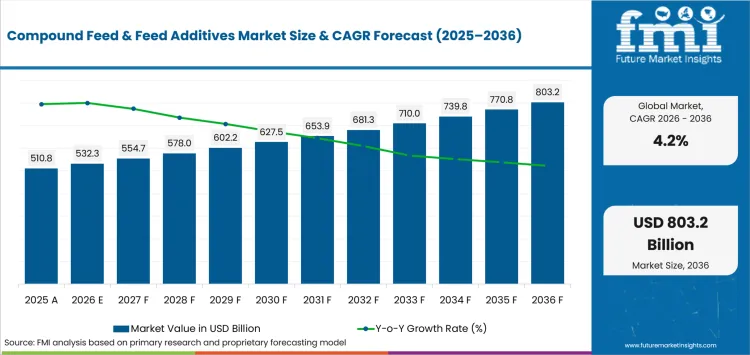
USD 532.3 billion in 2026 and USD 803.2 billion by 2036 at a 4.2% CAGR.
Demand for compound feed and feed additives is projected to expand at a 4.2% CAGR through 2036. Market value is expected to rise from USD 532.3 billion in 2026 to USD 803.2 billion by 2036. Commercial feed mills need enough cereal supply to formulate balanced rations at commercial scale daily. FAO reported in July 2025 that 33% of global cereals are projected for animal feed by 2034. Projected grain use keeps animal feed additives commercially relevant as mills balance nutrient density against changing ingredient costs.
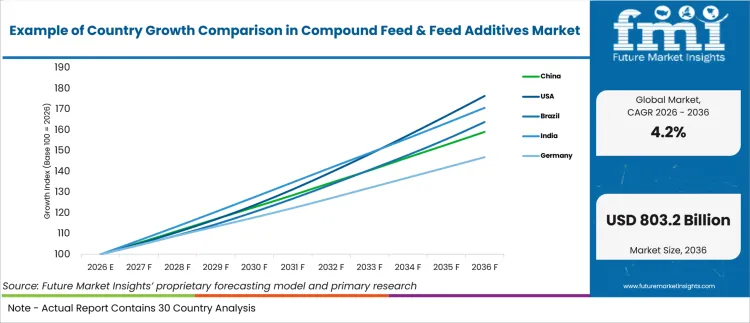
Country growth depends on livestock scale and approval routes for new feed ingredients before commercial sale. USDA ERS projected in February 2026 that United States feed spending would reach USD 65.6 billion during 2026. The USA is forecast at 5.8% CAGR while Germany is projected at 3.9% as authorization raises documentation demands. Feed premix manufacturers need local regulatory support and farm results before customers adopt changed formulations.
Key Takeaways of Compound Feed & Feed Additives Market
- Livestock producers need feed programs that protect output as grain and protein-meal costs alter ration economics.
- Based on product, compound feed is projected to account for 53.6% in 2026 due to reduced farm-level formulation work.
- By additive, amino acids are estimated to hold 44.9% in 2026 owing to precise nutrient balancing for lower-protein diets.
- In 2026, poultry is expected to lead livestock with 40.2% share because frequent cycles expose feed-conversion differences quickly.
- Ingredient-price volatility delays premium formulation changes unless producers can verify better conversion or output under local conditions.
- Cargill, ADM, Nutreco, Alltech, dsm-firmenich, Evonik, De Heus and Land O'Lakes are profiled across feed manufacturing and nutrition.
Analyst Perspective
"A feed program earns its place when a mill can trace higher ration cost to feed conversion and repeatable animal output under local raw-material conditions. Stronger commercial offers pair formulation changes with regulatory dossiers and local technical service so producers can scale trials without disrupting established feeding routines."
- Nandini Roy Choudhury, Principal Consultant, Future Market Insights
How is the Compound Feed & Feed Additives Market segmented?
The compound feed & feed additives market is segmented by product, additive, livestock and region.
The compound feed & feed additives market is segmented by product, additive, livestock and region. Product covers compound feed, premix and additives. Additive includes amino acids, vitamins, enzymes and probiotics. Livestock includes poultry, swine, ruminants and aquaculture. Region covers North America, Latin America, Western Europe, Eastern Europe, East Asia, South Asia and Pacific and Middle East and Africa.
Why does compound feed lead demand within the product category?
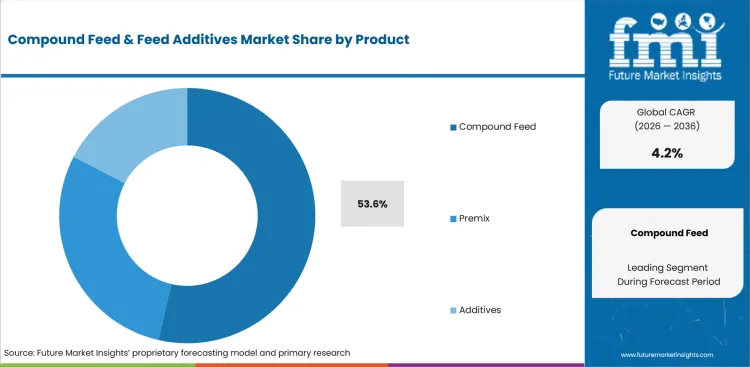
Compound feed moves ingredient selection and mixing into a finished ration for farms that need consistent nutrient delivery across repeated production cycles. De Heus opened a Kenya feed mill in February 2026 with 240,000 metric tons of annual capacity for poultry, pig and cattle feed programs.
- By product, compound feed is forecast to represent 53.6% in 2026 driven by finished rations reducing formulation and mixing work at farm level.
- Commercial mills can reformulate rations as grain and protein-meal values change without transferring mixing work back to individual farms. Integrators place repeat orders when mills maintain standardized diets across sites and changing raw-material conditions.
Why do amino acids lead demand within the additive category?
Amino acids let nutritionists lower crude-protein content without losing the amino acid balance required for growth and feed conversion in commercial livestock diets.
- Amino acids are projected to hold 44.9% share in 2026 owing to precise nutrient balancing for lower-protein formulations.
- Feed mills depend on reliable amino acid supply once a revised formula reduces protein-meal inclusion. Evonik completed backward integration at its Mobile methionine hub in July 2026 within a network linking Antwerp and Singapore. The integrated setup reduces exposure to intermediate supply disruptions as mills maintain consistent methionine dosing across recurring commercial batches.
Why does poultry lead demand within the livestock category?
Poultry integrators see ration changes quickly because short grow-out cycles expose feed-conversion differences across flocks. Feed programs change by growth phase, giving nutrition teams frequent checkpoints for intake and weight-gain performance. That rhythm makes standardized feed and precise additive dosing easier to evaluate than in slower production cycles.
- Poultry is set to lead the livestock category with 40.2% share in 2026 due to frequent feeding cycles and tightly measured conversion.
- Evonik announced Ecobiol's mainland China debut in April 2025 as a registered probiotic for poultry feed programs. Integrators can add animal feed probiotics when documented gut-function performance fits local diets without changing ration management.
What are the drivers, restraints and opportunities in the Compound Feed & Feed Additives Market?
Animal-protein output sustains recurring feed demand as ingredient-price exposure restrains formula changes and precision nutrition increases the value of targeted additives.
- Driver: Livestock producers need repeatable feed conversion as animal-source food output expands across commercial production systems.
- Restraint: Higher additive or ingredient costs can delay formula changes unless measurable performance gains offset the added ration expense.
- Opportunity: Precision lower-protein diets increase use of additives that preserve nutrient supply while reducing reliance on conventional protein meals.
Animal-Protein Output Sustains Recurring Feed Demand
FAO reported in October 2025 that the global feed sector produces about one billion tonnes of livestock feed annually, quantifying the recurring ration base behind compound-feed purchasing. Poultry, swine, ruminant and aquaculture programs consume formulated rations that combine feed protein ingredients with other nutrients across repeated production cycles. Feed mills therefore earn repeat orders by holding ration performance steady as grain and protein-meal quality changes across commercial batches.
Ingredient Exposure Delays Formula Changes
Ingredient exposure becomes a material restraint when a higher-cost formula cannot show enough improvement in feed conversion to cover added ration expense. Evonik raised global net prices for feed-grade MetAMINO by 10% in March 2026 while honoring existing contracts. Feed mills therefore compare added methionine cost with expected performance before extending revised formulas across routine production.
Precision Formulation Expands Additive Use
Precision nutrition gives feed mills a practical route to lower crude protein while preserving essential nutrient supply across commercial rations. Amino acid systems and feed enzymes can reduce dependence on conventional protein meals if local trials confirm stable animal performance under changing ingredient conditions. China's April 2025 feed-saving plan targets a reduction above 7% in feed used per kilogram of animal product by 2030, tying formulation efficiency to a national operating target.
Which country CAGRs are profiled in the Compound Feed & Feed Additives Market?
| Country | CAGR |
|---|---|
| USA | 5.8% |
| India | 5.5% |
| Brazil | 5.1% |
| China | 4.7% |
| Germany | 3.9% |
How do country-level CAGRs compare in the Compound Feed & Feed Additives Market?
The 1.9-point spread forms two compact bands and one lower-growth market. The USA and India occupy the upper pair while Brazil and China remain closely grouped behind them. Germany forms the lower-growth case because mature channels and stricter additive authorization make replacement decisions slower despite a large established feed base.
- United States growth combines high feed spending with FDA consultation for new ingredients.
- India adds feed capacity near livestock clusters while protein-meal costs pressure formulas.
- Brazil converts concentrated poultry and swine output into recurring regional feed volumes.
- China links lower-protein policy with amino acid balancing and local production access.
- Germany couples mature feed channels with EU authorization requirements for additive changes.
Similar growth rates therefore produce different entry conditions for feed manufacturers. The full report provides country-level CAGR analysis across North America, Latin America, Europe, East Asia, South Asia, Oceania and the Middle East and Africa.
Country-wise Analysis
- United States feed mills serve dense poultry and livestock networks that test formulation changes against delivered ration cost and measurable farm output across established commercial plants in major production states. FDA finalized Guidance for Industry #294 in January 2025 and established the Animal Food Ingredient Consultation process, giving developers an interim safety-consultation route for ingredients entering commercial feed programs with public review. Compound feed and feed additives demand in the United States is forecast to rise at 5.8% CAGR over the forecast period, supported by domestic manufacturing capacity while new formulas still need safety documentation and farm-level performance evidence before established customers change routine programs.
- Indian feed manufacturers are adding local capacity around poultry and dairy clusters, shortening delivery routes for formulated rations across major livestock-producing states and integrated farm networks that need dependable supply. Adoption of compound feed and feed additives in India is estimated to expand at 5.5% CAGR through 2036, supported by new infrastructure although protein-meal costs still force frequent reformulation around local raw-material conditions. The Press Information Bureau reported in December 2025 that 3,843 National Livestock Mission entrepreneurship projects spanning poultry, small ruminant, pig and feed-and-fodder units — had been approved with a total project cost of Rs. 2,672.65 crore, expanding supply while fragmented farm channels continue to reward flexible formulas and dependable regional sourcing.
- Brazilian poultry and swine clusters concentrate recurring feed orders around integrated processors in Paraná and other producing states, where nearby mills reduce delivery distance and support rapid ration adjustments for large commercial farms. Sindirações reported in March 2026 that Brazilian feed and supplement output reached about 94 million tonnes during 2025, giving local formulators a large base for premix services and repeat technical support across livestock accounts. Brazil is estimated to post 5.1% CAGR over the forecast period as intensive livestock production sustains volume, although maize and soybean-meal costs favor manufacturers that combine regional sourcing with fast formulation support during ingredient-price changes.
- China's feed market combines large integrated livestock operations with a policy push toward lower-protein diets and less soybean-meal dependence across regional mills serving major poultry and swine production clusters. A February 2025 State Council action plan extended national-treatment terms to foreign investment in animal-feed production, widening formal entry for manufacturers able to pair local production with technical service and distribution. In China, compound feed and feed additives demand is predicted to advance at 4.7% CAGR through 2036 owing to feed-saving priorities while entrants still need amino acid systems that fit variable ingredients and produce local performance evidence before established ration programs change.
- German feed manufacturers qualify additives within the EU authorization system, which makes legal status and species coverage part of routine purchasing decisions across mature livestock programs and established premix channels. In December 2025 dsm-firmenich announced EU authorization of Hy-D for salmonids and all other animal species, expanding the eligible species base for that nutritional additive across commercial European feed channels. Germany's compound feed and feed additives outlook is anticipated to advance at 3.9% CAGR over the assessment period, influenced by stable feed demand while new entrants must provide compliant dossiers and credible local performance evidence before customers replace established formulations.
Who are the notable companies in the Compound Feed & Feed Additives Market?
Cargill, ADM, Nutreco, Alltech, dsm-firmenich, Evonik, De Heus and Land O'Lakes are the notable companies serving this market.
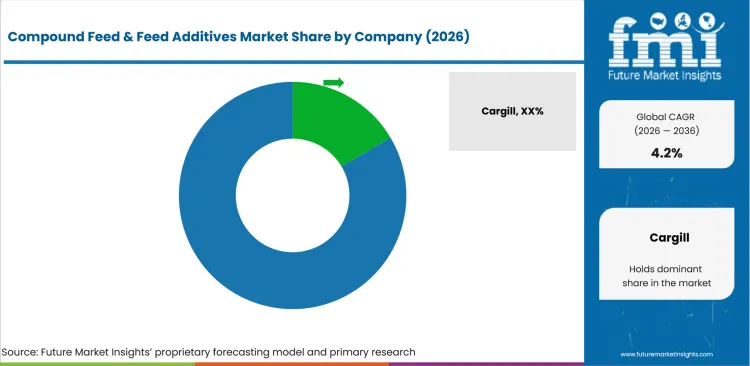
The competitive field is moderately fragmented because complete-feed manufacturers and concentrated-additive companies solve different parts of the livestock ration. Feed mills compare batch consistency, formulation support and delivery coverage before replacing established programs. Entry barriers rise when a new formula needs regulatory clearance or species-level performance evidence before routine account conversion. Regional feed plants compete on proximity while additive specialists protect positions with technical dossiers, including clean-label feed additives that need clear composition and regulatory fit.
- Integrated feed platforms: Cargill, ADM, De Heus and Land O'Lakes combine feed manufacturing with direct farm or distributor channels.
- Premix and species-focused platforms: Nutreco and Alltech combine premixes with specialty nutrition across livestock programs.
- Precision-nutrition specialists: dsm-firmenich and Evonik concentrate on nutrients or functional additives supported by technical services.
Competitive Benchmarking: Compound Feed & Feed Additives Market
| Company | Feed & Premix Manufacturing Breadth | Additive & Functional Nutrition Depth | Species and Farm-Channel Coverage | Geographic Reach |
|---|---|---|---|---|
| Cargill | High | High | High | Global |
| ADM | High | High | High | Americas, Europe and Asia-Pacific |
| Nutreco | High | High | High | Global |
| Alltech | High | High | High | Global |
| dsm-firmenich | Medium | High | High | Global |
| Evonik | Low | High | High | Global |
| De Heus | High | Medium | High | Europe, Asia, Africa and Americas |
| Land O'Lakes | High | Medium | Medium | United States and North America |
Key Developments in the Compound Feed & Feed Additives Market
- In July 2026, De Heus opened a marine and cold-water fish feed mill in Vietnam with 168,000 tonnes of annual capacity for domestic and export programs.
- In June 2026, ADM opened a premix and feed additives facility in Paraná with about 40,000 tonnes of annual capacity and enhanced ingredient traceability.
- In February 2026, Cargill opened a dairy feed plant in Punjab with 400,000 metric tons of annual capacity for regional farms and feed mills.
Key Players in the Compound Feed & Feed Additives Market
Integrated Feed and Farm-Nutrition Networks
- Cargill
- ADM
- De Heus
- Land O'Lakes
Premix and Species-Specialist Nutrition Platforms
- Nutreco
- Alltech
Specialty Additive and Precision-Nutrition Suppliers
- dsm-firmenich
- Evonik
Compound Feed & Feed Additives Market - Report Scope
| Coverage field | Report scope |
|---|---|
| Market breakdown | By product, additive, livestock and region. |
| Quantitative Units | Revenue in USD billion and CAGR in %. |
| Market Definition | Revenue includes compound feed, premixes and specified feed additives used for poultry, swine, ruminants and aquaculture. It excludes separately sold commodity feed ingredients, veterinary drugs, pet food, farm equipment and downstream animal-product revenue. |
| Regions Covered | North America, Latin America, Europe, East Asia, South Asia and Pacific, and Middle East and Africa. |
| Countries Covered | USA, India, Brazil, China, Germany and 20+ countries included in the full report. |
| Key Companies Profiled | Cargill, ADM, Nutreco, Alltech, dsm-firmenich, Evonik, De Heus, Land O'Lakes. |
| Forecast Period | 2026 to 2036. |
| Approach | Primary and secondary research with market triangulation. |
Compound Feed & Feed Additives Market - Research Methodology
| Method | Approach |
|---|---|
| Primary Research | FMI analysts gathered input from manufacturers, service providers, technology developers, distributors, end users, procurement teams, and subject-matter experts. Interviews examined purchasing decisions, product or service evaluation, adoption barriers, approval requirements, pricing considerations, and expectations for technical or commercial support. Respondents were also asked what evidence is required before a trial, pilot, or initial order develops into regular purchasing. |
| Desk Research | Desk research covered government statistics, regulatory publications, trade data, industry associations, technical literature, standards, company filings, product information, and official corporate announcements. Sources were reviewed for relevance, publication date, geographic coverage, and consistency with the defined market scope. Claims relating to performance, applications, approvals, capacity, investment, and commercial activity were retained only when supported by credible public evidence. |
| Market Sizing and Forecasting | The market model combined the baseline value with historical performance, segment structure, pricing and volume indicators, adoption levels, company participation, and country-level demand conditions. Forecast assumptions considered economic activity, investment trends, regulatory developments, technology adoption, purchasing cycles, supply availability, and barriers to wider market use. Segment and regional estimates were reconciled before the final market total was calculated. |
| Data Validation | Estimates were checked against multiple independent indicators, including public data, company activity, trade patterns, industry developments, and findings from primary interviews. Validation also tested whether products, services, applications, and company revenues fell within the defined market boundaries. Adjacent categories, unsupported claims, overlapping revenues, and activities without direct market relevance were excluded to reduce double counting and maintain consistency across segments and countries. |
Compound Feed & Feed Additives Market by Segments
Compound Feed & Feed Additives Market segmented by Product:
- Compound Feed
- Premix
- Additives
Compound Feed & Feed Additives Market segmented by Additive:
- Amino Acids
- Vitamins
- Enzymes
- Probiotics
Compound Feed & Feed Additives Market segmented by Livestock:
- Poultry
- Swine
- Ruminants
- Aquaculture
Compound Feed & Feed Additives Market by Region:
- North America
- United States
- Canada
- Latin America
- Brazil
- Mexico
- Chile
- Rest of Latin America
- Western Europe
- Germany
- United Kingdom
- Italy
- Spain
- France
- Nordics
- Benelux
- Rest of Western Europe
- Eastern Europe
- Russia
- Poland
- Hungary
- Balkan and Baltic States
- Rest of Eastern Europe
- East Asia
- China
- Japan
- South Korea
- South Asia and Pacific
- India
- ASEAN
- Australia and New Zealand
- Rest of South Asia and Pacific
- Middle East and Africa
- Kingdom of Saudi Arabia
- Other GCC Countries
- Türkiye
- South Africa
- Other African Union Countries
- Rest of Middle East and Africa
Research Sources and Bibliography
- Food and Agriculture Organization of the United Nations. (2025, July 15). OECD-FAO Agricultural Outlook 2025-2034: Emerging economies will drive animal-source food consumption and production.
- USA Department of Agriculture, Economic Research Service. (2026, February 5). Selected USA farm production expenses, 2024-26F.
- De Heus Animal Nutrition. (2026, February 17). De Heus Kenya opens landmark feed mill in Athi River, boosting agricultural sector and regional growth.
- Evonik Industries AG. (2026, July 16). Evonik completes backward integration of its global MetAMINO® production network.
- Evonik Industries AG. (2025, April 14). Evonik showcases efficiency and sustainability benefits of portfolio at China Feed Industry Expo 2025.
- Food and Agriculture Organization of the United Nations. (2025, October 2). Building safe, sustainable, and equitable animal feed systems.
- Evonik Industries AG. (2026, March 5). Evonik to increase its global price for MetAMINO®.
- Ministry of Agriculture and Rural Affairs of the People's Republic of China. (2025, April 30). 农业农村部办公厅关于印发《养殖业节粮行动实施方案》的通知.
- USA Food and Drug Administration. (2025, January 6). Evaluation of FDA Pre-market Animal Food Programs and Plan for Consultations.
- Press Information Bureau, Government of India. (2025, December 9). NATIONAL LIVESTOCK MISSION:
- Sindirações. (2026, March 17). Entre ameaças e oportunidades: resiliência e protagonismo.
- State Council of the People's Republic of China. (2025, February 19). China issues action plan to stabilize foreign investment in 2025.
- dsm-firmenich Animal Nutrition & Health. (2025, December 15). dsm-firmenich announces EU Authorization of Hy-D® in Aquaculture and All Animal Species.
- Cargill. (2025). Cargill 2025 Annual Report: Progress in corporate social responsibility, sustainability and innovation.
- Archer-Daniels-Midland Company. (2026, February 17). Form 10-K for the fiscal year ended December 31, 2025.
- Nutreco. (2026, May 5). Nutreco cuts Scope 1 and 2 emissions by 47%, publishes its Impact Report 2025.
- Alltech. (2025, June 30). Alltech Sustainability Report highlights progress toward emissions reduction, champions agriculture's role in building resilient food systems.
- dsm-firmenich. (2026, February 20). Animal Nutrition & Health - dsm-firmenich Integrated Annual Report 2025.
- Land O'Lakes, Inc. (2026). Rooted In Resilience: Land O'Lakes, Inc. 2025 Annual Report.
- De Heus Animal Nutrition. (2026, July 22). De Heus expands aquaculture capabilities with new marine and cold-water fish feed mill.
- ADM. (2026, June 1). ADM Expands Animal Nutrition Footprint in Brazil with New Premix Plant.
- Cargill. (2026, February 26). Cargill deepens India commitment, opens new dairy feed plant in Wazirabad.
This bibliography is provided for reader reference and is not exhaustive. The full report contains the complete reference list and detailed citations.
This Report Answers
- How large is the compound feed & feed additives market in 2026 and 2036?
- Which livestock and feed economics sustain recurring demand for compound feed and additives?
- Why does compound feed hold the leading product share in 2026?
- How do amino acids support lower-protein feed programs across commercial mills?
- Why does poultry account for the leading livestock share in 2026?
- How do country growth rates differ across the five profiled markets?
- Which companies combine complete-feed manufacturing with premix or additive capabilities?
- Which cost and approval conditions can delay adoption of new feed formulations?
- What evidence should producers compare beyond unit feed price before changing a formulation?
Frequently Asked Questions
How big is the Compound Feed & Feed Additives Market in 2026?
The compound feed & feed additives market is expected to be valued at USD 532.3 billion in 2026. Recurring feed requirements sustain purchasing as producers compare ration cost with measurable animal output across regular production cycles.
What is the CAGR of the Compound Feed & Feed Additives Market from 2026 to 2036?
The compound feed & feed additives market is projected to expand at 4.2% CAGR from 2026 to 2036. Feed conversion economics and precision formulation keep compound feed and additives central to livestock production costs.
Which product segment is projected to account for 53.6% of the Compound Feed & Feed Additives Market?
The compound feed & feed additives market is led by compound feed with a 53.6% product share in 2026. Finished rations reduce on-farm formulation work while commercial mills adjust recipes around ingredient cost and performance targets.
Which livestock segment leads the Compound Feed & Feed Additives Market in 2026?
The compound feed & feed additives market is led by poultry with a 40.2% livestock share in 2026. Short production cycles expose feed-conversion differences and support frequent purchases of standardized rations across commercial flocks.
Which companies are active in the Compound Feed & Feed Additives Market?
The compound feed & feed additives market includes Cargill, ADM, Nutreco, Alltech, dsm-firmenich, Evonik, De Heus and Land O'Lakes among the profiled companies. Their roles span complete-feed manufacturing and premixes alongside concentrated nutrients and functional additives across livestock programs.
Preview the report firsthand - request a free sample
Get SampleGet the brochure for pricing and purchase details.
Get PDFTable of Content
- Key Takeaways
- Market Size and CAGR
- Top Growth Driver
- Fastest Growing Segment
- Leading Region
- Key Companies
- Emerging Opportunities
- Executive Summary
- Global Market Outlook
- Demand-side Trends
- Supply-side Trends
- Technology Roadmap Analysis
- Analysis and Recommendations
- Analyst Perspective (What is happening? Why now? What should investors know?)
- Key Questions Answered
- How large is the market?
- What is the CAGR?
- What are key trends?
- Which region dominates?
- Who are the leaders?
- Market Overview
- Market Coverage / Taxonomy
- Market Definition / Scope / Limitations
- Research Methodology
- Chapter Orientation
- Analytical Lens and Working Hypotheses
- Market Structure, Signals, and Trend Drivers
- Benchmarking and Cross-market Comparability
- Market Sizing, Forecasting, and Opportunity Mapping
- Research Design and Evidence Framework
- Desk Research Programme (Secondary Evidence)
- Expert Input and Fieldwork (Primary Evidence)
- Tooling, Models, and Reference Databases
- Data Engineering and Model Build
- Quality Assurance and Audit Trail
- Market Background
- Market Dynamics (Drivers, Restraints, Opportunity, Trends)
- Scenario Forecast (Optimistic, Likely, Conservative)
- Impact Analysis
- AI Impact
- Sustainability Impact
- Regulatory Impact
- Technology Impact
- Consumer / Buyer Analysis
- Purchase Drivers
- Adoption Barriers
- Buyer Journey
- Opportunity Map Analysis
- Product Life Cycle Analysis
- Supply Chain Analysis
- Investment Feasibility Matrix
- Value Chain Analysis
- PESTLE and Porter's Analysis
- Regulatory Landscape
- Regional Parent Market Outlook
- Production and Consumption Statistics
- Import and Export Statistics
- Global Market Analysis and Forecast, 2021 to 2036
- Historical Market Size Value (USD Billion) Analysis, 2021 to 2025
- Current and Future Market Size Value (USD Billion) Projections, 2026 to 2036
- Y-o-Y Growth Trend Analysis
- Absolute $ Opportunity Analysis
- Global Market Pricing Analysis, 2021 to 2036
- Global Market Analysis and Forecast, By Product, 2021 to 2036
- Introduction / Key Findings
- Historical Market Size Value (USD Billion) Analysis By Product, 2021 to 2025
- Current and Future Market Size Value (USD Billion) Analysis and Forecast By Product, 2026 to 2036
- Compound Feed
- Premix
- Additives
- Compound Feed
- Y-o-Y Growth Trend Analysis By Product, 2021 to 2025
- Absolute $ Opportunity Analysis By Product, 2026 to 2036
- Global Market Analysis and Forecast, By Additive, 2021 to 2036
- Introduction / Key Findings
- Historical Market Size Value (USD Billion) Analysis By Additive, 2021 to 2025
- Current and Future Market Size Value (USD Billion) Analysis and Forecast By Additive, 2026 to 2036
- Amino Acids
- Vitamins
- Enzymes
- Probiotics
- Amino Acids
- Y-o-Y Growth Trend Analysis By Additive, 2021 to 2025
- Absolute $ Opportunity Analysis By Additive, 2026 to 2036
- Global Market Analysis and Forecast, By Livestock, 2021 to 2036
- Introduction / Key Findings
- Historical Market Size Value (USD Billion) Analysis By Livestock, 2021 to 2025
- Current and Future Market Size Value (USD Billion) Analysis and Forecast By Livestock, 2026 to 2036
- Poultry
- Swine
- Ruminants
- Aquaculture
- Poultry
- Y-o-Y Growth Trend Analysis By Livestock, 2021 to 2025
- Absolute $ Opportunity Analysis By Livestock, 2026 to 2036
- Global Market Analysis and Forecast, By Region, 2021 to 2036
- Introduction
- Historical Market Size Value (USD Billion) Analysis By Region, 2021 to 2025
- Current Market Size Value (USD Billion) Analysis and Forecast By Region, 2026 to 2036
- North America
- Latin America
- Western Europe
- Eastern Europe
- East Asia
- South Asia and Pacific
- Middle East & Africa
- Market Attractiveness Analysis By Region
- North America Market Analysis and Forecast, By Country, 2021 to 2036
- Historical Market Size Value (USD Billion) Trend Analysis By Market Taxonomy, 2021 to 2025
- Market Size Value (USD Billion) Forecast By Market Taxonomy, 2026 to 2036
- By Country
- USA
- Canada
- By Product
- By Additive
- By Livestock
- By Country
- Market Attractiveness Analysis
- By Country
- By Product
- By Additive
- By Livestock
- Key Takeaways
- Latin America Market Analysis and Forecast, By Country
- Historical Market Size Value (USD Billion) Trend Analysis By Market Taxonomy, 2021 to 2025
- Market Size Value (USD Billion) Forecast By Market Taxonomy, 2026 to 2036
- By Country
- Brazil
- Mexico
- Chile
- Rest of Latin America
- By Product
- By Additive
- By Livestock
- By Country
- Market Attractiveness Analysis
- By Country
- By Product
- By Additive
- By Livestock
- Key Takeaways
- Western Europe Market Analysis and Forecast, By Country
- Historical Market Size Value (USD Billion) Trend Analysis By Market Taxonomy, 2021 to 2025
- Market Size Value (USD Billion) Forecast By Market Taxonomy, 2026 to 2036
- By Country
- Germany
- UK
- Italy
- Spain
- France
- Nordic
- BENELUX
- Rest of Western Europe
- By Product
- By Additive
- By Livestock
- By Country
- Market Attractiveness Analysis
- By Country
- By Product
- By Additive
- By Livestock
- Key Takeaways
- Eastern Europe Market Analysis and Forecast, By Country
- Historical Market Size Value (USD Billion) Trend Analysis By Market Taxonomy, 2021 to 2025
- Market Size Value (USD Billion) Forecast By Market Taxonomy, 2026 to 2036
- By Country
- Russia
- Poland
- Hungary
- Balkan & Baltic
- Rest of Eastern Europe
- By Product
- By Additive
- By Livestock
- By Country
- Market Attractiveness Analysis
- By Country
- By Product
- By Additive
- By Livestock
- Key Takeaways
- East Asia Market Analysis and Forecast, By Country
- Historical Market Size Value (USD Billion) Trend Analysis By Market Taxonomy, 2021 to 2025
- Market Size Value (USD Billion) Forecast By Market Taxonomy, 2026 to 2036
- By Country
- China
- Japan
- South Korea
- By Product
- By Additive
- By Livestock
- By Country
- Market Attractiveness Analysis
- By Country
- By Product
- By Additive
- By Livestock
- Key Takeaways
- South Asia and Pacific Market Analysis and Forecast, By Country
- Historical Market Size Value (USD Billion) Trend Analysis By Market Taxonomy, 2021 to 2025
- Market Size Value (USD Billion) Forecast By Market Taxonomy, 2026 to 2036
- By Country
- India
- ASEAN
- Australia & New Zealand
- Rest of South Asia and Pacific
- By Product
- By Additive
- By Livestock
- By Country
- Market Attractiveness Analysis
- By Country
- By Product
- By Additive
- By Livestock
- Key Takeaways
- Middle East & Africa Market Analysis and Forecast, By Country
- Historical Market Size Value (USD Billion) Trend Analysis By Market Taxonomy, 2021 to 2025
- Market Size Value (USD Billion) Forecast By Market Taxonomy, 2026 to 2036
- By Country
- Kingdom of Saudi Arabia
- Other GCC Countries
- Türkiye
- South Africa
- Other African Union
- Rest of Middle East & Africa
- By Product
- By Additive
- By Livestock
- By Country
- Market Attractiveness Analysis
- By Country
- By Product
- By Additive
- By Livestock
- Key Takeaways
- Key Countries Market Analysis
- USA
- Pricing Analysis
- Market Share Analysis, 2025
- By Product
- By Additive
- By Livestock
- Canada
- Pricing Analysis
- Market Share Analysis, 2025
- By Product
- By Additive
- By Livestock
- Mexico
- Pricing Analysis
- Market Share Analysis, 2025
- By Product
- By Additive
- By Livestock
- Brazil
- Pricing Analysis
- Market Share Analysis, 2025
- By Product
- By Additive
- By Livestock
- Chile
- Pricing Analysis
- Market Share Analysis, 2025
- By Product
- By Additive
- By Livestock
- Germany
- Pricing Analysis
- Market Share Analysis, 2025
- By Product
- By Additive
- By Livestock
- UK
- Pricing Analysis
- Market Share Analysis, 2025
- By Product
- By Additive
- By Livestock
- Italy
- Pricing Analysis
- Market Share Analysis, 2025
- By Product
- By Additive
- By Livestock
- Spain
- Pricing Analysis
- Market Share Analysis, 2025
- By Product
- By Additive
- By Livestock
- France
- Pricing Analysis
- Market Share Analysis, 2025
- By Product
- By Additive
- By Livestock
- India
- Pricing Analysis
- Market Share Analysis, 2025
- By Product
- By Additive
- By Livestock
- ASEAN
- Pricing Analysis
- Market Share Analysis, 2025
- By Product
- By Additive
- By Livestock
- Australia & New Zealand
- Pricing Analysis
- Market Share Analysis, 2025
- By Product
- By Additive
- By Livestock
- China
- Pricing Analysis
- Market Share Analysis, 2025
- By Product
- By Additive
- By Livestock
- Japan
- Pricing Analysis
- Market Share Analysis, 2025
- By Product
- By Additive
- By Livestock
- South Korea
- Pricing Analysis
- Market Share Analysis, 2025
- By Product
- By Additive
- By Livestock
- Russia
- Pricing Analysis
- Market Share Analysis, 2025
- By Product
- By Additive
- By Livestock
- Poland
- Pricing Analysis
- Market Share Analysis, 2025
- By Product
- By Additive
- By Livestock
- Hungary
- Pricing Analysis
- Market Share Analysis, 2025
- By Product
- By Additive
- By Livestock
- Kingdom of Saudi Arabia
- Pricing Analysis
- Market Share Analysis, 2025
- By Product
- By Additive
- By Livestock
- Türkiye
- Pricing Analysis
- Market Share Analysis, 2025
- By Product
- By Additive
- By Livestock
- South Africa
- Pricing Analysis
- Market Share Analysis, 2025
- By Product
- By Additive
- By Livestock
- USA
- Market Structure Analysis
- Competition Dashboard
- Competition Benchmarking
- Market Share Analysis of Top Players
- By Regional
- By Product
- By Additive
- By Livestock
- Emerging Startups
- Innovation Benchmarking
- Competition Analysis
- Competition Deep Dive
- Cargill
- Overview
- Product Portfolio
- Profitability by Market Segments
- Sales Footprint
- Strategy Overview
- Marketing Strategy
- Product Strategy
- Channel Strategy
- ADM
- Nutreco
- Alltech
- dsm-firmenich
- Evonik
- De Heus
- Land O'Lakes
- Cargill
- Case Studies
- Success Stories
- Recent Developments
- Competition Deep Dive
- Assumptions & Acronyms Used


