

- Market Size (2026)
- USD 1.6 Bn
- Forecast (2036)
- USD 5.7 Bn
- CAGR (2026 to 2036)
- 13.2%
How big is the Synthetic Dye (Red 40 / Red 3) Replacement Colorants Market in 2026?
USD 1.6 billion in 2026 and USD 5.7 billion by 2036 at a 13.2% CAGR.
Sales of synthetic dye (red 40 / red 3) replacement colorants are projected to advance at a 13.2% CAGR, pushing the valuation from USD 1.6 billion in 2026 to USD 5.7 billion by 2036. The market outlook is being reinforced by regulatory measures that are prompting food manufacturers to replace widely used synthetic color additives with compliant alternatives. In April 2025, the FDA named Red 40 among six certified colors targeted for voluntary removal by the end of 2026. The federal initiative expands reformulation work across branded foods and increases demand for documented food color systems that preserve established shades. Color manufacturers must reproduce intensity and process stability without creating new labeling burdens or supply interruptions across customer portfolios.
Commercial routes differ inside the United States because federal and state requirements create separate reformulation schedules for the same product. California Assembly Bill 418 prohibits food containing Red Dye 3 from January 1, 2027 across manufacturing and commercial sale. Federal food authorization ends on January 15, 2027 under FDA rules while California’s state prohibition starts fourteen days earlier. Food manufacturers therefore need clean-label ingredients that perform across recipes and support documentation for every intended selling jurisdiction. Application testing must match shade targets with acidity and thermal exposure under representative processing conditions. Weak technical evidence can create repeated trials and inventory exposure even if the selected pigment remains legally acceptable.
-replacement-colorants-market-value-analysis.webp "Synthetic Dye (red 40 Red 3) Replacement Colorants Market Value Analysis")
Key Takeaways of Synthetic Dye (Red 40 / Red 3) Replacement Colorants Market
- Demand for synthetic dye replacement colorants is driven by regulatory deadlines and customer reformulation programs, with federal action on Red 3 and Red 40 increasing the number of branded products requiring documented natural replacement pathways across customer portfolios.
- Red 40 holds the leading share at 40.2% in 2026, attributable to its broad use across brightly colored foods and the volume of active reformulation projects requiring application evidence across processing heat, storage exposure, and final shade consistency.
- Anthocyanin leads the colorant type category at 41.5% share in 2026, supported by botanical sourcing and strong acidic-system shade performance, with beet and fermentation-derived routes broadening sourcing choices where processing needs cannot be met by one anthocyanin source.
- Confectionery accounts for 38.0% application share in 2026, owing to visible shade requirements across candy formats that demand repeatable color performance under normal processing and storage conditions.
- China, Canada, and the United States record CAGRs of 12.7%, 12.3%, and 11.9% respectively through 2036, shaped by GB 2760-2024 implementation, nationwide permitted-color lists with defined category limits, and the fixed January 2027 federal Red 3 deadline.
- Competition separates broad botanical portfolios from fermentation platforms, with Oterra and Sensient competing through direct replacement portfolios, ADM and Givaudan combining varied natural sources with formulation resources, and GNT and dsm-firmenich providing synthetic-red transition systems supported by established regional technical and regulatory networks.
Analyst Perspective
"Commercial adoption will depend on consistent color performance across real manufacturing conditions rather than laboratory validation alone. Food manufacturers are evaluating formulation stability, cost-in-use, and processing compatibility alongside ingredient pricing. Suppliers that demonstrate reliable application performance, regulatory compliance, and strong technical support will be better positioned to expand long-term customer relationships."
- Nandini Roy Choudhury, Principal Analyst at Future Market Insights
Source: FMI's proprietary forecasting model and primary research
How is the Synthetic Dye (Red 40 / Red 3) Replacement Colorants Market segmented?
The synthetic dye (red 40 / red 3) replacement colorants industry is segmented by Target Dye, Alternative, Application, and Region.
The segmentation framework separates the synthetic color being replaced from the chemistry used and the final food application. Target Dye analysis covers Red 40 and Red 3 alongside Yellow 5/6 and Blue 1 replacement programs across food applications. Alternative analysis compares Anthocyanin with Carmine and Beet plus Fermentation-derived systems used commercially across natural food colors. Application analysis covers Confectionery and Beverages alongside Snacks and Dairy where processing conditions determine the final shade. Regional analysis then compares authorization routes and product qualification conditions across more than thirty countries.
What supports demand for Red 40 within the target dye category?
-replacement-colorants-market-analysis-by-target-dye.webp "Synthetic Dye (red 40 Red 3) Replacement Colorants Market Analysis By Target Dye")
Red 40 replacement requires a close match across hue intensity and cost-in-use because synthetic color normally delivers strong concentration. Sensient lists anthocyanins and beet among varied natural red choices while emphasizing heat and acidity during selection. The source range expands available plant-based colors across beverages and confectionery, yet each chemistry responds differently to processing and storage. Food manufacturers should test dosage and shelf stability together because a weak match can increase ingredient use and repeated qualification.
- Red 40 is likely to capture 40.2% share in 2026 attributable to its use across prominent red and pink formulations. Replacement programs often cover several products within one branded portfolio rather than one isolated recipe. Portfolio-wide exposure supports larger qualification programs and rewards color manufacturers that reproduce approved shades across different processing conditions.
- Beverage and snack manufacturers evaluate Red 40 alternatives through dosage efficiency and finished-product stability across routine production runs. A replacement gains approval once it preserves the intended shade through processing and storage without creating flavor or texture defects. Customer trials become more reliable when laboratories test the intended dosage inside the actual package and production sequence.
How is anthocyanin positioned within the alternative category?
-replacement-colorants-market-analysis-by-alternative.webp "Synthetic Dye (red 40 Red 3) Replacement Colorants Market Analysis By Alternative")
Anthocyanin delivers bright red shades in acidic systems but loses structural stability as product pH rises across dairy and fruit applications. Formulators therefore select botanical sources according to product acidity and expected heat exposure instead of treating every anthocyanin system as interchangeable. Sensient states that anthocyanins commonly lose stability above pH 4.0 within dairy and frozen applications. The verified boundary supports anthocyanin color systems in beverages and fruit preparations with controlled acidity and protected shelf life.
- By alternative, anthocyanin is estimated to hold 41.5% share in 2026 owing to broad botanical sourcing and vivid performance in acidic foods. Black carrot and purple sweet potato can cover several red or pink targets within established extraction and formulation routes. The segment retains commercial strength where controlled acidity protects color during processing and extended product storage.
- Drink and fruit-preparation formulators favor Anthocyanin for products whose acidity protects color through the intended shelf life. Their adoption process focuses on source consistency and light exposure rather than the neutral-pH limits common in dairy systems. Package-specific testing documents light resistance and raw-material variation without borrowing performance assumptions from another acidic product.
How do confectionery manufacturers evaluate replacement colorants?
-replacement-colorants-market-analysis-by-application.webp "Synthetic Dye (red 40 Red 3) Replacement Colorants Market Analysis By Application")
Confectionery exposes replacement colors to heat and moisture while requiring vivid shades that remain consistent across dosage changes. Candy manufacturers evaluate shade strength together with coating behavior because uneven deposits can reduce line output and surface quality. Confectionery ingredients must work together during heating and coating so color selection cannot be isolated from formulation and surface behavior. ADM lists natural red solutions for hard-boiled and panned products plus tailored stability across processing conditions. Stable processing favors systems that preserve target appearance without flavor defects or repeated adjustment during production.
- The application category is forecast to be led by confectionery with 37.2% share in 2026 due to frequent use of bright red and pink visual cues. Candy portfolios contain several shapes and coatings that share color targets across seasonal production schedules. Portfolio concentration supports coordinated reformulation and raises the value of one application partner serving multiple formats.
- Gummy and coating manufacturers purchase replacement systems that maintain shade through heating and later moisture exposure. Their commercial test separates color strength from handling performance because sticky deposits or uneven coatings can reduce output. Approved systems gain wider use once application teams reproduce both appearance and line behavior across seasonal production batches.
What are the drivers, restraints, and opportunities in the Synthetic Dye (Red 40 / Red 3) Replacement Colorants Market?
Regulatory reformulation creates immediate demand; application-specific stability slows qualification; and new natural color approvals expand the available solution set.
- Driver: Federal and customer phase-out schedules are converting future reformulation plans into active purchasing projects.
- Restraint: Natural red performance changes across acidity and heat which can extend product-specific qualification work.
- Opportunity: Newly authorized natural colors can widen formulation choices and reduce dependence on narrow pigment routes.
Reformulation schedules now create a direct demand mechanism because large food portfolios must replace certified colors across many recipes. The FDA tracker was current on June 16 2026 and listed commitments across cereals plus beverages and snacks. Separate entries covered products sold through school meal programs and retail portfolios with fixed completion dates. The documented schedules support commercial purchasing for clean-label additives that have application evidence and dependable manufacturing capacity. Color manufacturers can organize trials around portfolio groups and processing conditions rather than treating every recipe as an isolated project.
Technical variability remains a notable restraint because one natural red rarely performs equally across acidity and processing heat. The FDA stated in July 2025 that Red 3 substitution may require expanded use of authorized colors or new additive development. Formulations containing multifunctional food ingredients require isolated testing for color interactions with flavor systems and texture modifiers. Qualification slows further if color developers cannot explain dosage limits and shelf behavior for the customer’s exact recipe.
New color authorizations create a commercial opening for developers that can translate approved pigments into stable application systems. On February 5 2026 the FDA approved beetroot red and expanded spirulina use while revising treatment for voluntary color claims. Panned confectionery developers can combine the wider palette with food coating ingredients, but each system requires stability and labeling checks. Commercial gains depend on rapid application development and clear labeling guidance rather than approval status by itself.
Which country CAGRs are profiled in the Synthetic Dye (Red 40 / Red 3) Replacement Colorants Market?
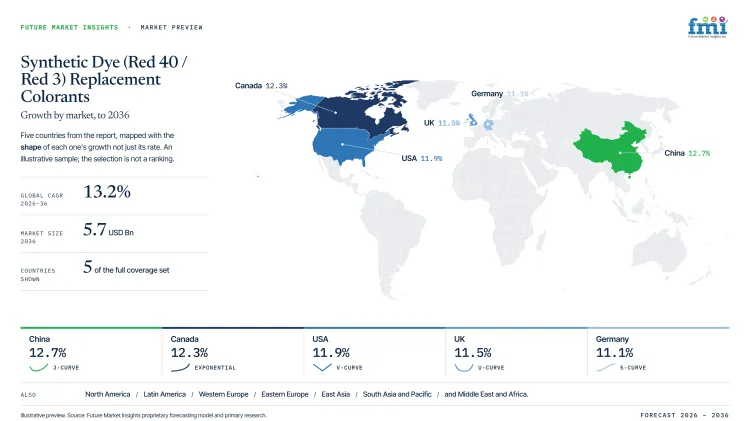
| Country | CAGR |
|---|---|
| USA | 11.9% |
| UK | 11.5% |
| Germany | 11.1% |
| China | 12.7% |
| Canada | 12.3% |
How do country-level CAGRs compare in the Synthetic Dye (Red 40 / Red 3) Replacement Colorants Market?
The country comparison shows a relatively narrow spread in projected growth rates across the synthetic dye (Red 40 / Red 3) replacement colorants market. China and Canada form a closely aligned upper group with only a limited gap between their forecasts. The USA follows nearby and remains connected to this cluster through a modest difference in projected expansion. The UK and Germany create a lower pair that is separated from the upper group by a wider step-down. The overall gap between the first and last country is 1.6 percentage points which indicates a concentrated growth outlook across the markets profiled. These differences reflect the pace of clean-label reformulation, regulatory pressure on synthetic colorants and the adoption of natural color alternatives across food and beverage applications.
- China shows a notable position within the comparison as food manufacturers continue to increase the use of naturally derived colorants to support changing consumer preferences and product reformulation strategies.
- Canada remains close to China in CAGR terms but follows a different market route through growing demand for clean-label ingredients and greater use of natural color solutions in packaged foods.
- The USA occupies a strong position within the group as regulatory scrutiny surrounding synthetic dyes encourages investment in replacement colorant technologies across multiple product categories.
- The UK remains relatively close to the USA yet market development is supported by manufacturer efforts to align products with consumer expectations for recognizable ingredient lists.
- Germany forms part of the lower cluster while maintaining steady expansion through the adoption of plant-based and naturally sourced color systems across food and beverage manufacturing.
Comparable CAGRs do not create identical market conditions across countries. Differences in food labeling requirements, reformulation timelines, ingredient approval processes and manufacturing capabilities can influence how quickly replacement colorants are adopted. As a result, suppliers may encounter different commercialization and market entry conditions even when forecast growth rates remain closely aligned. The full report provides country-level CAGR analysis across North America, Latin America, Europe, East Asia, South Asia, Oceania and the Middle East and Africa.
Country-wise Analysis
- United States food manufacturers face a federal Red 3 deadline alongside a broader voluntary transition from certified petroleum-based dyes. The FDA revoked Red 3 authorization on January 15 2025 and set January 15 2027 as the food reformulation deadline. The USA replacement colorants market is estimated to post 11.9% CAGR between 2026 and 2036, reflecting a fixed regulatory timetable and product-specific testing. The fixed federal deadline gives ingredient manufacturers a defined schedule for customer trials and regulatory documentation. Product-specific qualification remains the main friction since acidity and heat vary across beverage and confectionery processing lines. National distribution also requires consistent supply across manufacturing sites that may use different process conditions. Color manufacturers should identify performance exceptions before reserving production capacity for nationwide customer reformulation programs.
- UK food manufacturers face split authorization routes across Great Britain and Northern Ireland under separate food-additive frameworks. The target market is forecast to expand at 11.5% CAGR through 2036 shaped by selective reformulation and established authorization registers. The FSA register lists Allura Red AC and Erythrosine for specified uses across Great Britain. The official register gives color developers a direct route for checking permitted applications and conditions. Northern Ireland alignment with EU food rules creates material friction for portfolios intended for nationwide distribution. Commercial programs need separate label and use-condition reviews before one formulation can serve the complete United Kingdom.
- German food manufacturers follow the European Union positive list plus national rules that govern additive declarations on packaged and loose foods. Germany’s federal food ministry states that EU authorization defines permitted additives and use levels across every member state. The common authorization route enables one compliant formulation to enter several European markets after product-specific checks. Germany’s target market is expected to advance at 11.1% CAGR during the forecast period. Mandatory additive declarations and customer specifications remain material friction for portfolios using one package design across several channels. Color manufacturers should document the legal color name and intended food category before confirming production or customer launch dates.
- Chinese food producers must map every natural or synthetic color to the food categories and maximum levels defined by GB 2760-2024. The target market is projected to rise at 12.7% CAGR through 2036 enabled by a current nationwide authorization route for domestic formulations. The standard simplifies category lookups but applies a combined-use calculation to same-shade colorants with numerical maximum levels. Hongjiang’s market regulator stated in February 2025 that the sum of each same-shade colorant’s usage ratio cannot exceed one. The combined-use calculation creates material friction for blended red systems designed to match Red 40 intensity across several recipes. Color developers should complete the category and ratio review before transferring an overseas formulation into Chinese production.
- Canadian processors select red colorants from a federal permitted list that links each additive to named foods and maximum use conditions. The category structure prevents one legal approval from transferring automatically across beverage and confectionery recipes. The Canadian replacement colorants market is set to record 12.3% CAGR by 2036, reinforced by a nationwide authorization reference for formulation teams. The federal list lets developers screen legal fit before funding representative plant trials or preparing customer samples. Health Canada published the current version on October 20 2025 and retained Allura Red plus Erythrosine for specified applications. Category-specific limits create material friction for portfolio-wide conversion programs that cover several food types and processing conditions. Commercial quotations should identify the intended food category and permitted dosage before ingredient manufacturers reserve supply or begin application testing.
Who are the notable companies in the Synthetic Dye (Red 40 / Red 3) Replacement Colorants Market?
Oterra; Debut; GNT; Sensient Technologies; dsm-firmenich; ADM; Phytolon; and Givaudan are the notable companies shaping this market.
-replacement-colorants-market-analysis-by-company.webp "Synthetic Dye (red 40 Red 3) Replacement Colorants Market Analysis By Company")
The competitive field combines established botanical portfolios with fermentation platforms and application laboratories that guide customer conversions. Oterra and Sensient publish direct Red 40 or Red 3 replacement routes while ADM and GNT support both targets through varied botanical sources. Givaudan competes through a broad natural-red range with multi-application testing serving beverage and dairy plus confectionery applications. dsm-firmenich adds Red 3 and Red 40 transition support through a carotenoid portfolio backed by extensive application laboratories and research sites. Debut and Phytolon offer precision-fermentation routes at different commercialization stages so customers must distinguish development access from immediately available supply. Company selection should reflect the intended recipe and application support model rather than corporate size or general ingredient revenue.
- In May 2026, Debut and Oterra announced a multi-million-dollar collaboration to develop and scale a precision-fermentation alternative to Red 40 for food and beverage applications. Oterra contributes formulation expertise, while Debut supplies the fermentation platform for commercial customer scale-up programs. Customer collaboration with leading food and beverage companies will precede commercialization, and the partners are working toward an FDA approval filing with the goal of bringing a commercially scaled product to market in approximately three years.
- In April 2026, GNT opened its first dedicated China office with a sales team and application laboratory in Shanghai. The facility provides formulation support, stability testing, and customer workshops for plant-based EXBERRY colors. Local application service can shorten development cycles and help manufacturers interpret China's coloring-food classification within current product and labeling requirements for domestic and export launches.
- In August 2025, Phytolon secured investment from Colorcon Ventures through a bridge round as the company advanced toward commercialization of precision-fermented natural colors for food and adjacent applications. Colorcon stated that Phytolon's platform has the potential to deliver high-performing, sustainable natural colors at scale. The financing strengthens commercialization resources around a platform that produces betalain pigments through modified baker's yeast.
- In May 2025, Oterra opened a United States headquarters in Mount Pleasant, Wisconsin, spanning 155,000 square feet. The site combines application laboratories with manufacturing and logistics operations for coordinated customer conversion programs. The facility supports food manufacturers converting from artificial dyes to natural sources such as carrots, beets, and sweet potatoes.
Competitive Benchmarking: Synthetic Dye (Red 40 / Red 3) Replacement Colorants Market
| Company | Target Dye | Alternative | Process Integration | Geographic Reach |
|---|---|---|---|---|
| Oterra | High | High | High | Global |
| Debut | Low | Low | Medium | North America |
| GNT | High | High | High | Global |
| Sensient Technologies | High | High | High | Global |
| dsm-firmenich | High | Low | High | Global |
| ADM | High | High | High | Global |
| Phytolon | Low | Low | Medium | Israel and United States |
| Givaudan | Medium | Medium | Medium | Global |
Key Developments in the Synthetic Dye (Red 40 / Red 3) Replacement Colorants Market
- In May 2026, Debut and Oterra announced a multi-million-dollar collaboration to develop and scale a precision-fermentation alternative to Red 40 for food and beverage applications. Oterra contributes formulation expertise, while Debut supplies the fermentation platform for commercial customer scale-up programs. Customer collaboration will precede commercialization, and the partners target an FDA filing before a commercially scaled product reaches the market in approximately three years.
- In April 2026, GNT opened its first dedicated China office with a sales team and application laboratory in Shanghai. The facility provides formulation support, stability testing, and customer workshops for plant-based EXBERRY colors. Local application service can shorten development cycles and help manufacturers interpret China’s coloring-food classification within current product and labeling requirements for domestic and export launches.
- In August 2025, Phytolon secured investment from Colorcon Ventures through a bridge round as the company advanced toward commercialization of precision-fermented natural colors for food and adjacent applications. Colorcon stated that Phytolon’s platform could deliver high-performing natural colors at scale while adding formulation and regulatory expertise. The financing strengthens commercialization resources around a platform that produces betalain pigments through modified baker’s yeast.
- In June 2025, Oterra opened a United States headquarters in Mount Pleasant, Wisconsin, spanning 155,000 square feet. The site combines application laboratories with manufacturing and logistics operations for coordinated customer conversion programs. The facility supports food manufacturers converting from artificial dyes to natural sources such as carrots and beets.
Key Players in the Synthetic Dye (Red 40 / Red 3) Replacement Colorants Market
Core Technology and Ingredient Developers
- Debut
- Sensient Technologies
- Phytolon
Scaled Manufacturing and Supply Groups
- Oterra
- dsm-firmenich
- ADM
Application and Commercialization Specialists
- GNT
- Givaudan
Synthetic Dye (Red 40 / Red 3) Replacement Colorants Market - Report Scope
-replacement-colorants-market-breakdown-by-target-dye,-alternative,-and-region.webp "Synthetic Dye (red 40 Red 3) Replacement Colorants Market Breakdown By Target Dye, Alternative, And Region")
| Coverage field | Report scope |
|---|---|
| Market breakdown | Target Dye, Alternative, Application, and region. |
| Quantitative Units | USD Million, CAGR in %. |
| Market Definition | Revenue from colorant ingredients and formulation technologies used directly to replace synthetic Red 40 or Red 3 in food and beverage applications. The scope includes approved alternative categories and excludes unrelated colorants without a direct replacement role. |
| Regions Covered | North America; Latin America; Western Europe; Eastern Europe; East Asia; South Asia and Pacific; and Middle East and Africa. |
| Countries Covered | USA; UK; Germany; China; and Canada plus more than twenty-five additional countries across the regions covered. |
| Key Companies Profiled | Oterra; Debut; GNT; Sensient Technologies; dsm-firmenich; ADM; Phytolon; Givaudan |
| Forecast Period | 2026 to 2036. |
| Approach | Hybrid bottom-up and top-down market sizing supported by company, regulatory, technical, and trade evidence. |
Synthetic Dye (Red 40 / Red 3) Replacement Colorants Market - Research Methodology
| Method | Approach |
|---|---|
| Primary Research | FMI analysts gathered input from manufacturers, service providers, technology developers, distributors, end users, sourcing teams, and subject-matter experts. Interviews examined purchasing decisions, product or service evaluation, adoption barriers, approval requirements, pricing considerations, and expectations for technical or commercial support. Respondents were also asked what evidence is required before a trial, pilot, or initial order develops into regular purchasing. |
| Desk Research | Desk research covered government statistics, regulatory publications, trade data, industry associations, technical literature, standards, company filings, product information, and official corporate announcements. Sources were reviewed for relevance, publication date, geographic coverage, and consistency with the defined market scope. Claims relating to performance, applications, approvals, capacity, investment, and commercial activity were retained only when supported by credible public evidence. |
| Market Sizing and Forecasting | The market model combined the baseline value with historical performance, segment structure, pricing and volume indicators, adoption levels, company participation, and country-level demand conditions. Forecast assumptions considered economic activity, investment trends, regulatory developments, technology adoption, purchasing cycles, supply availability, and barriers to wider market use. Segment and regional estimates were reconciled before the final market total was calculated. |
| Data Validation | Estimates were checked against multiple independent indicators, including public data, company activity, trade patterns, industry developments, and findings from primary interviews. Validation also tested whether products, services, applications, and company revenues fell within the defined market boundaries. Adjacent categories, unsupported claims, overlapping revenues, and activities without direct market relevance were excluded to reduce double counting and maintain consistency across segments and countries. |
Synthetic Dye (Red 40 / Red 3) Replacement Colorants Market by Segments
Synthetic Dye (Red 40 / Red 3) Replacement Colorants Market segmented by Target Dye:
- Red 40
- Red 3
- Yellow 5/6
- Blue 1
Synthetic Dye (Red 40 / Red 3) Replacement Colorants Market segmented by Alternative:
- Anthocyanin
- Carmine
- Beet
- Fermentation-derived
Synthetic Dye (Red 40 / Red 3) Replacement Colorants Market segmented by Application:
- Confectionery
- Beverages
- Snacks
- Dairy
Synthetic Dye (Red 40 / Red 3) Replacement Colorants Market by Region:
- North America
- United States
- Canada
- Latin America
- Brazil
- Mexico
- Argentina
- Chile
- Western Europe
- Germany
- France
- United Kingdom
- Italy
- Spain
- Benelux
- Nordics
- Eastern Europe
- Poland
- Czech Republic
- Romania
- Hungary
- East Asia
- China
- Japan
- South Korea
- South Asia and Pacific
- India
- ASEAN
- Australia and New Zealand
- Middle East and Africa
- GCC Countries
- South Africa
- Türkiye
- Israel
Research Sources and Bibliography
- USA Food and Drug Administration. (2025, April 22). HHS, FDA to Phase Out Petroleum-Based Synthetic Dyes in Nation’s Food Supply.
- California Legislative Information. (2023, October 9). Bill Text - AB-418 The California Food Safety Act.
- Sensient Food Colors. (n.d.). Clean Label Reds and Pinks to Replace Red 40.
- Sensient Food Colors. (n.d.). Replacing Red 3 in Dairy and Frozen Treats.
- ADM. (n.d.). Naturally Derived Red & Pink Shades for Foods and Beverages.
- USA Food and Drug Administration. (2026, June 16). Tracking Food Industry Pledges to Remove Petroleum Based Food Dyes.
- USA Food and Drug Administration. (2025, July 14). FDA Encourages Food Manufacturers to Accelerate Phasing Out the Use of FD&C Red No. 3 in Foods Before 2027 Deadline.
- USA Food and Drug Administration. (2026, February 5). FDA Takes New Approach to "No Artificial Colors" Claims.
- USA Food and Drug Administration. (2025, January 15). FDA to Revoke Authorization for the Use of Red No. 3 in Food and Ingested Drugs.
- Food Standards Agency. (2025, April 1). Allura Red AC.
- Food Standards Agency. (2025, April 1). Erythrosine.
- Food Standards Agency. (2018, January 23). General food law.
- Bundesministerium für Landwirtschaft, Ernährung und Heimat. (n.d.). Zulassung und Verwendung von Lebensmittelzusatzstoffen.
- Hongjiang Municipal Administration for Market Regulation. (2025, February 6). 《食品安全国家标准 食品添加剂使用标准》(GB 2760-2024).
- Health Canada. (2025, October 20). 3. List of Permitted Food Colours (Lists of Permitted Food Additives).
- Oterra. (2026, May 6). Debut and Oterra partner to develop and scale biotech alternative to Red 40 for food and beverage.
- Oterra. (2025, June 10). Oterra opens new HQ in Mt. Pleasant to meet the demand for natural colors.
- GNT Group. (2026, April 24). GNT announces first dedicated China office for plant-based EXBERRY® colors.
- Colorcon. (2025, August 13). Colorcon Ventures Invests in Phytolon to Advance the Future of Natural Colorants.
- GNT. (n.d.). Plant-based, natural red EXBERRY® coloring for food and drink.
- GNT. (n.d.). Achieving clean-label reds: Replace artificial red dyes with confidence.
- Sensient Food Colors. (n.d.). Infinite Spectrum.
- dsm-firmenich. (n.d.). Coloration Solutions | dsm-firmenich Taste, Texture & Health.
- Phytolon. (n.d.). Natural Colors Powered by Fermentation.
- Givaudan. (n.d.). Let nature colour your imagination with Sense Colour Red.
- Givaudan. (n.d.). Creating clean label food experiences with natural colours.
- GNT Group. (2025, December 17).GNT expands Middle East operations with new application laboratory for plant-based EXBERRY® colors.
- Sensient Food Colors. (n.d.).SensiBake™ | Heat Stable Food Colors and Flavors.
- ADM. (2026, January 15).ADM’s $26M Investment in Erlanger Facility Strengthens Capabilities for Growing Reformulation Demand.
This bibliography is provided for reader reference and is not exhaustive. The full report contains the complete reference list and detailed citations.
This Report Answers
- How large is the synthetic dye (red 40 / red 3) replacement colorants market in 2026 and 2036?
- Which regulatory and reformulation pressures support replacement colorant spending?
- Why does Red 40 hold the leading Target Dye share in 2026?
- Why does Anthocyanin hold the leading Alternative share in 2026?
- Why does Confectionery hold the leading Application share in 2026?
- How do country growth rates differ across the USA and UK compared with Germany, China and Canada?
- Which companies provide botanical and fermentation-derived replacement colorants with application support?
- What technical conditions slow qualification across food and beverage recipes?
- What should formulation teams test before approving a wider commercial conversion?
Frequently Asked Questions
How big is the Synthetic Dye (Red 40 / Red 3) Replacement Colorants Market in 2026?
The synthetic dye (red 40 / red 3) replacement colorants market is valued at USD 1.6 billion in 2026 and is forecast to reach USD 5.7 billion by 2036, reflecting active reformulation programs driven by federal regulatory deadlines and branded food manufacturers replacing certified petroleum-based dyes with compliant natural alternatives.
What is the CAGR of the Synthetic Dye (Red 40 / Red 3) Replacement Colorants Market from 2026 to 2036?
The synthetic dye (red 40 / red 3) replacement colorants market is projected to grow at a CAGR of 13.2% between 2026 and 2036, supported by federal and customer phase-out schedules converting future reformulation plans into active purchasing projects across branded food and beverage portfolios.
Which alternative leads the Synthetic Dye (Red 40 / Red 3) Replacement Colorants Market?
Anthocyanin accounts for 41.5% of the synthetic dye (red 40 / red 3) replacement colorants market by alternative in 2026, driven by broad botanical sourcing and vivid shade performance in acidic food systems across beverages, confectionery, and fruit preparations.
Which country segment is growing fastest in the Synthetic Dye (Red 40 / Red 3) Replacement Colorants Market?
China is the fastest-growing country segment in the synthetic dye (red 40 / red 3) replacement colorants market, expanding at a 12.7% CAGR through 2036, ahead of the market average of 13.2%, shaped by implementation of GB 2760-2024 and category-specific additive controls driving natural colorant adoption across domestic food manufacturing.
Who are the leading companies in the Synthetic Dye (Red 40 / Red 3) Replacement Colorants Market?
Leading companies in the synthetic dye (red 40 / red 3) replacement colorants market include Oterra, GNT, Sensient Technologies, dsm-firmenich, ADM, Givaudan, Debut, and Phytolon, competing across botanical portfolios, fermentation-derived pigment platforms, and application laboratories supporting customer reformulation programs.
Preview the report firsthand - request a free sample
Get SampleGet the brochure for pricing and purchase details.
Get PDFTable of Content
- Key Takeaways
- Market Size and CAGR
- Top Growth Driver
- Fastest Growing Segment
- Leading Region
- Key Companies
- Emerging Opportunities
- Executive Summary
- Global Market Outlook
- Demand-side Trends
- Supply-side Trends
- Technology Roadmap Analysis
- Analysis and Recommendations
- Analyst Perspective (What is happening? Why now? What should investors know?)
- Key Questions Answered
- How large is the market?
- What is the CAGR?
- What are key trends?
- Which region dominates?
- Who are the leaders?
- Market Overview
- Market Coverage / Taxonomy
- Market Definition / Scope / Limitations
- Research Methodology
- Chapter Orientation
- Analytical Lens and Working Hypotheses
- Market Structure, Signals, and Trend Drivers
- Benchmarking and Cross-market Comparability
- Market Sizing, Forecasting, and Opportunity Mapping
- Research Design and Evidence Framework
- Desk Research Programme (Secondary Evidence)
- Expert Input and Fieldwork (Primary Evidence)
- Tooling, Models, and Reference Databases
- Data Engineering and Model Build
- Quality Assurance and Audit Trail
- Market Background
- Market Dynamics (Drivers, Restraints, Opportunity, Trends)
- Scenario Forecast (Optimistic, Likely, Conservative)
- Impact Analysis
- AI Impact
- Sustainability Impact
- Regulatory Impact
- Technology Impact
- Consumer / Buyer Analysis
- Purchase Drivers
- Adoption Barriers
- Buyer Journey
- Opportunity Map Analysis
- Product Life Cycle Analysis
- Supply Chain Analysis
- Investment Feasibility Matrix
- Value Chain Analysis
- PESTLE and Porter's Analysis
- Regulatory Landscape
- Regional Parent Market Outlook
- Production and Consumption Statistics
- Import and Export Statistics
- Global Market Analysis and Forecast, 2021 to 2036
- Historical Market Size Value (USD Million) Analysis, 2021 to 2025
- Current and Future Market Size Value (USD Million) Projections, 2026 to 2036
- Y-o-Y Growth Trend Analysis
- Absolute $ Opportunity Analysis
- Global Market Pricing Analysis, 2021 to 2036
- Global Market Analysis and Forecast, By Target Dye, 2021 to 2036
- Introduction / Key Findings
- Historical Market Size Value (USD Million) Analysis By Target Dye, 2021 to 2025
- Current and Future Market Size Value (USD Million) Analysis and Forecast By Target Dye, 2026 to 2036
- Red 40
- Red 3
- Yellow 5/6
- Blue 1
- Red 40
- Y-o-Y Growth Trend Analysis By Target Dye, 2021 to 2025
- Absolute $ Opportunity Analysis By Target Dye, 2026 to 2036
- Global Market Analysis and Forecast, By Alternative, 2021 to 2036
- Introduction / Key Findings
- Historical Market Size Value (USD Million) Analysis By Alternative, 2021 to 2025
- Current and Future Market Size Value (USD Million) Analysis and Forecast By Alternative, 2026 to 2036
- Anthocyanin
- Carmine
- Beet
- Fermentation-derived
- Anthocyanin
- Y-o-Y Growth Trend Analysis By Alternative, 2021 to 2025
- Absolute $ Opportunity Analysis By Alternative, 2026 to 2036
- Global Market Analysis and Forecast, By Application, 2021 to 2036
- Introduction / Key Findings
- Historical Market Size Value (USD Million) Analysis By Application, 2021 to 2025
- Current and Future Market Size Value (USD Million) Analysis and Forecast By Application, 2026 to 2036
- Confectionery
- Beverages
- Snacks
- Dairy
- Confectionery
- Y-o-Y Growth Trend Analysis By Application, 2021 to 2025
- Absolute $ Opportunity Analysis By Application, 2026 to 2036
- Global Market Analysis and Forecast, By Region, 2021 to 2036
- Introduction
- Historical Market Size Value (USD Million) Analysis By Region, 2021 to 2025
- Current Market Size Value (USD Million) Analysis and Forecast By Region, 2026 to 2036
- North America
- Latin America
- Western Europe
- Eastern Europe
- East Asia
- South Asia and Pacific
- Middle East & Africa
- Market Attractiveness Analysis By Region
- North America Market Analysis and Forecast, By Country, 2021 to 2036
- Historical Market Size Value (USD Million) Trend Analysis By Market Taxonomy, 2021 to 2025
- Market Size Value (USD Million) Forecast By Market Taxonomy, 2026 to 2036
- By Country
- USA
- Canada
- By Target Dye
- By Alternative
- By Application
- By Country
- Market Attractiveness Analysis
- By Country
- By Target Dye
- By Alternative
- By Application
- Key Takeaways
- Latin America Market Analysis and Forecast, By Country
- Historical Market Size Value (USD Million) Trend Analysis By Market Taxonomy, 2021 to 2025
- Market Size Value (USD Million) Forecast By Market Taxonomy, 2026 to 2036
- By Country
- Brazil
- Mexico
- Chile
- Rest of Latin America
- By Target Dye
- By Alternative
- By Application
- By Country
- Market Attractiveness Analysis
- By Country
- By Target Dye
- By Alternative
- By Application
- Key Takeaways
- Western Europe Market Analysis and Forecast, By Country
- Historical Market Size Value (USD Million) Trend Analysis By Market Taxonomy, 2021 to 2025
- Market Size Value (USD Million) Forecast By Market Taxonomy, 2026 to 2036
- By Country
- Germany
- UK
- Italy
- Spain
- France
- Nordic
- BENELUX
- Rest of Western Europe
- By Target Dye
- By Alternative
- By Application
- By Country
- Market Attractiveness Analysis
- By Country
- By Target Dye
- By Alternative
- By Application
- Key Takeaways
- Eastern Europe Market Analysis and Forecast, By Country
- Historical Market Size Value (USD Million) Trend Analysis By Market Taxonomy, 2021 to 2025
- Market Size Value (USD Million) Forecast By Market Taxonomy, 2026 to 2036
- By Country
- Russia
- Poland
- Hungary
- Balkan & Baltic
- Rest of Eastern Europe
- By Target Dye
- By Alternative
- By Application
- By Country
- Market Attractiveness Analysis
- By Country
- By Target Dye
- By Alternative
- By Application
- Key Takeaways
- East Asia Market Analysis and Forecast, By Country
- Historical Market Size Value (USD Million) Trend Analysis By Market Taxonomy, 2021 to 2025
- Market Size Value (USD Million) Forecast By Market Taxonomy, 2026 to 2036
- By Country
- China
- Japan
- South Korea
- By Target Dye
- By Alternative
- By Application
- By Country
- Market Attractiveness Analysis
- By Country
- By Target Dye
- By Alternative
- By Application
- Key Takeaways
- South Asia and Pacific Market Analysis and Forecast, By Country
- Historical Market Size Value (USD Million) Trend Analysis By Market Taxonomy, 2021 to 2025
- Market Size Value (USD Million) Forecast By Market Taxonomy, 2026 to 2036
- By Country
- India
- ASEAN
- Australia & New Zealand
- Rest of South Asia and Pacific
- By Target Dye
- By Alternative
- By Application
- By Country
- Market Attractiveness Analysis
- By Country
- By Target Dye
- By Alternative
- By Application
- Key Takeaways
- Middle East & Africa Market Analysis and Forecast, By Country
- Historical Market Size Value (USD Million) Trend Analysis By Market Taxonomy, 2021 to 2025
- Market Size Value (USD Million) Forecast By Market Taxonomy, 2026 to 2036
- By Country
- Kingdom of Saudi Arabia
- Other GCC Countries
- Türkiye
- South Africa
- Other African Union
- Rest of Middle East & Africa
- By Target Dye
- By Alternative
- By Application
- By Country
- Market Attractiveness Analysis
- By Country
- By Target Dye
- By Alternative
- By Application
- Key Takeaways
- Key Countries Market Analysis
- USA
- Pricing Analysis
- Market Share Analysis, 2025
- By Target Dye
- By Alternative
- By Application
- Canada
- Pricing Analysis
- Market Share Analysis, 2025
- By Target Dye
- By Alternative
- By Application
- Mexico
- Pricing Analysis
- Market Share Analysis, 2025
- By Target Dye
- By Alternative
- By Application
- Brazil
- Pricing Analysis
- Market Share Analysis, 2025
- By Target Dye
- By Alternative
- By Application
- Chile
- Pricing Analysis
- Market Share Analysis, 2025
- By Target Dye
- By Alternative
- By Application
- Germany
- Pricing Analysis
- Market Share Analysis, 2025
- By Target Dye
- By Alternative
- By Application
- UK
- Pricing Analysis
- Market Share Analysis, 2025
- By Target Dye
- By Alternative
- By Application
- Italy
- Pricing Analysis
- Market Share Analysis, 2025
- By Target Dye
- By Alternative
- By Application
- Spain
- Pricing Analysis
- Market Share Analysis, 2025
- By Target Dye
- By Alternative
- By Application
- France
- Pricing Analysis
- Market Share Analysis, 2025
- By Target Dye
- By Alternative
- By Application
- India
- Pricing Analysis
- Market Share Analysis, 2025
- By Target Dye
- By Alternative
- By Application
- ASEAN
- Pricing Analysis
- Market Share Analysis, 2025
- By Target Dye
- By Alternative
- By Application
- Australia & New Zealand
- Pricing Analysis
- Market Share Analysis, 2025
- By Target Dye
- By Alternative
- By Application
- China
- Pricing Analysis
- Market Share Analysis, 2025
- By Target Dye
- By Alternative
- By Application
- Japan
- Pricing Analysis
- Market Share Analysis, 2025
- By Target Dye
- By Alternative
- By Application
- South Korea
- Pricing Analysis
- Market Share Analysis, 2025
- By Target Dye
- By Alternative
- By Application
- Russia
- Pricing Analysis
- Market Share Analysis, 2025
- By Target Dye
- By Alternative
- By Application
- Poland
- Pricing Analysis
- Market Share Analysis, 2025
- By Target Dye
- By Alternative
- By Application
- Hungary
- Pricing Analysis
- Market Share Analysis, 2025
- By Target Dye
- By Alternative
- By Application
- Kingdom of Saudi Arabia
- Pricing Analysis
- Market Share Analysis, 2025
- By Target Dye
- By Alternative
- By Application
- Türkiye
- Pricing Analysis
- Market Share Analysis, 2025
- By Target Dye
- By Alternative
- By Application
- South Africa
- Pricing Analysis
- Market Share Analysis, 2025
- By Target Dye
- By Alternative
- By Application
- USA
- Market Structure Analysis
- Competition Dashboard
- Competition Benchmarking
- Market Share Analysis of Top Players
- By Regional
- By Target Dye
- By Alternative
- By Application
- Emerging Startups
- Innovation Benchmarking
- Competition Analysis
- Competition Deep Dive
- Oterra
- Overview
- Product Portfolio
- Profitability by Market Segments
- Sales Footprint
- Strategy Overview
- Marketing Strategy
- Product Strategy
- Channel Strategy
- Debut
- GNT
- Sensient
- dsm-firmenich
- ADM
- Phytolon
- Chr. Hansen (Novonesis)
- Oterra
- Case Studies
- Success Stories
- Recent Developments
- Competition Deep Dive
- Assumptions & Acronyms Used


