

- Market Size (2026)
- USD 45.7 Bn
- Forecast (2036)
- USD 63.8 Bn
- CAGR (2026 to 2036)
- 3.4%
How big is Children's Breakfast Cereal Reformulation (Sugar & Fiber) Market in 2026?
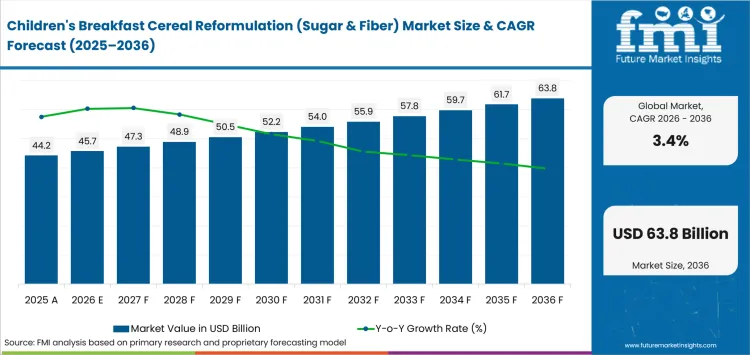
USD 45.7 billion in 2026 and USD 63.8 billion by 2036 at a 3.4% CAGR.
Demand for children's breakfast cereal reformulation (sugar & fiber) is projected to expand at 3.4% CAGR between 2026 and 2036, increasing valuation from USD 45.7 billion in 2026 to USD 63.8 billion by 2036. Expansion is driven by reformulating familiar cereals to meet explicit nutrition screens without weakening child acceptance. USDA updated its cereal guidance in April 2025 to cap added sugars at 6 grams per dry ounce, making sugar content a measurable qualification condition in child nutrition programs.
Regional demand follows different regulatory routes across major markets even as manufacturers solve the same sugar-and-fiber problem. Santé publique France estimated in March 2026 that 30% to 40% of products would change Nutri-Score, giving participating brands a direct reason to review recipes and packaging together. The revised method also strengthens the commercial case for whole-grain foods that pair more fiber with lower sugar.
Key Takeaways of Children's Breakfast Cereal Reformulation (Sugar & Fiber) Market
- Nutrition rules turn sugar and fiber targets into measurable requirements across established child-facing cereal portfolios.
- By focus, sugar reduction is estimated to hold 41.3% in 2026 owing to direct sugar limits in regulated channels.
- In 2026, cereal is expected to lead the product category with 51.6% share because familiar breakfast formats support staged reformulation.
- Whole-grain and fiber work improves nutrient density inside familiar cereals without changing the eating occasion.
- Sensory changes weaken repeat purchase if lower sugar or added fiber alters sweetness and texture.
- Kellanova (Mars), Cereal Partners Worldwide, General Mills, H. & J. Brüggen KG, Lantmännen Cerealia, Weetabix Food Company, Associated British Foods (Jordans) and Post Consumer Brands are profiled.
Analyst Perspective
"For children's cereal reformulation, evaluation starts with the nutrient rule controlling channel access beyond unit price. A viable recipe preserves sweetness and crunch at production scale across school and retail packs."
- Nandini Roy Choudhury, Principal Consultant, Future Market Insights
How is the Children's Breakfast Cereal Reformulation (Sugar & Fiber) Market segmented?
The market is segmented by focus and product, with region used for geographic analysis.
The market taxonomy covers focus and product categories, with region used as the geographic analysis axis across the forecast period. Focus includes sugar reduction, fiber enrichment, fortification and whole grain, while product coverage includes cereal, cereal bars and snacks for child and family eating occasions.
Why does sugar reduction lead demand within the focus category?
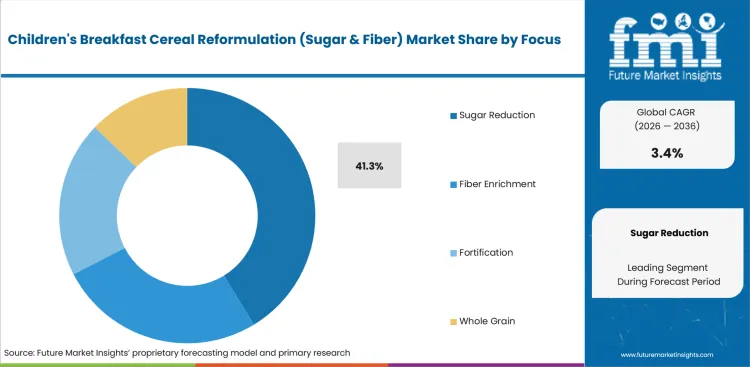
School rules and nutrition labels set measurable sugar limits for child-facing cereal, giving formulation teams a direct target. CEEREAL reported in June 2026 that members' children's cereals cut average sugar by nearly 30% between 2015 and 2025, documenting sustained reformulation across established portfolios.
- Sugar reduction is projected to hold 41.3% share in 2026 owing to its direct connection with measurable nutrition qualification.
- Formulation teams need sweetener systems that protect flavor release and cereal texture during repeated production at commercial scale. A compliant sugar target has limited commercial value once children reject the product’s sweetness or texture.
Why does cereal lead demand within the product category?
Cereal gives manufacturers an established breakfast format for staged sugar and fiber changes without creating a new eating occasion. Existing bowl-based use also lets food fortification accompany reformulation without changing the core product format.
- Cereal is set to lead the product category with 51.6% share in 2026 due to familiar serving formats that preserve repeat use despite recipe changes.
- Post Consumer Brands launched two Mom's Best cereals in February 2025 and stated that Fruity Rings is made with whole grain. The launch kept whole-grain positioning inside a familiar ready-to-eat format without requiring a new family breakfast occasion.
What are the drivers, restraints and opportunities in the Children's Breakfast Cereal Reformulation (Sugar & Fiber) Market?
Nutrition qualification increases reformulation pressure while sensory and processing limits slow adoption and multi-nutrient recipes broaden commercial use.
- Driver: School food rules convert nutrient thresholds into formula requirements that can determine access to child-facing institutional channels.
- Restraint: Lower sugar or higher fiber can alter sweetness and cereal structure enough to weaken repeat purchase or raise processing cost.
- Opportunity: A reusable recipe platform can combine lower sugar with fiber or whole grain and reduce separate nutrition-led variants.
School Nutrition Rules Convert Policy into Formula Specifications
School food rules turn nutrient limits into formula specifications that determine which packaged cereals can remain eligible for institutional sales. Mexico's education ministry reported in March 2025 that healthy-food rules entered operation across 262,547 schools and made school access a direct commercial test for reformulated fortified foods. Manufacturers that meet the specification with an established family recipe can avoid a separate cereal development program for education channels.
Texture and Sweetness Trade-Offs Raise Reformulation Cost
CEEREAL reported in October 2025 that Brüggen's 2024 retail cereal portfolio averaged 45% whole-grain content following gradual recipe changes built around consumer acceptance. Sugar and grain changes can alter sweetness and cereal structure enough to increase formulation and production-testing costs. Food additives and line settings need sensory validation during pilot work so revised cereals can enter routine retail production with familiar texture.
Multi-Nutrient Recipes Extend the Commercial Return
One cereal platform can lower sugar and raise fiber across breakfast formats and related healthy snacks. A reusable dietary fiber system reduces separate development work if it performs consistently on existing cereal lines. CEEREAL reported in October 2025 that Nesquik cereal fiber rose 288% from 2003 to 2025 alongside lower sugar and higher whole-grain content.
Which country CAGRs are profiled in the Children's Breakfast Cereal Reformulation (Sugar & Fiber) Market?
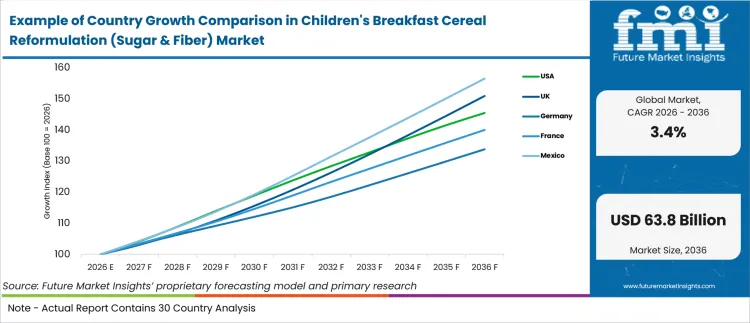
| Country | CAGR |
|---|---|
| Mexico | 4.6% |
| UK | 4.2% |
| USA | 3.8% |
| France | 3.4% |
| Germany | 3.0% |
How do country-level CAGRs compare in the Children's Breakfast Cereal Reformulation (Sugar & Fiber) Market?
The 1.6-point range forms an upper pair in Mexico and the UK with the USA acting as a transition market between faster child-channel rules and slower scoring-led routes. France and Germany form the lower band. The overall forecast pattern reflects different reformulation clocks and does not measure current market size differences.
- Mexico links school access directly to nutrition rules for child-facing cereal brands.
- UK promotion rules raise costs for cereal formulas classified as less healthy.
- USA school and WIC specifications turn nutrient thresholds into institutional listing conditions.
- France uses Nutri-Score changes to make nutrition reformulation visible to shoppers before purchase.
- Germany uses product monitoring to favor gradual recipe adjustment across established cereal portfolios.
Similar CAGRs hide entry timing as national rules impose different commercial screens. The full report provides country-level CAGR analysis across North America, Latin America, Europe, East Asia, South Asia, Oceania and the Middle East and Africa.
Country-wise Analysis
- Mexican cereal brands face school rules that tie child-facing product access to national healthy-food standards across public and private education settings, giving compliant recipes a direct route into institutional breakfast occasions for branded cereals. The Mexico children's breakfast cereal reformulation sector is projected to record 4.6% CAGR during the assessment period, driven by formula changes needed to retain school access without creating a separate product family nationwide. The education ministry said in February 2025 that its national health strategy would reach 12 million students, but manufacturers need lower-sugar cereals that preserve familiar sweetness and crunch across school and retail packs.
- UK cereal brands operate under nutrient rules that affect advertising and promotions across child-facing media plus retail campaigns nationwide during launches, making formula classification part of commercial planning for established family portfolios. In March 2026, the government said its updated model could prevent more than 110,000 childhood obesity cases and bring certain sweetened cereals into scope for advertising controls that affect child-facing media and retail. Children's breakfast cereal reformulation demand in the UK is forecast to rise at 4.2% CAGR over the forecast period, shaped by nutrient screening that must improve formula scores without pushing family breakfast prices upward.
- The United States is projected to expand at a 3.8% CAGR through 2036 as nutrition standards increasingly influence cereal formulation decisions. In May 2025, USDA required at least 75% of cereals on each WIC state food list to identify whole grain as the first ingredient, making grain composition a direct eligibility criterion for participating brands. The requirement encourages manufacturers to reformulate products for institutional and assistance channels while maintaining compliance with established nutrition targets.
- French cereal portfolios use Nutri-Score as a front-of-pack comparison during national launches, and France's public information service stated in March 2025 that participating companies have two years to update packaging across participating retail brands. France's children's breakfast cereal reformulation outlook is anticipated to advance at 3.4% CAGR over the assessment period, shaped by recipe and packaging changes intended to improve the revised score without weakening familiar brand recognition on retail packs. Brand teams can coordinate sugar and fiber work ahead of a pack redesign, but reformulated cereals need sensory testing so score improvements preserve familiar taste during national retail launches and repeat purchase.
- German manufacturers work within recurring product monitoring that tracks nutrient changes in breakfast cereals and child-directed packaged foods, giving reformulation teams an external reference for gradual recipe decisions across established retail portfolios each year. In July 2026, the Max Rubner-Institut reported that more than 7,000 products were examined in its 2025 cycle and provided manufacturers with a national benchmark for nutrition changes across monitored packaged foods. Germany is estimated to post 3.0% CAGR over the forecast period, influenced by measured nutrient progress but limited by the need to validate child acceptance and factory economics during routine production scaling.
Who are the notable companies in the Children's Breakfast Cereal Reformulation (Sugar & Fiber) Market?
Kellanova (Mars), Cereal Partners Worldwide, General Mills, H. & J. Brüggen KG, Lantmännen Cerealia, Weetabix Food Company, Associated British Foods (Jordans) and Post Consumer Brands are the notable companies serving this market.
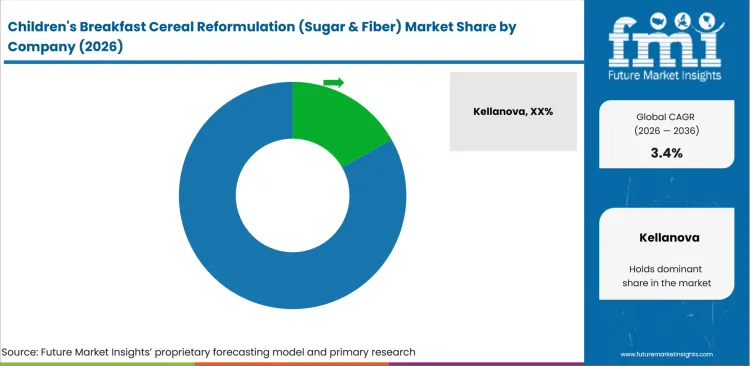
In the competitive outlook, global cereal platforms hold broad branded reach and European specialists rely more on private-label production plus whole-grain expertise. Child-facing functional foods must satisfy nutrition screens without weakening repeat purchase, making sensory validation and production consistency important entry requirements.
- Kellanova (Mars), Cereal Partners Worldwide and General Mills combine global cereal reach with documented recipe changes.
- H. & J. Brüggen KG, Lantmännen Cerealia and Weetabix Food Company bring European grain-processing depth plus established family cereal portfolios.
- Associated British Foods (Jordans) and Post Consumer Brands combine regional cereal portfolios with established family retail reach.
Competitive Benchmarking: Children's Breakfast Cereal Reformulation (Sugar & Fiber) Market
| Company | Family-Focused Nutrition Reformulation | Whole-Grain & Fiber Depth | Nutrition-Screen Channel Readiness | Geographic Reach |
|---|---|---|---|---|
| Kellanova (Mars) | High | High | Medium | International cereal markets |
| Cereal Partners Worldwide | High | High | High | Broad international distribution |
| General Mills | High | High | High | United States and CPW markets |
| H. & J. Brüggen KG | Medium | High | Medium | Germany and European retail |
| Lantmännen Cerealia | Medium | High | High | Nordic and selected European markets |
| Weetabix Food Company | Medium | Medium | Medium | United Kingdom and export markets |
| Associated British Foods (Jordans) | Medium | High | Medium | United Kingdom and France |
| Post Consumer Brands | Medium | Medium | Medium | North America |
Key Developments in the Children's Breakfast Cereal Reformulation (Sugar & Fiber) Market
- In March 2026, General Mills completed its K-12 color transition by reformulating Lucky Charms 25% Less Sugar Cereal within its institutional portfolio.
- In February 2026, Lantmännen renamed AXA Natural Oat Rings as Bamse's Oat Rings and stated that the family cereal carries Sweden's Keyhole nutrition label.
- In December 2025, Kellanova became part of Mars following all required approvals and placed Kellogg's international cereal brands inside the Mars Snacking portfolio.
Key Players in the Children's Breakfast Cereal Reformulation (Sugar & Fiber) Market
Global Cereal Reformulation Platforms
- Kellanova (Mars)
- Cereal Partners Worldwide
- General Mills
European Whole-Grain and Nutrition Platforms
- H. & J. Brüggen KG
- Lantmännen Cerealia
- Weetabix Food Company
Regional Branded Cereal Specialists
- Associated British Foods (Jordans)
- Post Consumer Brands
Children's Breakfast Cereal Reformulation (Sugar & Fiber) Market - Report Scope
| Coverage field | Report scope |
|---|---|
| Market breakdown | By focus, product and region. |
| Quantitative Units | Revenue in USD Billion and CAGR in %. |
| Market Definition | Manufacturer-level sales of children's cereal, bars and cereal-based snacks materially reformulated for sugar reduction, fiber enrichment, fortification or whole grain improvement. |
| Regions Covered | North America, Latin America, Europe, East Asia, South Asia and Pacific, and Middle East and Africa. |
| Countries Covered | USA, UK, Germany, France, Mexico, and 20+ countries included in the full report. |
| Key Companies Profiled | Kellanova (Mars), Cereal Partners Worldwide, General Mills, H. & J. Brüggen KG, Lantmännen Cerealia, Weetabix Food Company, Associated British Foods (Jordans), Post Consumer Brands. |
| Forecast Period | 2026 to 2036. |
| Approach | Primary and secondary research with market triangulation. |
Children's Breakfast Cereal Reformulation (Sugar & Fiber) Market - Research Methodology
| Method | Approach |
|---|---|
| Primary Research | FMI analysts gathered input from manufacturers, service providers, technology developers, distributors, end users, procurement teams, and subject-matter experts. Interviews examined purchasing decisions, product or service evaluation, adoption barriers, approval requirements, pricing considerations, and expectations for technical or commercial support. Respondents were also asked what evidence is required before a trial, pilot, or initial order develops into regular purchasing. |
| Desk Research | Desk research covered government statistics, regulatory publications, trade data, industry associations, technical literature, standards, company filings, product information, and official corporate announcements. Sources were reviewed for relevance, publication date, geographic coverage, and consistency with the defined market scope. Claims relating to performance, applications, approvals, capacity, investment, and commercial activity were retained only when supported by credible public evidence. |
| Market Sizing and Forecasting | The market model combined the baseline value with historical performance, segment structure, pricing and volume indicators, adoption levels, company participation, and country-level demand conditions. Forecast assumptions considered economic activity, investment trends, regulatory developments, technology adoption, purchasing cycles, supply availability, and barriers to wider market use. Segment and regional estimates were reconciled before the final market total was calculated. |
| Data Validation | Estimates were checked against multiple independent indicators, including public data, company activity, trade patterns, industry developments, and findings from primary interviews. Validation also tested whether products, services, applications, and company revenues fell within the defined market boundaries. Adjacent categories, unsupported claims, overlapping revenues, and activities without direct market relevance were excluded to reduce double counting and maintain consistency across segments and countries. |
Children's Breakfast Cereal Reformulation (Sugar & Fiber) Market by Segments
Children's Breakfast Cereal Reformulation (Sugar & Fiber) Market segmented by Focus:
- Sugar Reduction
- Fiber Enrichment
- Fortification
- Whole Grain
Children's Breakfast Cereal Reformulation (Sugar & Fiber) Market segmented by Product:
- Cereal
- Bars
- Snacks
Children's Breakfast Cereal Reformulation (Sugar & Fiber) Market by Region:
- North America
- United States
- Canada
- Latin America
- Brazil
- Mexico
- Chile
- Rest of Latin America
- Western Europe
- Germany
- United Kingdom
- Italy
- Spain
- France
- Nordics
- Benelux
- Rest of Western Europe
- Eastern Europe
- Russia
- Poland
- Hungary
- Balkan and Baltic States
- Rest of Eastern Europe
- East Asia
- China
- Japan
- South Korea
- South Asia and Pacific
- India
- ASEAN
- Australia and New Zealand
- Rest of South Asia and Pacific
- Middle East and Africa
- Kingdom of Saudi Arabia
- Other GCC Countries
- Türkiye
- South Africa
- Other African Union Countries
- Rest of Middle East and Africa
Research Sources and Bibliography
- Food and Nutrition Service, USA Department of Agriculture. (2025, April 15). Calculating the Added Sugars Limit for Breakfast Cereals in the CACFP.
- Ducrot, P., & Serry, A.-J. (2026, March 19). Evaluation of the Nutri-Score 2025 Campaign.
- European Breakfast Cereal Association. (2026, June 16). Europe’s breakfast cereal makers cut sugar and boost whole grains and fibre.
- Post Consumer Brands. (2025, February 5). Two New Mom’s Best Cereals Hit Grocery Stores Early 2025.
- Secretaría de Educación Pública. (2025, March 31). Boletín 104. Entran en operación en 262 mil 547 escuelas del país los lineamientos para el fomento de alimentos saludables: Mario Delgado.
- European Breakfast Cereal Association. (2025, October 9). Brüggen breakfast cereal reformulation.
- European Breakfast Cereal Association. (2025, October 9). Cereal Partners Worldwide whole grain portfolio extension.
- Secretaría de Educación Pública. (2025, February 25). Boletín 57. Garantiza el Gobierno de México derecho a la educación y a la salud de niñas y niños con Estrategia: Vive Saludable, Vive Feliz.
- Department of Health and Social Care. (2026, March 25). New consultation to help children to enjoy healthier diets.
- Food and Nutrition Service, USA Department of Agriculture. (2025, May 15). WIC Food Packages - Regulatory Requirements for WIC-Eligible Foods.
- Direction de l’information légale et administrative. (2025, March 20). Ce qu’il faut savoir sur le nouveau Nutri-Score.
- Max Rubner-Institut. (2026, July 17). Ergebnisse des Produktmonitorings 2025 veröffentlicht.
- European Breakfast Cereal Association. (2025, October 9). Kellanova whole grain reformulation and innovation.
- General Mills, Inc. (2026, April 15). General Mills Reports its Impact in 2026 Global Responsibility Report.
- European Breakfast Cereal Association. (2025, October 9). Lantmännen Cerealia whole grain innovation.
- Weetabix Food Company. (n.d.). Wholegrain. Retrieved August 11, 2026.
- Associated British Foods plc. (n.d.). Food safety and nutrition - Grocery. Retrieved August 11, 2026.
- Post Holdings, Inc. (2025, November 20). Post Holdings Reports Results for the Fourth Quarter and Fiscal Year 2025.
- General Mills, Inc. (2026, March 5). All General Mills K-12 School Foods Now Made without Certified Colors.
- Lantmännen. (2026, February 5). AXA initiates collaboration with Bamse.
- Mars, Incorporated. (2025, December 11). Mars Completes Acquisition of Kellanova.
- Ferrero Group. (2025, September 26). FERRERO COMPLETES ACQUISITION OF WK KELLOGG CO.
- Post Holdings, Inc. (2025, April 9). Post Holdings Announces Plan to Close Cobourg, Ontario and Sparks, Nevada Facilities.
- WK Kellogg Co. (2025, November 6). WK Kellogg Co Launches New K-12 Innovations to Support Student Nutrition and Wellbeing.
- Weetabix Food Company. (2025, June 5). Which of your products are suitable for a Kosher diet?
- Nestlé S.A. (n.d.). Our cereal brands. Retrieved August 11, 2026.
- H. & J. Brüggen KG. (n.d.). “We make the cool stuff!” - From the idea to the perfect product. Retrieved August 11, 2026.
- Mosentine, B. (2025, January 15). Kickstart Your Mornings with an Exciting New Breakfast Lineup for 2025.
- Kellanova. (2025, June 4). A Decade of Impact: How Our Partnership with Tolaram Fuels Strategic Growth in Africa.
- Lantmännen. (2025, March 18). Lantmännen Cerealia increases climate commitment.
- Associated British Foods plc. (n.d.). Agriculture and farming practices - Grocery. Retrieved August 11, 2026.
This bibliography is provided for reader reference and is not exhaustive. The full report contains the complete reference list and detailed citations.
This Report Answers
- How does the forecast change the case for child-focused cereal reformulation?
- Which nutrition rules turn sugar and fiber targets into specifications?
- Why does sugar reduction lead the focus category?
- Why does cereal lead the product category?
- Which sensory limits slow lower-sugar or higher-fiber cereal reformulation?
- How does reformulation timing differ across the five profiled countries?
- Which capabilities matter beyond ingredient price during formulation selection?
- How do recent company actions change child-facing cereal competition?
- What evidence should brand owners require before scaling reformulation?
Frequently Asked Questions
How big is the Children's Breakfast Cereal Reformulation (Sugar & Fiber) Market in 2026?
The children's breakfast cereal reformulation (sugar & fiber) market is expected to be valued at USD 45.7 billion in 2026. Nutrition thresholds require established cereals to satisfy school and retail screens without losing child acceptance.
What is the CAGR of the Children's Breakfast Cereal Reformulation (Sugar & Fiber) Market from 2026 to 2036?
The children's breakfast cereal reformulation (sugar & fiber) market is projected to expand at a 3.4% CAGR from 2026 to 2036. Sugar screens and fiber expectations place cereal recipes under reformulation pressure, and repeat purchase remains the commercial test.
Which focus segment is projected to account for 41.3% of the Children's Breakfast Cereal Reformulation (Sugar & Fiber) Market?
The children's breakfast cereal reformulation (sugar & fiber) market places sugar reduction at 41.3% of focus demand in 2026. Direct nutrient thresholds give manufacturers a measurable target for recipes sold across child-facing school and retail channels.
Which different exhaustive segment is projected to grow fastest through 2036?
The children's breakfast cereal reformulation (sugar & fiber) market does not provide an authorised CAGR for a separate fastest-growing product segment. Bars and snacks extend reformulation beyond breakfast bowls, but available figures do not establish the faster product through 2036.
Which companies are active in the Children's Breakfast Cereal Reformulation (Sugar & Fiber) Market?
The children's breakfast cereal reformulation (sugar & fiber) market includes Kellanova (Mars), Cereal Partners Worldwide, General Mills, H. & J. Brüggen KG, Lantmännen Cerealia, Weetabix Food Company, Associated British Foods (Jordans), and Post Consumer Brands.
Preview the report firsthand - request a free sample
Get SampleGet the brochure for pricing and purchase details.
Get PDFTable of Content
- Key Takeaways
- Market Size and CAGR
- Top Growth Driver
- Fastest Growing Segment
- Leading Region
- Key Companies
- Emerging Opportunities
- Executive Summary
- Global Market Outlook
- Demand-side Trends
- Supply-side Trends
- Technology Roadmap Analysis
- Analysis and Recommendations
- Analyst Perspective (What is happening? Why now? What should investors know?)
- Key Questions Answered
- How large is the market?
- What is the CAGR?
- What are key trends?
- Which region dominates?
- Who are the leaders?
- Market Overview
- Market Coverage / Taxonomy
- Market Definition / Scope / Limitations
- Research Methodology
- Chapter Orientation
- Analytical Lens and Working Hypotheses
- Market Structure, Signals, and Trend Drivers
- Benchmarking and Cross-market Comparability
- Market Sizing, Forecasting, and Opportunity Mapping
- Research Design and Evidence Framework
- Desk Research Programme (Secondary Evidence)
- Expert Input and Fieldwork (Primary Evidence)
- Tooling, Models, and Reference Databases
- Data Engineering and Model Build
- Quality Assurance and Audit Trail
- Market Background
- Market Dynamics (Drivers, Restraints, Opportunity, Trends)
- Scenario Forecast (Optimistic, Likely, Conservative)
- Impact Analysis
- AI Impact
- Sustainability Impact
- Regulatory Impact
- Technology Impact
- Consumer / Buyer Analysis
- Purchase Drivers
- Adoption Barriers
- Buyer Journey
- Opportunity Map Analysis
- Product Life Cycle Analysis
- Supply Chain Analysis
- Investment Feasibility Matrix
- Value Chain Analysis
- PESTLE and Porter's Analysis
- Regulatory Landscape
- Regional Parent Market Outlook
- Production and Consumption Statistics
- Import and Export Statistics
- Global Market Analysis and Forecast, 2021 to 2036
- Historical Market Size Value (USD Billion) Analysis, 2021 to 2025
- Current and Future Market Size Value (USD Billion) Projections, 2026 to 2036
- Y-o-Y Growth Trend Analysis
- Absolute $ Opportunity Analysis
- Global Market Pricing Analysis, 2021 to 2036
- Global Market Analysis and Forecast, By Focus, 2021 to 2036
- Introduction / Key Findings
- Historical Market Size Value (USD Billion) Analysis By Focus, 2021 to 2025
- Current and Future Market Size Value (USD Billion) Analysis and Forecast By Focus, 2026 to 2036
- Sugar Reduction
- Fiber Enrichment
- Fortification
- Whole Grain
- Sugar Reduction
- Y-o-Y Growth Trend Analysis By Focus, 2021 to 2025
- Absolute $ Opportunity Analysis By Focus, 2026 to 2036
- Global Market Analysis and Forecast, By Product, 2021 to 2036
- Introduction / Key Findings
- Historical Market Size Value (USD Billion) Analysis By Product, 2021 to 2025
- Current and Future Market Size Value (USD Billion) Analysis and Forecast By Product, 2026 to 2036
- Cereal
- Bars
- Snacks
- Cereal
- Y-o-Y Growth Trend Analysis By Product, 2021 to 2025
- Absolute $ Opportunity Analysis By Product, 2026 to 2036
- Global Market Analysis and Forecast, By Region, 2021 to 2036
- Introduction
- Historical Market Size Value (USD Billion) Analysis By Region, 2021 to 2025
- Current Market Size Value (USD Billion) Analysis and Forecast By Region, 2026 to 2036
- North America
- Latin America
- Western Europe
- Eastern Europe
- East Asia
- South Asia and Pacific
- Middle East & Africa
- Market Attractiveness Analysis By Region
- North America Market Analysis and Forecast, By Country, 2021 to 2036
- Historical Market Size Value (USD Billion) Trend Analysis By Market Taxonomy, 2021 to 2025
- Market Size Value (USD Billion) Forecast By Market Taxonomy, 2026 to 2036
- By Country
- USA
- Canada
- By Focus
- By Product
- By Country
- Market Attractiveness Analysis
- By Country
- By Focus
- By Product
- Key Takeaways
- Latin America Market Analysis and Forecast, By Country
- Historical Market Size Value (USD Billion) Trend Analysis By Market Taxonomy, 2021 to 2025
- Market Size Value (USD Billion) Forecast By Market Taxonomy, 2026 to 2036
- By Country
- Brazil
- Mexico
- Chile
- Rest of Latin America
- By Focus
- By Product
- By Country
- Market Attractiveness Analysis
- By Country
- By Focus
- By Product
- Key Takeaways
- Western Europe Market Analysis and Forecast, By Country
- Historical Market Size Value (USD Billion) Trend Analysis By Market Taxonomy, 2021 to 2025
- Market Size Value (USD Billion) Forecast By Market Taxonomy, 2026 to 2036
- By Country
- Germany
- UK
- Italy
- Spain
- France
- Nordic
- BENELUX
- Rest of Western Europe
- By Focus
- By Product
- By Country
- Market Attractiveness Analysis
- By Country
- By Focus
- By Product
- Key Takeaways
- Eastern Europe Market Analysis and Forecast, By Country
- Historical Market Size Value (USD Billion) Trend Analysis By Market Taxonomy, 2021 to 2025
- Market Size Value (USD Billion) Forecast By Market Taxonomy, 2026 to 2036
- By Country
- Russia
- Poland
- Hungary
- Balkan & Baltic
- Rest of Eastern Europe
- By Focus
- By Product
- By Country
- Market Attractiveness Analysis
- By Country
- By Focus
- By Product
- Key Takeaways
- East Asia Market Analysis and Forecast, By Country
- Historical Market Size Value (USD Billion) Trend Analysis By Market Taxonomy, 2021 to 2025
- Market Size Value (USD Billion) Forecast By Market Taxonomy, 2026 to 2036
- By Country
- China
- Japan
- South Korea
- By Focus
- By Product
- By Country
- Market Attractiveness Analysis
- By Country
- By Focus
- By Product
- Key Takeaways
- South Asia and Pacific Market Analysis and Forecast, By Country
- Historical Market Size Value (USD Billion) Trend Analysis By Market Taxonomy, 2021 to 2025
- Market Size Value (USD Billion) Forecast By Market Taxonomy, 2026 to 2036
- By Country
- India
- ASEAN
- Australia & New Zealand
- Rest of South Asia and Pacific
- By Focus
- By Product
- By Country
- Market Attractiveness Analysis
- By Country
- By Focus
- By Product
- Key Takeaways
- Middle East & Africa Market Analysis and Forecast, By Country
- Historical Market Size Value (USD Billion) Trend Analysis By Market Taxonomy, 2021 to 2025
- Market Size Value (USD Billion) Forecast By Market Taxonomy, 2026 to 2036
- By Country
- Kingdom of Saudi Arabia
- Other GCC Countries
- Türkiye
- South Africa
- Other African Union
- Rest of Middle East & Africa
- By Focus
- By Product
- By Country
- Market Attractiveness Analysis
- By Country
- By Focus
- By Product
- Key Takeaways
- Key Countries Market Analysis
- USA
- Pricing Analysis
- Market Share Analysis, 2025
- By Focus
- By Product
- Canada
- Pricing Analysis
- Market Share Analysis, 2025
- By Focus
- By Product
- Mexico
- Pricing Analysis
- Market Share Analysis, 2025
- By Focus
- By Product
- Brazil
- Pricing Analysis
- Market Share Analysis, 2025
- By Focus
- By Product
- Chile
- Pricing Analysis
- Market Share Analysis, 2025
- By Focus
- By Product
- Germany
- Pricing Analysis
- Market Share Analysis, 2025
- By Focus
- By Product
- UK
- Pricing Analysis
- Market Share Analysis, 2025
- By Focus
- By Product
- Italy
- Pricing Analysis
- Market Share Analysis, 2025
- By Focus
- By Product
- Spain
- Pricing Analysis
- Market Share Analysis, 2025
- By Focus
- By Product
- France
- Pricing Analysis
- Market Share Analysis, 2025
- By Focus
- By Product
- India
- Pricing Analysis
- Market Share Analysis, 2025
- By Focus
- By Product
- ASEAN
- Pricing Analysis
- Market Share Analysis, 2025
- By Focus
- By Product
- Australia & New Zealand
- Pricing Analysis
- Market Share Analysis, 2025
- By Focus
- By Product
- China
- Pricing Analysis
- Market Share Analysis, 2025
- By Focus
- By Product
- Japan
- Pricing Analysis
- Market Share Analysis, 2025
- By Focus
- By Product
- South Korea
- Pricing Analysis
- Market Share Analysis, 2025
- By Focus
- By Product
- Russia
- Pricing Analysis
- Market Share Analysis, 2025
- By Focus
- By Product
- Poland
- Pricing Analysis
- Market Share Analysis, 2025
- By Focus
- By Product
- Hungary
- Pricing Analysis
- Market Share Analysis, 2025
- By Focus
- By Product
- Kingdom of Saudi Arabia
- Pricing Analysis
- Market Share Analysis, 2025
- By Focus
- By Product
- Türkiye
- Pricing Analysis
- Market Share Analysis, 2025
- By Focus
- By Product
- South Africa
- Pricing Analysis
- Market Share Analysis, 2025
- By Focus
- By Product
- USA
- Market Structure Analysis
- Competition Dashboard
- Competition Benchmarking
- Market Share Analysis of Top Players
- By Regional
- By Focus
- By Product
- Emerging Startups
- Innovation Benchmarking
- Competition Analysis
- Competition Deep Dive
- Kellanova
- Overview
- Product Portfolio
- Profitability by Market Segments
- Sales Footprint
- Strategy Overview
- Marketing Strategy
- Product Strategy
- Channel Strategy
- Nestlé (Cereal Partners)
- General Mills
- Weetabix
- Jordans
- CEEREAL members
- Kellanova
- Case Studies
- Success Stories
- Recent Developments
- Competition Deep Dive
- Assumptions & Acronyms Used


