

- Market Size (2026)
- USD 414.3 Bn
- Forecast (2036)
- USD 619.2 Bn
- CAGR (2026 to 2036)
- 4.1%
How big is Carbonated & Still Soft Drinks Reformulation Ingredients Market in 2026?
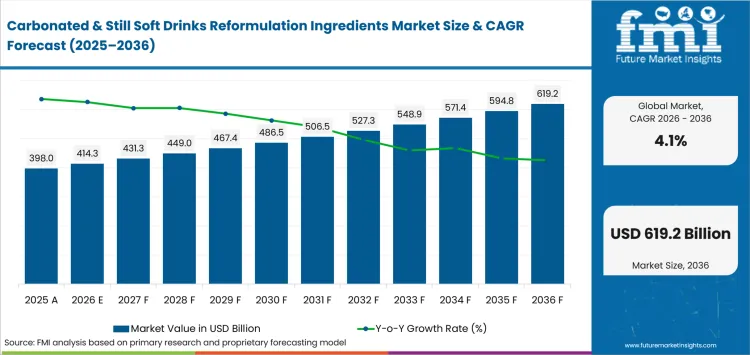
USD 414.3 billion in 2026 and USD 619.2 billion by 2036 at a 4.1% CAGR.
Demand for carbonated and still soft drinks reformulation ingredients is projected to expand at 4.1% CAGR between 2026 and 2036, raising valuation from USD 414.3 billion in 2026 to USD 619.2 billion by 2036. Evolving nutrition-labeling initiatives are increasing pressure on beverage manufacturers to reduce sugar content and adopt reformulation-focused ingredient solutions. In January 2025, the FDA proposed a front-of-package box that would classify added sugars through three levels: low, medium and high. The agency stated that clearer package information could encourage healthier nutrition profiles through product reformulation. The proposal creates a visible target for packaged drinks and increases scrutiny of sugar substitutes during renovation programs. Related beverage ingredients become relevant as sweetener changes require matching flavor release and mouthfeel adjustments.
United States programs increasingly connect package claims with lower-sugar recipe design across established national beverage portfolios. Japanese launches place greater weight on zero-sugar taste quality and exact label thresholds across high-frequency product renovation. In March 2026, Coca-Cola Japan reported that first-year shipments of Minute Maid Zero Sugar Lemonade reached 1.6 times plan. The company also launched a peach-lemonade variant that combined sweeteners and acidulants with vitamins for national retail distribution. The release shows that zero-sugar reformulation requires stable aroma and acidity together with consistent flavor and appearance during national distribution. Natural sweeteners provide a useful comparison for sweetness onset and finish across commercial reduced-sugar formulas. Beverage flavoring systems become equally important as pilot work separates taste recovery from label and shelf-life performance.
Key Takeaways of Carbonated & Still Soft Drinks Reformulation Ingredients Market
- Repeated reformulation programs increase demand for ingredient systems that reduce sugar or replace colors without changing familiar taste under commercial processing conditions.
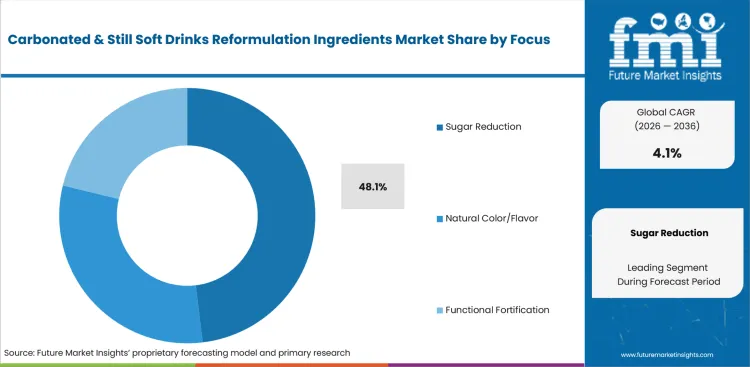
- In 2026, sugar reduction is expected to lead focus with 48.1% share, supported by recurring calorie-reduction programs across established beverage portfolios.
- CSD is forecast to represent 48.0% of product in 2026, driven by large formulation volumes and carbonation-sensitive flavor performance.
- Taste recovery remains the principal restraint; sugar removal changes body and bitterness alongside the intended reduction in sweetness and calories.
- The Coca-Cola Company and PepsiCo compete through branded renovation; Tate & Lyle and Cargill provide broader systems; Keurig Dr Pepper, Suntory and Sweegen add focused launch or taste capabilities.
Analyst Perspective
"Reformulation ingredients create value by helping a lower-sugar drink reach the bottling line with the original sweetness curve and aroma release. Carbonation can amplify bitterness, and changes to acids or stabilizers can alter flavor persistence throughout package life and storage. Beverage companies therefore need ingredient partners that reproduce pilot results at each plant and define operating limits across sweetener and color systems together with texture and fortification ingredients."
- Nandini Roy Choudhury, Principal Analyst, Future Market Insights
How is the Carbonated & Still Soft Drinks Reformulation Ingredients Market segmented?
The carbonated and still soft drinks reformulation ingredients industry is segmented by focus, product, and region.
The market is segmented across three parent dimensions for commercial analysis and planning: focus, product, and region. Focus comprises sugar reduction, natural color or flavor, and functional fortification, which separate the commercial purpose of each recipe change. Product segmentation covers CSD, juice, flavored water, and functional drinks, with each format requiring different controls for acidity, carbonation, heat treatment, and package stability. Region records the national ingredient permissions, nutrition-label rules, tax treatment, and claim thresholds that govern commercial launch. A bench recipe can behave differently during carbonation or hot filling, which separates laboratory design from plant qualification. Beverage developers therefore assess each segment through the final processing route and declared product position.
How does sugar reduction shape demand within the focus category?
Reducing sugar changes more than sweetness; sucrose also contributes body and balances acidity in soft drinks. In May 2026, Tate & Lyle expanded its BioHarvest collaboration to develop several plant-based sweetener molecules for food and beverage applications. The program broadens the available formulation toolbox for brands that need different taste and cost profiles across national labels. Developers compare nutritive sweeteners with high-intensity options and taste modulators to rebuild sweetness onset and finish without weakening mouthfeel.
- Sugar reduction is projected to hold 48.1% share in 2026 owing to repeated calorie-reduction programs across established carbonated and still drink portfolios. Sweetener choice changes acidity and flavor release throughout the recipe, making the segment the first formulation decision. A successful program must reproduce the familiar sweetness curve under commercial filling and storage conditions.
- In February 2026, Tate & Lyle launched Yume M Stevia as a scalable Reb M sweetener designed for sugar-like taste across food and beverage applications. High-intensity sweeteners gain adoption through application support that matches sweetness timing across pilot and production batches. Dependable regional supply protects sensory and stability approvals from commercial substitutions that differ from the tested material.
What drives CSD within the product category?
Carbonated soft drinks expose small ingredient changes through dissolved carbon dioxide, which sharpens acid perception and changes aroma release. In February 2026, PepsiCo launched Pepsi Prebiotic Cola nationwide with five grams of sugar and three grams of prebiotic fiber per serving. The national launch combined lower sugar with added function and preserved a familiar cola taste position. Formulators compare food acidulants with sweeteners to rebuild acid balance under final carbonation and flavor conditions. They validate related food additives separately under package conditions used for commercial filling and national release.
- The CSD segment is likely to capture 48.0% share in 2026 attributable to frequent reformulation across regular and zero-sugar brands. Carbonation exposes bitterness and changes aroma release throughout every sweetener adjustment made within the concentrate system. National brand owners repeat sensory and line testing across concentrate systems and package sizes during formula approval. The resulting evidence supports one formula across bottling plants without hiding site-specific sensory or sweetener risks.
- Keurig Dr Pepper introduced Dr Pepper Blackberry and expanded RC Cola Zero Sugar in February 2025 across its United States cold-beverage portfolio. Frequent brand renovation gives CSD ingredient systems a steady commercial route into repeated formulation and plant-validation trials. Adoption strengthens through formulations that transfer across several plants without separate changes to flavor intensity or sweetener balance at each location.
What are the drivers, restraints, and opportunities in the Carbonated & Still Soft Drinks Reformulation Ingredients Market?
Regulatory deadlines and portfolio renovation support ingredient demand, while taste recovery and cross-ingredient stability continue to slow commercial release.
- Driver: Regulatory deadlines and portfolio renovation create defined reformulation programs across carbonated and still drink brands.
- Restraint: Sugar removal changes sweetness timing and mouthfeel, which increases the number of pilot rounds required for commercial release.
- Opportunity: Integrated sweetener and functional systems support lower-sugar drinks with fiber or vitamin benefits through one qualification program.
Federal color deadlines create defined reformulation work for carbonated and still drinks that use affected synthetic colors. Following its January 2025 order revoking authorization for FD&C Red No. 3, the FDA in July 2025 encouraged food manufacturers to accelerate the phase-out ahead of the January 15, 2027, deadline. Beverage companies must replace the color and preserve shade consistency across acidic formulas throughout the complete package life. The federal deadline gives natural food colors and compatible emulsion systems a direct commercial role in products that require national relabeling and plant validation.
Sugar contributes body and suppresses bitterness beyond its direct sweetness, making sensory recovery a significant restraint in sugar-reduction reformulation. In July 2025, Tate & Lyle presented four prototypes from its combined portfolio with CP Kelco. The program joined sugar reduction and fortification with pectin and specialty gums to address mouthfeel. Beverage stabilizers can reduce texture gaps but each change introduces new interactions with acids and flavors. Qualifying a revised formula for commercial filling therefore requires repeated bench and plant-scale trials across multiple production locations.
Functional positioning creates a practical revenue opening by spreading reformulation costs across several consumer benefits within one product. At IFT FIRST in July 2025, Sweegen presented newly launched sweet protein systems in a no-added-sugar prebiotic soda and a reduced-sugar protein lemonade. The prototypes combined sweetness and taste modulation with fiber or protein across two recognizable beverage concepts. Integrated systems reduce coordination among ingredients and give developers one technical package for sensory and functional performance. Commercial value depends on documented performance under the final process and package conditions used for production.
Which country CAGRs are profiled in the Carbonated & Still Soft Drinks Reformulation Ingredients Market?
| Country | CAGR |
|---|---|
| Brazil | 5.3% |
| China | 4.9% |
| Mexico | 4.5% |
| USA | 4.1% |
| Japan | 3.7% |
How do country-level CAGRs compare in the Carbonated & Still Soft Drinks Reformulation Ingredients Market?
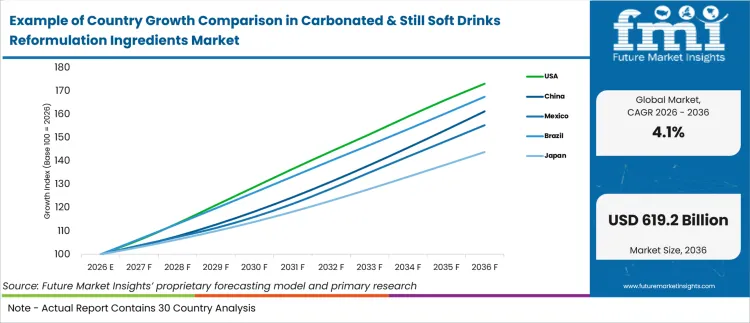
The country comparison spans 1.6 percentage points and reflects a closely grouped growth outlook across the carbonated & still soft drinks reformulation ingredients market. Brazil and China form an upper cluster with only a limited gap between their forecasts. Mexico remains close to this group and creates a gradual transition toward the lower-growth markets. The USA and Japan form a lower pair and are separated by just 0.4 percentage points. The relatively narrow range across all five countries suggests that reformulation activity is occurring across both developed and emerging beverage markets. Differences in growth rates largely reflect the pace of sugar reduction initiatives, clean-label reformulation programs and demand for alternative sweeteners and functional ingredients.
- Brazil shows a notable position within the comparison as beverage manufacturers continue to reformulate products in response to evolving consumer preferences and healthier beverage trends.
- China remains closely aligned with Brazil as producers increase the use of reduced-sugar formulations, natural ingredients and functional beverage components across a broad product base.
- Mexico reflects steady momentum through continued reformulation efforts aimed at improving nutritional profiles while maintaining product taste and affordability.
- The USA benefits from ongoing demand for low-sugar and clean-label beverages, encouraging the adoption of alternative sweeteners, flavor solutions and texture-enhancing ingredients.
- Japan maintains a measured position within the comparison as beverage innovation focuses on functional benefits, ingredient quality and gradual reformulation of established product lines.
Comparable CAGRs do not create identical market conditions across countries. Differences in consumer taste preferences, regulatory requirements, taxation policies, ingredient sourcing and product development priorities can influence reformulation strategies and adoption timelines. Similar growth rates may therefore reflect different commercial approaches to reducing sugar, improving nutrition and meeting changing consumer expectations. The full report provides country-level CAGR analysis across North America, Latin America, Europe, East Asia, South Asia, Oceania and the Middle East and Africa.
Country-wise Analysis
- United States beverage developers must align ingredient changes with FDA additive rules and the nutrition claims printed on every package format. Carbonated and still soft drinks reformulation ingredient sales in the USA are forecast to expand at 4.1% CAGR by 2036, supported by frequent national renovation across zero-sugar and functional beverages. In February 2025, The Coca-Cola Company launched Simply Pop with no added sugar and six grams of prebiotic fiber across five fruit flavors. The launch gives sweetener and fiber systems a visible route into a regional brand platform, with national expansion planned across several flavor profiles. Commercial release remains costly; each formula needs separate sensory and package-claim validation across juice content and carbonation conditions.
- China requires each reformulated beverage to match the permitted additives and maximum use levels assigned to its exact food category. Demand for carbonated and still soft drinks reformulation ingredients in China is forecast to rise at 4.9% CAGR over the forecast period, linked to clear national standards and broad manufacturing capacity. The defined route supports local testing by giving developers one published category limit for comparing proposed sweetener blends. In February 2025, the Yunnan Provincial Administration for Market Regulation confirmed that GB 2760-2024 had taken effect and introduced combined-use controls for certain sweeteners. Commercial timing remains exposed to category classification and documentation gaps for imported systems during product approval.
- Mexico applies different excise treatment to caloric and noncaloric drinks, which changes the economics of reformulating family-size packages. Mexico's carbonated and still soft drinks reformulation ingredients outlook is anticipated to advance at 4.5% CAGR over the assessment period, influenced by national calorie-reduction commitments and excise treatment. In October 2025, Industria Mexicana de Coca-Cola committed to reduce calories in Coca-Cola soft drinks by 30% within one year across family packages. The commitment covers more than 70% of national sales volume and creates a direct commercial route for lower-calorie sweetener systems. Formula changes can also alter label position and package pricing, so beverage companies must evaluate tax treatment during recipe scale-up across package formats.
- Brazilian beverage developers face an active nutrition-label revision process linked to Mercosur negotiations and national consultation. In Brazil, demand for carbonated and still soft drinks reformulation ingredients is predicted to advance at 5.3% CAGR through 2036 due to active formula and label updates. The consultation process gives formulation teams early visibility into possible changes ahead of package artwork and national distribution approval. In September 2025, Anvisa reported that more than 880 participants joined a sector dialogue on proposed nutrition-label revisions. Regulatory transition creates a material commercial friction by triggering another validation cycle across several package sizes. National launches therefore require coordinated formula and packaging schedules across bottling plants and several retail package formats.
- Japan applies defined nutrient-claim thresholds and ingredient-label rules to zero-sugar beverages sold through national retail channels. Adoption of carbonated and still soft drinks reformulation ingredients in Japan is estimated to expand at 3.7% CAGR through 2036, shaped by precise zero-sugar claims and frequent product renovation. In February 2025, Suntory announced new additions to its All-Free zero-sugar carbonated beverage lineup for national retail distribution in Japan. The launch provides a local route for sweetener and flavor systems that must create depth without relying on sugar. Zero claims and flavor balance require precise testing under Japanese labeling standards and national taste expectations during release. Plant teams must also reproduce the revised profile across cans and other national package formats.
Who are the notable companies in the Carbonated & Still Soft Drinks Reformulation Ingredients Market?
The Coca-Cola Company, PepsiCo, Keurig Dr Pepper, Suntory Beverage & Food, Tate & Lyle, Cargill, and Sweegen are the notable companies shaping this market.
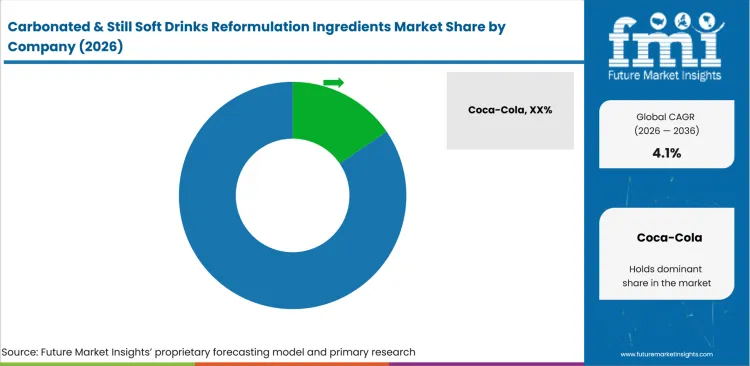
The competitive outlook combines beverage owners that create reformulation briefs with ingredient developers that solve sweetness and stability problems. The Coca-Cola Company and PepsiCo test new formulas across national brand platforms that provide rapid consumer feedback and repeatable launch evidence. Keurig Dr Pepper and Suntory add frequent regional launches across established cold-beverage portfolios and familiar retail channels. Tate & Lyle and Cargill compete through scalable sweetener systems backed by regulatory and formulation support. Sweegen contributes specialized sweet proteins and taste modulation for narrower sensory problems that require faster formula adjustment. Ingredient selection is ultimately driven by plant reproducibility and supply continuity, not by corporate scale or general sector profile.
- The Coca-Cola Company and PepsiCo combine broad brand portfolios with repeated regular and zero-sugar launches across carbonated and still formats. Keurig Dr Pepper and Suntory add frequent regional renovation programs across established cold-beverage brands and familiar retail channels. Their commercial advantage comes from national launch scale and direct consumer response across familiar products.
- Tate & Lyle combines sweetener expertise with texture and fortification support across several beverage formats and processing routes. Cargill contributes a commercially adopted stevia route across the United States and Canada together with Mexico and the European Union. Selection depends on whether a broad ingredient system or one scalable high-intensity sweetener fits the formula and supply plan.
- Sweegen focuses on sweet proteins and stevia systems together with taste modulation for reduced-sugar beverages. Its regional innovation studios support programs that require tailored sensory work and local regulatory review. The specialized model suits beverage developers that need rapid adjustments across a narrower formula or regional launch.
Competitive Benchmarking: Carbonated & Still Soft Drinks Reformulation Ingredients Market
| Company | 2025-2026 Reformulation Activity | Reduced-Sugar System Breadth | Commercial Beverage Validation | Geographic Reach |
|---|---|---|---|---|
| The Coca-Cola Company | High | High | High | North America and Japan |
| PepsiCo, Inc. | Medium | Medium | Medium | United States |
| Keurig Dr Pepper Inc. | High | Medium | High | United States and Canada |
| Suntory Beverage & Food Limited | Medium | Medium | Medium | Japan |
| Tate & Lyle PLC | High | High | Medium | Americas and Europe |
| Cargill, Incorporated | Medium | Low | High | United States, Canada, Mexico, and European Union |
| Sweegen, Inc. | Medium | Medium | Low | North America, Europe, and Asia Pacific |
Key Developments in the Carbonated & Still Soft Drinks Reformulation Ingredients Market
- In February 2026, The Coca-Cola Company introduced Coca-Cola Cherry Float and released Diet Coke Cherry nationwide across the United States and Canada. The portfolio included full-sugar and zero-sugar variants that create direct comparison points for cherry flavor and sweetness systems. The rollout increases demand for scalable flavor packages that perform across several sweetener bases and bottling conditions without separate development for every national package format.
- In February 2026, Keurig Dr Pepper announced more than thirty-five new varieties across carbonated soft drinks and multiple still-beverage portfolios. The program expanded several zero-sugar and flavor-led formats that require coordinated sweetener and aroma validation. Concurrent renovation across several brands gives ingredient developers a practical test of which systems transfer reliably across concentrate platforms and production networks with different package requirements.
- In October 2025, Tate & Lyle reported that its Manus partnership had scaled the first all-Americas Reb M stevia supply chain. The program combined regional bioconversion capacity with application expertise that supports repeatable sugar-reduction work across beverage formulas. Beverage developers gained a clearer route from pilot support to recurring commercial supply and reduced the risk that the production ingredient differs from the material used during sensory and stability testing.
- In September 2025, Cargill reported that EverSweet had gained approvals across the United States and Canada together with Mexico and the European Union. The company also documented adoption among major food and beverage brands operating across those approved commercial markets. The commercialization advance gives reduced-sugar beverage programs a multi-country regulatory route, although each final formula still requires local flavor and texture validation under its declared ingredient and package conditions.
Key Players in the Carbonated & Still Soft Drinks Reformulation Ingredients Market
Branded Beverage Reformulation Leaders
- The Coca-Cola Company
- PepsiCo, Inc.
- Keurig Dr Pepper Inc.
- Suntory Beverage & Food Limited
Integrated Ingredient System Developers
- Tate & Lyle PLC
- Cargill, Incorporated
Specialized Sweetener and Taste Technology Provider
- Sweegen, Inc.
Carbonated & Still Soft Drinks Reformulation Ingredients Market - Report Scope
| Coverage field | Report scope |
|---|---|
| Market breakdown | Focus, product, and region. |
| Quantitative Units | Revenue in USD Billion, CAGR in %. |
| Market Definition | Sweeteners, flavors, colors, acidulants, fibers, fortification systems, stabilizers, and related ingredients used to reformulate carbonated and still soft drinks for lower sugar, revised color or flavor, or added function. |
| Regions Covered | North America, Latin America, Western Europe, Eastern Europe, East Asia, South Asia and Pacific, and Middle East and Africa. |
| Countries Covered | USA, China, Mexico, Brazil, and Japan are profiled directly within a full report that covers more than thirty countries. |
| Key Companies Profiled | The Coca-Cola Company, PepsiCo, Keurig Dr Pepper, Suntory Beverage & Food, Tate & Lyle, Cargill, and Sweegen. |
| Forecast Period | 2026 to 2036. |
| Approach | Hybrid bottom-up and top-down market sizing supported by primary interviews and official desk research. |
Carbonated & Still Soft Drinks Reformulation Ingredients Market - Research Methodology
| Method | Approach |
|---|---|
| Primary Research | FMI analysts gathered input from manufacturers, service providers, technology developers, distributors, end users, procurement teams, and subject-matter experts. Interviews examined purchasing decisions, product or service evaluation, adoption barriers, approval requirements, pricing considerations, and expectations for technical or commercial support. Respondents were also asked what evidence is required before a trial, pilot, or initial order develops into regular purchasing. |
| Desk Research | Desk research covered government statistics, regulatory publications, trade data, industry associations, technical literature, standards, company filings, product information, and official corporate announcements. Sources were reviewed for relevance, publication date, geographic coverage, and consistency with the defined market scope. Claims relating to performance, applications, approvals, capacity, investment, and commercial activity were retained only when supported by credible public evidence. |
| Market Sizing and Forecasting | The market model combined the baseline value with historical performance, segment structure, pricing and volume indicators, adoption levels, company participation, and country-level demand conditions. Forecast assumptions considered economic activity, investment trends, regulatory developments, technology adoption, purchasing cycles, supply availability, and barriers to wider market use. Segment and regional estimates were reconciled before the final market total was calculated. |
| Data Validation | Estimates were checked against multiple independent indicators, including public data, company activity, trade patterns, industry developments, and findings from primary interviews. Validation also tested whether products, services, applications, and company revenues fell within the defined market boundaries. Adjacent categories, unsupported claims, overlapping revenues, and activities without direct market relevance were excluded to reduce double counting and maintain consistency across segments and countries. |
Carbonated & Still Soft Drinks Reformulation Ingredients Market by Segments
Carbonated & Still Soft Drinks Reformulation Ingredients Market segmented by Focus:
- Sugar Reduction
- Natural Color/Flavor
- Functional Fortification
Carbonated & Still Soft Drinks Reformulation Ingredients Market segmented by Product:
- CSD
- Juice
- Flavored Water
- Functional
Carbonated & Still Soft Drinks Reformulation Ingredients Market by Region:
- North America
- United States
- Canada
- Latin America
- Brazil
- Mexico
- Argentina
- Chile
- Western Europe
- Germany
- France
- United Kingdom
- Italy
- Spain
- Benelux
- Nordics
- Eastern Europe
- Poland
- Czech Republic
- Romania
- Hungary
- East Asia
- China
- Japan
- South Korea
- South Asia and Pacific
- India
- ASEAN
- Australia and New Zealand
- Middle East and Africa
- GCC Countries
- South Africa
- Türkiye
- Israel
Research Sources and Bibliography
- USA Food and Drug Administration. (2025, January 14). FDA Proposes Requiring At-a-Glance Nutrition Information on the Front of Packaged Foods.
- Coca-Cola (Japan) Company, Limited. (2026, March 24).
- Tate & Lyle PLC. (2026, May 18). Tate & lyle expands collaboration with BioHarvest to accelerate next-generation sweetener innovation.
- Tate & Lyle PLC. (2026, February 23). Introducing Yume™: A new standard for sweetness.
- PepsiCo, Inc. (2026, February 17). Pepsi® Prebiotic Cola now available nationwide in stores and online.
- Keurig Dr Pepper Inc. (2025, February 5). Keurig Dr Pepper Unveils Bold New Flavors Across Iconic USA Cold Beverages Portfolio.
- USA Food and Drug Administration. (2025, July 14). FDA Encourages Food Manufacturers to Accelerate Phasing Out the Use of FD&C Red No. 3 in Foods Before 2027 Deadline.
- Tate & Lyle PLC. (2025, July 7). Tate & Lyle debuts expanded portfolio and mouthfeel leadership at IFT FIRST 2025.
- Sweegen. (2025, July). Join Sweegen Taste Blazers at IFT 2025!
- The Coca-Cola Company. (2025, February 18). Simply Brings a Juicy Pop to Booming Prebiotic Soda Category.
- Yunnan Provincial Administration for Market Regulation. (2025, February 13).
- Industria Mexicana de Coca-Cola. (2025, October 24). Compromisos IEPS.
- Agência Nacional de Vigilância Sanitária. (2025, September 23). Disponíveis gravação e materiais do diálogo setorial sobre revisão do regulamento de rotulagem nutricional.
- Suntory Holdings Limited. (2025, February 5).
- The Coca-Cola Company. (2026, February 2). Coca-Cola Expands Its Cherry Portfolio with the Launch of Coca-Cola Cherry Float and the Nationwide Release of Diet Coke Cherry.
- Keurig Dr Pepper Inc. (2026, February 18). Keurig Dr Pepper Announces Flavorful New Innovation Across Its Refreshment Portfolio.
- Tate & Lyle PLC. (2025, October 31). One year on: How our stevia Reb M partnership with Manus is benefiting customers.
- Cargill, Incorporated. (2025, September 26). Cargill’s EverSweet® stevia sweetener named a finalist in the 2025 Global Good Awards Game Changing Innovation of the Year.
This bibliography is provided for reader reference and is not exhaustive. The full report contains the complete reference list and detailed citations
This Report Answers
- How large is the carbonated and still soft drinks reformulation ingredients market in 2026 and 2036?
- Which regulatory deadlines and portfolio changes support investment in reformulation ingredients?
- Why does sugar reduction account for the largest focus share in 2026?
- How does CSD influence ingredient validation under carbonation and shelf-life testing?
- How do country growth rates differ across Brazil, China, Mexico, the USA, and Japan?
- Which beverage owners and ingredient developers shape competitive activity?
- What limits taste recovery during lower-sugar beverage reformulation?
- How can functional systems combine sugar reduction with fiber or vitamin benefits?
- What should formulation and commercial teams evaluate during ingredient-system approval?
Frequently Asked Questions
How big is the Carbonated & Still Soft Drinks Reformulation Ingredients Market in 2026?
The carbonated & still soft drinks reformulation ingredients market is valued at USD 414.3 billion in 2026 and is forecast to reach USD 619.2 billion by 2036. Growth is supported by evolving nutrition-labeling initiatives increasing pressure on beverage manufacturers to reduce sugar content and adopt reformulation-focused ingredient solutions across established carbonated and still drink portfolios.
What is the CAGR of the Carbonated & Still Soft Drinks Reformulation Ingredients Market from 2026 to 2036?
The carbonated & still soft drinks reformulation ingredients market grows at a CAGR of 4.1% between 2026 and 2036, supported by beverage manufacturers adopting sweetener, color, and functional systems once those systems reproduce the familiar sweetness curve and aroma release under commercial filling and storage conditions across national brand programs.
Which focus leads the Carbonated & Still Soft Drinks Reformulation Ingredients Market?
Sugar reduction accounts for 48.1% of the carbonated & still soft drinks reformulation ingredients market by focus in 2026, driven by recurring calorie-reduction programs across established portfolios where sweetener choice changes acidity, body, and flavor release throughout the recipe and requires separate sensory validation across commercial filling conditions.
How much will the Carbonated & Still Soft Drinks Reformulation Ingredients Market add between 2026 and 2036?
The carbonated & still soft drinks reformulation ingredients market is set to add USD 204.9 billion between 2026 and 2036, growing from USD 414.3 billion to USD 619.2 billion as sweetener, natural color, and integrated functional systems enter funded reformulation pathways across a widening base of carbonated and still soft drink programs worldwide.
Who are the leading companies in the Carbonated & Still Soft Drinks Reformulation Ingredients Market?
Five companies lead the carbonated & still soft drinks reformulation ingredients market, including The Coca-Cola Company, PepsiCo, Keurig Dr Pepper, Tate & Lyle, and Cargill, competing through branded renovation programs, scalable sweetener systems, formulation support, and multi-country regulatory approvals across carbonated and still soft drink programs worldwide.
Preview the report firsthand - request a free sample
Get SampleGet the brochure for pricing and purchase details.
Get PDFTable of Content
- Key Takeaways
- Market Size and CAGR
- Top Growth Driver
- Fastest Growing Segment
- Leading Region
- Key Companies
- Emerging Opportunities
- Executive Summary
- Global Market Outlook
- Demand-side Trends
- Supply-side Trends
- Technology Roadmap Analysis
- Analysis and Recommendations
- Analyst Perspective (What is happening? Why now? What should investors know?)
- Key Questions Answered
- How large is the market?
- What is the CAGR?
- What are key trends?
- Which region dominates?
- Who are the leaders?
- Market Overview
- Market Coverage / Taxonomy
- Market Definition / Scope / Limitations
- Research Methodology
- Chapter Orientation
- Analytical Lens and Working Hypotheses
- Market Structure, Signals, and Trend Drivers
- Benchmarking and Cross-market Comparability
- Market Sizing, Forecasting, and Opportunity Mapping
- Research Design and Evidence Framework
- Desk Research Programme (Secondary Evidence)
- Expert Input and Fieldwork (Primary Evidence)
- Tooling, Models, and Reference Databases
- Data Engineering and Model Build
- Quality Assurance and Audit Trail
- Market Background
- Market Dynamics (Drivers, Restraints, Opportunity, Trends)
- Scenario Forecast (Optimistic, Likely, Conservative)
- Impact Analysis
- AI Impact
- Sustainability Impact
- Regulatory Impact
- Technology Impact
- Consumer / Buyer Analysis
- Purchase Drivers
- Adoption Barriers
- Buyer Journey
- Opportunity Map Analysis
- Product Life Cycle Analysis
- Supply Chain Analysis
- Investment Feasibility Matrix
- Value Chain Analysis
- PESTLE and Porter's Analysis
- Regulatory Landscape
- Regional Parent Market Outlook
- Production and Consumption Statistics
- Import and Export Statistics
- Global Market Analysis and Forecast, 2021 to 2036
- Historical Market Size Value (USD Billion) Analysis, 2021 to 2025
- Current and Future Market Size Value (USD Billion) Projections, 2026 to 2036
- Y-o-Y Growth Trend Analysis
- Absolute $ Opportunity Analysis
- Global Market Pricing Analysis, 2021 to 2036
- Global Market Analysis and Forecast, By Focus, 2021 to 2036
- Introduction / Key Findings
- Historical Market Size Value (USD Billion) Analysis By Focus, 2021 to 2025
- Current and Future Market Size Value (USD Billion) Analysis and Forecast By Focus, 2026 to 2036
- Sugar Reduction
- Natural Color/Flavor
- Functional Fortification
- Sugar Reduction
- Y-o-Y Growth Trend Analysis By Focus, 2021 to 2025
- Absolute $ Opportunity Analysis By Focus, 2026 to 2036
- Global Market Analysis and Forecast, By Product, 2021 to 2036
- Introduction / Key Findings
- Historical Market Size Value (USD Billion) Analysis By Product, 2021 to 2025
- Current and Future Market Size Value (USD Billion) Analysis and Forecast By Product, 2026 to 2036
- CSD
- Juice
- Flavored Water
- Functional
- CSD
- Y-o-Y Growth Trend Analysis By Product, 2021 to 2025
- Absolute $ Opportunity Analysis By Product, 2026 to 2036
- Global Market Analysis and Forecast, By Region, 2021 to 2036
- Introduction
- Historical Market Size Value (USD Billion) Analysis By Region, 2021 to 2025
- Current Market Size Value (USD Billion) Analysis and Forecast By Region, 2026 to 2036
- North America
- Latin America
- Western Europe
- Eastern Europe
- East Asia
- South Asia and Pacific
- Middle East & Africa
- Market Attractiveness Analysis By Region
- North America Market Analysis and Forecast, By Country, 2021 to 2036
- Historical Market Size Value (USD Billion) Trend Analysis By Market Taxonomy, 2021 to 2025
- Market Size Value (USD Billion) Forecast By Market Taxonomy, 2026 to 2036
- By Country
- USA
- Canada
- By Focus
- By Product
- By Country
- Market Attractiveness Analysis
- By Country
- By Focus
- By Product
- Key Takeaways
- Latin America Market Analysis and Forecast, By Country
- Historical Market Size Value (USD Billion) Trend Analysis By Market Taxonomy, 2021 to 2025
- Market Size Value (USD Billion) Forecast By Market Taxonomy, 2026 to 2036
- By Country
- Brazil
- Mexico
- Chile
- Rest of Latin America
- By Focus
- By Product
- By Country
- Market Attractiveness Analysis
- By Country
- By Focus
- By Product
- Key Takeaways
- Western Europe Market Analysis and Forecast, By Country
- Historical Market Size Value (USD Billion) Trend Analysis By Market Taxonomy, 2021 to 2025
- Market Size Value (USD Billion) Forecast By Market Taxonomy, 2026 to 2036
- By Country
- Germany
- UK
- Italy
- Spain
- France
- Nordic
- BENELUX
- Rest of Western Europe
- By Focus
- By Product
- By Country
- Market Attractiveness Analysis
- By Country
- By Focus
- By Product
- Key Takeaways
- Eastern Europe Market Analysis and Forecast, By Country
- Historical Market Size Value (USD Billion) Trend Analysis By Market Taxonomy, 2021 to 2025
- Market Size Value (USD Billion) Forecast By Market Taxonomy, 2026 to 2036
- By Country
- Russia
- Poland
- Hungary
- Balkan & Baltic
- Rest of Eastern Europe
- By Focus
- By Product
- By Country
- Market Attractiveness Analysis
- By Country
- By Focus
- By Product
- Key Takeaways
- East Asia Market Analysis and Forecast, By Country
- Historical Market Size Value (USD Billion) Trend Analysis By Market Taxonomy, 2021 to 2025
- Market Size Value (USD Billion) Forecast By Market Taxonomy, 2026 to 2036
- By Country
- China
- Japan
- South Korea
- By Focus
- By Product
- By Country
- Market Attractiveness Analysis
- By Country
- By Focus
- By Product
- Key Takeaways
- South Asia and Pacific Market Analysis and Forecast, By Country
- Historical Market Size Value (USD Billion) Trend Analysis By Market Taxonomy, 2021 to 2025
- Market Size Value (USD Billion) Forecast By Market Taxonomy, 2026 to 2036
- By Country
- India
- ASEAN
- Australia & New Zealand
- Rest of South Asia and Pacific
- By Focus
- By Product
- By Country
- Market Attractiveness Analysis
- By Country
- By Focus
- By Product
- Key Takeaways
- Middle East & Africa Market Analysis and Forecast, By Country
- Historical Market Size Value (USD Billion) Trend Analysis By Market Taxonomy, 2021 to 2025
- Market Size Value (USD Billion) Forecast By Market Taxonomy, 2026 to 2036
- By Country
- Kingdom of Saudi Arabia
- Other GCC Countries
- Türkiye
- South Africa
- Other African Union
- Rest of Middle East & Africa
- By Focus
- By Product
- By Country
- Market Attractiveness Analysis
- By Country
- By Focus
- By Product
- Key Takeaways
- Key Countries Market Analysis
- USA
- Pricing Analysis
- Market Share Analysis, 2025
- By Focus
- By Product
- Canada
- Pricing Analysis
- Market Share Analysis, 2025
- By Focus
- By Product
- Mexico
- Pricing Analysis
- Market Share Analysis, 2025
- By Focus
- By Product
- Brazil
- Pricing Analysis
- Market Share Analysis, 2025
- By Focus
- By Product
- Chile
- Pricing Analysis
- Market Share Analysis, 2025
- By Focus
- By Product
- Germany
- Pricing Analysis
- Market Share Analysis, 2025
- By Focus
- By Product
- UK
- Pricing Analysis
- Market Share Analysis, 2025
- By Focus
- By Product
- Italy
- Pricing Analysis
- Market Share Analysis, 2025
- By Focus
- By Product
- Spain
- Pricing Analysis
- Market Share Analysis, 2025
- By Focus
- By Product
- France
- Pricing Analysis
- Market Share Analysis, 2025
- By Focus
- By Product
- India
- Pricing Analysis
- Market Share Analysis, 2025
- By Focus
- By Product
- ASEAN
- Pricing Analysis
- Market Share Analysis, 2025
- By Focus
- By Product
- Australia & New Zealand
- Pricing Analysis
- Market Share Analysis, 2025
- By Focus
- By Product
- China
- Pricing Analysis
- Market Share Analysis, 2025
- By Focus
- By Product
- Japan
- Pricing Analysis
- Market Share Analysis, 2025
- By Focus
- By Product
- South Korea
- Pricing Analysis
- Market Share Analysis, 2025
- By Focus
- By Product
- Russia
- Pricing Analysis
- Market Share Analysis, 2025
- By Focus
- By Product
- Poland
- Pricing Analysis
- Market Share Analysis, 2025
- By Focus
- By Product
- Hungary
- Pricing Analysis
- Market Share Analysis, 2025
- By Focus
- By Product
- Kingdom of Saudi Arabia
- Pricing Analysis
- Market Share Analysis, 2025
- By Focus
- By Product
- Türkiye
- Pricing Analysis
- Market Share Analysis, 2025
- By Focus
- By Product
- South Africa
- Pricing Analysis
- Market Share Analysis, 2025
- By Focus
- By Product
- USA
- Market Structure Analysis
- Competition Dashboard
- Competition Benchmarking
- Market Share Analysis of Top Players
- By Regional
- By Focus
- By Product
- Emerging Startups
- Innovation Benchmarking
- Competition Analysis
- Competition Deep Dive
- Coca-Cola
- Overview
- Product Portfolio
- Profitability by Market Segments
- Sales Footprint
- Strategy Overview
- Marketing Strategy
- Product Strategy
- Channel Strategy
- PepsiCo
- Keurig Dr Pepper
- Suntory
- Tate & Lyle
- Cargill
- Sweegen
- Coca-Cola
- Case Studies
- Success Stories
- Recent Developments
- Competition Deep Dive
- Assumptions & Acronyms Used


