

- Market Size (2026)
- USD 48.7 Bn
- Forecast (2036)
- USD 97.6 Bn
- CAGR (2026 to 2036)
- 7.2%
How big is Synthetic Additive-Free & Natural Food Reformulation Services Market in 2026?
USD 48.7 billion in 2026 and USD 97.6 billion by 2036 at a 7.2% CAGR.
Demand for synthetic additive-free and natural food reformulation services is projected to expand at 7.2% CAGR between 2026 and 2036, increasing valuation from USD 48.7 billion in 2026 to USD 97.6 billion by 2036. The FDA revoked authorization for FD&C Red No. 3 in January 2025 and gave food manufacturers until January 15 2027 to reformulate. That deadline turns natural food colors into scheduled portfolio work because shade matching and processing stability must be revalidated before commercial release.
Country demand differs because national compliance routes change the amount of laboratory and documentation work attached to the same reformulation brief. UK projects face more routine retail-surveillance pressure than deadline-led USA color conversions. The Food Standards Agency found 72% of targeted retail samples satisfactory during its 2025/26 program across three UK nations. Findings involving unauthorized additives or labeling failures make clean-label ingredients expertise commercially useful alongside local application testing before national retail release.
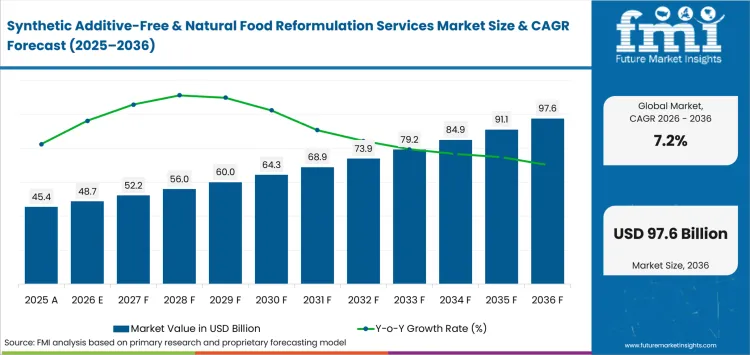
Key Takeaways of Synthetic Additive-Free & Natural Food Reformulation Services Market
- Regulatory color changes and cleaner-label specifications are expanding paid reformulation work across multi-product food and beverage portfolios.
- Based on service, additive removal is projected to account for 43.8% in 2026 due to targeted deletions that often expose linked color or flavor functions.
- Bakery is likely to capture 35.9% of application demand in 2026 attributable to heat exposure and shelf-life requirements that complicate natural replacement.
- Natural colors/flavors and preservative replacement remain follow-on service routes when additive removal changes sensory performance or shelf-life behavior during commercial validation.
- Sensory drift and shelf-life risk can extend validation cycles because natural replacements must perform across processing and storage conditions.
- Kerry, ADM, Ingredion, Sensient, dsm-firmenich, GNT, Corbion and IFF form the reconciled company set used across this article.
Analyst Perspective
"Natural-food reformulation should be priced against the functions a removed additive performs and the validation needed to replace them. Providers earn repeat work when one testing program moves related recipes from bench trials into documented plant production."
- Nandini Roy Choudhury, Principal Consultant, Future Market Insights
How is the Synthetic Additive-Free & Natural Food Reformulation Services Market segmented?
Service includes additive removal, natural colors/flavors and preservative replacement. Application includes bakery, snacks, beverages and dairy.
Service separates additive removal from natural colors/flavors and preservative replacement according to the reformulation task purchased from an external team. Application covers bakery, snacks, beverages and dairy because each category exposes replacement systems to different processing and shelf-life conditions during commercial validation.
What makes additive removal central to the service category?
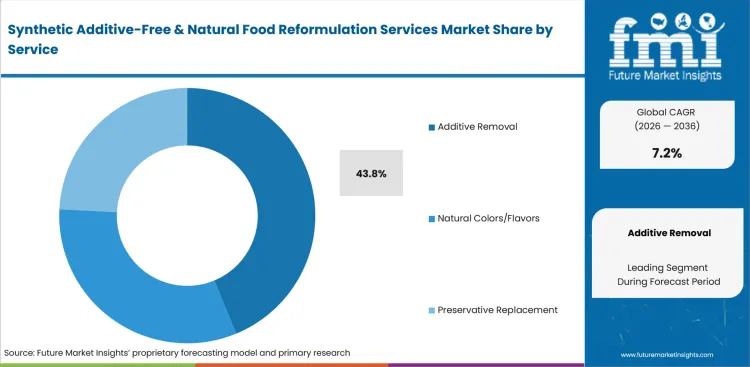
Additive removal starts with one named synthetic ingredient but the brief widens when that ingredient also carries sensory or processing functions that food colors or flavor alternatives must reproduce during production.
- Additive removal is projected to hold 43.8% share in 2026 owing to targeted deletions that often trigger wider formula rebuilding across established product families.
- ADM announced a USD 26 million Erlanger investment in January 2026 that expands naturally derived color and flavor capacity for reformulation programs. Its larger co-creation footprint gives food manufacturers more room to test linked sensory changes before commercial scale-up and repeat the validated approach across related recipes.
How do bakery manufacturers evaluate reformulation services within the application category?
Bakery reformulation combines heat exposure with microbial control and texture retention in one production route. Corbion introduced Verdad Essence WH100 in April 2025 with an enhanced model comparing natural mold-control performance across eleven mold types, giving bakery ingredients teams a direct way to test preservation risk before scale-up.
- The application category is forecast to be led by bakery at 35.9% share in 2026 due to repeated validation across processing and shelf-life conditions.
- Bakery development teams must also protect softness and handling after a synthetic additive leaves the recipe, so adoption depends on plant trials that confirm production behavior as well as finished-product quality.
What are the drivers, restraints and opportunities in the Synthetic Additive-Free & Natural Food Reformulation Services Market?
Regulatory color conversion expands portfolio work while sensory and shelf-life validation slows approval. Shared application infrastructure offers a route to larger multi-product reformulation programs.
- Driver: Time-bound color conversion and cleaner-label specifications place more established formulas into active reformulation programs across manufacturer portfolios.
- Restraint: Natural replacement can alter shade stability or microbial control and can also change taste or texture during commercial processing.
- Opportunity: Application laboratories and regulatory support let reformulation teams reuse proven testing logic across related product families and commercial production lines.
Regulatory Color Conversion Expands Portfolio Work
Regulatory deadlines become paid service work once food manufacturers must convert many established recipes within the same launch calendar. The FDA reported in July 2025 that Consumer Brands Association members had committed to remove six certified petroleum-based colors from product portfolios. Each color change can alter flavor perception and processing stability, so natural flavors specialists gain work when internal teams cannot validate every recipe in parallel.
Validation Burden Slows Natural Replacement
France's DGCCRF reported in April 2026 that more than half of 248 inspected prepared-food establishments had composition, labeling or claims anomalies, with corrective or legal follow-up applied in 20% of cases. The finding raises validation pressure for food preservatives because a replacement must satisfy declared composition rules while preserving the intended shelf life. Plant trials remain necessary when natural ingredients behave differently under heat or storage.
Shared Application Infrastructure Supports Multi-Product Programs
Shared application infrastructure lets technical teams compare sensory and shelf-life trade-offs across related recipes in one setting. dsm-firmenich opened the Van Marken Food Innovation Center in October 2025 with dedicated bakery and cheese application facilities, giving comparable providers a model for combining natural food preservatives expertise with portfolio-scale testing across related product families.
Which country CAGRs are profiled in the Synthetic Additive-Free & Natural Food Reformulation Services Market?
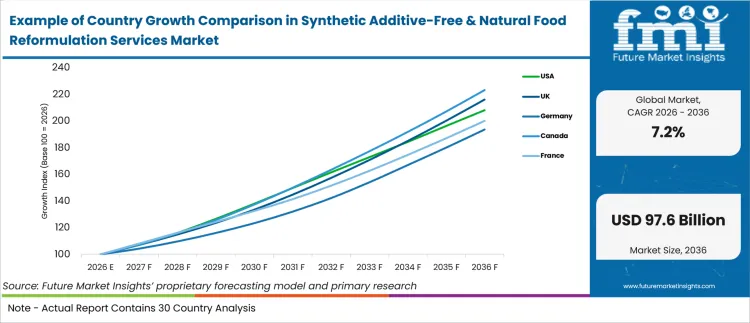
| Country | CAGR |
|---|---|
| Canada | 8.4% |
| UK | 8.0% |
| USA | 7.6% |
| France | 7.2% |
| Germany | 6.8% |
How do country-level CAGRs compare in the Synthetic Additive-Free & Natural Food Reformulation Services Market?
The 1.6 percentage-point range between Canada and Germany forms one compact band with Canada and the UK grouped above USA and France. Germany remains close enough that CAGR alone offers little guidance on entry priority. Regulatory conversion routes and local validation capacity explain more of the difference among these markets.
- Canada combines cross-border production with bilingual-label checks and permitted-color rules for retail.
- UK retail surveillance makes additive permissions and label verification part of packaged-food release decisions.
- USA color deadlines concentrate service work around shade conversion and plant validation across portfolios.
- France tests natural food flavors claims against formulation records during official aroma controls.
- Germany applies EU additive rules alongside clean-label starch qualification and national food-control sampling.
Similar rates therefore hide different approval workloads and service requirements. The full report provides country-level CAGR analysis across North America, Latin America, Europe, East Asia, South Asia, Oceania and the Middle East and Africa.
Country-wise Analysis
- American food manufacturers are converting certified synthetic colors across national portfolios while application laboratories test shade identity under heat and acidity plus shelf-life conditions before retailer approval across several high-volume packaged-food categories and major retail channels. Adoption of reformulation services in USA is estimated to expand at 7.6% CAGR through 2036, aided by the FDA's February 2026 authorization of six additional natural color options for food use. The wider color set broadens trial choices for brand teams, but botanical supply consistency and plant-scale stability still favor providers with domestic regulatory knowledge plus rapid shade-matching capacity across related recipes and production sites.
- UK food manufacturers face additive permissions and retailer label review as routine launch conditions, and the Food Standards Agency reported in 2025 that its 2024/25 surveillance program sampled 822 products across three UK nations. Reformulation service sales in the UK are forecast to expand at 8.0% CAGR by 2036, aided by a mature retail channel that makes formula and label validation part of the same release decision. Unauthorized ingredients or late labeling defects can delay conversion, so local food teams value providers combining UK compliance knowledge with application testing and production-ready documentation before a revised recipe enters national retail channels.
- German food manufacturers qualify natural replacements under harmonized European additive rules, while domestic quality teams must keep ingredient declarations aligned with the final formula during retailer and official review. Germany is estimated to post 6.8% CAGR over the forecast period, shaped by established ingredient laboratories and detailed retailer specifications that make documented reformulation work routine for larger branded portfolios. CVUA Stuttgart reported in January 2026 that more than one quarter of checked unpackaged foods had allergen or additive-labeling errors, so providers serving Germany need precise ingredient records and local label review alongside plant validation for natural color, flavor, or preservative changes.
- Canadian food manufacturers often retain one North American production platform, but they must separately confirm permitted color uses and bilingual ingredient declarations before a USA formula enters Canadian retail channels serving national grocery networks. By 2036 Canada is projected to grow at 8.4% CAGR, reinforced by cross-border manufacturing that makes shared reformulation work economical for brands selling related recipes in both countries and using common production assets. CFIA reported in September 2025 that 380 of 394 targeted food-color samples met Canadian requirements, yet remaining noncompliance keeps permitted-use checks and declarations central to local qualification before one formula can serve both markets.
- French reformulation programs often start with natural flavor claims, and technical teams must align source documentation with the finished recipe before national enforcement review or retailer approval across branded packaged-food ranges. DGCCRF reported in September 2025 that 31 of 136 aroma samples were non-compliant during national surveillance, making traceable flavor records central to defending naturality claims in packaged food products sold nationally. Synthetic additive-free and natural food reformulation service demand in France is forecast to rise at 7.2% CAGR over the forecast period, supported by specialist flavor expertise although inaccurate wording can still delay launch and require corrected consumer labeling.
Who are the notable companies in the Synthetic Additive-Free & Natural Food Reformulation Services Market?
Kerry, ADM, Ingredion, Sensient, dsm-firmenich, GNT, Corbion and IFF are the notable companies profiled in this market.
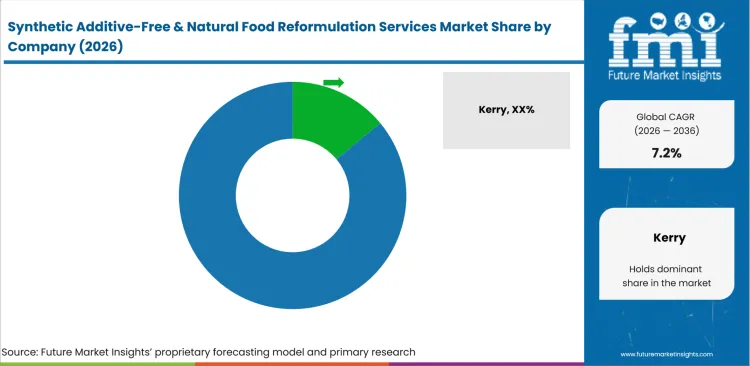
Competition remains fragmented because no single formulation house owns every function that a synthetic additive can perform. Integrated taste companies compete for multi-function briefs while color and preservation specialists win assignments requiring deeper shade or shelf-life expertise. Entry depends on application laboratories, regulatory files and dependable ingredient supply because a replacement must survive the client's production process before commercial approval.
- Integrated Reformulation and Taste Systems: Kerry, ADM, dsm-firmenich and IFF combine taste work with application support across categories.
- Natural Color Conversion Specialists: Sensient and GNT focus on plant-derived color systems that require shade matching and process-stability testing.
- Clean-Label Function and Preservation: Ingredion and Corbion address food texturing agents or microbial-control problems exposed after synthetic additive removal.
Competitive Benchmarking: Synthetic Additive-Free & Natural Food Reformulation Services Market
| Company | Reformulation Category Breadth | Sensory Replacement Breadth | Application Validation Depth | Geographic Reach |
|---|---|---|---|---|
| Kerry | High | High | High | Global |
| ADM | High | High | High | Global |
| Ingredion | High | Medium | High | Global |
| Sensient | High | High | High | North America, Europe and Asia Pacific |
| dsm-firmenich | High | High | High | Global |
| GNT | Medium | Medium | High | Europe, North America and Asia |
| Corbion | Medium | Medium | High | Global |
| IFF | High | High | High | Global |
Key Developments in the Synthetic Additive-Free & Natural Food Reformulation Services Market
- In March 2026, Sensient broke ground on a St. Louis expansion adding almost 29,000 square feet for natural-color processing and manufacturing. The scheduled project is intended to expand domestic processing for larger synthetic-to-natural color conversion programs.
- In February 2026, Kerry opened a Customer Co-Creation Center in Medellín serving bakery and snacks plus dairy and beverages. Local application teams connect testing and prototyping with regional commercial reformulation work.
- In June 2025, GNT launched EXBERRY Organics Brilliant Pink from purple sweet potatoes for food applications. Its heat and low-pH performance gives reformulation teams another plant-based route for demanding color conversions.
Key Players in the Synthetic Additive-Free & Natural Food Reformulation Services Market
Integrated Reformulation and Taste Systems
- Kerry
- ADM
- dsm-firmenich
- IFF
Natural Color Conversion Specialists
- Sensient
- GNT
Clean-Label Function and Preservation
- Ingredion
- Corbion
Synthetic Additive-Free & Natural Food Reformulation Services Market - Report Scope
| Coverage field | Report scope |
|---|---|
| Market breakdown | By service, application and region. |
| Quantitative Units | Revenue in USD billion and CAGR in %. |
| Market Definition | Contracted food and beverage reformulation services that remove synthetic additives or replace them with natural color, flavor and preservation systems while supporting formulation, validation, labeling and scale-up. |
| Regions Covered | North America, Latin America, Europe, East Asia, South Asia and Pacific, and Middle East and Africa. |
| Countries Covered | USA, UK, Germany, Canada, France, and 20+ countries included in the full report. |
| Key Companies Profiled | Kerry, ADM, Ingredion, Sensient, dsm-firmenich, GNT, Corbion, IFF. |
| Forecast Period | 2026 to 2036. |
| Approach | Primary and secondary research with market triangulation. |
Synthetic Additive-Free & Natural Food Reformulation Services Market - Research Methodology
| Method | Approach |
|---|---|
| Primary Research | FMI analysts gathered input from manufacturers, service providers, technology developers, distributors, end users, procurement teams, and subject-matter experts. Interviews examined purchasing decisions, product or service evaluation, adoption barriers, approval requirements, pricing considerations, and expectations for technical or commercial support. Respondents were also asked what evidence is required before a trial, pilot, or initial order develops into regular purchasing. |
| Desk Research | Desk research covered government statistics, regulatory publications, trade data, industry associations, technical literature, standards, company filings, product information, and official corporate announcements. Sources were reviewed for relevance, publication date, geographic coverage, and consistency with the defined market scope. Claims relating to performance, applications, approvals, capacity, investment, and commercial activity were retained only when supported by credible public evidence. |
| Market Sizing and Forecasting | The market model combined the baseline value with historical performance, segment structure, pricing and volume indicators, adoption levels, company participation, and country-level demand conditions. Forecast assumptions considered economic activity, investment trends, regulatory developments, technology adoption, purchasing cycles, supply availability, and barriers to wider market use. Segment and regional estimates were reconciled before the final market total was calculated. |
| Data Validation | Estimates were checked against multiple independent indicators, including public data, company activity, trade patterns, industry developments, and findings from primary interviews. Validation also tested whether products, services, applications, and company revenues fell within the defined market boundaries. Adjacent categories, unsupported claims, overlapping revenues, and activities without direct market relevance were excluded to reduce double counting and maintain consistency across segments and countries. |
Synthetic Additive-Free & Natural Food Reformulation Services Market by Segments
Synthetic Additive-Free & Natural Food Reformulation Services Market segmented by Service:
- Additive Removal
- Natural Colors/Flavors
- Preservative Replacement
Synthetic Additive-Free & Natural Food Reformulation Services Market segmented by Application:
- Bakery
- Snacks
- Beverages
- Dairy
Synthetic Additive-Free & Natural Food Reformulation Services Market by Region:
- North America
- United States
- Canada
- Latin America
- Brazil
- Mexico
- Chile
- Rest of Latin America
- Western Europe
- Germany
- United Kingdom
- Italy
- Spain
- France
- Nordics
- Benelux
- Rest of Western Europe
- Eastern Europe
- Russia
- Poland
- Hungary
- Balkan and Baltic States
- Rest of Eastern Europe
- East Asia
- China
- Japan
- South Korea
- South Asia and Pacific
- India
- ASEAN
- Australia and New Zealand
- Rest of South Asia and Pacific
- Middle East and Africa
- Kingdom of Saudi Arabia
- Other GCC Countries
- Türkiye
- South Africa
- Other African Union Countries
- Rest of Middle East and Africa
Research Sources and Bibliography
- USA Food and Drug Administration. (2025, January 15). FDA to Revoke Authorization for the Use of Red No. 3 in Food and Ingested Drugs.
- Food Standards Agency, Scarrett, A., Cooke, S., & Bachelor, J. (2026, July 2). Retail Surveillance Survey Sampling Programme 2025/26.
- ADM. (2026, January 15). ADM’s $26M Investment in Erlanger Facility Strengthens Capabilities for Growing Reformulation Demand.
- Corbion. (2025, April 21). Corbion Unveils Verdad® Essence WH100: Redefining Natural Mold Inhibition for Bakers.
- USA Food and Drug Administration. (2025, July 22). HHS, FDA Praise Consumer Brands Association’s Vow to Remove Artificial Colors from America’s Food Supply.
- Direction générale de la concurrence, de la consommation et de la répression des fraudes. (2026, April 9). Étiquetage, composition, allégations… attention aux étiquettes mensongères des plats cuisinés.
- dsm-firmenich. (2025, October 2). dsm-firmenich opens global food innovation center in Delft, the Netherlands to accelerate diet transformation.
- USA Food and Drug Administration. (2026, February 5). FDA Takes New Approach to “No Artificial Colors” Claims.
- Food Standards Agency, Scarrett, A., Cooke, S., & Bachelor, J. (2025, June 26). Retail Surveillance Sampling Programme 2024/25.
- Kielkopf, D. (2026, January 27). Allergen- und Zusatzstoffkennzeichnung bei unverpackten Lebensmitteln.
- Canadian Food Inspection Agency. (2025, September 15). Food colours in selected foods - April 1, 2023 to March 31, 2024.
- Direction générale de la concurrence, de la consommation et de la répression des fraudes. (2025, September 1). Étiquetage et composition : les arômes et denrées aromatisées sous surveillance.
- Kerry. (2026, March 19). Kerry publishes 2025 Annual Report: A year defined by impact, innovation and purpose.
- Archer-Daniels-Midland Company. (2026, February 17). Annual Report on Form 10-K for the fiscal year ended December 31, 2025.
- Ingredion Incorporated. (2026, July 6). Ingredion to Spotlight Next-Generation Solutions for Texture, Clean Labels and Positive Nutrition at IFT FIRST 2026.
- Sensient Technologies Corporation. (2026, February 13). Annual Report on Form 10-K for the year ended December 31, 2025.
- dsm-firmenich. (2026, February 20). Our markets - dsm-firmenich Integrated Annual Report 2025.
- GNT. (2025, August 12). From blue to brown and beyond: GNT to present plant-based EXBERRY® shades at Drinktec 2025.
- Corbion. (2025, September 2). Corbion leads clean-label reformulation forward at IBIE 2025.
- IFF. (2025, October 9). Product Reformulation: Navigating the Future of Food & Beverage.
- Sensient Technologies Corporation. (2026, March 23). Breaking Ground to Expand the World’s Leading Natural Color Manufacturing Network.
- Kerry. (2026, February 11). Kerry inaugurates its Customer Co-Creation Center in Medellín and boosts Collaborative Innovation in the Andean Region.
- GNT. (2025, June 23). GNT expands certified organic EXBERRY® color range with new vibrant pink.
- Corbion. (2026, June 15). Corbion launches LUMI™ Set to help bakers reformulate away from titanium dioxide without sacrificing visual appeal.
This bibliography is provided for reader reference and is not exhaustive. The full report contains the complete reference list and detailed citations
This Report Answers
- How does market value change between 2026 and 2036?
- Which regulatory changes are increasing portfolio reformulation assignments?
- Why does additive removal hold 43.8% service share?
- Why does bakery hold 35.9% application share?
- Which validation problems delay commercial reformulation?
- How do profiled countries differ in conversion conditions?
- Which companies cover color, taste and preservation work?
- Which capabilities determine qualification for reformulation programs?
Frequently Asked Questions
How big is the synthetic additive-free & natural food reformulation services market in 2026?
The synthetic additive-free & natural food reformulation services market is valued at USD 48.7 billion in 2026 and is projected to reach USD 97.6 billion by 2036. Growth is driven by cleaner-label initiatives and increasing demand for natural alternatives to synthetic additives.
What is the CAGR of the synthetic additive-free & natural food reformulation services market from 2026 to 2036?
The synthetic additive-free & natural food reformulation services market is projected to grow at a CAGR of 7.2% between 2026 and 2036. Expansion is supported by regulatory changes, natural ingredient adoption, and rising reformulation activity across food and beverage portfolios.
Which service is projected to account for 43.8% of the synthetic additive-free & natural food reformulation services market?
Additive removal is projected to account for 43.8% of the market in 2026. Its leading share is driven by growing efforts to eliminate synthetic ingredients while maintaining product quality, flavor, and functionality.
Which application is projected to account for 35.9% of the synthetic additive-free & natural food reformulation services market?
Bakery is projected to account for 35.9% of the market in 2026. Its dominance is supported by the complexity of replacing synthetic additives in products that require consistent texture, shelf life, and heat stability.
Which countries are expected to record the highest growth in the synthetic additive-free & natural food reformulation services market?
Canada is projected to grow at a CAGR of 8.4%, followed by the UK at 8.0% and the USA at 7.6% through 2036. Growth is supported by regulatory compliance requirements, clean-label trends, and increasing reformulation investments.
Which companies are active in the synthetic additive-free & natural food reformulation services market?
Key companies operating in the market include Kerry, ADM, Ingredion, Sensient, dsm-firmenich, GNT, Corbion, and IFF. These companies compete through reformulation expertise, natural ingredient portfolios, application support, and product validation capabilities.
Preview the report firsthand - request a free sample
Get SampleGet the brochure for pricing and purchase details.
Get PDFTable of Content
- Key Takeaways
- Market Size and CAGR
- Top Growth Driver
- Fastest Growing Segment
- Leading Region
- Key Companies
- Emerging Opportunities
- Executive Summary
- Global Market Outlook
- Demand-side Trends
- Supply-side Trends
- Technology Roadmap Analysis
- Analysis and Recommendations
- Analyst Perspective (What is happening? Why now? What should investors know?)
- Key Questions Answered
- How large is the market?
- What is the CAGR?
- What are key trends?
- Which region dominates?
- Who are the leaders?
- Market Overview
- Market Coverage / Taxonomy
- Market Definition / Scope / Limitations
- Research Methodology
- Chapter Orientation
- Analytical Lens and Working Hypotheses
- Market Structure, Signals, and Trend Drivers
- Benchmarking and Cross-market Comparability
- Market Sizing, Forecasting, and Opportunity Mapping
- Research Design and Evidence Framework
- Desk Research Programme (Secondary Evidence)
- Expert Input and Fieldwork (Primary Evidence)
- Tooling, Models, and Reference Databases
- Data Engineering and Model Build
- Quality Assurance and Audit Trail
- Market Background
- Market Dynamics (Drivers, Restraints, Opportunity, Trends)
- Scenario Forecast (Optimistic, Likely, Conservative)
- Impact Analysis
- AI Impact
- Sustainability Impact
- Regulatory Impact
- Technology Impact
- Consumer / Buyer Analysis
- Purchase Drivers
- Adoption Barriers
- Buyer Journey
- Opportunity Map Analysis
- Product Life Cycle Analysis
- Supply Chain Analysis
- Investment Feasibility Matrix
- Value Chain Analysis
- PESTLE and Porter's Analysis
- Regulatory Landscape
- Regional Parent Market Outlook
- Production and Consumption Statistics
- Import and Export Statistics
- Global Market Analysis and Forecast, 2021 to 2036
- Historical Market Size Value (USD Billion) Analysis, 2021 to 2025
- Current and Future Market Size Value (USD Billion) Projections, 2026 to 2036
- Y-o-Y Growth Trend Analysis
- Absolute $ Opportunity Analysis
- Global Market Pricing Analysis, 2021 to 2036
- Global Market Analysis and Forecast, By Service, 2021 to 2036
- Introduction / Key Findings
- Historical Market Size Value (USD Billion) Analysis By Service, 2021 to 2025
- Current and Future Market Size Value (USD Billion) Analysis and Forecast By Service, 2026 to 2036
- Additive Removal
- Natural Colors/Flavors
- Preservative Replacement
- Additive Removal
- Y-o-Y Growth Trend Analysis By Service, 2021 to 2025
- Absolute $ Opportunity Analysis By Service, 2026 to 2036
- Global Market Analysis and Forecast, By Application, 2021 to 2036
- Introduction / Key Findings
- Historical Market Size Value (USD Billion) Analysis By Application, 2021 to 2025
- Current and Future Market Size Value (USD Billion) Analysis and Forecast By Application, 2026 to 2036
- Bakery
- Snacks
- Beverages
- Dairy
- Bakery
- Y-o-Y Growth Trend Analysis By Application, 2021 to 2025
- Absolute $ Opportunity Analysis By Application, 2026 to 2036
- Global Market Analysis and Forecast, By Region, 2021 to 2036
- Introduction
- Historical Market Size Value (USD Billion) Analysis By Region, 2021 to 2025
- Current Market Size Value (USD Billion) Analysis and Forecast By Region, 2026 to 2036
- North America
- Latin America
- Western Europe
- Eastern Europe
- East Asia
- South Asia and Pacific
- Middle East & Africa
- Market Attractiveness Analysis By Region
- North America Market Analysis and Forecast, By Country, 2021 to 2036
- Historical Market Size Value (USD Billion) Trend Analysis By Market Taxonomy, 2021 to 2025
- Market Size Value (USD Billion) Forecast By Market Taxonomy, 2026 to 2036
- By Country
- USA
- Canada
- By Service
- By Application
- By Country
- Market Attractiveness Analysis
- By Country
- By Service
- By Application
- Key Takeaways
- Latin America Market Analysis and Forecast, By Country
- Historical Market Size Value (USD Billion) Trend Analysis By Market Taxonomy, 2021 to 2025
- Market Size Value (USD Billion) Forecast By Market Taxonomy, 2026 to 2036
- By Country
- Brazil
- Mexico
- Chile
- Rest of Latin America
- By Service
- By Application
- By Country
- Market Attractiveness Analysis
- By Country
- By Service
- By Application
- Key Takeaways
- Western Europe Market Analysis and Forecast, By Country
- Historical Market Size Value (USD Billion) Trend Analysis By Market Taxonomy, 2021 to 2025
- Market Size Value (USD Billion) Forecast By Market Taxonomy, 2026 to 2036
- By Country
- Germany
- UK
- Italy
- Spain
- France
- Nordic
- BENELUX
- Rest of Western Europe
- By Service
- By Application
- By Country
- Market Attractiveness Analysis
- By Country
- By Service
- By Application
- Key Takeaways
- Eastern Europe Market Analysis and Forecast, By Country
- Historical Market Size Value (USD Billion) Trend Analysis By Market Taxonomy, 2021 to 2025
- Market Size Value (USD Billion) Forecast By Market Taxonomy, 2026 to 2036
- By Country
- Russia
- Poland
- Hungary
- Balkan & Baltic
- Rest of Eastern Europe
- By Service
- By Application
- By Country
- Market Attractiveness Analysis
- By Country
- By Service
- By Application
- Key Takeaways
- East Asia Market Analysis and Forecast, By Country
- Historical Market Size Value (USD Billion) Trend Analysis By Market Taxonomy, 2021 to 2025
- Market Size Value (USD Billion) Forecast By Market Taxonomy, 2026 to 2036
- By Country
- China
- Japan
- South Korea
- By Service
- By Application
- By Country
- Market Attractiveness Analysis
- By Country
- By Service
- By Application
- Key Takeaways
- South Asia and Pacific Market Analysis and Forecast, By Country
- Historical Market Size Value (USD Billion) Trend Analysis By Market Taxonomy, 2021 to 2025
- Market Size Value (USD Billion) Forecast By Market Taxonomy, 2026 to 2036
- By Country
- India
- ASEAN
- Australia & New Zealand
- Rest of South Asia and Pacific
- By Service
- By Application
- By Country
- Market Attractiveness Analysis
- By Country
- By Service
- By Application
- Key Takeaways
- Middle East & Africa Market Analysis and Forecast, By Country
- Historical Market Size Value (USD Billion) Trend Analysis By Market Taxonomy, 2021 to 2025
- Market Size Value (USD Billion) Forecast By Market Taxonomy, 2026 to 2036
- By Country
- Kingdom of Saudi Arabia
- Other GCC Countries
- Türkiye
- South Africa
- Other African Union
- Rest of Middle East & Africa
- By Service
- By Application
- By Country
- Market Attractiveness Analysis
- By Country
- By Service
- By Application
- Key Takeaways
- Key Countries Market Analysis
- USA
- Pricing Analysis
- Market Share Analysis, 2025
- By Service
- By Application
- Canada
- Pricing Analysis
- Market Share Analysis, 2025
- By Service
- By Application
- Mexico
- Pricing Analysis
- Market Share Analysis, 2025
- By Service
- By Application
- Brazil
- Pricing Analysis
- Market Share Analysis, 2025
- By Service
- By Application
- Chile
- Pricing Analysis
- Market Share Analysis, 2025
- By Service
- By Application
- Germany
- Pricing Analysis
- Market Share Analysis, 2025
- By Service
- By Application
- UK
- Pricing Analysis
- Market Share Analysis, 2025
- By Service
- By Application
- Italy
- Pricing Analysis
- Market Share Analysis, 2025
- By Service
- By Application
- Spain
- Pricing Analysis
- Market Share Analysis, 2025
- By Service
- By Application
- France
- Pricing Analysis
- Market Share Analysis, 2025
- By Service
- By Application
- India
- Pricing Analysis
- Market Share Analysis, 2025
- By Service
- By Application
- ASEAN
- Pricing Analysis
- Market Share Analysis, 2025
- By Service
- By Application
- Australia & New Zealand
- Pricing Analysis
- Market Share Analysis, 2025
- By Service
- By Application
- China
- Pricing Analysis
- Market Share Analysis, 2025
- By Service
- By Application
- Japan
- Pricing Analysis
- Market Share Analysis, 2025
- By Service
- By Application
- South Korea
- Pricing Analysis
- Market Share Analysis, 2025
- By Service
- By Application
- Russia
- Pricing Analysis
- Market Share Analysis, 2025
- By Service
- By Application
- Poland
- Pricing Analysis
- Market Share Analysis, 2025
- By Service
- By Application
- Hungary
- Pricing Analysis
- Market Share Analysis, 2025
- By Service
- By Application
- Kingdom of Saudi Arabia
- Pricing Analysis
- Market Share Analysis, 2025
- By Service
- By Application
- Türkiye
- Pricing Analysis
- Market Share Analysis, 2025
- By Service
- By Application
- South Africa
- Pricing Analysis
- Market Share Analysis, 2025
- By Service
- By Application
- USA
- Market Structure Analysis
- Competition Dashboard
- Competition Benchmarking
- Market Share Analysis of Top Players
- By Regional
- By Service
- By Application
- Emerging Startups
- Innovation Benchmarking
- Competition Analysis
- Competition Deep Dive
- Kerry
- Overview
- Product Portfolio
- Profitability by Market Segments
- Sales Footprint
- Strategy Overview
- Marketing Strategy
- Product Strategy
- Channel Strategy
- ADM
- Ingredion
- Sensient
- dsm-firmenich
- GNT
- Corbion
- Kerry
- Case Studies
- Success Stories
- Recent Developments
- Competition Deep Dive
- Assumptions & Acronyms Used


