


- EV battery growth is not lifting every Tier supplier equally.
- Winners are suppliers tied to battery thermal management, power electronics, BMS, high-voltage systems, pack safety, lightweighting, battery enclosures, and recycling.
- Losers are suppliers overexposed to legacy engine, exhaust, fuel, and conventional transmission systems.
- Consolidation risk is rising because battery and electrification suppliers need high capital investment before stable returns are proven.
- Capability gaps are largest in localized battery manufacturing, production yield, thermal safety, software integration, and supply-chain traceability.
- The biggest misconception is that all EV suppliers benefit from EV adoption. Only suppliers with scarce, scalable, and defensible capabilities are positioned to gain.
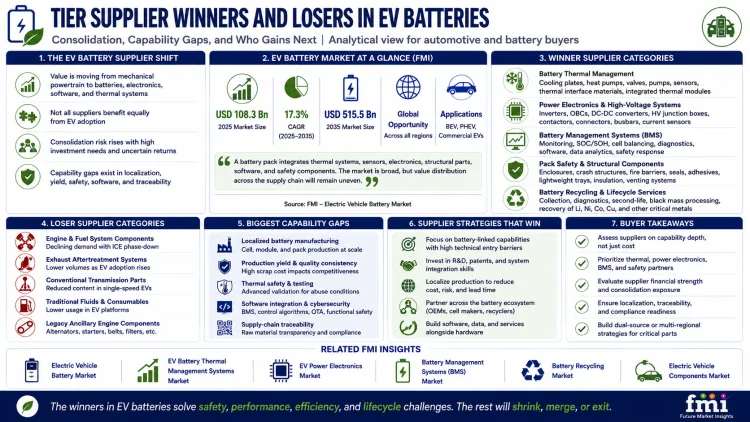
The EV battery transition is changing the supplier map. It is not simply replacing one set of parts with another. It is shifting value from mechanical powertrain systems toward battery packs, power electronics, software, high-voltage safety, cooling, lightweight structures, charging hardware, and lifecycle services. This creates clear winners and losers across the Tier supplier base.
The winners are suppliers that solve battery-linked problems. The losers are suppliers whose content declines as internal combustion engines lose share. Between these two groups sits a large middle market of suppliers trying to reposition, acquire capability, or defend relevance through partnerships. This is where consolidation risk is rising.
FMI’s Electric Vehicle Battery Market is relevant because battery demand cuts across vehicle type, battery capacity, propulsion type, chemistry, sales channel, and geography. That means supplier opportunities are not limited to cell makers. rephrase this - " A battery pack requires thermal systems, sensors, electronics, structural parts, connectors, busbars, insulation, sealing, adhesives, safety devices, software, and service support. The market is broad, but the value will not be distributed evenly. Battery thermal management is one of the clearest winner categories. EV batteries must operate within controlled temperature limits during fast charging, high-speed driving, heavy loads, cold starts, and long warranty periods. A battery that overheats loses performance and creates safety risk. A battery that runs too cold can lose range and charging efficiency. This creates demand for cooling plates, heat pumps, refrigerant circuits, thermal interface materials, valves, sensors, pumps, and integrated thermal modules."
The battery pack assembly integrates a wide range of components including thermal systems, sensors, structural parts, and specialized software. While this creates a broad market opportunity, value distribution across the supply chain will likely remain uneven. Battery thermal management stands out as a primary growth category because electric vehicle batteries require precise temperature control during fast charging, heavy loading, and extreme weather conditions. Excessive heat compromises performance and safety, while extreme cold reduces driving range and charging speed. This technical necessity drives sustained demand for cooling plates, heat pumps, sensors, and integrated thermal modules.
Thermal suppliers are especially important because EVs have changed the role of heat inside the vehicle. Internal combustion engines produced waste heat that could be used for cabin heating. EVs must manage cabin comfort and battery temperature differently. This makes heat pumps, integrated thermal circuits, and smart control systems more valuable. Suppliers that can combine battery cooling, cabin heating, and electronics thermal control are better positioned than suppliers offering isolated components.
Power electronics suppliers are another winner group. EVs require inverters, onboard chargers, DC-DC converters, high-voltage junction boxes, battery disconnect units, current sensors, busbars, contactors, and high-voltage connectors. These systems influence vehicle efficiency, charging behavior, safety, packaging, and reliability. Suppliers that understand high-voltage design and can support silicon carbide adoption, compact packaging, electromagnetic compatibility, and automotive-grade validation will be difficult to replace.
Battery management system suppliers also gain importance. A BMS is not only a monitoring device. It helps manage state of charge, state of health, cell balancing, thermal behavior, fault detection, safety response, and battery life. As EV fleets age, BMS quality will influence warranty cost, resale value, insurance assessment, and fleet uptime. This shifts value toward electronics, software, data analytics, and diagnostics.
Pack safety and structural suppliers also gain. Battery enclosures, crash structures, venting systems, fire barriers, thermal runaway mitigation materials, seals, adhesives, and lightweight trays are becoming strategic. Automakers want lighter packs, lower cost, better safety, and easier assembly. That creates opportunities for suppliers in aluminum structures, composite materials, engineered plastics, insulation, specialty coatings, and fastening systems. These are not always high-visibility components, but they are essential to pack safety and manufacturability.
Recycling-linked suppliers are another group to watch. Battery recycling connects raw material security, environmental compliance, end-of-life management, and future supply-chain resilience. Recycling is still developing unevenly across regions, but OEMs and battery makers increasingly need partners that can handle collection, diagnostics, second-life assessment, black mass processing, and recovery of lithium, nickel, cobalt, copper, and other materials. Suppliers connected to closed-loop systems can become more strategic as battery volumes rise.
Identifying vulnerable suppliers is relatively simple, but managing their transition is a complex undertaking. Companies specializing in internal combustion engines, exhaust systems, and fuel delivery face a sharp decline in component value within the battery electric vehicle market. Although some firms may pivot toward hybrid technology or thermal management, this shift is rarely seamless. Expertise in traditional fuel systems does not easily transfer to the specialized requirements of battery production. EV programs operate with distinct engineering standards, software needs, and capital requirements that differ fundamentally from legacy automotive manufacturing.
The most exposed suppliers are those with narrow portfolios and high customer concentration. If a supplier depends on one legacy system, one OEM, or one regional platform, EV transition can create sudden volume risk. This is why consolidation is likely to continue. Larger suppliers may buy capability. Smaller suppliers may merge to survive. Some suppliers may exit low-margin lines. Others may move from automotive into adjacent battery energy storage, charging, or industrial electrification applications.
Capital intensity is one reason consolidation risk is rising. EV battery-related suppliers need to invest ahead of revenue. They must fund plants, tooling, automation, testing, software teams, safety validation, and quality systems. If an OEM delays a platform, reduces volume, or changes chemistry, the supplier may be left with underused assets. This risk is higher in areas tied to battery localization because new regional supply chains take time to mature.
IEA data shows why localization is both an opportunity and a challenge. China accounted for 60% of EV battery deployment in 2025 and more than 80% of global battery manufacturing capacity. For Europe and North America, this creates a strategic need to localize battery ecosystems. Yet localization requires more than announcing factories. It requires technological expertise, process yield, supplier clusters, permitting, energy access, material flow, and stable OEM demand. Suppliers with proven scale and technical know-how will benefit, while underprepared entrants may struggle.
European region offers a clear perspective at how the transition is unfolding in practice. Data from ACEA shows that battery electric vehicles hit a 17.4% market share in the EU in 2025. This trend definitely boosts the demand for EV components, yet the persistent strength of hybrids indicates that the shift isn't a straight line toward pure electric models. Suppliers might find more success by investing in thermal systems, power electronics, and flexible manufacturing rather than focusing narrowly on just one type of powertrain.
Valeo is an example of how a major supplier is repositioning around electrification-adjacent capabilities. Its 2025 results showed sales of EUR 20.9 billion, order intake of EUR 24.6 billion, operating margin of 4.7%, and a first Battery Energy Storage System contract worth USD 225 million. The BESS contract matters because it shows how automotive thermal, electronics, and power-management capabilities can extend into adjacent battery markets. For Tier suppliers, this kind of adjacency can reduce dependence on uncertain vehicle-program timing.
The industry currently faces several distinct capability gaps that complicate the transition. A primary challenge is the lack of specialized labor in many regions to support large-scale battery manufacturing. New facilities also face significant hurdles as they work to stabilize production yields over time. Suppliers with a legacy in hardware manufacturing are finding the shift toward software integration particularly difficult. Meanwhile, safety expectations for battery systems are increasing at a rate that outpaces the adaptation capabilities of some firms. Finally, the growing complexity of international material sourcing has led to much more demanding requirements for traceability and regulatory compliance.
Supplier winners will be those that reduce OEM pain points. OEMs want lower battery cost, safer packs, shorter development cycles, flexible chemistry support, local sourcing, and fewer integration failures. Suppliers that can offer tested modules, validated systems, design support, and manufacturing discipline will win more durable contracts. Suppliers that only offer capacity without capability will face price pressure.
It cannot be concluded that the growth of electric vehicles will lift the entire automotive supply chain. Instead, this transition creates new value pools while simultaneously eroding others. Companies specializing in battery cooling systems are positioned to gain more content per vehicle, but those tied to traditional exhaust systems face a significant loss of business. In the same way, software diagnostic firms are seeing their importance grow, whereas suppliers of basic mechanical hardware are facing intense pressure on their margins.
Bottom line: Tier supplier winners will be thermal management, power electronics, BMS, high-voltage systems, pack safety, battery enclosures, lightweighting, and recycling-linked players. Losers will be legacy powertrain suppliers and under-scaled EV entrants that cannot fund the capability jump. The next phase of the EV battery market will reward suppliers that bring real technical depth, not just EV branding.

