


- Traditional reference weather stations remain essential where observations support forecasting, aviation, research, regulatory reporting, climate records, and public warnings.
- IoT-connected sensors are expanding the density and frequency of local weather measurement, particularly in agriculture, cities, industrial sites, renewable plants, and distributed environmental monitoring.
- The market is not moving from one model to another in a simple replacement cycle. It is moving toward layered observing networks.
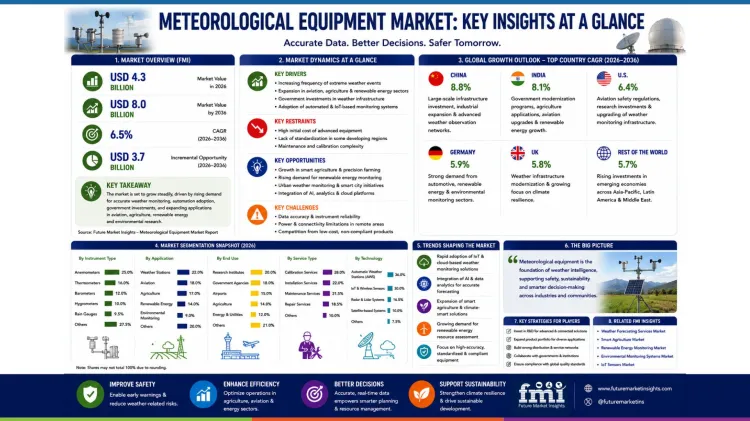
- FMI projects the meteorological equipment market to grow from USD 4.3 billion in 2026 to USD 8.0 billion by 2036 at a 6.5% CAGR.
- Anemometers account for 25.0% of instrument demand in 2026, reflecting the persistent need for wind data across weather, aviation, industry, and renewable energy applications.
- The winning monitoring model appears to combine certified reference stations with distributed connected sensors that expand local visibility.
Meteorological monitoring is becoming more connected, more distributed, and more application-specific. That does not make the conventional weather station irrelevant. The opposite holds true in many critical use cases. As more sensors are deployed, the need for reliable reference measurements, calibration, siting discipline, and standardized data becomes more important.
From an analyst standpoint, the market is not splitting neatly between traditional stations and IoT sensors. It is evolving into a layered system where each model performs a different role.
FMI estimates that the meteorological equipment market will increase from USD 4.3 billion in 2026 to USD 8.0 billion by 2036, expanding at a 6.5% CAGR. Anemometers are expected to account for 25.0% of instrument demand in 2026, while research institutes represent 20.0% of end-use demand. The report also points to rising procurement of specification-compliant instruments, tighter quality standards, and demand from industrial and institutional buyers.
The first distinction is between the station itself and the way its data is connected. A traditional meteorological station may be manually observed, automated, or semi-automated. An IoT sensor may measure the same parameter, such as temperature, humidity, pressure, wind speed, rainfall, or solar radiation, but transmit data through wireless networks, cloud dashboards, mobile networks, satellite links, or local gateways.
The question is not whether one sensor is more modern than another. The more useful question is whether the data is accurate enough, calibrated properly, positioned correctly, maintained consistently, and suitable for the decision being made.
For public weather services, climate records, aviation operations, and formal warning systems, the reference station model remains central. The WMO Guide to Instruments and Methods of Observation covers automatic weather stations, aeronautical observations, road meteorology, urban measurements, remote sensing, calibration, intercomparison, quality management, and data reduction. This scope reflects the fact that automated systems are not informal add-ons. They form part of formal meteorological observing infrastructure when they meet the required standards.
Reference stations generally hold several characteristics that low-cost distributed sensors may lack. They are installed in controlled locations, follow established siting principles, use validated instruments, undergo calibration, and are maintained through defined procedures. These measures matter because weather data can be distorted by buildings, local heat sources, vegetation, poor airflow, reflective surfaces, shading, vibration, or inconsistent sensor placement.
The WMO siting classification for land-based surface observing stations is published as a common ISO and WMO framework. That serves as a useful reminder that the quality of observation depends not only on the sensor, but also on where and how it is installed.
This is where traditional and IoT models begin to diverge.
A reference-grade station may be installed at an airport, national weather observatory, research site, agricultural research centre, hydrological basin, coastal station, or climate-monitoring location. It may operate for many years and feed data into national systems, aviation weather products, climate databases, forecasts, or regulatory reports. Such stations carry comparatively high cost, yet their value is measured through reliability, traceability, and long-term comparability.
IoT sensors are often deployed where data density matters more than a single official reference record. A farm operator may want weather data from several plots, not one station located many kilometres away. A city authority may want local rainfall, temperature, heat stress, wind, and air-quality context across multiple neighbourhoods. A solar developer may want irradiance and temperature data across a project location. A logistics operator may want route-specific weather alerts. An industrial facility may need local wind and atmospheric information for safety decisions.
In these settings, the IoT model creates a scale advantage. Hundreds of lower-cost sensor nodes can be installed across an area where building a full reference network would be costly. The result is better spatial resolution, more localized alerts, and faster access to field-level conditions.
The practical limitation is data quality. A sensor network can produce many measurements, but more measurements do not automatically mean better decisions. Sensors may drift, lose communication, suffer battery failure, become contaminated, or operate outside their intended accuracy range. Data from several sensors may also prove inconsistent if their siting and calibration differ.
This is why the strongest meteorological monitoring architecture is likely to use a reference network as the quality anchor and connected sensors as the density layer.
The WMO 2026 explanation of the global observing system captures this idea. It notes that surface observations from automatic weather stations and human observers are recorded and transmitted across a coordinated network that includes approximately 16,300 surface land meteorological stations, of which around 9,000 are part of the Global Basic Observing Network.
The growth of IoT does not reduce the value of these formal networks. It expands the number of use cases that can benefit from meteorological data.
Agriculture is a strong example. Farmers increasingly need field-specific information on rainfall, temperature, humidity, wind, soil moisture, evapotranspiration, disease conditions, frost risk, and irrigation timing. A centrally located weather station may provide broad regional guidance. A connected agricultural sensor network can support decisions at plot or farm level.
The WMO agrometeorological work includes guidance and technical material on automatic weather stations for agricultural applications, showing that automated field observation has become a recognized part of agricultural data infrastructure.
Urban monitoring is another area where IoT sensors are likely to gain. Cities experience local variation in rainfall intensity, heat, wind, and flooding risk. A dense network of connected sensors can provide real-time inputs for flood alerts, traffic management, emergency response, urban heat planning, and public communication. IMD states that it provides real-time rainfall and rainfall intensity information through dense AWS and automatic rain-gauge networks in major Indian cities, while expanding coverage to additional urban areas.
Renewable energy sites represent a third growth area. Wind farms need reliable wind speed and direction data. Solar projects need irradiance, temperature, soiling, and atmospheric conditions. Green hydrogen projects, hybrid renewable systems, and energy-storage planning also benefit from site-specific resource data. The requirement is not simply more sensors. It is dependable measurement that supports project design, operations, forecasting, and asset performance.
In this category, IoT connectivity adds clear value because renewable assets are often geographically dispersed. A project operator may want real-time data from multiple points across a wind or solar site, linked to a central operational dashboard. The reference-grade station still matters, particularly for resource assessment and long-term project validation. Lower-cost connected nodes can then support operational monitoring.
Aviation is the clearest example of where formal observing systems retain priority. ICAO-related material on automatic weather observing systems identifies instruments such as anemometers, ceilometers, transmissometers, pressure sensors, temperature sensors, and humidity systems as part of automated aviation weather infrastructure. Such systems support wind measurement, cloud-base detection, visibility assessment, runway visual range, and atmospheric conditions needed for safe flight operations.
A consumer-grade IoT sensor cannot simply substitute for an aviation weather system because aviation requires controlled siting, reliable communications, operational availability, and standardized reporting. The operating consequence of poor data is too high.
This explains why IoT sensors will probably gain fastest in supplementary, distributed, and application-specific monitoring. They are not likely to replace formal weather stations in aviation, national forecasting, climate science, or regulated environmental observation.
The business implications carry weight for suppliers.
Manufacturers of reference-grade systems need to compete on accuracy, calibration, reliability, global service, data integration, and compliance support. These buyers are often public agencies, research institutes, airports, renewable developers, industrial groups, and national weather services. The sales cycle may run long, and the equipment relationship can also run long-term.
IoT-focused suppliers can compete through affordability, wireless connectivity, ease of installation, cloud platforms, dashboards, API access, remote maintenance, and sector-specific applications. Their advantage lies in deployment scale. Their challenge lies in proving that the data is trustworthy enough for the intended use.
The market will likely reward suppliers that can bridge the two worlds. A company that sells a reference-grade automatic weather station, offers lower-cost sensor nodes for distributed monitoring, and provides a unified cloud platform can address both official and operational buyers. This approach is more resilient than positioning the market as a binary choice.
The conclusion is not that IoT sensors are winning over traditional weather stations. They are winning where local density, fast deployment, and remote monitoring matter most. Traditional stations remain the backbone where accuracy, comparability, certification, and long-term records are essential.
Meteorological monitoring is becoming a networked ecosystem. Reference stations provide trust. IoT sensors provide reach. The most effective model combines both.

