


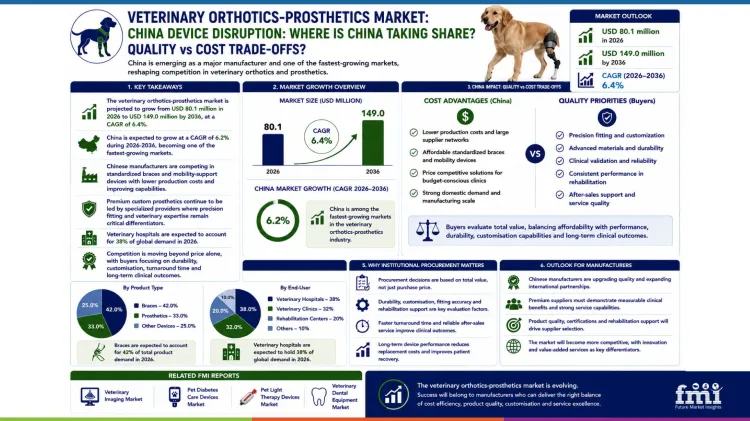
- The veterinary orthotics-prosthetics market is projected to grow from USD 80.1 million in 2026 to USD 149.0 million by 2036, at a CAGR of 6.4% during the forecast period.
- China is emerging as one of the fastest-growing markets in the industry, expected to grow at a CAGR of 6.2% during the forecast period 2026-2036, owing to growing veterinary infrastructure and rising spending on pet healthcare.
- Chinese manufacturers are increasingly competing in standardized braces and mobility-support devices, using lower production costs and improving manufacturing capabilities.
- Premium custom prosthetics continue to be concentrated among specialized providers where precision fitting, advanced materials and veterinary expertise are still critical differentiators.
- Institutional procurement decisions are becoming increasingly important for the competitiveness of suppliers, with veterinary hospitals expected to account for 38% of global demand by 2026.
- The competition is starting to move beyond price alone, with buyers increasingly looking at durability, customisation capabilities, turnaround times and long-term clinical outcomes.
The veterinary orthotics-prosthetics market is entering an era of greater competitive pressure as Chinese manufacturers increase their footprint in the animal mobility and rehabilitation solutions. Historically, the specialty providers who design custom braces, prosthetics and rehabilitation devices have catered to the market. But changing manufacturing capabilities in China is gradually changing pricing dynamics and procurement behavior.
The market is predicted to touch USD 149.0 million in 2036 from USD 80.1 million in 2026 offering ample opportunities for both existing and new players. As demand grows, competitive intensity is expected to increase across various product segments.
Much of China’s growing influence comes from its cost competitiveness.
Manufacturers in the Chinese medical device ecosystem are leveraging large supplier networks, lower manufacturing costs and increasing expertise in precision fabrication technologies. These advantages enable Chinese suppliers to provide veterinary braces and support devices at prices that are often hard to compete with for smaller specialized manufacturers.
The effects are most pronounced in the case of standardized orthotic products.
Braces are expected to account for 42% of the total demand for products in 2026 and will be the largest product category in the market. Chinese manufacturers are increasingly bringing standardized support braces used for ligament injuries, joint instability, arthritis management and post-surgical rehabilitation into price competition.
For veterinary hospitals and rehabilitation centers working within a budget, the lower-cost options may be appealing, especially for common orthopedic issues.
When custom prosthetic solutions are taken into account the competitive environment is more complex.
Prosthetics are usually custom designed, fitted, analyzed for gait and adjusted over time. This is very different from braces, which are more standard. Clinical success means not only quality manufacturing but also veterinary know-how and rehabilitation support. These factors create barriers to direct substitution on the basis of price alone.
Therefore, premium providers continue to have advantages in highly customized applications.
The quality-vs-cost debate is becoming increasingly relevant in the procurement conversations.
Total value is what institutional buyers are increasingly looking at instead of just purchase price. In 2026, veterinary hospitals are forecast to account for 38% of market demand. The longevity of the device, the quality of the material, the fit and the support after the sale all affect the end results and satisfaction of the owner.
A cheaper device may result in a lower initial outlay, but may lead to higher adjustment costs, the need for replacement, or difficulties in rehabilitation if the clinical performance is not consistent.
This is why procurement teams are turning to more sophisticated evaluation frameworks.
Chinese suppliers are improving quality, investing in advanced fabrication technologies and broadening distribution partnerships in response to these expectations. This evolution is closing the historical quality gap between low-cost manufacturers and premium players.
The result is a more competitive marketplace where differentiation depends increasingly on service capabilities rather than manufacturing cost alone.
China’s importance is evident in regional growth patterns.
Among the major national markets, China is expected to grow at a 6.2% CAGR through 2036, outpacing growth in several mature markets. Increasing pet ownership, rising disposable income and growing acceptance of advanced veterinary care are driving strong domestic demand for orthopedic and rehabilitation solutions.
The expanding domestic market gives Chinese manufacturers scale advantages that can support efforts to expand internationally.
At the same time, the veterinary professionals are still cautious about product selection.
Orthotic and prosthetic devices have a direct impact on animal mobility, recovery outcomes and quality of life. So veterinarians are more interested in clinical performance and reliability than in cost alone. Poor support or durability of a device may have negative consequences for rehabilitation outcomes and increase the long-term costs of treatment.
Manufacturers are therefore under pressure to demonstrate measurable value.
Product quality certifications, clinical validation, customization possibilities and rehabilitation support services are becoming more and more important competitive tools. Companies that are able to combine cost efficiency with good clinical performance will likely be the most successful in gaining market share.
The mistake is to think that China is only competing on price.
In fact, the very nature of competition is shifting toward a balance between affordability and quality. Cost advantages remain important, but sustained market share gains increasingly require the ability to satisfy veterinary clinical expectations and provide consistent results.
Bottom Line
China is becoming a more important player in the veterinary orthotics-prosthetics space, especially in the standardized brace segments where manufacturing efficiency can lead to competitive pricing. But over the long term, success will be in balancing cost advantages with quality, customization and clinical reliability as veterinary providers focus more on patient outcomes and value over the life cycle.

