

- Industry Size (2026)
- USD 389.8 Mn
- Forecast (2036)
- USD 694.5 Mn
- CAGR (2026 to 2036)
- 5.9%
Veterinary Dental Equipment Market Size, Market Forecast and Outlook By FMI
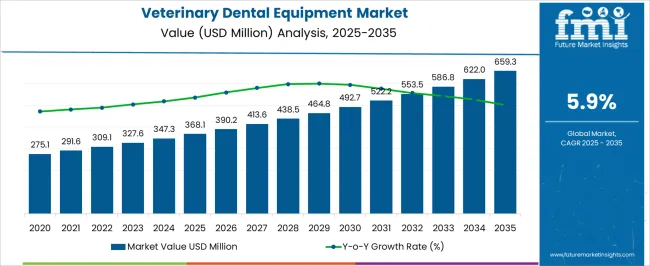
In 2025, the veterinary dental equipment market was valued at USD 368.1 million. Based on Future Market Insights' analysis, demand for veterinary dental equipment is estimated to grow to USD 389.8 million in 2026 and USD 694.5 million by 2036. FMI projects a CAGR of 5.9% during the forecast period.
An absolute dollar growth of USD 304.7 million between 2026 and 2036 reflects a structural shift from basic hand instruments toward integrated dental suites comprising high-speed drills, digital radiography systems, and specialised consumables for companion animal dentistry. Growth depends on the conversion of general practice veterinary clinics into dental-capable facilities offering prophylaxis, periodontics, and endodontics rather than simple extractions, and on the expansion of dedicated veterinary dental training programs that create practitioner confidence in performing advanced procedures.
In June 2025, iM3, a leading veterinary dental equipment manufacturer, inaugurated its dedicated education center named iM3 ACE in Ireland. The facility is designed to facilitate hands-on training for veterinary professionals worldwide, offering simulated environments for dental procedures. [1] This investment signals that equipment manufacturers now view education as a core market development function, recognising that procedural competence determines adoption rates for advanced dental systems.
Summary of the Veterinary Dental Equipment Market
- Market Definition
- The market comprises instruments, powered equipment, and consumables specifically designed for veterinary oral care, ranging from basic hand tools for examination and extraction to digital radiography systems and high-speed drill stations for advanced endodontics and periodontics.
- Demand Drivers
- Rising companion animal ownership and humanisation of pets, with owners increasingly willing to invest in preventive healthcare including professional dental cleanings.
- Growing recognition of the systemic health impacts of periodontal disease in animals, linking oral health to cardiac, renal, and metabolic outcomes.
- Expansion of dedicated veterinary dental training programs and certification pathways that equip general practitioners to offer comprehensive dental services in-clinic rather than referring to specialists.
- Key Segments Analyzed
- Product: Hand instruments lead, accounting for 39.7% share in 2025 due to their essential role in every dental procedure, from examination to extraction, and their lower cost barrier compared to powered equipment.
- Animal Type: Small animals dominate at 70.5% share, driven by the sheer volume of dogs and cats receiving regular veterinary care and their high susceptibility to periodontal disease.
- End User: Veterinary clinics lead at 53.2% share, reflecting their position as the primary point of care for routine dental procedures and the trend toward in-clinic dental suites rather than referral to hospitals.
- Geography: North America leads revenue through high procedure volumes and premium pricing; Asia-Pacific leads growth through rapid clinic expansion and increasing dental service awareness.
- Analyst Opinion at FMI
- Sabyasachi Ghosh, Principal Consultant for Healthcare & Life Sciences at Future Market Insights, observes: 'The veterinary dental equipment market has reached an inflection point where equipment sales are no longer the primary constraint on market expansion. The limiting factor is now clinical competence, the number of veterinarians trained to perform dental radiography, periodontal therapy, and endodontic procedures. Manufacturers who recognise this have begun investing in education infrastructure, such as iM3's new ACE centre in Ireland, because they understand that a trained practitioner purchases more equipment over a career than an untrained one. The next decade will favour companies that sell procedural confidence alongside hardware.'
- Strategic Implications / Executive Takeaways
- Develop bundled equipment-and-training packages for corporate veterinary groups standardising dental service offerings across multiple clinic locations.
- Invest in digital radiography sensor compatibility with existing practice management software to reduce workflow friction and accelerate analogue-to-digital conversion.
- Expand distribution partnerships in Asia-Pacific veterinary schools to establish equipment familiarity at the formative stage of practitioner training.
- Methodology
- Built on primary interviews with veterinary dental equipment manufacturers and companion animal practice owners.
- Benchmarked against companion animal population data, veterinary clinic counts, and dental procedure frequency studies.
- Validated using shipment audit data and internal peer review as per FMI modelling standards.
China (7.6% CAGR) leads global expansion, supported by the rapid proliferation of companion animal veterinary clinics in tier-1 and tier-2 cities and the inclusion of dental procedures in the Chinese Veterinary Medical Association's continuing education curriculum. India (6.9% CAGR) follows, driven by the expansion of corporate veterinary hospital chains offering standardised dental service packages and by increasing awareness of periodontal disease in pedigreed breeds.
Germany (6.3% CAGR) grows on the back of the European Veterinary Dental Society's guideline updates that recommend annual oral health assessments under anaesthesia for all dogs over three years of age, creating predictable demand for monitoring and prophylaxis equipment.
Mature markets such as the United States (5.7% CAGR), the United Kingdom (5.1% CAGR), and Japan (4.5% CAGR) generate comparatively slower expansion, where demand is shaped primarily by equipment replacement cycles and the conversion of analogue dental X-ray systems to digital sensors rather than by new clinic formation, with market saturation in urban areas acting as a structural constraint on unit growth.
Veterinary Dental Equipment Market Definition
The veterinary dental equipment market covers the global production and supply of instruments, devices, and consumables used for the diagnosis, treatment, and prevention of oral diseases in animals. This includes hand instruments such as probes, scalers, elevators, and forceps, powered equipment like dental stations, ultrasonic scalers, polishers, surgical drills, and digital radiography systems, and consumables such as burs, prophylaxis paste, sutures and haemostatic agents.
Market Inclusions
The report includes global and regional market size estimates in value terms, with a forecast period from 2026 to 2036. It provides segmentation by Product, Animal Type, End User, and Region. The analysis incorporates manufacturing technology trends, ergonomic design improvements, digital imaging sensor development, and infection control compliance requirements. Regional demand dynamics, country-level growth rates, and competitive positioning are also evaluated as per FMI methodology.
Market Exclusions
The scope excludes human dental equipment repurposed for veterinary use without modification, non-dental surgical instruments used occasionally in oral procedures, and pharmaceutical products (anaesthetics, antibiotics) administered during dental treatment. It also excludes revenues from dental procedure services themselves and focuses strictly on the equipment manufacturing layer. Custom orthopaedic devices fabricated for individual animal patients are not considered due to negligible market contribution.
Research Methodology
- Primary Research: Interviews were conducted with veterinary dental equipment manufacturers, companion animal practice owners, veterinary dental specialists, and veterinary school teaching hospital procurement managers.
- Desk Research: Public company filings, veterinary medical association guideline documents, pet ownership epidemiology studies, and veterinary school curriculum data were reviewed.
- Market-Sizing and Forecasting: A hybrid top-down and bottom-up model was constructed, reconstructing demand from companion animal population counts, veterinary clinic numbers, dental procedure penetration rates, and equipment replacement cycle analysis.
- Data Validation and Update Cycle: Outputs were subjected to variance testing against production shipment data, trade flow benchmarking under relevant HS codes, and structured internal review prior to publication.
Segmental Analysis
Veterinary Dental Equipment Market Analysis by Product
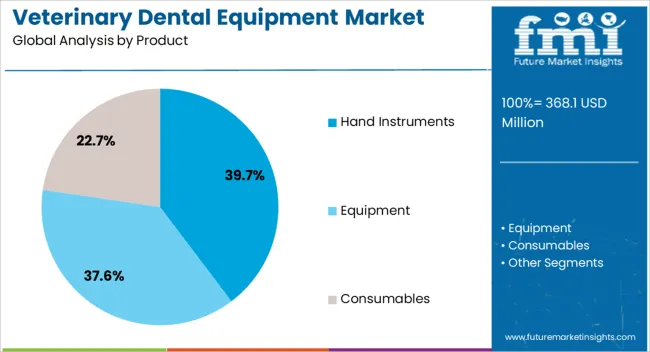
Based on FMI's veterinary dental equipment market report, demand for hand instruments remains the leading product category, capturing 39.7% of the market share. This dominance is sustained by the instruments' essential role in every dental procedure, from initial probing to final extraction, and by their relatively low cost, which places them within reach of even the smallest practices. Hand instruments also benefit from professional longevity, a quality set of elevators and forceps may remain in service for decades, generating replacement demand only through loss or damage rather than technological obsolescence.
- Ergonomic design advances: Cislak Manufacturing introduced a new line of ergonomic dental instruments in 2024 featuring larger-diameter, textured handles and balanced weight distribution designed to reduce hand fatigue during prolonged procedures. The design, developed in consultation with veterinary dental specialists, addresses the occupational health concern of repetitive strain injury among practitioners performing multiple dental procedures weekly. [5]
- Material science application: Integra LifeSciences launched a range of titanium nitride-coated elevators in early 2025, offering improved wear resistance and reduced friction compared to standard stainless steel. The coating extends instrument life and improves tactile feedback during ligament elevation, a critical factor in atraumatic extraction technique. [6]
- Sterilisation compatibility: As veterinary practices increasingly adopt pre-sterilised individual instrument packaging to meet infection control standards, manufacturers are adapting hand instrument packaging for compatibility with autoclave cycles without compromising sterile integrity. This trend favours suppliers with in-house packaging engineering capability over those relying on third-party repackaging.
Veterinary Dental Equipment Market Analysis by Animal Type
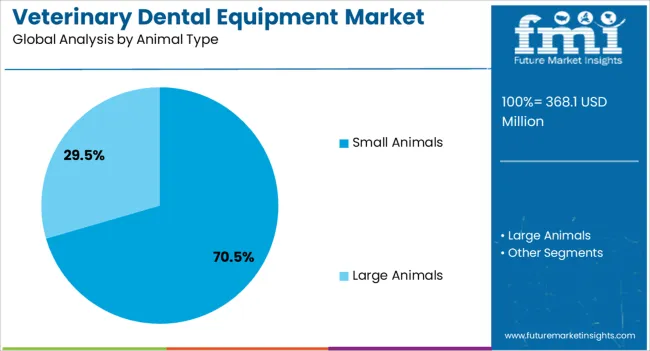
Small animals such as dogs and cats generate maximum demand at 70.5% for veterinary dental equipment because they constitute the vast majority of patients receiving professional dental care. The segment's dominance is reinforced by the high prevalence of periodontal disease in dogs, estimated at 80-90% of animals over three years of age, and by owner willingness to invest in preventive care for companion animals. Small animal dental procedures also require a broader range of equipment than large animal work, which often relies on general surgical tools.
- Brachycephalic breed considerations: The growing popularity of brachycephalic breeds (French bulldogs, pugs, English bulldogs) with crowded dentition and high rates of periodontal disease has created demand for specialised instruments capable of navigating restricted oral access. Manufacturers are developing shorter-handled, angulated instruments specifically for these breeds, expanding the small animal product portfolio. [7]
- Feline dental resorption: Feline odontoclastic resorptive lesions affect an estimated 30-70% of cats, requiring specialised equipment for crown amputation and vital pulp therapy. The prevalence of FORLs sustains demand for high-speed dental drills and fine burs in feline practice, procedures that cannot be performed with basic extraction instruments alone. [8]
- Large animal niche: While smaller in volume, the large animal segment (equine, bovine) commands premium pricing for equipment designed to withstand field conditions and larger anatomical structures. Portable dental stations and long-shank instruments for equine dentistry represent a specialised subsegment with loyal manufacturer-customer relationships.
Veterinary Dental Equipment Market Analysis by End User
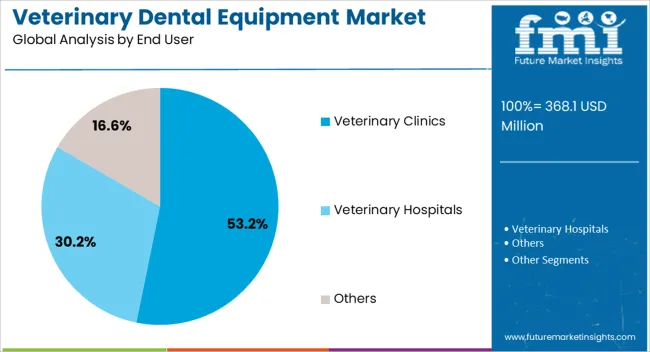
Veterinary clinics account for approximately 53.2% share in the end user category, supported by their role as the primary point of care for routine dental treatments. Unlike veterinary hospitals, which may serve as referral centres for complex cases, clinics provide the majority of prophylactic cleanings, periodontal therapy, and simple extractions that constitute the volume base of veterinary dentistry. The segment's growth is driven by the trend toward in-clinic dental suites rather than referral, enabled by compact, affordable equipment designs suitable for general practice floorplans.
- Corporate clinic standardisation: Corporate veterinary groups are increasingly specifying complete dental equipment packages for new clinic construction and existing clinic renovations. A 2025 agreement between iM3 and a major corporate group standardised on iM3 dental stations and digital radiography sensors across 200 clinics, creating predictable multi-year revenue for the manufacturer while simplifying procurement for the group. [9]
- Mobile dentistry emergence: A niche but growing segment of mobile veterinary dental practitioners operates from specially equipped vehicles, providing dental services to clinics without in-house equipment or to horse owners at stable sites. This application drives demand for compact, durable, and battery-powered equipment capable of reliable operation in non-clinical environments.
- Academic training influence: Veterinary schools function as influential end users because equipment installed in teaching hospitals shapes the brand preferences of graduating students. Manufacturers maintain demonstration units in academic settings and offer student discounts to establish familiarity before practitioners enter independent practice.
Veterinary Dental Equipment Market Drivers, Restraints, and Opportunities
The market has historically functioned as a niche segment within broader veterinary surgical equipment, with many practices performing extractions using general surgical instruments rather than dedicated dental tools. Its baseline scale is anchored in the universal requirement for occasional tooth extraction in companion animal practice, a procedure that does not demand specialised equipment beyond basic elevators and forceps.
FMI analysts observe a bifurcation between practices performing only occasional extractions with minimal dedicated equipment and dental-capable clinics investing in complete suites including dental stations, ultrasonic scalers, and digital radiography. Standard hand instruments face stable demand from all practices, while growth is concentrated in powered equipment and consumables adopted by clinics transitioning to comprehensive oral health services.
- Veterinary Oral Health Council product endorsements: The Veterinary Oral Health Council, established by the American Veterinary Dental College, provides a seal of acceptance for products proven effective in controlling plaque and calculus. As of 2025, VOHC endorsement has become a de facto requirement for dental consumables marketed to evidence-based practitioners, influencing purchasing decisions in corporate practice groups. [2]
- AAHA dental care guidelines: The American Animal Hospital Association's 2024 update to its dental care guidelines for dogs and cats recommends annual oral health assessments under anaesthesia for all patients, with dental radiography as an essential component of comprehensive oral evaluation. This guideline directly drives demand for anaesthesia-compatible dental stations and digital X-ray sensors in AAHA-accredited practices. [3]
- Corporate practice consolidation: The acquisition of independent veterinary clinics by corporate groups (Mars Veterinary Health, National Veterinary Associates, IVC Evidensia) has accelerated standardisation of equipment purchasing. Corporate practice groups now negotiate national contracts with equipment manufacturers, creating volume commitments that reward vendors offering integrated digital ecosystems rather than standalone devices. [4]
Regional Analysis
The veterinary dental equipment market is segmented geographically across North America, Europe, East Asia, South Asia & Pacific, Latin America, and Middle East & Africa. Growth dynamics differ based on companion animal population density, veterinary clinic penetration, corporate practice consolidation rates, and regulatory requirements for veterinary facility equipment. The full report also provides market attractiveness analysis across regions.
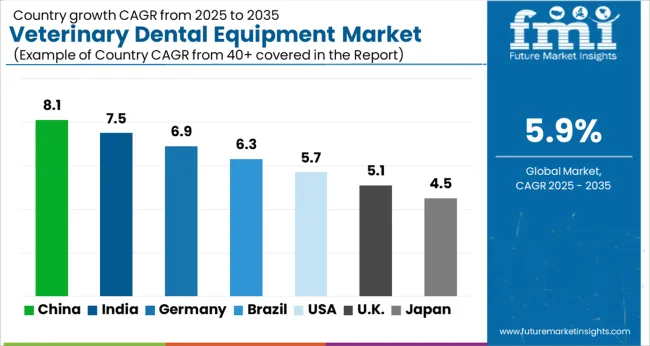
| Country | CAGR (2026-2036) |
|---|---|
| China | 7.6% |
| India | 6.9% |
| Germany | 6.3% |
| Brazil | 5.7% |
| USA | 5.1% |
| UK | 4.5% |
Source: Future Market Insights (FMI) analysis, based on proprietary forecasting model and primary research
North America Market Analysis
North America functions as the largest regional market by value, supported by the world's highest per-capita veterinary expenditure and near-universal adoption of companion animal insurance or wellness plans that cover preventive dental care. The region also benefits from strong influence of the American Veterinary Dental College and AAHA guidelines, which set standards that drive equipment purchasing.
- United States: Demand for veterinary dental equipment in the United States is forecasted to advance at 5.1% CAGR through 2036. Growth is driven not by new clinic formation which has plateaued in urban areas but by equipment replacement cycles and the conversion of analogue dental X-ray systems to digital sensors. The Veterinary Medicine Mobility Act of 2014, which clarified veterinarians' right to transport and use controlled substances across state lines, has facilitated the growth of mobile dental practices serving rural areas without dedicated clinic facilities. [10]
FMI's analysis of veterinary dental equipment market in North America consists of country-wise assessment that includes the United States and Canada. Readers can find AAHA accreditation trends, corporate group purchasing agreement analysis, and digital radiography adoption tracking.
Europe Market Analysis
Europe acts as a standard-setting region for veterinary dental equipment, with the European Veterinary Dental Society issuing guidelines that influence practice across EU member states. The region's market is characterised by strong variation between Western European countries with mature veterinary markets and Eastern European nations where clinic infrastructure remains in development.
- Germany: Demand for veterinary dental equipment in Germany is projected to rise at 6.3% CAGR through 2036. Growth is influenced by the Tierärztekammer (veterinary chamber) continuing education requirements, which now mandate demonstrated competence in dental radiography interpretation for practitioners offering dental services. This regulatory push has accelerated digital sensor adoption and created demand for training courses that often utilise specific equipment brands, creating indirect sales channels through education partnerships.
FMI's analysis of veterinary dental equipment market in Europe consists of country-wise assessment that includes Germany, United Kingdom, France, Italy, and Spain. Readers can find veterinary chamber guideline tracking, corporate practice penetration analysis, and continuing education requirement mapping.
Asia-Pacific Market Analysis
Asia-Pacific remains the growth engine for the global veterinary dental equipment market, driven by rapid expansion of companion animal ownership, proliferation of Western-style veterinary clinics, and increasing awareness of preventive oral care among urban pet owners.
- China: Veterinary dental equipment sales in China are projected to rise at 7.6% CAGR through 2036. Growth is supported by the Chinese Veterinary Medical Association's 2024 continuing education curriculum, which for the first time included dedicated modules on small animal dentistry with practical training requirements. The curriculum specifies minimum equipment standards for teaching hospitals, creating immediate demand for dental stations and radiography systems in veterinary colleges. [11]
- China's market is distinctive for its high proportion of newly constructed clinics equipping from scratch rather than upgrading existing facilities. This greenfield opportunity favours manufacturers offering complete suite packages rather than individual instruments, as clinic owners seek single-supplier solutions for streamlined procurement.
FMI's analysis of veterinary dental equipment market in Asia-Pacific consists of country-wise assessment that includes China, India, Japan, and South Korea. Readers can find CVMA curriculum tracking, corporate clinic expansion analysis, and import tariff trend monitoring.
- India: Demand for veterinary dental equipment in India is projected to rise at 6.9% CAGR through 2036. Growth is supported by the expansion of corporate veterinary hospital chains such as Max Vets and PetVet, which offer standardised dental service packages including prophylactic cleaning under anaesthesia. Unlike China's emphasis on veterinary college training, India's growth is driven by private sector investment in companion animal care, with equipment purchasing decisions made by corporate procurement managers rather than individual practitioners.
FMI's analysis of veterinary dental equipment market in Asia-Pacific consists of country-wise assessment that includes China, India, Japan, and South Korea. Readers can find corporate chain expansion tracking, import duty analysis, and domestic manufacturing emergence monitoring.
Competitive Aligners for Market Players
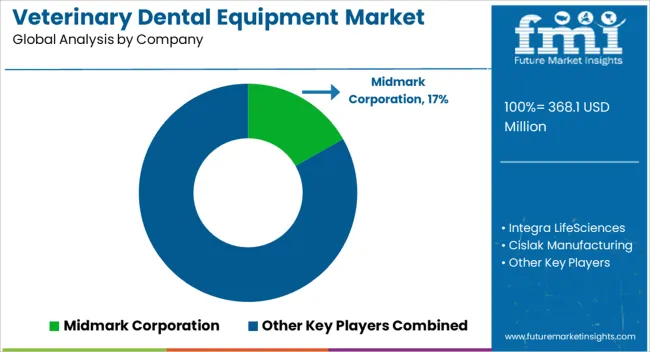
The veterinary dental equipment market is moderately fragmented, with no single manufacturer holding dominant share across all product categories. Midmark Corporation, iM3Vet Pty Ltd., and Acteon Group Ltd. are recognised as full-line suppliers offering comprehensive equipment portfolios, while speciality manufacturers such as Cislak Manufacturing focus on hand instrument excellence.
The primary competitive variable has shifted from product features alone to the provision of integrated education and training support. Manufacturers that invest in continuing education facilities such as iM3's ACE centre create brand loyalty that extends beyond the initial equipment purchase, as practitioners trained on specific equipment prefer to continue using familiar brands.
Buyer behavior in this market reflects the influence of corporate group procurement, where national contracts can shift significant volume between suppliers. Independent practitioners, by contrast, exhibit strong loyalty to brands encountered during veterinary training, making academic institution relationships critical for long-term market positioning.
Recent Developments
- iM3 - Education Center Opening (June 2025): iM3 inaugurated its dedicated education center named iM3 ACE in Ireland, designed for hands-on training of veterinary professionals worldwide in simulated dental procedure environments. [1]
- Animalcare - Product Launch (April 2025): Animalcare introduced Plaqtiv+, a novel range of dental care products for cats and dogs formulated to mitigate calculus formation, including a water additive endorsed by the Veterinary Oral Health Council. [12]
- Cislak Manufacturing - Product Launch (2024): Cislak introduced ergonomic hand instruments with textured handles designed to reduce hand fatigue during prolonged dental procedures. [5]
- Integra LifeSciences - Product Launch (2025): Integra launched titanium nitride-coated elevators offering improved wear resistance and tactile feedback. [6]
Key Players in the Veterinary Dental Equipment Market
- Midmark Corporation
- Integra LifeSciences
- Cislak Manufacturing
- Eickemeyer Veterinary Equipment Inc.
- MAI Animal Health
- Dentalaire International
- Planmeca OY
- J & J Instruments
- iM3Vet Pty Ltd.
- Acteon Group Ltd.
Scope of Report
| Metric | Value |
|---|---|
| Quantitative Units | USD 389.8 million (2026) to USD 694.5 million (2036), at a CAGR of 5.9% |
| Market Definition | The veterinary dental equipment market comprises the global production and supply of instruments, powered equipment, and consumables specifically designed for veterinary oral care, ranging from basic hand tools for examination and extraction to digital radiography systems and high-speed drill stations for advanced procedures. |
| Product Segmentation | Hand Instruments, Equipment, Consumables |
| Animal Type Segmentation | Large Animals, Small Animals |
| End User Segmentation | Veterinary Hospitals, Veterinary Clinics, Others |
| Region Segmentation | North America, Europe, Asia-Pacific, Latin America, Middle East & Africa |
| Countries Covered | United States, Canada, Germany, United Kingdom, France, Italy, Spain, China, India, Japan, South Korea, Brazil and 40+ countries |
| Key Companies Profiled | Midmark Corporation, Integra LifeSciences, Cislak Manufacturing, Eickemeyer Veterinary Equipment Inc., MAI Animal Health, Dentalaire International, Planmeca OY, J & J Instruments, iM3Vet Pty Ltd., Acteon Group Ltd. |
| Forecast Period | 2026 to 2036 |
| Approach | Hybrid top‑down and bottom‑up market modeling validated through primary interviews with veterinary dental equipment manufacturers, companion animal practice owners, and veterinary school teaching hospital procurement managers, supported by trade benchmarking and veterinary demographic analysis |
Veterinary Dental Equipment Market Analysis by Segments
Product
- Hand Instruments
- Equipment
- Consumables
Animal Type
- Large Animals
- Small Animals
End User
- Veterinary Hospitals
- Veterinary Clinics
- Others
Region
- North America
- USA
- Canada
- Mexico
- Latin America
- Brazil
- Chile
- Rest of Latin America
- Western Europe
- Germany
- UK
- Italy
- Spain
- France
- Nordic
- BENELUX
- Rest of Western Europe
- Eastern Europe
- Russia
- Poland
- Hungary
- Balkan & Baltic
- Rest of Eastern Europe
- East Asia
- China
- Japan
- South Korea
- South Asia and Pacific
- India
- ASEAN
- Australia & New Zealand
- Rest of South Asia and Pacific
- Middle East & Africa
- Kingdom of Saudi Arabia
- Other GCC Countries
- Turkiye
- South Africa
- Other African Union
- Rest of Middle East & Africa
Bibliography
- [1] iM3Vet Pty Ltd. (2025, June 10). iM3 inaugurates ACE education center in Ireland for veterinary dental training. iM3 Corporate News.
- [2] Veterinary Oral Health Council. (2025). VOHC Accepted Products List and Protocol for Acceptance. St. Paul, MN: VOHC.
- [3] American Animal Hospital Association. (2024). AAHA Dental Care Guidelines for Dogs and Cats – 2024 Update. Lakewood, CO: AAHA.
- [4] Mars Veterinary Health. (2024). Annual Sustainability Report 2024: Standardising Care Across Practice Networks. Vancouver, WA: Mars Veterinary Health.
- [5] Cislak Manufacturing. (2024, September 18). Cislak introduces ergonomic hand instrument line for veterinary dentistry. Cislak Product Announcement.
- [6] Integra LifeSciences. (2025, January 22). Integra launches titanium nitride-coated elevator range for veterinary oral surgery. Integra LifeSciences Press Release.
- [7] American Kennel Club. (2024). Brachycephalic Breed Health Report 2024: Dental and Oral Health Findings. New York: AKC Canine Health Foundation.
- [8] American Veterinary Dental College. (2024). Feline Odontoclastic Resorptive Lesions: Diagnosis and Treatment Guidelines. AVDC Position Statement.
- [9] iM3Vet Pty Ltd. (2025, March 5). iM3 secures corporate group agreement for dental equipment standardisation across 200 clinics. iM3 Corporate News.
- [10] U.S. Congress. (2014). Veterinary Medicine Mobility Act of 2014, Public Law 113-143. Washington, D.C.: U.S. Government Publishing Office.
- [11] Chinese Veterinary Medical Association. (2024). Small Animal Dentistry Continuing Education Curriculum Standards. Beijing: CVMA.
- [12] Animalcare Group. (2025, April 17). Animalcare launches Plaqtiv+ VOHC-endorsed dental care range for cats and dogs. Animalcare Press Release.
- [13] European Veterinary Dental Society. (2024). Guidelines for Veterinary Dental Equipment and Facility Standards. EVDS Position Paper.
- [14] Bureau of Indian Standards. (2024). IS 18473:2024 – Veterinary Dental Instruments – Specification. New Delhi: BIS.
This Report Addresses
- Market intelligence to enable structured strategic decision-making across veterinary dental equipment manufacturers, veterinary corporate group procurement managers, and veterinary school teaching hospital administrators.
- Market size estimation and 10-year revenue forecasts from 2026 to 2036, including validated CAGR and absolute dollar opportunity sizing.
- Growth opportunity mapping across Product, Animal Type, End User, and regional demand pockets, with emphasis on conversion of basic extraction practices to comprehensive dental service providers.
- Segment and regional forecasting covering hand instruments, powered equipment, and consumables, alongside demand trajectories across companion animal and equine practice segments.
- Competition strategy assessment, including education infrastructure investment, corporate group contract negotiation capability, and veterinary school relationship management shaping supplier retention.
- Product and compliance tracking focused on ergonomic design innovation, digital radiography sensor compatibility, and sterilisation protocol integration.
- Regulatory impact analysis covering AAHA and EVDS guideline updates, VOHC endorsement requirements, and national veterinary curriculum standards influencing equipment specification and purchasing patterns.
- Report delivery in PDF, Excel, and presentation-ready formats to support executive planning, R&D portfolio alignment, and market access strategy development.
Frequently Asked Questions
How large is the demand for veterinary dental equipment in the global market in 2026?
Demand for veterinary dental equipment is estimated to be valued at USD 389.8 million in 2026.
What will be the market size of veterinary dental equipment in the global market by 2036?
Market size for veterinary dental equipment is projected to reach USD 694.5 million by 2036.
What is the expected demand growth for veterinary dental equipment between 2026 and 2036?
Demand for veterinary dental equipment is expected to grow at a 5.9% CAGR between 2026 and 2036.
Which product segment is poised to lead global sales?
Hand instruments are expected to remain the leading product segment, anchored by their essential role in every dental procedure and lower cost barrier, holding 39.7% share in 2025.
Which animal type dominates the veterinary dental equipment market?
Small animals (dogs and cats) dominate at 70.5% share in 2025, driven by patient volume and high periodontal disease prevalence.
Which end user segment leads adoption of veterinary dental equipment?
Veterinary clinics lead at 53.2% share in 2025, reflecting their position as the primary point of care for routine dental procedures.
What is driving demand in the United States?
Equipment replacement cycles, conversion of analogue X-ray to digital sensors, and mobile dental practice growth facilitated by the Veterinary Medicine Mobility Act are driving demand in the United States.
What is the United States growth outlook in this report?
The United States is projected to expand at a 5.1% CAGR during 2026 to 2036.
What is driving demand in Germany?
Tierärztekammer continuing education requirements mandating competence in dental radiography interpretation for practitioners offering dental services are driving demand in Germany.
What is Germany's growth outlook in this report?
Germany is projected to expand at a 6.3% CAGR during 2026 to 2036.
Does the report cover the United Kingdom in its regional analysis?
Yes, the United Kingdom is included within Europe under the regional coverage framework.
What is the United Kingdom's growth outlook in this report?
The United Kingdom is projected to expand at a 4.5% CAGR during 2026 to 2036.
What is driving demand in China?
Chinese Veterinary Medical Association 2024 continuing education curriculum with dedicated small animal dentistry modules and practical training requirements are driving demand in China.
What is China's growth outlook in this report?
China is projected to expand at a 7.6% CAGR during 2026 to 2036.
What is driving demand in India?
Expansion of corporate veterinary hospital chains offering standardised dental service packages and procurement decisions by corporate managers are driving demand in India.
What is India's growth outlook in this report?
India is projected to expand at a 6.9% CAGR during 2026 to 2036.
Does the report cover Japan in its regional analysis?
Yes, Japan is included within East Asia under the regional scope of analysis.
What is Japan's growth outlook in this report?
Japan is projected to expand at a 3.9% CAGR during 2026 to 2036.
Does the report cover Brazil in its regional analysis?
Yes, Brazil is included within Latin America and is covered in the country-wise assessment.
What is Brazil's growth outlook in this report?
Brazil is projected to expand at a 5.7% CAGR during 2026 to 2036.
What is veterinary dental equipment and what is it mainly used for?
Veterinary dental equipment comprises instruments, powered devices, and consumables specifically designed for animal oral care, used for examination, prophylaxis, periodontics, endodontics, and oral surgery in companion animals, equines, and livestock.
What does the veterinary dental equipment market mean in this report?
It refers to the global manufacturing and supply of veterinary dental equipment by product, animal type, end user, and region, measured in value terms at the equipment manufacturing layer.
What is included in the scope of this veterinary dental equipment market report?
Scope includes market sizing and forecasting for 2026 to 2036, segmentation by product, animal type, end user, and region, along with competitive assessment, regulatory impact analysis, and country-wise outlook.
What is excluded from the scope of this report?
The scope excludes human dental equipment repurposed without modification, non-dental surgical instruments, pharmaceutical products administered during dental treatment, and dental procedure service revenues.
How are professional guidelines shaping the veterinary dental equipment market?
Professional guidelines from AAHA, EVDS, and national veterinary associations are shifting competitive advantage from basic instrument provision to integrated education support and digital ecosystem compatibility, as guideline compliance increasingly requires specific equipment capabilities.
Preview the report firsthand - request a free sample
Get SampleGet the brochure for pricing and purchase details.
Get PDFTable of Content
- Executive Summary
- Global Market Outlook
- Demand-side Trends
- Supply-side Trends
- Technology Roadmap Analysis
- Analysis and Recommendations
- Market Overview
- Market Coverage / Taxonomy
- Market Definition / Scope / Limitations
- Research Methodology
- Chapter Orientation
- Analytical Lens and Working Hypotheses
- Market Structure, Signals, and Trend Drivers
- Benchmarking and Cross-market Comparability
- Market Sizing, Forecasting, and Opportunity Mapping
- Research Design and Evidence Framework
- Desk Research Programme (Secondary Evidence)
- Company Annual and Sustainability Reports
- Peer-reviewed Journals and Academic Literature
- Corporate Websites, Product Literature, and Technical Notes
- Earnings Decks and Investor Briefings
- Statutory Filings and Regulatory Disclosures
- Technical White Papers and Standards Notes
- Trade Journals, Industry Magazines, and Analyst Briefs
- Conference Proceedings, Webinars, and Seminar Materials
- Government Statistics Portals and Public Data Releases
- Press Releases and Reputable Media Coverage
- Specialist Newsletters and Curated Briefings
- Sector Databases and Reference Repositories
- FMI Internal Proprietary Databases and Historical Market Datasets
- Subscription Datasets and Paid Sources
- Social Channels, Communities, and Digital Listening Inputs
- Additional Desk Sources
- Expert Input and Fieldwork (Primary Evidence)
- Primary Modes
- Qualitative Interviews and Expert Elicitation
- Quantitative Surveys and Structured Data Capture
- Blended Approach
- Why Primary Evidence is Used
- Field Techniques
- Interviews
- Surveys
- Focus Groups
- Observational and In-context Research
- Social and Community Interactions
- Stakeholder Universe Engaged
- C-suite Leaders
- Board Members
- Presidents and Vice Presidents
- R&D and Innovation Heads
- Technical Specialists
- Domain Subject-matter Experts
- Scientists
- Physicians and Other Healthcare Professionals
- Governance, Ethics, and Data Stewardship
- Research Ethics
- Data Integrity and Handling
- Primary Modes
- Tooling, Models, and Reference Databases
- Desk Research Programme (Secondary Evidence)
- Data Engineering and Model Build
- Data Acquisition and Ingestion
- Cleaning, Normalisation, and Verification
- Synthesis, Triangulation, and Analysis
- Quality Assurance and Audit Trail
- Market Background
- Market Dynamics
- Drivers
- Restraints
- Opportunity
- Trends
- Scenario Forecast
- Demand in Optimistic Scenario
- Demand in Likely Scenario
- Demand in Conservative Scenario
- Opportunity Map Analysis
- Product Life Cycle Analysis
- Supply Chain Analysis
- Investment Feasibility Matrix
- Value Chain Analysis
- PESTLE and Porter’s Analysis
- Regulatory Landscape
- Regional Parent Market Outlook
- Production and Consumption Statistics
- Import and Export Statistics
- Market Dynamics
- Global Market Analysis 2021 to 2025 and Forecast, 2026 to 2036
- Historical Market Size Value (USD Million) Analysis, 2021 to 2025
- Current and Future Market Size Value (USD Million) Projections, 2026 to 2036
- Y-o-Y Growth Trend Analysis
- Absolute $ Opportunity Analysis
- Global Market Pricing Analysis 2021 to 2025 and Forecast 2026 to 2036
- Global Market Analysis 2021 to 2025 and Forecast 2026 to 2036, By Product
- Introduction / Key Findings
- Historical Market Size Value (USD Million) Analysis By Product , 2021 to 2025
- Current and Future Market Size Value (USD Million) Analysis and Forecast By Product , 2026 to 2036
- Hand Instruments
- Equipment
- Consumables
- Hand Instruments
- Y-o-Y Growth Trend Analysis By Product , 2021 to 2025
- Absolute $ Opportunity Analysis By Product , 2026 to 2036
- Global Market Analysis 2021 to 2025 and Forecast 2026 to 2036, By Animal Type
- Introduction / Key Findings
- Historical Market Size Value (USD Million) Analysis By Animal Type, 2021 to 2025
- Current and Future Market Size Value (USD Million) Analysis and Forecast By Animal Type, 2026 to 2036
- Small
- Large
- Small
- Y-o-Y Growth Trend Analysis By Animal Type, 2021 to 2025
- Absolute $ Opportunity Analysis By Animal Type, 2026 to 2036
- Global Market Analysis 2021 to 2025 and Forecast 2026 to 2036, By End User
- Introduction / Key Findings
- Historical Market Size Value (USD Million) Analysis By End User, 2021 to 2025
- Current and Future Market Size Value (USD Million) Analysis and Forecast By End User, 2026 to 2036
- Veterinary Clinics
- Veterinary Hospitals
- Others
- Veterinary Clinics
- Y-o-Y Growth Trend Analysis By End User, 2021 to 2025
- Absolute $ Opportunity Analysis By End User, 2026 to 2036
- Global Market Analysis 2021 to 2025 and Forecast 2026 to 2036, By Region
- Introduction
- Historical Market Size Value (USD Million) Analysis By Region, 2021 to 2025
- Current Market Size Value (USD Million) Analysis and Forecast By Region, 2026 to 2036
- North America
- Latin America
- Western Europe
- Eastern Europe
- East Asia
- South Asia and Pacific
- Middle East & Africa
- Market Attractiveness Analysis By Region
- North America Market Analysis 2021 to 2025 and Forecast 2026 to 2036, By Country
- Historical Market Size Value (USD Million) Trend Analysis By Market Taxonomy, 2021 to 2025
- Market Size Value (USD Million) Forecast By Market Taxonomy, 2026 to 2036
- By Country
- USA
- Canada
- Mexico
- By Product
- By Animal Type
- By End User
- By Country
- Market Attractiveness Analysis
- By Country
- By Product
- By Animal Type
- By End User
- Key Takeaways
- Latin America Market Analysis 2021 to 2025 and Forecast 2026 to 2036, By Country
- Historical Market Size Value (USD Million) Trend Analysis By Market Taxonomy, 2021 to 2025
- Market Size Value (USD Million) Forecast By Market Taxonomy, 2026 to 2036
- By Country
- Brazil
- Chile
- Rest of Latin America
- By Product
- By Animal Type
- By End User
- By Country
- Market Attractiveness Analysis
- By Country
- By Product
- By Animal Type
- By End User
- Key Takeaways
- Western Europe Market Analysis 2021 to 2025 and Forecast 2026 to 2036, By Country
- Historical Market Size Value (USD Million) Trend Analysis By Market Taxonomy, 2021 to 2025
- Market Size Value (USD Million) Forecast By Market Taxonomy, 2026 to 2036
- By Country
- Germany
- UK
- Italy
- Spain
- France
- Nordic
- BENELUX
- Rest of Western Europe
- By Product
- By Animal Type
- By End User
- By Country
- Market Attractiveness Analysis
- By Country
- By Product
- By Animal Type
- By End User
- Key Takeaways
- Eastern Europe Market Analysis 2021 to 2025 and Forecast 2026 to 2036, By Country
- Historical Market Size Value (USD Million) Trend Analysis By Market Taxonomy, 2021 to 2025
- Market Size Value (USD Million) Forecast By Market Taxonomy, 2026 to 2036
- By Country
- Russia
- Poland
- Hungary
- Balkan & Baltic
- Rest of Eastern Europe
- By Product
- By Animal Type
- By End User
- By Country
- Market Attractiveness Analysis
- By Country
- By Product
- By Animal Type
- By End User
- Key Takeaways
- East Asia Market Analysis 2021 to 2025 and Forecast 2026 to 2036, By Country
- Historical Market Size Value (USD Million) Trend Analysis By Market Taxonomy, 2021 to 2025
- Market Size Value (USD Million) Forecast By Market Taxonomy, 2026 to 2036
- By Country
- China
- Japan
- South Korea
- By Product
- By Animal Type
- By End User
- By Country
- Market Attractiveness Analysis
- By Country
- By Product
- By Animal Type
- By End User
- Key Takeaways
- South Asia and Pacific Market Analysis 2021 to 2025 and Forecast 2026 to 2036, By Country
- Historical Market Size Value (USD Million) Trend Analysis By Market Taxonomy, 2021 to 2025
- Market Size Value (USD Million) Forecast By Market Taxonomy, 2026 to 2036
- By Country
- India
- ASEAN
- Australia & New Zealand
- Rest of South Asia and Pacific
- By Product
- By Animal Type
- By End User
- By Country
- Market Attractiveness Analysis
- By Country
- By Product
- By Animal Type
- By End User
- Key Takeaways
- Middle East & Africa Market Analysis 2021 to 2025 and Forecast 2026 to 2036, By Country
- Historical Market Size Value (USD Million) Trend Analysis By Market Taxonomy, 2021 to 2025
- Market Size Value (USD Million) Forecast By Market Taxonomy, 2026 to 2036
- By Country
- Kingdom of Saudi Arabia
- Other GCC Countries
- Turkiye
- South Africa
- Other African Union
- Rest of Middle East & Africa
- By Product
- By Animal Type
- By End User
- By Country
- Market Attractiveness Analysis
- By Country
- By Product
- By Animal Type
- By End User
- Key Takeaways
- Key Countries Market Analysis
- USA
- Pricing Analysis
- Market Share Analysis, 2025
- By Product
- By Animal Type
- By End User
- Canada
- Pricing Analysis
- Market Share Analysis, 2025
- By Product
- By Animal Type
- By End User
- Mexico
- Pricing Analysis
- Market Share Analysis, 2025
- By Product
- By Animal Type
- By End User
- Brazil
- Pricing Analysis
- Market Share Analysis, 2025
- By Product
- By Animal Type
- By End User
- Chile
- Pricing Analysis
- Market Share Analysis, 2025
- By Product
- By Animal Type
- By End User
- Germany
- Pricing Analysis
- Market Share Analysis, 2025
- By Product
- By Animal Type
- By End User
- UK
- Pricing Analysis
- Market Share Analysis, 2025
- By Product
- By Animal Type
- By End User
- Italy
- Pricing Analysis
- Market Share Analysis, 2025
- By Product
- By Animal Type
- By End User
- Spain
- Pricing Analysis
- Market Share Analysis, 2025
- By Product
- By Animal Type
- By End User
- France
- Pricing Analysis
- Market Share Analysis, 2025
- By Product
- By Animal Type
- By End User
- India
- Pricing Analysis
- Market Share Analysis, 2025
- By Product
- By Animal Type
- By End User
- ASEAN
- Pricing Analysis
- Market Share Analysis, 2025
- By Product
- By Animal Type
- By End User
- Australia & New Zealand
- Pricing Analysis
- Market Share Analysis, 2025
- By Product
- By Animal Type
- By End User
- China
- Pricing Analysis
- Market Share Analysis, 2025
- By Product
- By Animal Type
- By End User
- Japan
- Pricing Analysis
- Market Share Analysis, 2025
- By Product
- By Animal Type
- By End User
- South Korea
- Pricing Analysis
- Market Share Analysis, 2025
- By Product
- By Animal Type
- By End User
- Russia
- Pricing Analysis
- Market Share Analysis, 2025
- By Product
- By Animal Type
- By End User
- Poland
- Pricing Analysis
- Market Share Analysis, 2025
- By Product
- By Animal Type
- By End User
- Hungary
- Pricing Analysis
- Market Share Analysis, 2025
- By Product
- By Animal Type
- By End User
- Kingdom of Saudi Arabia
- Pricing Analysis
- Market Share Analysis, 2025
- By Product
- By Animal Type
- By End User
- Turkiye
- Pricing Analysis
- Market Share Analysis, 2025
- By Product
- By Animal Type
- By End User
- South Africa
- Pricing Analysis
- Market Share Analysis, 2025
- By Product
- By Animal Type
- By End User
- USA
- Market Structure Analysis
- Competition Dashboard
- Competition Benchmarking
- Market Share Analysis of Top Players
- By Regional
- By Product
- By Animal Type
- By End User
- Competition Analysis
- Competition Deep Dive
- Midmark Corporation
- Overview
- Product Portfolio
- Profitability by Market Segments (Product/Age /Sales Channel/Region)
- Sales Footprint
- Strategy Overview
- Marketing Strategy
- Product Strategy
- Channel Strategy
- Integra LifeSciences
- Cislak Manufacturing
- Eickemeyer Veterinary Equipment Inc.
- MAI Animal Health
- Dentalaire International
- Planmeca OY
- Midmark Corporation
- Competition Deep Dive
- Assumptions & Acronyms Used


